
As one of Switzerland’s most important cities, Lausanne has numerous excellent museums. Here are the best ones!
Table of Contents
Best museums in Lausanne
Olympic Museum (Musée Olympique)
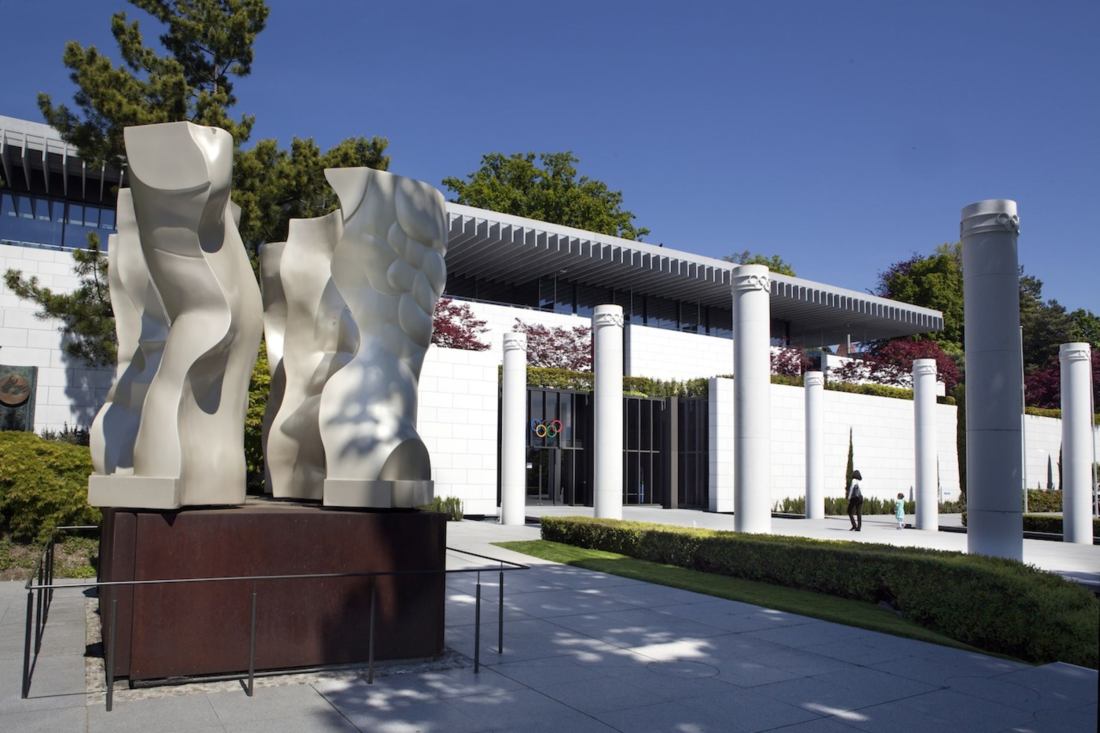
One of the world’s most comprehensive sports museums opened in its new form in 2013 on the shores of Lake Geneva, in a stunning building that stands as an architectural masterpiece in its own right. The museum presents the history of the Olympic ideal across three floors, from the ancient Greek games to the modern Olympics, with the help of more than 10,000 artifacts.
In the interactive exhibition spaces, visitors can try out numerous sports on simulators, view Olympic medals, torches and sports equipment, and gain insight into the lives of Olympic athletes. The museum’s pride is its audiovisual archive, which preserves more than 43,000 hours of footage from the history of the Games.
The complex also includes an impressive sculpture park where various artists’ Olympic-themed works can be seen. Thanks to its lakeside location, there are unparalleled views of the French Alps, while the museum’s café and restaurant offer a Mediterranean-style terrace. The building also received environmental certification for its sustainable architectural solutions.
All information can be found here!
MUDAC (Musée de Design et d’Arts Appliqués Contemporains)
The Museum of Contemporary Design and Applied Arts is housed in a 17th-century building, which previously operated under the name Maison Gaudard.
The museum opened its doors in 1995 and has since become one of Switzerland’s most significant design museums, showcasing a wide spectrum of contemporary art, design, graphics and textiles. In addition to the permanent collection, several temporary exhibitions are organized annually, focusing on 20th-21st century design, fashion art, typography and industrial design.
Its special feature is that it not only displays objects but also the creative process, giving visitors insight into designers’ working methods. Despite its smaller size, the museum has gained international recognition by exhibiting the works of renowned designers such as Jean Prouvé and Charlotte Perriand.
All information can be found here!
Collection de l’Art Brut
One of the world’s most significant outsider art collections has been operating since 1976 in an 18th-century castle, the former Château de Beaulieu building.
The museum was founded by French painter Jean Dubuffet, who was a committed advocate of art created not by academic artists, but by self-taught creators, people suffering from mental illness, or those living on the margins of society.
The collection contains more than 60,000 works of art from approximately 1,000 artists: paintings, sculptures, textile works and installations. The exhibited works often speak with shocking intensity and honesty about the inner world and human experience that doesn’t fit into conventional artistic directions. The museum also regularly organizes temporary exhibitions that introduce new artists or arrange thematic displays.
All information can be found here!
Hermitage Foundation (Fondation de l’Hermitage)
A villa from the 1850s houses this art foundation, which has welcomed audiences with outstanding temporary exhibitions since 1984. The building was once the home of banker Charles-Juste Bugnion, who was renowned as a great art patron, and after his death, his property was transferred for artistic purposes.
The foundation organizes 3-4 major exhibitions annually, focusing on 19th-20th century art: works by Monet, Magritte, Cézanne and Picasso have been displayed here. In terms of exhibition quality and curation, the foundation has earned international fame.
The six-hectare English park surrounding the building is a true oasis above the city: tree-lined paths, grassy areas and beautiful views of Lake Geneva and the Alps. The tea room operating on the villa’s terrace is an excellent place for relaxation combined with a cultural experience. From spring to autumn, the park also functions as a sculpture park where contemporary artists’ works can be seen.
All information can be found here!
Vidy Roman Museum (Musée romain de Lausanne-Vidy)
The archaeological museum on the shores of Lake Geneva, at the site of the ruins of the Roman settlement Lousonna, provides insight into everyday life during the Roman era. The settlement was established around 15 AD and was located along an important trade route that connected Italy with the Rhine region.
The museum building was built directly over the excavated ruins: beneath the glass floor, the remains of the Roman vicus (small town) are visible, including the foundations of streets, houses and public buildings. The exhibition displays mosaics, bronze objects, ceramic vessels, coins and everyday items, all discovered on site.
A special attraction is the visual reconstruction in the museum’s basement, which shows what the interior of a Roman house might have looked like with furniture, tools and decorations. The museum also contains interactive elements: visitors can try Roman games or learn about the writing systems of the era. The outdoor part of the ruins site is freely accessible, and informative signs help with orientation.
All information can be found here!
Museum of Archaeology and History (MCAH)
The institution located in the heart of the Palais de Rumine presents the history of the Lake Geneva region from the Neolithic to the present day, and even into the future.
The free-to-visit permanent exhibition begins with a full-scale lakeside excavation and Neolithic cemetery visible through a glass floor, then continues with the year 3081, followed by 1803, the date of Vaud canton’s independence.
The museum’s history dates back to 1818, when the first collection of the cantonal museum was created. The institution, named Museum of Antiquities in 1852, Archaeological Museum in 1877, and then Historical Museum in 1908, has been housed in the Palais de Rumine building since 1908. The year 1955 was a turning point when, under the leadership of curator Anne-Lise Reinbold, the museum adopted its current name. The building is located in the central Place de la Riponne.
The museum’s collection numbers more than 100,000 objects covering every historical period from prehistory to modern times. The exhibition includes ceramics, baskets and wooden objects from the Neolithic period, discovered on the region’s lakeshores. The museum offers three permanent exhibition rooms: one dedicated to prehistory, one to history, and one to the coin and medal collection. Special pieces include the famous princely chariot burial from Payerne from the early Iron Age, as well as decorations from Saint-Sulpice.
All information can be found here!
Zoological Museum
The zoological collection on the fifth floor of the neo-Renaissance Palais de Rumine building displays animals from all over the world.
The museum’s specialty is the world’s largest stuffed white shark, which is 5.89 meters long and the centerpiece of the spectacular exhibition. Visitors can freely explore the wonders of the animal world displayed in old-fashioned vitrines, with free admission.
The institution’s roots go back to 1818, when the cantonal museum was created, initially containing only 678 shells, 377 fossils, 239 foreign and domestic birds, a small Surinamese snake collection, and a few quadrupeds preserved in alcohol. In 1833, with the acquisition of Daniel-Alexandre Chavannes’ collection, the zoological collections expanded significantly. They moved to the newly built Palais de Rumine building in 1909.
The museum’s collection now numbers approximately 50,000 vertebrates and nearly 2 million invertebrates. The main gallery regularly displays the major groups of vertebrates, while the comparative anatomy room features skeletons and specimens preserved in glass vessels with impressive detail.
The entomological collections, especially the ants, represent the museum’s highlight – the institution has operated as a recognized ant research center since 1982. Special collections include Vladimir Nabokov’s butterfly collection, as well as James Rochat’s insect collection of 100,000 specimens.
All information can be found here!
Cantonal Museum of Fine Arts (MCBA)
The institution, which has been present on the Swiss art scene since 1841, has been located in the heart of the Plateforme 10 arts district since 2019. The museum presents numerous temporary exhibitions throughout the year while drawing on its rich collection of more than 10,000 works of art, spanning from the late 18th century to the present day.
It was created in 1841 through private initiative from funds donated by artist Marc-Louis Arlaud, who became the institution’s first curator. In October 2019, the museum moved to the new Plateforme 10 facility. The building’s architecture is the work of Barcelona’s Estudio Barozzi Veiga design studio, whose monumental brick form evokes the site’s past, the history of the locomotive depot.
The museum’s reputation is due to five magnificent collections: works by Abraham-Louis-Rodolphe Ducros, Charles Gleyre, Théophile-Alexandre Steinlen, Félix Vallotton and Louis Soutter. The collection’s main emphasis spans from the 18th century to post-impressionism, with fine examples of Cubism and Vaud abstract art.
The modern and contemporary art collections include works by Marcel Broodthaers, Rolf Iseli, Tadeusz Kantor, Charles Rollier, Daniel Spoerri and Maria Elena Vieira da Silva. Between 1990-2010, the museum focused on acquiring works by significant international artists.
Admission is free on the first Saturday of every month.
All information can be found here!
Geological Museum
The collection located on the third floor of the Palais de Rumine is a true history book, full of treasures and testimony to an often mysterious past. The free-to-visit permanent exhibition offers fossils, crystals and an explanation of the formation of the Alps for the general public.
The museum was created in 1818 and moved into the Palais de Rumine in 1906. Initially, the institution mainly preserved and displayed about a thousand minerals donated by Tsar Alexander I to Frédéric-César de La Harpe, before diversifying over time. In 1874, thanks to Eugène Renevier’s efforts, the museum gained its independence and opened to the general public from 1878.
Among its greatest attractions is „The Welcome Nugget”, a replica of the largest gold nugget ever found, weighing 57.3 kilos, as well as one of Europe’s most complete mammoth skeletons, discovered in the Praz-Rodet gravel pit near Brassus. The museum’s collection manages approximately one million rock, fossil and mineral samples.
The mineralogical exhibition is continuously enriched and displays magnificent crystals from all over the world, including a unique collection of polished stones from the Swiss Alps, including large pink fluorites. The museum has the most significant collection of fluorescent minerals in the country. Additional highlights include remarkable examples of ichthyosaurs, giant palms and ammonites.
All information can be found here!