Vietnam’s capital, Hanoi, has grown into a true metropolis. Fortunately, many historical and cultural attractions have been preserved.
Hanoi is located in the northern part of the country, close to Halong Bay. From 1954 to 1976, it was the capital of North Vietnam, and from the 11th century until 1802, with minor interruptions, it was the capital of Vietnam.
Table of Contents
Hanoi attractions
Ho Chi Minh Mausoleum
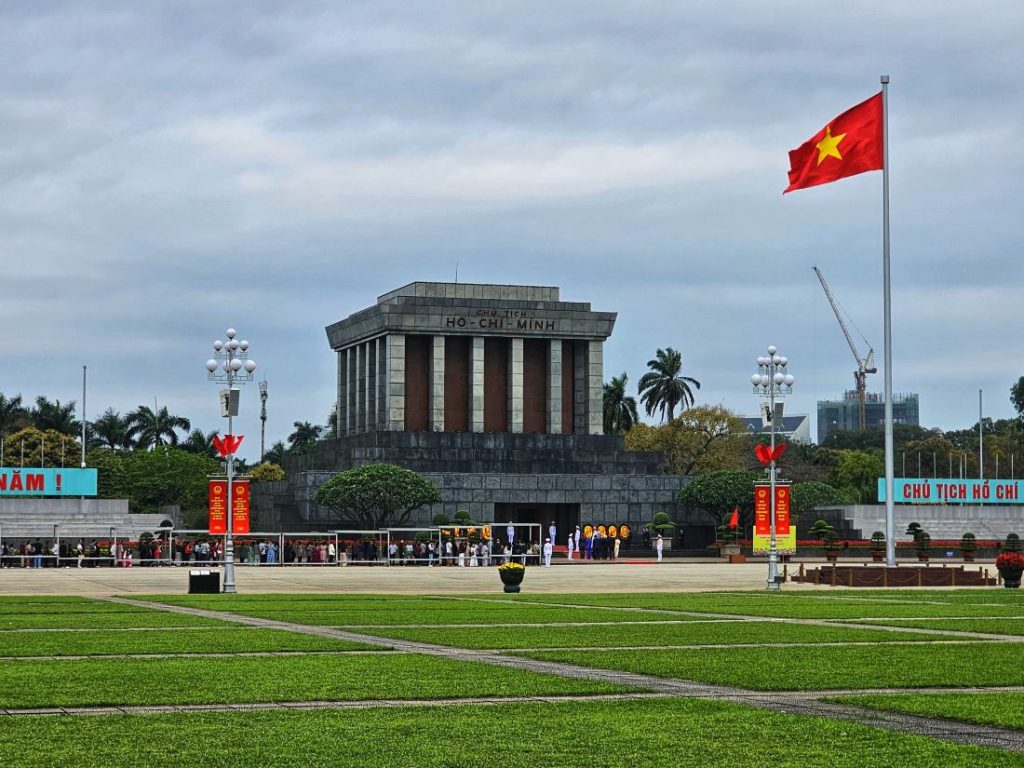
One of Hanoi’s most famous and visited sites, it is a significant historical monument for the Vietnamese. The mausoleum houses Ho Chi Minh’s embalmed body in a glass coffin.
Ho Chi Minh was not only an iconic figure of the Vietnamese independence movement but also the unifier of the country and the founder of the socialist state. Construction began two years after his death in 1971 and was completed in 1975. It was built following the model of Lenin’s Mausoleum in Moscow but also reflects Vietnamese traditions.
Entry is free, but visitors must wear respectful attire (covered shoulders and knees) and remain silent inside the building. Photography and videography are strictly prohibited inside the mausoleum.

Ho Chi Minh Museum
The museum showcases Ho Chi Minh’s life, work, and the history of the Vietnamese independence struggle.
It contains numerous personal items associated with Ho Chi Minh, including his clothes, manuscripts, books, and everyday objects. Some parts of the museum also contain symbolic exhibitions that focus not only on historical events but also on the symbolic significance of Ho Chi Minh’s ideas and personality.
Presidential Palace
The government building used for official purposes has symbolic significance in Vietnamese history and Ho Chi Minh’s life.
Built between 1900 and 1906 for the French colonial government, it originally served as the official residence of the Governor of French Indochina. Its color is a vibrant yellow, which is a characteristic feature of French colonial architecture in Vietnam.
Today, it still serves mainly official government purposes. International delegations are received here, and important diplomatic events are held. The interior of the palace is not open to tourists, but the garden and surrounding buildings are.
After independence in 1945, Ho Chi Minh became the country’s first president. Although he was officially supposed to live here, he decided to live in a much more modest wooden house next to a small pond in the garden. This house can be visited, where we can see the objects and furniture used at that time.
The garden surrounding the palace is full of various plants and trees from different parts of Vietnam. The garden is a pleasant place for a walk.

Hoan Kiem Lake
Located in the center of Hanoi, it is one of the most popular tourist and cultural attractions, as well as an important community space for the city’s residents.
Its name means „Lake of the Returned Sword”, named after a legend. According to this, in the 15th century, when King Le Loi successfully liberated Vietnam from the rule of the Chinese Ming dynasty, a golden turtle appeared in the lake and reclaimed the magical sword that the king had used for victory. Le Loi returned the sword, and the golden turtle disappeared into the depths of the lake.
The area around the lake is beautifully landscaped with lush vegetation and trees, making for pleasant walking paths.
Thap Rua (Turtle Tower)
This structure was erected on a small island in Hoan Kiem Lake to commemorate the above legend. Its name means Turtle Tower.
It was built at the end of the 19th century during the French colonial period. It was initiated by local authorities and a wealthy official named Nguyen Ngoc Kim. The structure is three stories high and made of characteristic stone.
It is located on the largest island in the lake, but the island is so small that the tower almost completely occupies it. The island cannot be accessed directly, so visitors can only admire it from the lake shore. It is illuminated at night, making the view even more beautiful.

Ngoc Son Temple
One of Hanoi’s most important religious attractions is located on a small island in the northern part of Hoan Kiem Lake. It is named after its island, which means Jade Mountain.
The temple was originally a sacred place of Buddhist and Taoist faith, dedicated to Van Xuong, the patron saint of Vietnamese sciences, and the famous general Tran Hung Dao, who successfully led Vietnamese forces against the Mongols in the 13th century.
The temple buildings were constructed in traditional Vietnamese style, richly decorated with red and gold motifs. There are several pavilions and shrines where visitors can light candles and place incense.
The temple is connected to the lake shore by a famous red-painted wooden bridge, the Thue Huc Bridge. The bridge’s arched shape and vivid color make it a popular photography spot.

Old Quarter
This part of the city has a history spanning several centuries and is one of the best places to experience Vietnamese culture, history, and everyday life.
The Old Quarter was established as early as the 13th century and was originally the center of the city’s craft guilds. Each street was home to a particular craft, which is why the street names are often associated with trades, such as „Silver Street” (Hang Bac) or „Paper Street” (Hang Ma).
It consists of 36 streets that are narrow, chaotic, and extremely busy. Most of the buildings are traditional, narrow, long houses called „tube houses.” These architectural solutions were developed due to high land prices, and the buildings often serve as homes for multi-generational families. Shops or workshops are often found on the ground floor, while apartments are on the upper floors.
Train Street (Đường Tàu)
One of Hanoi’s most famous and unique attractions is a small street in the Old Quarter where a train runs through.
The railway line runs directly between residential buildings, and the streets are so narrow that when trains pass, people have to press themselves against the walls of buildings. At such times, street vendors quickly pack up their things to allow the train to pass. After the train passes, life returns to normal.
It’s one of the biggest experiences for tourists. There are many pictures and videos on the internet showing the train passing just centimeters away from people who have moved aside or are sitting in cafes.

Bach Ma Temple
Located in the Old Quarter, this building is one of Hanoi’s oldest and most significant temples.
Its name means „White Horse”, which comes from a legend. According to this, the temple was dedicated to the city’s guardian spirit, a white horse that helped King Lý Thái Tổ lay the foundations of the Thang Long Citadel (later Hanoi).
Its architectural style follows traditional Vietnamese forms, richly decorated with carvings and colorful dragon and horse motifs. In the central part of the temple, there is an altar dedicated to the spirit of the white horse.
Thăng Long Imperial Citadel
This over 1000-year-old citadel is one of the most important monuments of Vietnamese history, which was the center of numerous dynasties. UNESCO declared it a World Heritage Site in 2010.
It was built in the 7th century but gained its true significance during the Lý dynasty in 1010. At that time, King Lý Thái Tổ named the city Thăng Long and established the capital here. During the French colonial period, part of the fortress was demolished, but the remaining parts are still important historical monuments today.
Its most significant part is the flag tower. The 33-meter high tower is topped with a Vietnamese flag, which is a symbol of national pride. The tower was built in 1812 and survived the destruction of both the French and American wars.
The Kinh Thien Palace was the center of the citadel, where important ceremonies were held. Although the palace no longer stands, the remaining foundations of the site can still be seen today. The impressive Doan Mon Gate was one of the main gates used by the royal family and high-ranking officials. The Cua Bac Gate is the northern gate of the citadel, which is one of the best-preserved gates from the citadel’s original structure.

Temple of Literature
This complex of buildings is one of the symbols of Vietnamese science, education, and Confucian philosophy.
It was founded in 1070 by King Lý Thánh Tông, originally dedicated to Confucius and his disciples to honor the Chinese philosopher and teacher. Six years later, Vietnam’s first university was founded here.
Its architectural style also shows Chinese influences. The temple consists of five separate courtyards. The first courtyard symbolizes peace and harmony. In the third courtyard is the famous Khuê Văn Các, a red-painted pavilion that is a symbol of scientific excellence. In the fifth courtyard is the main temple, where Confucius and his four most important disciples are worshipped. On the altars stands a statue of Confucius.

West Lake (Tây Hồ)
Located in the western part of the city, it is surrounded by numerous important historical, cultural, and religious sites.
With an area of about 500 hectares, it is Hanoi’s largest lake. Promenades and resting places have been built around the lake, making it an excellent location for walks. From the shore, there is a beautiful view of the city.
Tran Quoc Pagoda
Hanoi’s oldest Buddhist pagoda, located on a small peninsula on the southern shore of West Lake.
The original pagoda was built in the 6th century, but due to a flood, it was moved to its current location in the 17th century. With the support of Vietnamese rulers, it remained one of the centers of Buddhist teachings for a long time. Over the centuries, the pagoda was rebuilt and expanded several times, making it an impressive architectural monument today.
The main building of the pagoda is an 11-story tower made of red brick, standing 15 meters tall. The structure of the building is reminiscent of Buddhist sacred mountains, and each floor contains a Buddha statue. At the top of the tower is a lotus flower symbol. There are several shrines and altars on the grounds dedicated to Buddha and other religious figures.

One Pillar Pagoda
This small Buddhist shrine is famous for its unique architecture, as it is built on a single pillar that resembles a blooming lotus.
According to legend, it was built by Emperor Lý Thái Tông in 1049. The story goes that the emperor had no children, and in a dream, he saw the bodhisattva Avalokitesvara sitting on a lotus, who gave him a son. Soon after, the emperor’s son was born, and in gratitude, the emperor had this pagoda built in the shape of a lotus flower.
The pagoda is a small wooden structure supported by a single stone pillar and is located in the middle of an artificial pond where lotus flowers grow. It has an ornate roof decorated with traditional Vietnamese carvings and Buddha statues. Inside is a statue of the bodhisattva Avalokitesvara.
Hoa Lo Prison Museum
It showcases the dark chapters of the city’s French colonial past and the period of the Vietnam War.
During the colonial period, the prison held political prisoners under terrible conditions. In the 1960s, the North Vietnamese government held American military pilots here. They nicknamed the place „Hanoi Hilton.” One of the most famous prisoners was John McCain, later a United States Senator and presidential candidate.
The museum was opened in 1993. Most of the prison was demolished, but the remaining parts were restored to show its original condition. We can see prison cells, torture instruments, and exhibitions about different periods.
Opera House
The building, which is an impressive legacy of the French colonial era, must be highlighted.
It was built by the French in the early 20th century to provide a place for cultural events and performances for the French community. The Paris Garnier Opera House served as a model.
The building is in neoclassical and baroque style, with its most beautiful part being the staircase. Its interior halls are decorated with ornate gilded carvings, elegant chandeliers, and painted ceilings.
St. Joseph’s Cathedral
Hanoi’s largest Catholic church was built during the French colonial period.
It is a typical example of Gothic architectural style, built mainly on the model of Notre Dame in Paris. The church has colorful stained glass windows, and its two towers are 31 meters high. Its organ is one of the largest in the country.

Hanoi weather: when is the best time to visit?
Hanoi has a humid subtropical climate characterized by hot, rainy summers and mild, drier winters. Temperature and precipitation vary significantly throughout the year, so choosing the right time to travel greatly influences your experience.
Spring (March-May):
Spring brings pleasantly warm weather with average temperatures between 18-28°C. Humidity gradually increases, and occasional rainfall occurs. This period is ideal for sightseeing as nature is green and blooming, and temperatures are not too overwhelming.
Summer (June-September):
Summer is extremely hot and humid with frequent heavy rains and tropical storms. Temperatures range between 28-35°C, but feel even hotter due to high humidity. This period is less popular among tourists due to monsoon rains, although the landscape is green and lush.
Autumn (October-November):
Autumn is one of the most pleasant seasons in Hanoi. Average temperatures range between 20-28°C, precipitation decreases significantly, and humidity moderates. The sunny, dry weather makes it particularly attractive for sightseeing and excursions in the surrounding areas.
Winter (December-February):
Winter is mild but can be cool and humid. Average temperatures range between 12-20°C, and while it rarely drops below 10°C, the dampness can make it feel colder. This period is drier, making it favorable for exploring the city, though the sky is often overcast.
Best time to visit:
The most ideal time to visit Hanoi is autumn (October-November) and spring (March-May). During these periods, the weather is pleasant, precipitation is moderate, and the city’s cultural attractions can be enjoyed under the best conditions.
Frequently Asked Questions about Hanoi
Hanoi is located in the Vietnamese time zone (ICT, UTC+7) and does not observe daylight saving time.
Vietnam’s official language is Vietnamese. English is generally understood in tourist centers, hotels, restaurants, and travel agencies, but it’s less common in smaller shops, markets, and rural areas.
The official currency is the Vietnamese đồng (VND). Cash usage is very common, especially in markets and smaller restaurants. Larger hotels and shops also accept credit cards, but it’s advisable to always carry cash for smaller expenses. Here is a currency exchange calculator.
Hanoi’s main airport is Nội Bài International Airport (HAN). You can reach downtown by airport bus, minibus service, shuttle bus, or taxi. The journey takes about 40-60 minutes; taxi is the most comfortable while bus is the cheapest option.
In the city, motorbike taxis (xe ôm), Grab (app-based taxi service), and traditional taxis are most common. Public transport (bus) also operates but is less convenient for tourists. Walking is also recommended in the city center, especially in the narrow streets of the Old Quarter.
Hanoi is generally a safe city for tourists. The biggest risks are traffic congestion and pickpocketing, especially in tourist-popular areas and markets. It’s worth paying attention to valuables and using official taxis or apps for transportation.
Most tourists stay in the Old Quarter, where they’re close to main attractions, restaurants, and markets. The area around Hoan Kiem Lake is also popular due to its central location. If you’re looking for a quieter environment, the French Quarter or West Lake (Ho Tay) area are good choices.
It’s worth behaving respectfully in religious places, such as pagodas and temples – here it’s appropriate to wear clothing that covers shoulders and knees. Vietnamese people are friendly, but public arguments and loud disputes should be avoided. It’s customary to bargain with street vendors, but always politely.
Phở – traditional Vietnamese rice noodle soup with beef or chicken
Bún chả – grilled pork with rice and fresh vegetables
Nem rán (spring rolls) – vegetables and meat wrapped in fried rice paper
Bánh mì – French baguette with Vietnamese fillings
Cà phê trứng (egg coffee) – special, creamy coffee specialty