
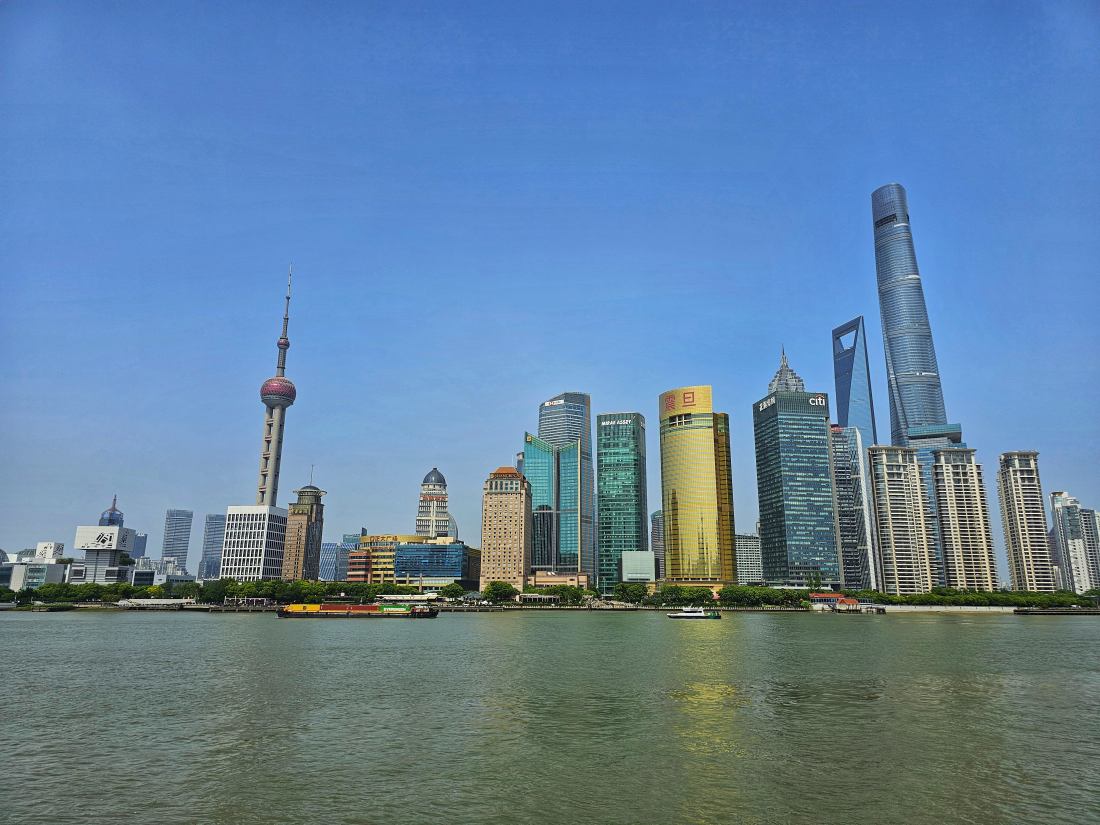
Shanghai is China’s largest city and economic capital, offering travellers a stunning blend of modern skyscrapers and traditional Chinese culture. The following questions and answers will help you navigate the most important things to know, whether it’s safety, transportation, or the best time to visit.
Table of Contents
Basic information
What time zone is Shanghai in?
Shanghai operates on China Standard Time (CST, UTC+8). China does not observe daylight saving time, so the time in Shanghai remains consistent throughout the year.
When is the best time to visit Shanghai?
The spring (March–May) and autumn (September–November) periods are generally considered the most ideal for visiting Shanghai. The weather is pleasant, temperatures are moderate, and the rainy season does not make travelling uncomfortable.
Spring (March–May) is one of the best times to visit Shanghai. Temperatures generally range between 10–22°C, and the cherry blossoms give the city a special atmosphere. However, some rain should be expected.
Summer (June–August) in Shanghai is hot and humid, with temperatures regularly exceeding 35°C. This period is also riskier in terms of typhoons, and is therefore less recommended for visiting.
Autumn (September–November) is also an excellent period, with milder temperatures and less rainfall. Daytime temperatures are generally between 15–25°C, and the sky is clearer.
Winter (December–February) in Shanghai is cool and grey, with temperatures around 0–10°C. Although snow is rare, the damp and foggy weather makes this not the ideal time to visit.
How many days should you spend in Shanghai?
At least 3–4 days are generally recommended to explore Shanghai. The city is vast and incredibly diverse, so even a week would not get boring.
In 3 days, you can generally fit in the most important sights: the Bund, Nanjing Road, Yu Garden, and the Pudong district.
With a 4–5 day stay, you can explore the city at a more leisurely pace, including museum visits, a boat trip on the Huangpu River, or a visit to Disneyland.
What is the official currency in Shanghai?
China’s official currency is the Chinese yuan (CNY), also known as renminbi (RMB). In Shanghai, all everyday transactions are conducted exclusively in Chinese yuan.
Almost everywhere, only Chinese payment apps (WeChat Pay, Alipay) are accepted. It is worth researching in advance and, if possible, withdrawing cash from ATMs at the airport or banks. However, many hotels and larger restaurants also accept Visa and Mastercard.
Here is a currency conversion calculator where you can check the current exchange rate!
Do people speak English in Shanghai?
Shanghai is one of the most English-friendly cities in China, especially in tourist areas, hotels, the airport, and larger restaurants. However, English proficiency is far from universal in everyday life.
In districts frequented by tourists – such as the Bund, Xintiandi, or the French Concession – there are generally staff who can communicate in English. English signs and bilingual announcements at metro stations also help with navigation.
In smaller restaurants, markets, and at street vendors, however, it is almost certain that no one will speak English. In such cases, a translation app – such as Google Translate or DeepL – comes in handy, and it is worth downloading it in advance and making it available in offline mode.
What type of plug is used in Shanghai?
China primarily uses the following socket types: Type A (two flat pins), Type I (angled pins), and Type C (two round pins). European devices will most often require a travel adapter.
The mains voltage in China is 220 Volts, 50 Hz. Therefore, most European electronic devices can be used without a voltage converter — an adapter is only needed because of the plug shape.
How does internet and SIM card usage work in Shanghai?
The internet in China is heavily restricted: many well-known sites and apps – including Google, Facebook, Instagram, WhatsApp, and YouTube – are not accessible due to the ‘Great Firewall’. It is worth installing and setting up a VPN in advance, while still in Hungary.
Local SIM cards and eSIMs are available in Shanghai, which can be used for mobile data. Additionally, tourist SIM cards offering unlimited data are increasingly available.
Is tipping customary in Shanghai?
In China – and thus in Shanghai – tipping is not a widespread custom. In most restaurants and service providers, tips are neither expected nor accepted.
In luxury hotels and restaurants specifically catering to foreign tourists, a small tip may be given, but it is not obligatory. At street food vendors and local restaurants, leaving a tip would be completely unusual.
Travel and transportation
How do I get from the airport to the centre of Shanghai?
Shanghai has two international airports: Pudong International Airport (PVG), located approximately 40–50 km east of the city centre, and Hongqiao Airport (SHA), which is closer to the downtown area.
From Pudong Airport, the fastest option is the Maglev (magnetic levitation train), which reaches Longyang Road metro station in just 7–8 minutes, where you can transfer to the metro. A direct metro line (Line 2) is also available, though this takes considerably longer (approx. 1 hour).
From Hongqiao Airport, you can easily and quickly reach the city centre by metro (Lines 2 and 10) in approximately 30–40 minutes.
Taxis are also available at both airports, and Didi, the Chinese equivalent of Uber, can be used via a smartphone app.
What is the most convenient way to get around Shanghai?
Shanghai’s public transport network is one of the best and most modern in the world. The metro covers most tourist destinations and is fast, cheap, and easy to use.
The metro network consists of 20 lines and reaches virtually every corner of the city. English signs and maps at stations help with navigation. Tickets can be purchased at ticket vending machines.
Taxis are also a popular mode of transport, and the fares are relatively affordable. The Didi app (China’s Uber) is particularly convenient, as the destination can be entered in both Chinese and English.
Accommodation and safety
Is Shanghai a safe city?
Shanghai is one of China’s safest cities, and tourists generally report pleasant, safe experiences. Due to the strong public security presence and state surveillance, the crime rate is low.
Pickpocketing and minor thefts may occur in crowded places, markets, or on public transport, so it is worth keeping an eye on your valuables. At night, the city centre is also relatively safe, but as in any large city, you should be vigilant.
Which neighbourhood is best to stay in Shanghai?
The most popular areas for tourists to stay in Shanghai are the Bund area, the Old French Concession, Xintiandi, Jing’an, and the Pudong district. These are well located, with numerous restaurants and attractions accessible on foot.
The Bund area is located near Shanghai’s most famous tourist spot – from here, the riverfront, Nanjing pedestrian street, and historic buildings are accessible on foot.
The French Concession, with its charming tree-lined streets, bistros, and boutiques, is ideal for those seeking a pleasant, quieter neighbourhood in the city centre.
Xintiandi is Shanghai’s fashionable and elegant district, where excellent restaurants, bars, and shopping opportunities are found within preserved old buildings.
Jing’an is a well-connected, vibrant neighbourhood with a temple, shopping centres, and a wide range of accommodation options.
Pudong is the heart of modern Shanghai, with its skyscrapers, the Oriental Pearl Tower, and the Lujiazui financial district. It is primarily recommended for business travellers, but tourists also frequently choose it for its spectacular panorama.
Health information
Are mandatory vaccinations required for travelling to Shanghai?
Travelling to Shanghai generally does not require any mandatory vaccinations for most travellers. However, some recommended vaccinations may be considered, especially for longer stays in China.
Is tap water safe to drink in Shanghai?
Drinking tap water in Shanghai is not recommended. Although the water supply is officially treated, most residents and tourists use bottled water due to the risk of contamination from old pipe networks.
Bottled water is easily available in supermarkets and small shops, generally very cheaply. Hotels usually provide mineral water in rooms free of charge, and hot water dispensers are also widely available.
Most tourists use tap water for brushing their teeth, but those with a sensitive stomach should also use bottled water for this purpose.
Experiences
What are the must-see sights in Shanghai?
Shanghai’s most well-known sights include the Bund, the skyscrapers of the Pudong district, Yu Garden, the Old French Concession, and the Xintiandi district. Together, these places create Shanghai’s unique character.
The Bund is Shanghai’s symbol: the colonial-era buildings lining the Huangpu River form an impressive panorama, facing the ultramodern skyscrapers of the Pudong district. It is particularly stunning at sunset and when lit up at night.
The Pudong district showcases Shanghai’s modern face: the Oriental Pearl Tower, Shanghai Tower, and Jin Mao Tower are iconic skyscrapers reaching into the sky. From the observation deck of Shanghai Tower, a breathtaking panorama of the city unfolds.
Yu Garden (Yuyuan) is a 400-year-old traditional Chinese garden complex in the city centre, made unique by its pavilions, rocks, ponds, and winding pathways. The nearby Yu Garden Bazaar is the best place to buy Chinese souvenirs and street food.
The Old French Concession is one of Shanghai’s most atmospheric districts, where elegant villas, cafés, and boutiques can be discovered while strolling in the shade of plane trees.
Xintiandi, with its renovated shikumen (stone gate) style buildings, forms a chic, modern district where traditional and modern Shanghai meet.
What are the most popular foods and drinks in Shanghai?
Shanghai’s cuisine is rich and varied: the most well-known local specialities are xiaolongbao (steamed filled dumplings), shengjianbao (pan-fried dumplings), and hairy crab. Among drinks, Chinese tea and local beer brands are the most popular.
Xiaolongbao is Shanghai’s most famous culinary speciality: small, thin-skinned dumplings that conceal hot broth and filling. The best xiaolongbao can be tasted at Din Tai Fung or Jia Jia Tang Bao restaurants.
Shengjianbao is similar to xiaolongbao, but the bottom is fried crispy in a pan. An excellent breakfast or snack from street vendors.
Hairy crab is an autumn seasonal delicacy that is almost adored in Shanghai – it is offered throughout the September–November season from Yangcheng Lake.
Chinese tea culture is also strong in Shanghai: jasmine tea, pu-erh tea, and green tea can be tasted in teahouses. Street boba tea (tapioca milk tea) is also extremely popular.
What are the important holidays and festivals in Shanghai?
Numerous important holidays and festivals are held in Shanghai throughout the year. Among the most memorable are Chinese New Year, the Mid-Autumn Festival, and the Dragon Boat Festival.
Chinese New Year (Chūnjié) is the most important Chinese holiday, held in late January or early February. Fireworks, lanterns, and parades fill the city. The most spectacular celebrations take place along the Bund and around Yu Garden. It is important to note that many shops and restaurants close during the festive period.
The Mid-Autumn Festival is held in September or October. Traditional mooncakes are tasted, and people stroll through the city in the light of the full moon. It is celebrated in Shanghai with beautiful decorations and festive markets.
The Dragon Boat Festival takes place in June and is celebrated with dragon boat races and the eating of traditional zongzi (rice balls wrapped in bamboo leaves).
The Shanghai International Film Festival is generally held in June and is one of Asia’s most significant film festivals.

