
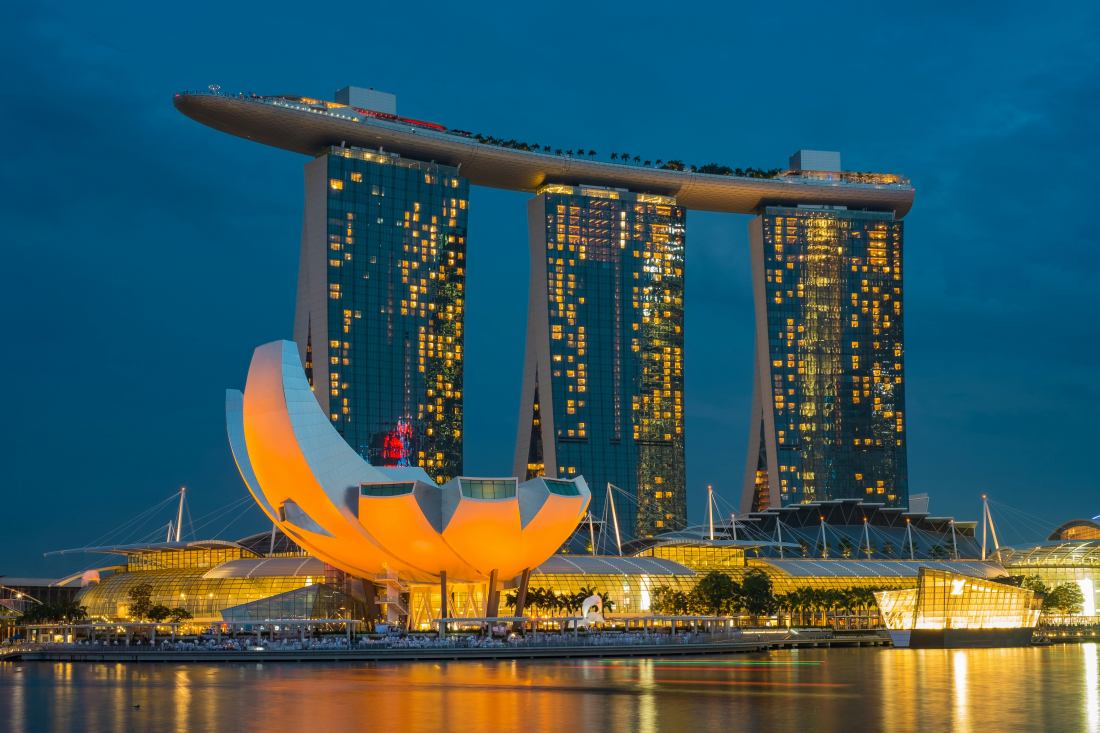
Singapore is one of the most developed countries in the world, which is evident in every aspect of life. The following questions and answers will help you navigate the most important information, whether it concerns safety, transportation, or the best time to travel.
Table of Contents
Basic information
What time zone is Singapore is?
Singapore operates on Singapore Standard Time (SST, UTC+8) and does not observe daylight saving time.
When is the best time to visit Singapore?
Singapore can be visited year-round; however, the most pleasant period is generally considered to be the dry season between February and April, when there is less rainfall and temperatures are somewhat more manageable.
The period from February to April is considered the most ideal. Although temperatures hover around 25–32 °C throughout the year, the chance of heavy downpours is lower during these months, making sightseeing more comfortable.
The rainy season from November to January is the period of the northeast monsoon, when the most rainfall occurs. The rains typically arrive as short but intense showers and usually pass quickly.
One of Singapore’s most special periods is Chinese New Year, usually celebrated in late January or early February. During this time, the Chinatown district and the entire city are adorned with festive lights, and numerous cultural programmes are held.
How many days is it worth spending in Singapore?
Singapore, as a city-state, is relatively compact but offers a wealth of attractions. For most travellers, at least 3–4 days are recommended to explore the main sights.
In 3 days, it is generally possible to fit in the Marina Bay Sands observation deck, Gardens by the Bay, Sentosa Island, and the Chinatown and Little India districts.
With a 4–5 day stay, there is time to explore the Singapore Zoo, the Arab Street quarter, the stunning Jewel building at Changi Airport, and the less touristy parts of the island.
What is the official currency in Singapore?
The official currency of Singapore is the Singapore Dollar (SGD), which is accepted throughout the city-state.
Card payments are accepted in most places; hotels, restaurants, shopping centres, and larger shops generally accept Visa and Mastercard. However, it is advisable to keep some cash on hand at smaller street restaurants and markets. ATMs are widely available across the city.
Here is a currency converter where you can check the current exchange rate!
Do people speak English in Singapore?
Yes, English is one of the official languages of Singapore, so you can make yourself understood in English almost everywhere in the city.
Locals generally speak English fluently, so communication is usually not a problem for tourists. In addition, a local English dialect called Singlish is widely spoken, which blends Malay, Chinese, and Tamil elements. Transport signs, menus, and official notices are all available in English as well.
What type of plug/socket is used in Singapore?
Singapore uses British-type, three-pronged Type G sockets. Therefore, a travel adapter will be needed for European devices.
The mains voltage is 230 Volts, 50 Hz, which matches the European standard, so most electronic devices can be connected with just an adapter, without a voltage converter.
How does internet and SIM card usage work in Singapore?
Singapore has excellent internet connectivity, and free Wi-Fi is available almost everywhere in the city. If you need continuous mobile internet access, it is worth purchasing a local SIM card or eSIM.
Singapore is one of the best-connected countries in the world: 5G networks and free Wi-Fi are available at metro stations, the airport, many restaurants, and public areas. A local SIM card can easily be purchased at the airport or convenience stores in the city centre (e.g. 7-Eleven) with a subscriber ID. eSIM cards are also becoming increasingly popular and can be activated online before the trip.
Is tipping customary in Singapore?
Tipping is generally not expected in Singapore, and this is completely accepted. In most restaurants and hotels, a service charge is included in the final bill, so leaving a separate tip is not customary.
In larger restaurants, a 10% service charge is usually automatically added and appears on the bill. At hawker centres and smaller food stalls, tipping is almost never expected. If someone wishes to express gratitude for exceptional service, a small amount is perfectly acceptable but is by no means obligatory.
Travel and transportation
How do I get from the airport to the centre of Singapore?
Singapore’s Changi Airport is located approximately 20 kilometres east of the city centre and can be reached quickly by several modes of transport.
The cheapest option is the MRT metro (Mass Rapid Transit), whose East-West line directly connects the airport to the city centre. The journey takes approximately 30 minutes.
Taxis and ride-sharing services (e.g. Grab) are also available at the airport, offering a convenient but somewhat more expensive alternative. The city can also be reached by bus, but this journey takes considerably longer.
What is the most convenient mode of transport in Singapore?
Singapore’s public transport system is one of the most advanced and reliable in the world. For tourists, the best solution is a combination of the MRT metro network, buses, and the Grab app.
The MRT metro network efficiently covers all the main attractions of the city-state. It is clean, air-conditioned, punctual, and affordable – clearly the best choice for sightseeing.
It is worth getting an EZ-Link card, which allows simple payment on both the metro and buses, and offers cheaper fares than purchasing individual tickets each time.
Accommodation and safety
Is Singapore a safe city?
Singapore is one of the safest cities in the world. Public safety is excellent, street crime is extremely low, and tourists can travel almost anywhere confidently, both day and night.
Due to strict laws and effective policing, the crime rate in Singapore is very low. It is important to know that the city-state takes many behavioural rules seriously: chewing gum in public is prohibited, littering is banned, and smoking regulations are strictly enforced. It is advisable to familiarise yourself with local regulations to avoid fines.
Which neighbourhood is best to stay in Singapore?
Among the best accommodation districts in Singapore are Marina Bay, Orchard Road, Chinatown, Clarke Quay, and the Bugis district. Each offers a different atmosphere, but all have excellent public transport connections.
Marina Bay boasts the most impressive views and is close to the main attractions. Hotels here are the most expensive but offer a premium experience.
Orchard Road is the heart of Singapore’s shopping parade, lined with luxury brands, restaurants, and well-located hotels.
Chinatown and Clarke Quay are the lively, nightlife-filled areas where a rich selection of hotels and hostels at various price ranges can be found.
Health information
Are mandatory vaccinations required to travel to Singapore?
There are generally no mandatory vaccinations required for Hungarian travellers to Singapore, unless the traveller has been in a yellow fever-endemic area within the previous 6 days.
Singapore is a city-state with a modern, well-developed healthcare infrastructure, so risks are low. However, it is recommended to update routine vaccinations (hepatitis A, typhoid) and to seek information about the possible risk of dengue fever, as this mosquito-borne disease can occasionally occur.
Is tap water safe to drink in Singapore?
Yes, tap water in Singapore is safe to drink and healthy. Singapore’s drinking water is among the cleanest in the world, and the authorities continuously monitor water quality.
Singapore’s water supply comes from multiple sources, including rainwater harvesting systems, water reclamation technology (NEWater), and desalination. The quality of tap water meets WHO standards, so there is no need to buy bottled water – although hotels often offer bottled water as a courtesy.
Experiences
What are the must-see attractions in Singapore?
Singapore’s most famous attractions include Marina Bay Sands, Gardens by the Bay, Sentosa Island, the Merlion statue, and the Chinatown district. These places beautifully showcase the city-state’s stunning architecture, natural beauty, and diverse culture.
Marina Bay Sands has become a symbol of Singapore. The SkyPark observation terrace on top of the iconic hotel complex offers an unparalleled panoramic view of the city.
Gardens by the Bay is a futuristic botanical garden where the giant metal trees called Supertrees put on a light show in the evening. The Cloud Forest and Flower Dome greenhouses also offer breathtaking views.
Sentosa Island is the capital of entertainment: beaches, theme parks, the Universal Studios Singapore amusement park, and luxury resorts await visitors.
The Chinatown, Little India, and Arab Street quarters reflect Singapore’s cultural diversity, with unique food, temples, and bazaars.
What are the most popular foods and drinks in Singapore?
Singapore is world-famous for its food culture. The best-known local dishes include Hainanese Chicken Rice, Chilli Crab, Laksa, and Char Kway Teow, while popular drinks include Teh Tarik and fresh coconut juice.
Hainanese Chicken Rice is Singapore’s national dish: a combination of slowly poached chicken, fragrant rice, and special sauces, available almost everywhere.
Chilli Crab is the pride of Singaporean cuisine: crab served in a spicy tomato-chilli sauce, accompanied by bread or steamed buns.
Laksa is a spicy coconut curry noodle soup, a masterpiece of the Malay-Chinese Peranakan cuisine.
Local hawker centres are covered food courts where dozens of different dishes are available at very affordable prices. These have received UNESCO heritage status and are an inseparable part of Singaporean life.
What are the important holidays and festivals in Singapore?
Singapore celebrates numerous holidays and festivals throughout the year, reflecting the city-state’s multicultural character. The most well-known include Chinese New Year, Deepavali, Hari Raya, and Singapore National Day.
Chinese New Year (late January – early February) is one of the most colourful celebrations in the city-state. Chinatown is dressed in special decorations, with light shows, parades, and fireworks making the holiday unforgettable.
Deepavali is the Hindu festival of lights, celebrated in October–November. Little India is adorned with thousands of colourful lanterns and decorations, creating a true carnival atmosphere.
Singapore National Day (9 August) is one of the biggest events, celebrated with a grand military parade, air shows, and fireworks along the Marina Bay waterfront.