

Argentina’s capital is famous not just for tango! Buenos Aires holds its own with its attractions as well. It’s an exciting, vibrant, bustling Latin American city where visitors are sure to have a great time. In this article, I’ll introduce you to the must-see sights!
Buenos Aires is located in the northeastern part of Argentina, on the southern shore of the Río de la Plata, opposite the Uruguayan coast. The city is also called the Paris of South America, as it is the fashion capital of the continent.
Table of Contents
Buenos Aires attractions
Plaza de Mayo
Plaza de Mayo is the main square of Buenos Aires, with the May Pyramid monument at its center.
On Thursday afternoons, mothers gather here to remember their sons who disappeared during the military dictatorship several decades ago.
Casa Rosada
The city’s most famous building, Casa Rosada, stands on the square.
The Casa Rosada palace is the official residence of the current Argentine president, although it is now used only for formal occasions. If a smaller flag is hoisted under the Argentine flag on top, it means the president is in the palace.
Interestingly, the building is pink, which is unusual for a presidential palace (Casa Rosada means „pink house”). There is no exact explanation, but the accepted reason is that houses were often painted this color in the 19th century. This tradition has been preserved.
The building also houses a museum (Museo Casa Rosada), where you can see personal items of former presidents. Entry is free!

Evita Museum (Museo Evita)
Eva Perón was the second wife and political supporter of President Juan Domingo Perón from 1945 to 1952. She was known to the people of Argentina simply as Evita, adored by thousands, and her death plunged the entire country into mourning. This was due to her significant contributions to the working class and women’s equality.
The museum showcases her life with photos, videos, books, and personal items. Reviews unanimously recommend visiting the museum.
Recoleta
One of the city’s most elegant districts, featuring mansions, luxury hotels, and theaters. It used to be the residence of the wealthy.
Recoleta Cemetery (Cementerio de Recoleta)
It can be said without exaggeration that this is one of the most beautiful and interesting cemeteries in the world!
Here you can see beautiful mausoleums and wander through streets lined with nearly 5,000 tombs.
Many famous people are buried here: besides former presidents, this is the resting place of Eva Perón and a mausoleum for one of Napoleon’s granddaughters.

Obelisco
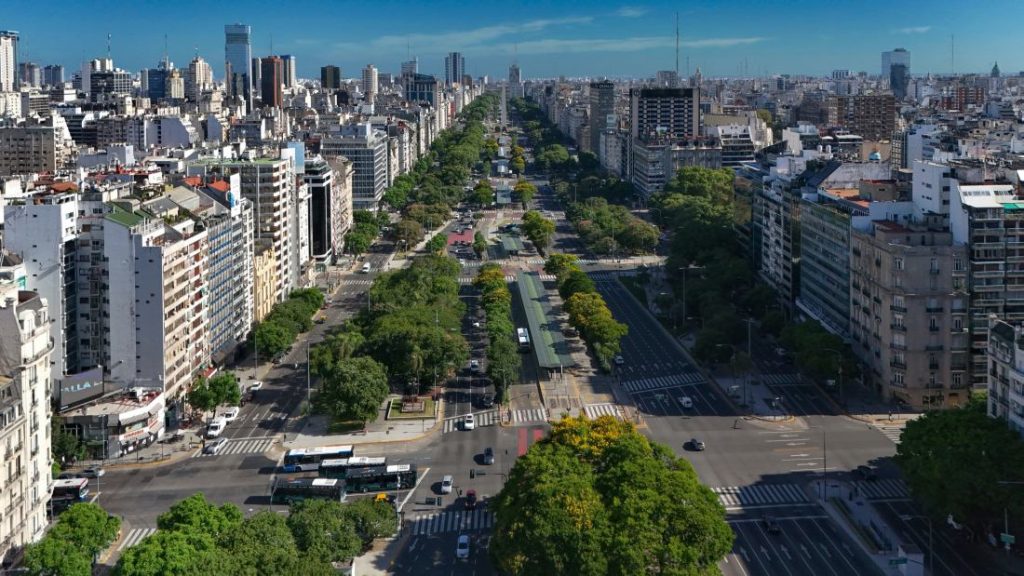
At the intersection of two major roads, Avenida 9 de Julio and Calle Corrientes, stands the 68-meter high monument. Today, the area around the obelisk is the site of numerous political demonstrations and celebrations.
It was built in 1936 to commemorate the 400th anniversary of Buenos Aires’ founding. It was erected here because it was the site where the Argentine flag was first raised in 1812.
There is a lookout at the top, but unfortunately, tourists cannot access it currently.

La Boca
One of Buenos Aires’ oldest districts, settled by Genoese immigrants in the late 19th century.
Most found work at the port, earning very little. They couldn’t afford to beautify their homes, so they used leftover paint from the port, resulting in houses of various colors.
This colorful district is now one of the most popular parts of the Argentine capital, where tango and football take center stage.
Here you will find the stadium of the famous football team, Boca Juniors (La Bombonera). The sidewalk next to the stadium features the footprints of the team’s famous players.
An interesting sight is a statue of Maradona made from scrap materials on one of the balconies! The former Ballon d’Or winner is revered as a god here!
The district is full of bars and cafes. It’s not uncommon to stumble upon amateur or even professional tango performances!
Caminito is a small street in the southwestern corner of La Boca, along the Matanza River. It’s a real artist’s spot where creators display and sell their works on the street. There are many museums in the area as well.

Palacio Barolo
The lighthouse of the building offers a great view. The building itself is beautiful, and even if you don’t go inside, it’s worth seeing from the outside.
You can go up to the lookout as part of a guided tour! Be prepared to climb many stairs.
Puerto Madero
The most modern district, built on the site of the old port, located east of Casa Rosada. Interestingly, all the streets are named after famous women.
Skyscrapers and restaurants have been built on the site of the old docks. It’s a truly 21st-century part of the city, with new buildings continuously being constructed.

Calle Florida
This street is Buenos Aires’ equivalent of Váci Street. It connects Plaza de Mayo with Plaza San Martin.
The street is filled with shops, luxury stores, and cafes, and in the evenings, it comes alive with musicians, tango dancers, and comedians.
San Telmo
On weekends, you can find South America’s largest open-air market here. The Sunday market stretches over a 2-kilometer area along Rua Defensa, with Plaza Dorrego as its center.
Everything is available at the stalls, from antiques to typical flea market items, as well as trendy, fashionable goods.
Café Tortoni
Argentina’s oldest café, opened in 1858 by a French immigrant named Touan.
It has a unique atmosphere, often hosting local writers and artists at work. Additionally, you can also watch tango performances here.
MALBA (Museo de Arte Latinoamericano de Buenos Aires)
One of South America’s most important art museums, with over 400 works (paintings, sculptures, photos).
You can see great works by famous Argentine artists such as Diego Rivera, Antonio Berni, Xul Solar, Jorge de la Vega, and Pedro Figari.
One of its most valuable pieces is a self-portrait by the Mexican artist Frida Kahlo.
All information here!
Teatro Colón
The city’s most significant cultural institution. For a long time, it was the largest opera house in the world.
Hungarian works are also frequently performed, with Kodály and Bartók being particularly popular.

Palermo
This area, founded by Italians, is a favorite among the youth. Cozy bars, cafes, and restaurants are plentiful, and clubs open in the evening.
Two areas are particularly trendy: Palermo Soho and Palermo Hollywood. These are the „coolest” districts in the city.
Another part of the district is the city’s largest green area, with many different parks. For example, the Japanese Garden mentioned in the next section.

Japanese Garden (Jardín Japonés)
The garden was a „gift” from the Japanese emperor, featuring waterfalls, streams, bridges, and tea houses that offer relaxation.
It’s worth spending a few hours here to enjoy the peace and tranquility.
Football in Buenos Aires
For decades, Argentine players have been among the best in the world. Just mentioning the name Maradona, who is revered as a god in Argentina.
Football is one of the few ways out of poverty for those in poorer neighborhoods. You can often see children playing football in the streets.
Two football teams stand out. The matches between these two teams are among the greatest derbies in the world.
One of them has already been mentioned, with Boca Juniors’ stadium, La Bombonera, located in the La Boca district.

The other popular team is River Plate. Their stadium, El Monumental, is located in the Núñez district. It is the largest stadium in Argentina, with a capacity of 62,000 spectators.

Weather
It should be noted that due to its location in the southern hemisphere, the seasons are reversed!
Buenos Aires has a humid subtropical climate, characterized by wet summers and mild winters.
The hottest month is January, with a daily average temperature of 25.1°C. In summer, the daily average temperature ranges between 28-31°C, with nighttime temperatures typically between 16-21°C. The relative humidity in summer is 64-70%, making the heat feel even more intense.
Spring (September-November) and autumn (March-May) are generally mild and variable. The average temperature is around 17°C, with frequent thunderstorms, especially in spring.
July is the coldest month, with an average temperature of 10.9°C. In winter, daytime temperatures average 12-17°C, dropping to 3-8°C at night.

Wonderful World Heritage sites in South America
South America has numerous natural and cultural World Heritage sites.