
Kuala Lumpur is one of the most dynamically developing Asian capitals. The following questions and answers will help you navigate the most important information, whether it concerns safety, transportation, or the best time to travel.
Table of Contents
Basic information
What time zone is Kuala Lumpur in?
Kuala Lumpur is located in the Malaysian Standard Time zone (MST, UTC+8). Malaysia does not observe daylight saving time.
When is the best time to visit Kuala Lumpur?
Kuala Lumpur can be visited year-round, as the climate is warm and humid throughout the year. The best periods are generally the May–July and December–January drier months, when there is somewhat less rain.
Dry season (May–July and December–February): This is the most favourable period for travel. Temperatures range around 28–33 °C, and rainfall is more moderate, although showers can still occur.
Rainy season (March–April and September–November): During this period, heavy tropical downpours are common in the afternoons and evenings. However, the rains are usually short-lived and the weather clears up quickly.
A special time in Kuala Lumpur is Hari Raya Aidilfitri (the celebration after Ramadan), when the city is adorned with festive lights and many shops and streets have a special atmosphere. The date changes each year according to the lunar calendar.
How many days is it worth spending in Kuala Lumpur?
To explore the main attractions of Kuala Lumpur, at least 3–4 days are generally recommended. The city’s compact centre is relatively easy to navigate, but the rich cultural and gastronomic experiences can justify an even longer stay.
In 3 days, the most important sites can generally be covered: the Petronas Twin Towers and KLCC Park, the Batu Caves, Merdeka Square, and Chinatown (Petaling Street).
With a 4–5 day stay, local markets, the Bukit Bintang shopping district, the KL Tower, and day trips near the city, such as to Putrajaya or Malacca, can also be included.
What is the official currency in Kuala Lumpur?
The official currency of Kuala Lumpur is the Malaysian ringgit (MYR), which is used throughout the country.
Most places accept ringgit. It is advisable for tourists to exchange money in advance, as exchange rates at the airport and banks are generally more favourable than at hotels. Major shopping centres, hotels, and restaurants typically accept credit cards as well.
Here is a currency converter calculator where you can check the current exchange rate!
Do people speak English in Kuala Lumpur?
Yes, English is widely spoken in Kuala Lumpur, and in tourist areas, hotels, restaurants, and shopping centres, almost everyone understands it. This is partly due to the British colonial past and partly to the country’s multicultural nature.
The local variety of English is called Manglish, which incorporates Malay, Chinese, and Tamil elements. People often communicate this way among themselves, but they also use a more standard, comprehensible English for tourists.
What type of plug is used in Kuala Lumpur?
Kuala Lumpur uses the British standard Type G plug (triangular, three-pin socket). Therefore, a travel adapter will be needed for most European devices.
The mains voltage is 240 Volts, 50 Hz so most European appliances (laptops, phone chargers, hair dryers) can be used without issue with an adapter.
How does the internet and SIM card work in Kuala Lumpur?
Internet access in Kuala Lumpur is excellent. Free Wi-Fi is available in most hotels, shopping centres, cafés, and restaurants. If you need continuous mobile internet, it is worth purchasing a local SIM card or eSIM.
Local prepaid SIM cards can be purchased at the airport and in many places in the city, typically at very affordable prices. The main providers are Maxis, Celcom, and Digi.
More and more people are using eSIMs, which can be purchased and activated online before travelling. This is particularly convenient, as mobile internet will be up and running immediately upon arrival at the airport or in the city.
Is tipping customary in Kuala Lumpur?
Tipping in Kuala Lumpur is not as obligatory a custom as in the West, but it is appreciated. Restaurant bills usually include a 10% service charge, so a separate tip is generally not expected.
If you are satisfied with the service and the service charge is not included in the bill, it is polite to leave around 10%. Rounding up is customary for taxi drivers, but not obligatory. Tips are warmly welcomed at massage salons and other personal service providers.
Travel and transportation
How do I get from the airport to the centre of Kuala Lumpur?
Kuala Lumpur’s main airport is Kuala Lumpur International Airport (KLIA), located approximately 55 kilometres from the city centre. The city centre can be reached by several means of transport.
The KLIA Ekspres is the fastest and most comfortable option: a direct train runs from the airport to KL Sentral station in approximately 28 minutes. Tickets can also be purchased in advance online.
Bus travel is a cheaper alternative: several bus companies operate between the airport and the city centre. The journey is slower, but considerably cheaper than the train.
Taxis and ride-sharing services (Grab) are also available at the airport. The Grab app is especially recommended, as the price is transparent and it is safer than street taxis.
What is the most convenient mode of transport in Kuala Lumpur?
Kuala Lumpur’s public transport is well-developed and extensive. For tourists, the LRT, MRT, monorail, and the Grab app are generally the most convenient options.
The urban rail network (LRT, MRT, KTM Komuter) is extensive and reliable. Trains run frequently, and most major tourist sites are near a station.
The KL Monorail runs between the Bukit Bintang shopping district and the city centre, and is a convenient option for tourists.
The Grab app is the most widespread ride-sharing solution. It shows the price upfront and is a safer alternative to street taxis. It is worth downloading the app before you travel.
The Touch ‘n Go card is the local travel card, which makes it easy to pay for the metro, buses, and even some tolls and car parks.
Accommodation and safety
Is Kuala Lumpur a safe city?
Kuala Lumpur is generally considered a safe city for tourists. In the main tourist districts, few problems are to be expected during the day, but general caution – especially at night and in crowded places – is recommended everywhere.
Which neighbourhoods are considered safe?
The areas most frequently chosen by visitors include:
- KLCC (area around the Petronas Towers) – modern, safe, with many hotels and restaurants
- Bukit Bintang – the main shopping and entertainment district
- Bangsar – an elegant, youthful neighbourhood with restaurants and cafés
- Mont Kiara – quiet and safe
In these areas, there is generally a lot of traffic, the infrastructure is well-developed, and movement is safe.
How safe is it at night?
In the districts visited by tourists, nightlife on the streets is also lively. However, it is advisable to avoid less well-lit side streets, and to use Grab at night rather than walking. In crowded places, watch your belongings, as pickpocketing can occur.
Which neighbourhood is best to stay in in Kuala Lumpur?
The most popular accommodation areas for tourists in Kuala Lumpur are KLCC, Bukit Bintang, Chinatown (Petaling Street), and Bangsar. These are well-located, easily accessible, and offer a variety of options.
KLCC is located at the foot of the Petronas Twin Towers, full of luxury hotels, shopping centres, and parks. It is an ideal choice for those who want to be close to the city’s most iconic attraction.
Bukit Bintang is the city’s entertainment and shopping hub. Many restaurants, markets, and entertainment venues can be found here. Both affordable and more expensive accommodation options are available.
Chinatown (Petaling Street) is one of the most atmospheric and most affordable neighbourhoods. It is characterised by night markets, street food, and colonial-era buildings. It is ideal for backpackers and budget-conscious tourists.
Bangsar is a quieter, elegant neighbourhood with many restaurants, cafés, and shops. It is especially popular among the expat community and those staying for longer periods.
Health information
Are mandatory vaccinations required for travelling to Kuala Lumpur?
There are generally no mandatory vaccinations required for Hungarian travellers to Kuala Lumpur. However, certain vaccinations may be recommended, especially for longer stays or visits to rural areas.
The WHO and travel medicine doctors generally recommend vaccinations against hepatitis A, typhoid, and tetanus. For longer stays, the hepatitis B vaccination is also worth considering. Malaysia is a tropical country, so it is worth protecting yourself against dengue fever with insect repellent, especially during the rainy season.
Is tap water safe to drink in Kuala Lumpur?
Tap water in Kuala Lumpur is technically drinking water quality, yet most local residents and tourists consume bottled water for drinking. Caution is advisable, especially for travellers with more sensitive stomachs.
Why is it not recommended? Although water treatment is generally adequate, old pipe networks and tank storage can cause contamination in some cases. Tour guides and hotels generally recommend bottled water.
Can it be used for brushing teeth? Most tourists use tap water for brushing teeth without problems, but if you have a sensitive stomach, it is worth using bottled water for this as well.
Experiences
What are the must-see attractions in Kuala Lumpur?
Among the most well-known attractions of Kuala Lumpur are the Petronas Twin Towers, the Batu Caves, the KL Tower, Merdeka Square and the Sultan Abdul Samad Building, the Petaling Street night market, and the nearby Putrajaya. These places well reflect the city’s diverse culture and stunning architecture.
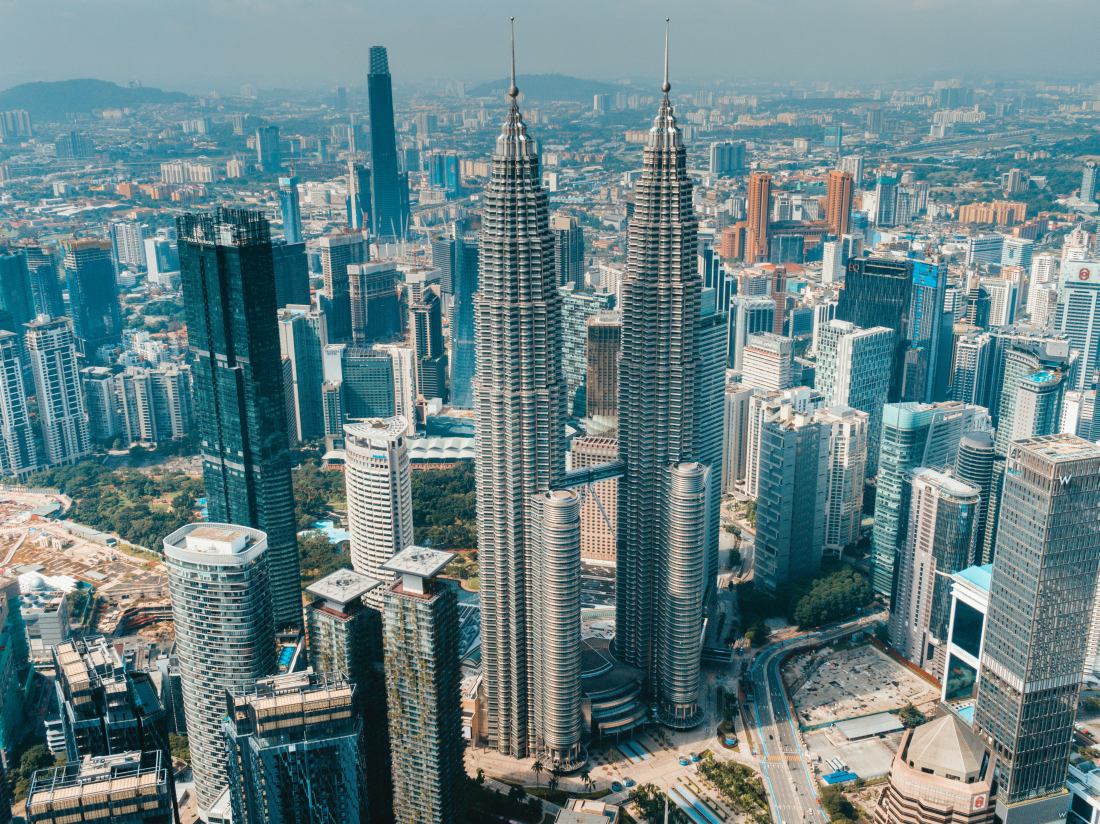
The Petronas Twin Towers (KLCC) are the symbol of Kuala Lumpur. The 88-storey skyscrapers were for a time the tallest buildings in the world. The Sky Bridge connecting the towers and the observation deck are also open to visitors (it is advisable to book tickets in advance).
The Batu Caves are a Hindu temple complex located deep within a massive limestone hill, just 13 km from the city centre. To reach the entrance, you must climb 272 steps, guarded by a huge golden Murugan statue.
The KL Tower (Menara KL) is a 421-metre-high telecommunications tower offering a breathtaking panorama of the city. The observation deck and the glass-floored Sky Box provide a unique experience.
Merdeka Square and the Sultan Abdul Samad Building form the heart of colonial Kuala Lumpur. The elegant Moorish-style building and the vast square were the site of Malaysia’s declaration of independence.
The Petaling Street night market is located in Chinatown and is one of the most atmospheric places in Kuala Lumpur. Street food, souvenirs, and an abundance of local goods await visitors.
What are the most popular foods and drinks in Kuala Lumpur?
Kuala Lumpur is world-famous for its diverse and delicious cuisine. The fusion of Malaysian, Chinese, and Indian culinary traditions creates a unique gastronomic experience. Among the most well-known dishes are nasi lemak, char kway teow, roti canai, and laksa.
Nasi lemak – the Malaysian national dish. Rice cooked in coconut milk, sambal sauce, dried anchovies, peanuts, and boiled egg make up this iconic breakfast.
Char kway teow – flat rice noodles stir-fried in a wok with prawns, bean sprouts, and egg. One of the most popular street foods.
Roti canai – a crispy, layered flatbread served with dhal (lentil) sauce or curry. One of Malaysia’s most beloved breakfast dishes.
Laksa – a spicy noodle soup with a coconut milk or sour base, served with prawns and other toppings. It has countless regional variations.
Teh tarik – strong tea and condensed milk are poured back and forth from a height to make it frothy. The characteristic drink of Malaysian coffee shops.
What important holidays and festivals are there in Kuala Lumpur?
Due to Kuala Lumpur’s multicultural character, numerous important holidays are celebrated throughout the year. The most well-known include Hari Raya Aidilfitri, Chinese New Year, Deepavali, and Malaysian National Day.
Hari Raya Aidilfitri (Eid) – the Muslim holiday marking the end of the month of Ramadan. At this time, the city is illuminated, and bazaars and markets exude a special atmosphere. The date changes each year.
Chinese New Year (January–February) – the Chinatown district becomes the scene of fireworks, lanterns, and traditional dances. It is a vibrant, colourful, and festive period.
Deepavali (October–November) – the Hindu festival of lights. The Brickfields neighbourhood (Little India) is particularly spectacular at this time, full of light decorations and festive events.
Malaysia Independence Day (31 August) – a grand parade and celebrations are held at Merdeka Square, which continue until 16 September, Malaysia Day.