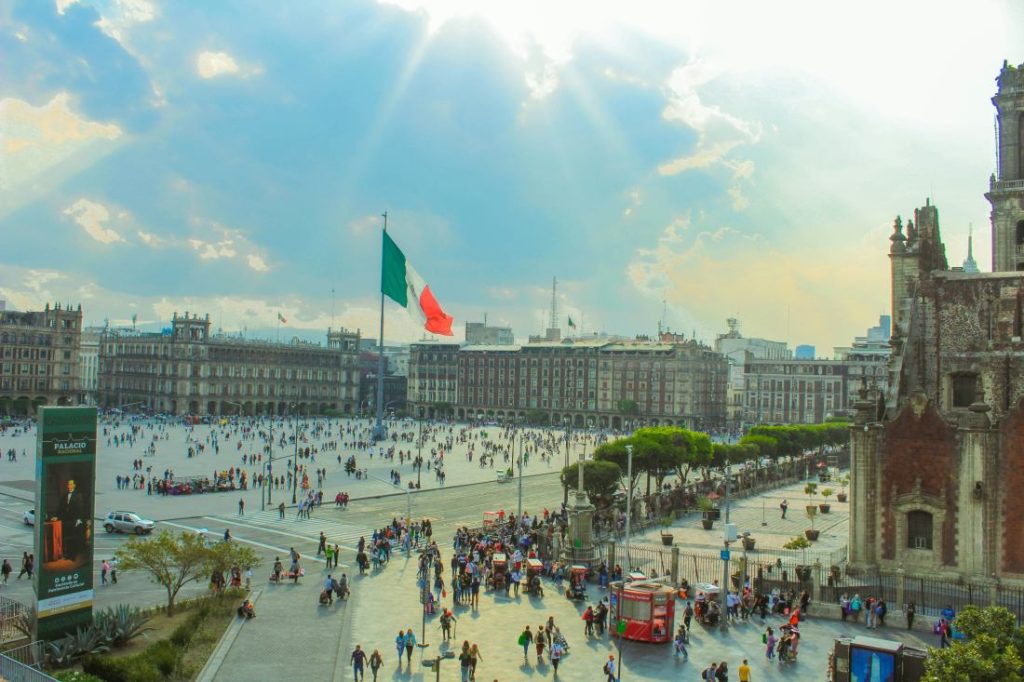
Due to its history, Mexico City has numerous attractions. The mix of Aztec, Spanish, and modern culture makes it a unique destination.
The capital of Mexico was founded by the Aztecs around 1325 under the name Tenochtitlán. In the first half of the 16th century, Spanish conquistador Hernán Cortés conquered it. They built their palaces, churches, and the new city using stones from the pyramids, which became the cradle of today’s metropolis, Mexico City.
The city is one of Latin America’s most important economic centers. It has hosted several globally significant sporting events, including the 1968 Summer Olympics and numerous matches of the 1970 and 1986 FIFA World Cups.
Mexico City has many museums. Check out the best museums here!
Table of Contents
Mexico City attractions
Zócalo (Plaza de la Constitución)
One of Mexico’s most important and largest squares which is the part of UNESCO World Heritage Sites.
It was an important meeting place during the Aztec era, and the main square of ancient Tenochtitlan stood at this location. Following the Spanish conquest, the square was transformed and is now the center of Mexico’s political, cultural, and religious life.
Famous buildings on the square include the Metropolitan Cathedral, the National Palace, and the Templo Mayor.
Metropolitan Cathedral
Latin America’s largest and oldest cathedral stands on the Zócalo square.
Its construction took nearly three centuries, from 1573 to 1813, resulting in a blend of different architectural styles — baroque, renaissance, and neoclassical. The cathedral was built on the ruins of Aztec Tenochtitlan, symbolizing Christianity’s victory over the ancient religion. The site was chosen by Hernán Cortés to be the most important church in the new colonial capital.
Four huge bell towers adorn the building, containing a total of 25 bells. One of the cathedral’s most impressive features is the „Altar de los Reyes” altar, which serves as the main altar. Made of pure gold, it offers an impressive sight with its rich detail.

National Palace
One of the country’s most important government buildings, located on the Zócalo square.
Originally serving as the residence of Spanish conquistador Hernán Cortés, it later became the colonial government’s headquarters. After Mexican independence, the building was taken over by the Mexican government.
The building’s red tezontle (volcanic stone) covering and ornate facade give the palace a special character. Its balcony is where the Mexican president commemorates the independence struggle every September 15th, on the eve of Independence Day.
The palace’s inner courtyard features a series of famous murals painted by Diego Rivera between 1929 and 1951. These frescoes depict Mexico’s history, from ancient Aztec civilizations through Spanish conquest and colonial period to the independence struggles.

Templo Mayor
Also located on the Zócalo square, it was the main temple of the ancient Aztec city of Tenochtitlan.
The structure represented the Aztec empire’s religious and political center. It was dedicated to two gods: Huitzilopochtli (god of sun and war) and Tlaloc (god of rain and fertility). At the top of the temple were separate shrines where priests performed sacrifices, including animal sacrifices and even human sacrifices.
The ruins were accidentally discovered in 1978. Excavations revealed the temple’s foundations and numerous artifacts. The museum next to the ruins displays thousands of finds, including ceremonial objects, stone sculptures, carvings, and the famous Coyolxauhqui stone artifact depicting a female figure worshipped as a moon deity.
El Ángel de la Independencia
„The Angel of Independence” is one of Mexico City’s most famous monuments commemorating the heroes of the Mexican War of Independence.
The monument was inaugurated in 1910, marking the 100th anniversary of Miguel Hidalgo and the Mexican independence movement. The monument’s base contains the remains of several Mexican independence leaders, including Miguel Hidalgo, José María Morelos, and other heroes.
At its top stands a gilded bronze statue depicting a female figure. The statue symbolizes freedom and victory: in her left hand, she holds a laurel wreath symbolizing the heroes’ glory, while in her right hand, she holds a broken chain symbolizing liberation from Spanish rule.

Monumento a la Revolución
The „Monument to the Revolution” was built in memory of the Mexican Revolution’s heroes in the Juárez district.
The 67-meter-high building has a domed design with an observation deck at the top. It offers a 360-degree view of the city. In the evening, it’s illuminated and features a colorful water light show in front, making the structure even more beautiful.
The pantheon beneath the monument contains the remains of Mexican Revolution leaders, including famous personalities like Francisco I. Madero, Pancho Villa, Venustiano Carranza, and Lázaro Cárdenas.

Chapultepec Park
One of the city’s largest and most popular public parks spans nearly 700 hectares and is one of the largest urban parks in the world.
The park features numerous attractions, including museums, lakes, sculptures, and Mexico’s only royal castle, Chapultepec Castle. Among the cultural institutions, the Museum of Modern Arts and the Rufino Tamayo Museum of Contemporary Art stand out.
It’s home to one of Mexico’s largest and most popular zoos. It houses more than 200 species, including giant pandas, which are found in only a few other zoos worldwide.
Chapultepec Castle
Standing atop Chapultepec Hill, it’s the only castle in North America that served as a royal residence.
Construction began in 1785, originally intended as the Spanish colonial governor’s country summer residence. Between 1864 and 1867, the castle was home to Emperor Maximilian I of Mexico and his wife Charlotte. Over the years, it served various functions: military academy, royal palace, government center, and finally a museum.
Today, the castle houses the National Museum of History (Museo Nacional de Historia), showcasing Mexico’s history from pre-Columbian times through independence struggles to the revolution.
It features beautiful gardens and fountains with exotic plants and sculptures. The castle terraces offer spectacular views of the city.

Altar a la Patria
„The Altar to the Homeland” is located in Chapultepec Park, where one of the final battles of the Mexican-American War took place.
The altar’s central piece features a bronze statue depicting a winged figure holding an idealized Mexican soldier carrying Mexico’s flag. Above the bronze statue is a huge laurel wreath symbolizing heroism and sacrifice.
Around the statue stand six white marble columns known as „Niños Héroes” (Hero Children). It commemorates six young, heroic cadets who sacrificed their lives defending Mexico during the Mexican-American War.

Basilica of Guadalupe
One of the world’s most famous churches and most visited Marian shrines.
It was built on Tepeyac Hill, where according to Catholic believers, the Virgin Mary, known as Our Lady of Guadalupe, appeared to Juan Diego in 1531. The current building opened in 1976, but next to it stands a centuries-old church that was previously the Guadalupe basilica.
The old basilica, built from gray stone and reddish tezontle, has three naves covered by fifteen vaults, with the highest in the middle where the dome rests on pendentives. The new building houses Mexico’s most valuable religious relic, Juan Diego’s tilma with the image of Mary.

Coyoacán
A historic district in southern Mexico City famous for its artistic, cultural, and bohemian atmosphere.
One of the oldest districts founded by Spanish conquistadors, it has preserved its colonial character. It’s full of cafes, art galleries, and antique shops.
Its main square, Plaza Hidalgo and Jardín Centenario, regularly hosts festivals, musical performances, and craft fairs. In the center is the famous coyote fountain, which refers to the meaning of Coyoacán: „place of coyotes”.

San Ángel District
One of Mexico City’s historically rich districts was founded in the 16th century and has maintained its magical, calm atmosphere.
One of its most important events is the Bazar Sábado. The Saturday craft market is an open-air art fair where unique handcrafted items, paintings, jewelry, and textiles can be purchased.
Its central square is Plaza San Jacinto, surrounded by old colonial houses and small cafes. The square features statues, fountains, and numerous colorful buildings.
Xochimilco
This popular district is known for its beautiful canals and colorful, decorated boats.
Its canal system extends over 170 kilometers, created by the Aztecs. Visitors can ride on spectacular boats called trajineras, decorated with fresh flowers and loaded with food and drinks. There are often bands playing traditional Mexican tunes.
Xochimilco is famous for its „chinampas” agricultural systems developed by the Aztecs. This floating agricultural area maintains environmental balance and produces various vegetables and fruits.

Plaza Garibaldi
One of Mexico City’s most famous and vibrant squares is known as the center for mariachi musicians.
Mariachi musicians perform Mexican tunes in traditional, ornate costumes and sombreros, often taking live requests. In the evening hours, the square transforms into a true Mexican fiesta venue where people celebrate and dance together.
Plaza de las Tres Culturas
The name „Place of the Three Cultures” refers to the visible Aztec, Spanish colonial, and modern Mexican styles.
The square’s central part consists of ruins from the ancient city of Tlatelolco, once an important trade and religious center of the Aztec empire. The pyramid remains and other structures here indicate Aztec culture.
The Santiago de Tlatelolco church is one of the square’s most spectacular buildings. Built after the 16th-century Spanish conquest, the church represents the colonial era and is one of the oldest Spanish-style buildings in the area.
Modernism is best represented by the Edificio de Relaciones Exteriores, the former building of the Mexican Ministry of Foreign Affairs.
Torre Latinoamericana
One of Mexico City’s iconic skyscrapers towering in the downtown center.
Built in 1956, at over 180 meters tall, it was Latin America’s tallest building at the time, hence the name „Latin American Tower”. The tower is an architectural feat: thanks to its special structure, it has successfully withstood Mexico’s frequent earthquakes, including the devastating 1985 earthquake.
The 44th-floor observation deck is Torre Latinoamericana’s most popular attraction, offering a 360-degree panorama of the city. From here, visitors can admire the city’s extent, and on clear days, even see the distant Popocatépetl and Iztaccíhuatl volcanoes.
All information can be found here!

Weather in Mexico City: when is the best time to visit?
Mexico City has a highland climate that is milder than coastal areas. Due to its altitude of 2,250 meters above sea level, temperatures are moderate, with no extremely hot summers, though nights can be cool.
Spring (March–May):
Spring is pleasant and sunny, with average temperatures ranging from 12–26°C. This is the driest season, with little rainfall. It is ideal for sightseeing and outdoor activities, though air pollution levels can be high.
Summer (June–September):
Summer in Mexico City is the rainy season. Afternoon and evening showers and storms are frequent. Daytime temperatures are between 14–24°C, and the air is humid, but heavy rains refresh the city. Despite the rainfall, the season is lively, as many festivals and cultural events take place.
Autumn (October–November):
Autumn is pleasant with moderate rainfall as the rainy season ends. Average temperatures are 12–23°C, the air is cleaner, and the city becomes especially vibrant during Día de los Muertos celebrations. This period is a favorite for many travelers.
Winter (December–February):
Winter is mild, but the high altitude brings cool nights around 6–8°C, while daytime temperatures are typically 18–22°C. Rain is rare, and the air is drier, making it ideal for exploring the city. A heavy coat isn’t necessary, but a light sweater or jacket is useful.
Best time to visit:
The best time to visit Mexico City is in spring (March–May) and autumn (October–November), when the weather is pleasant, rainfall is minimal, and numerous cultural events enrich the experience.
Frequently Asked Questions about Mexico City
Mexico City is in the Central Standard Time zone (CST, UTC–6) and observes daylight saving time during certain periods.
The official language of Mexico is Spanish, and it is the most widely spoken in Mexico City. English is generally understood in tourist areas, hotels, and larger restaurants, but less common in small shops and local markets. It’s useful to learn a few basic Spanish phrases before your trip.
The official currency is the Mexican peso (MXN). Cash is widely used, especially at markets, small restaurants, and local shops. Credit cards are accepted in major stores, shopping centers, and hotels, and mobile payments are becoming more common. Still, it’s wise to carry some cash for small expenses. Here is a currency converter.
The city’s main airport is Benito Juárez International Airport (MEX). Downtown is easily accessible by metro (Line 5), airport buses, and official taxi services. The Metrobus also offers a fast and convenient option. The metro is the cheapest, while taxis are more comfortable, especially with heavy luggage.
The metro is the fastest and cheapest way to travel around the city, though it can be extremely crowded during rush hours. The Metrobus and trolleybus are also good options. Taxis and Uber are available but often slower due to heavy traffic. The Integrated Mobility Card (Tarjeta de Movilidad Integrada) makes paying across different transport systems easier.
Certain areas of Mexico City are safe, especially tourist districts like Centro Histórico, Polanco, and Coyoacán. However, caution is advised, particularly at night, and it’s best to avoid less familiar suburban areas. Pickpocketing can occur in crowded places, so always keep an eye on your belongings.
Centro Histórico – ideal for staying close to major landmarks like the Zócalo Square and Templo Mayor.
Polanco – upscale and safe, with luxury restaurants and shopping centers.
Roma and Condesa – trendy neighborhoods with a bohemian atmosphere, cafes, and restaurants.
Coyoacán – a quieter choice with charming streets and the Frida Kahlo Museum.
Mexico City offers a rich culinary scene. Recommended dishes include:
Tacos al pastor: Spiced, spit-roasted meat served in tortillas.
Tamales: Steamed corn dough with filling, wrapped in corn husks.
Pozole: Traditional hominy soup with meat and spices.
Chiles en nogada: Stuffed peppers in walnut sauce, served in national colors.
Elote: Grilled corn with cheese and chili sauce, a popular street food.