
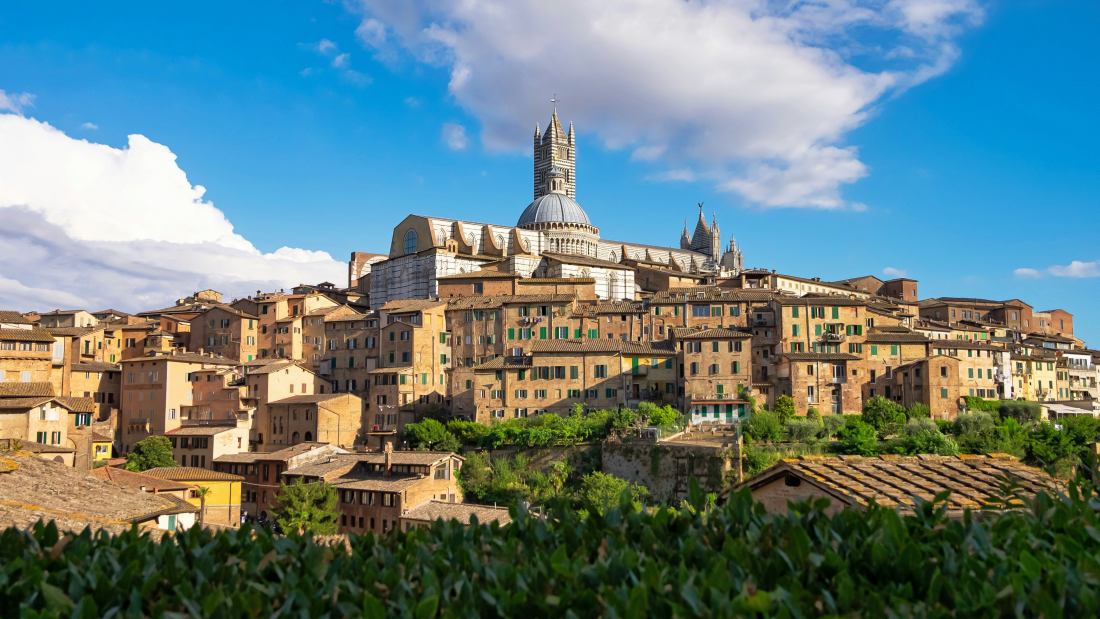
Siena is an Italian city nestled in the heart of the Tuscan hills that has preserved its medieval atmosphere to this day, and whose historic city centre has been declared a UNESCO World Heritage Site.
One of the most outstanding cities of the Tuscany region, it lies just 70 kilometres south of Florence. During the Middle Ages, Siena was one of the wealthiest and most influential city-states in Europe: thanks to its flourishing banking system and trade, it became an important stronghold of Renaissance culture. A living tradition here is the Palio, one of the world’s most famous horse races, held every year in the main square.
Table of Contents
Siena attractions
Piazza del Campo
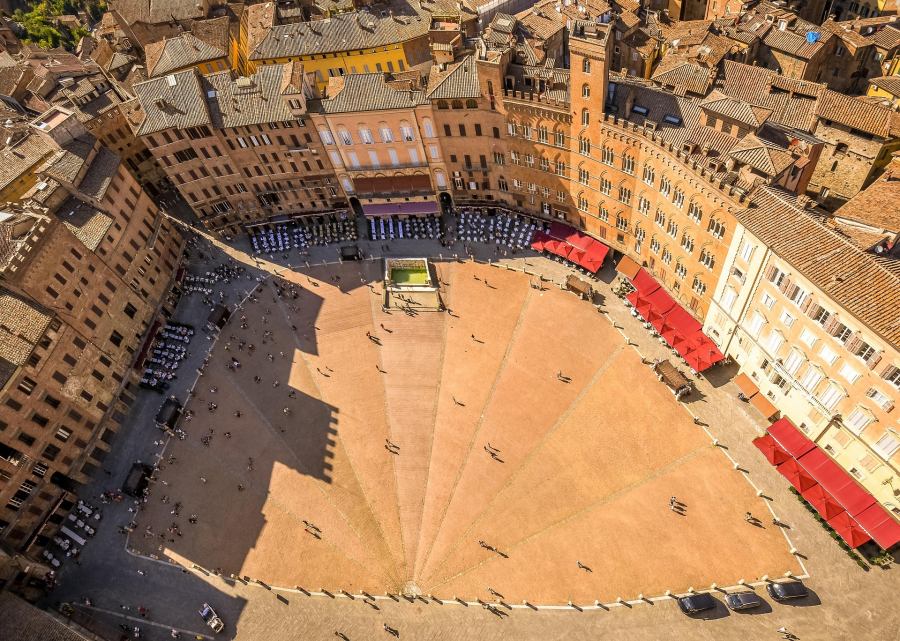
One of the most beautiful and unique main squares in Europe stands out from among the medieval squares with its shell-like form and impressive proportions. The square has been the heart of Sienese public life since the 13th century, where the Palio horse race is held.
The square’s surface, divided into nine sections and paved with pale red brick, refers to the Council of the Nine (Nove) that once ruled the city. Among the main buildings, the 14th-century Palazzo Pubblico and the Torre del Mangia tower rising beside it form the most spectacular ensemble in the square. Climbing the 400 steps to the top of the tower is quite a feat, but the panorama from the summit offers an unforgettable view.
Numerous café and restaurant terraces await visitors around the square. In summer, the Palio races (2 July and 16 August) are watched by huge crowds; at these times the entire square transforms into a natural arena where the competing horses gallop past spectators within arm’s reach.
Siena Cathedral (Duomo di Siena)
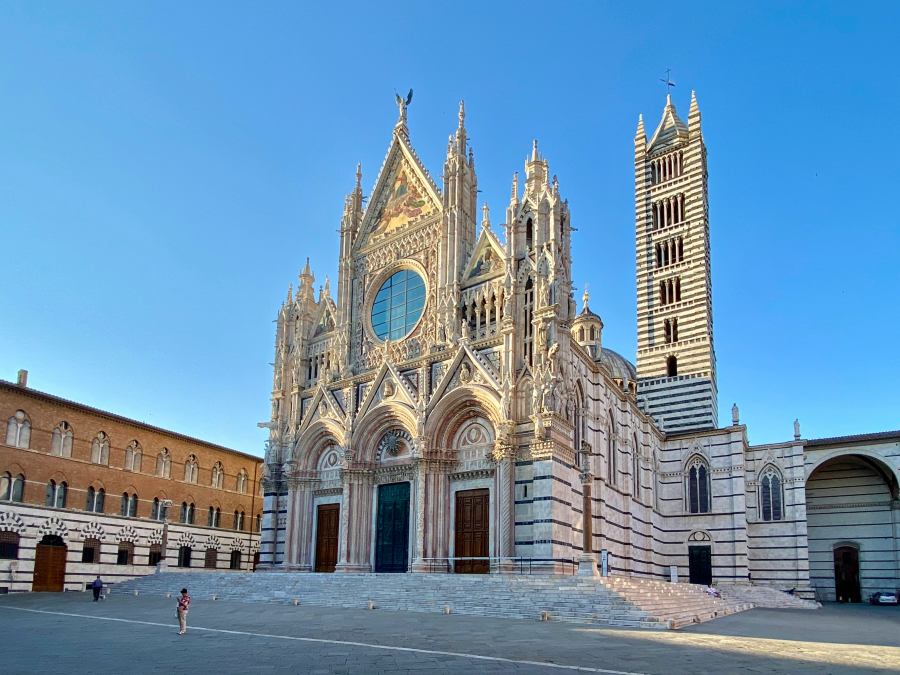
Regarded as the city’s foremost symbol and one of Italy’s most breathtaking Gothic cathedrals. Construction began in the 12th century and continued for more than two hundred years; its facade features alternating stripes of white, green and pink marble forming a beautiful contrast.
One of the most remarkable treasures of the interior is the extraordinary marble floor, on which 56 mosaic-like images tell scenes from antiquity and the Bible; some sections are covered with cloths at various periods to protect them from wear. In the nave stands Nicola Pisano’s renowned pulpit, and sculptures by Michelangelo and Donatello can also be found in the building.
The walls of the so-called Duomo Nuovo, the originally planned but never completed larger cathedral, are also visible, offering a glimpse into the ambitious medieval urban development plans. The 15th-century frescoes of the Piccolomini Library adjoining the cathedral are among the vibrant works of Pinturicchio.
Torre del Mangia
Rising 102 metres at the corner of the Piazza del Campo, this tower is one of Siena’s best-known symbols, whose name refers to the legendary bell-ringer, the eating-obsessed „Mangiaguadagni”. It was built between 1338 and 1348 and is one of the tallest brick towers in Italy.
The narrow internal staircase leading to the top of the tower is fairly steep and winding, but the effort is richly rewarded by the view from the summit: from here one can see the entire Piazza del Campo, the cathedral tower and the surrounding Tuscan hills alike. The view is especially spectacular at sunrise and sunset.
At the base of the tower stands the Cappella di Piazza chapel, built in 1348 in gratitude for the passing of the plague. Only a limited number of tourists may enter the tower each day, so it is worth arriving early or booking in advance.
Palazzo Pubblico
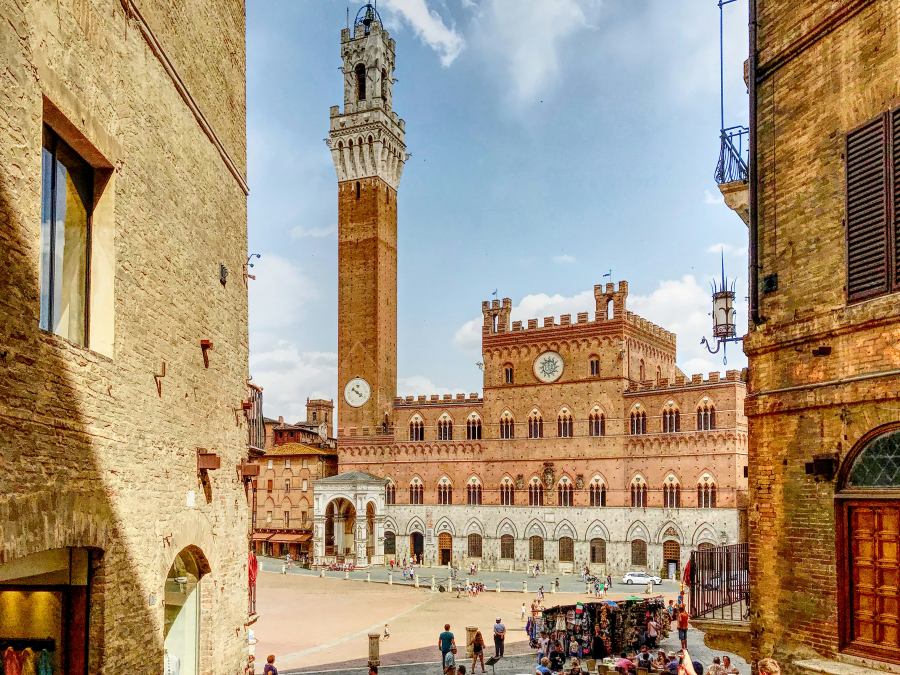
The medieval town hall dominating the south-eastern side of the Piazza del Campo is the foremost representation of Sienese civic power from the 13th and 14th centuries. Built in Gothic style and adorned with slender windows, it is one of the most perfectly preserved medieval town halls.
Its interior rooms can now be visited as a museum. The most important room is the Sala del Mappamondo, where Simone Martini’s vast Maestà fresco (1315) is displayed, one of the pinnacles of Sienese painting. Also on view here is the lively equestrian composition of Guidoriccio da Fogliano, likewise attributed to Martini.
In the Sala della Pace, Ambrogio Lorenzetti’s fresco cycle „Allegory of Good and Bad Government” (1338–1339) is one of the most important examples of secular medieval painting, depicting scenes of ideal urban life. A splendid view over the main square also opens from the terrace of the palace.
Fortezza Medicea
The Renaissance fortress rising on a natural hill at the western edge of the city is one of the most painful memories of Siena’s history: it was built by Cosimo de’ Medici, Duke of Florence, in 1560, after his forces suppressed the Sienese Republic and the city permanently lost its independence. The castle’s unambiguous purpose was the military demonstration of Florentine dominance over the defeated citizens.
The fortress, with its regular rectangular plan and four corner towers, has survived in an almost completely intact state to this day, placing it among the best-preserved 16th-century fortifications in central Italy. The massive brick walls and wide bastions retain their original form, enclosing an inner courtyard where a pleasant park of green lawns and cypress trees has been created.
For visitors, the fortress offers a dual attraction. On the one hand, the designated walkway along the top of the walls provides a unique panorama over Siena and the Tuscan landscape – this is one of the best free viewpoints in the city. On the other hand, the Enoteca Italiana, Italy’s national wine library, is housed within the fortress’s interior spaces, where wines from all of Italy’s wine regions can be tasted and purchased.
Battistero di San Giovanni
Hidden behind the Siena Cathedral, a few flights of steps lower down, lies the city’s baptistery, whose Gothic marble facade dates from the early 15th century. It receives fewer visitors than the cathedral, but in terms of its interior treasures it is a genuine treat for lovers of medieval and Renaissance art.
Its most famous sight is the hexagonal marble font, whose bronze relief panels were made by Jacopo della Quercia, Lorenzo Ghiberti and Donatello in the first half of the 15th century. These works clearly illustrate the development of early Renaissance sculpture; Donatello’s panel of the „Dance of Salome” stands out in particular for its dynamic depiction.
Due to the lower visitor numbers in the interior, the works of art can be admired here in much greater tranquillity than in the cathedral.
Basilica di San Domenico
The Dominican basilica standing on a height that dominates the city, with its brownish brick facade, is an imposing Gothic church complex built from the mid-13th century. It is a pilgrimage site closely connected to the life of Saint Catherine of Siena, considered one of the city’s patron saints.
The church preserves the relics of Saint Catherine, including her head, which is displayed in an ornate tabernacle in the Cappella di Santa Caterina. The walls of the chapel were painted by Il Sodoma in the early 1520s, and the paintings depict the saint’s ecstasies and fainting fits with vivid dynamism.
From the basilica’s long nave and the path running alongside it, a wonderful view opens over the city of Siena and the more distant Tuscan hills. The small park around the building provides a peaceful resting place for visitors amid the excitements of sightseeing.
Oratorio di San Bernardino
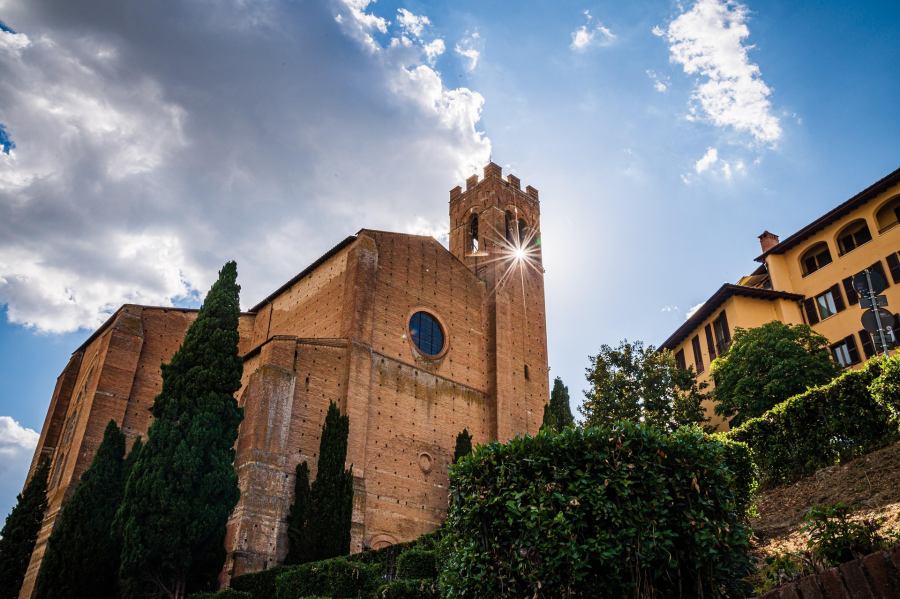
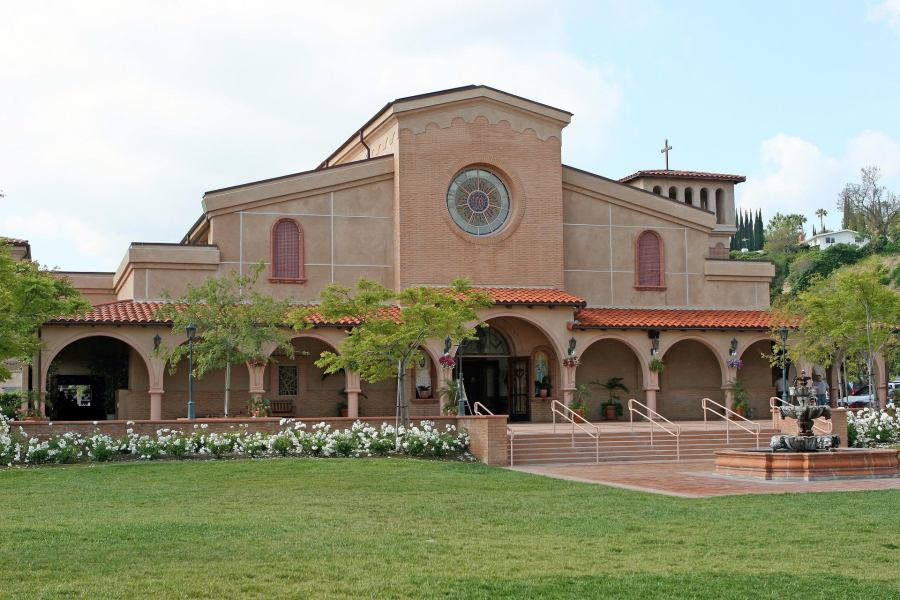
Located next to the Piazza San Francesco, it consists of two chapels placed one above the other, built in memory of Saint Bernardino of Siena, considered a native son of the city, during the 15th and 16th centuries. Few tourists know of it, yet it conceals exceptionally valuable Renaissance interiors.
The walls and ceiling of the upper oratory are decorated with frescoes by Sodoma, Girolamo del Pacchia and Domenico Beccafumi, painted from the 1490s onwards; the works depicting scenes from the life of Mary are extraordinarily finely executed. The subtle grisaille (grey-toned) decoration creates a particularly refined effect.
Fonte Gaia
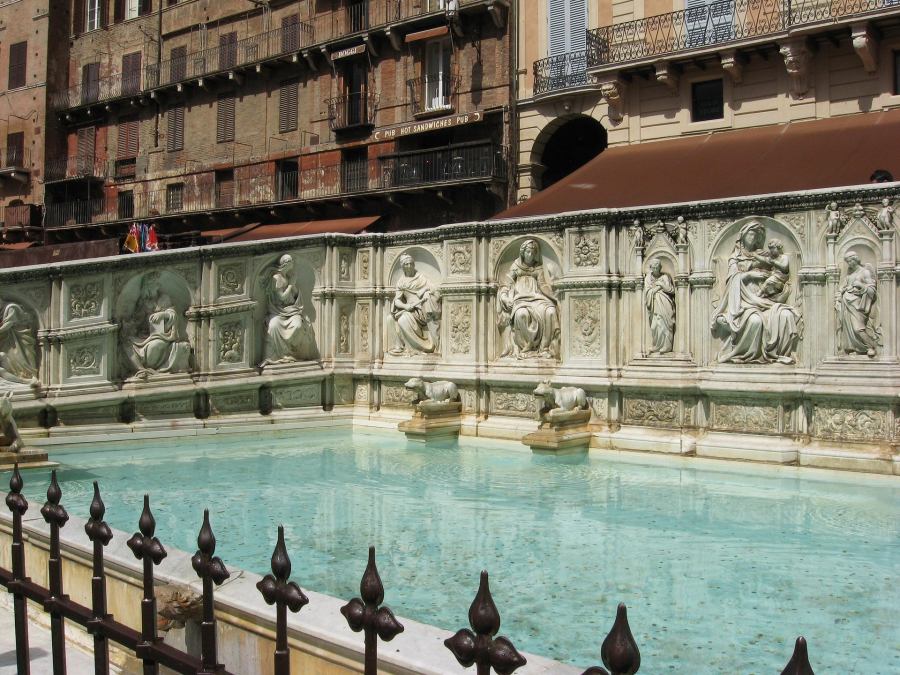
The elegant marble fountain placed on the northern side of the Piazza del Campo bears the name „joyful fountain”. In the early 14th century, when the aqueduct was completed, the citizens of Siena reacted with jubilation, since water scarcity had previously caused serious problems in the city.
The fountain visible today is a 19th-century copy of Jacopo della Quercia’s work completed in 1419. Decorated with figures of angels, virtues and the Virgin Mary, the fountain is a living element of the Sienese public square, still regarded as a favourite meeting place for locals and tourists alike.
Most of the original fresco panels have been damaged by the ravages of time; the authentic fragments can be viewed in the Palazzo Pubblico museum.
Contrade
Siena is unique in its kind: the city is divided into 17 historic contrade (city districts), each with its own symbol, flag, church and museum. This system dates back at least to the 13th century and still provides a living community framework for Sienese life.
The pride and rivalry of the contrade reaches its peak in the Palio horse race, where the riders of the districts compete against each other with almost wild passion. Each district operates its own „museo della contrada” museum, where centuries-old flags, prizes and documents from the history of the Palio can be viewed.
Via di Città
One of the city’s most beautiful shopping and promenading streets conceals numerous local craft shops behind its medieval palace facades. In keeping with Sienese traditions, gastronomic specialities, ceramics, gold and silver jewellery and local textiles are offered here.
While strolling along the streets, notice the characteristic black-and-white striped paving that defines the entire cityscape of Siena and is a symbol of local pride. The „balzana” pattern, recurring on paint, marble and stone alike, is linked to the city’s legend, which traces its founding to Romulus and Remus, the twin brothers who fled from Alba Longa.
Orto Botanico dell’Università di Siena
Founded in 1784, the botanical garden is a scientific institution of the University of Siena, spread out on the steep terraced slope near the city wall. It is home to more than 2,500 plant species, including rare Mediterranean, mountain and tropical plants.
The garden’s distinctive feature is its terraced design, which allowed the creation of different microclimatic zones. Walking along the paths lined with cypress trees, olive trees and bay laurels, one almost forgets that one is just a few steps away from the bustling main squares of the tourist circuit.
The relatively little-visited garden is a peaceful retreat where locals and more discerning tourists escape the city’s hustle and bustle. In spring the flowering shrubs and herb beds are particularly beautiful; exotic plants can also be admired in the small greenhouse.
Best museums in Siena
Museo dell’Opera del Duomo
The museum established within the unfinished walls of the cathedral’s Nuovo wing houses the collection of the Opera della Metropolitana, founded in 1339, which includes works related to the construction and decoration of the cathedral. The building itself was created within the remnant walls of the unrealised larger cathedral.
The greatest treasure of the collection is Duccio di Buoninsegna’s vast Maestà altarpiece, painted between 1308 and 1311, which once stood on the high altar of the cathedral. This double-sided panel painting on a gold background is the pinnacle of Sienese Trecento painting, still impressive today with its dimensions and refinement. Also displayed here is the group of sculptures carved by Giovanni Pisano from the cathedral facade.
The panorama from the museum’s roof terrace is one of the best views over Siena: from here the Piazza del Campo, the cathedral dome and the Torre del Mangia rise at almost the same height, while the Tuscan landscape stretches out in the background.
Santa Maria della Scala
One of Siena’s most significant cultural institutions is housed in the former pilgrim hospital complex opposite the cathedral, whose origins date back to the 9th century. In the Middle Ages it was one of the most important hospitals and shelters in Europe for pilgrims arriving from Santiago de Compostela.
The main jewel of the extensive building complex is the Pellegrinaio hall, whose walls are covered with frescoes by Domenico di Bartolo from the 1440s: these depict the everyday and religious scenes of hospital life with unusual realism and vividness, with an almost modern sensibility.
Deep within the complex, the Etruscan tunnel network running beneath ancient Siena can also be visited; part of it functioned as hospital storage and later as guild workshops over the centuries. In addition to permanent and temporary exhibitions, the museum also offers children’s programmes.
Pinacoteca Nazionale
Siena’s state picture gallery is housed in the 13th-century Palazzo Buonsignori and presents the entire developmental history of Sienese painting, from the gold-ground Byzantine Trecento pictures to the 16th-century Mannerist works.
The backbone of the collection consists of works by Duccio di Buoninsegna, Simone Martini, the Lorenzetti brothers (Pietro and Ambrogio), and then Sassetta and Sano di Pietro. The gilded, meticulously detailed Sienese Gothic painting, with its distinctive aesthetic, differs from Florentine Renaissance painting and represents an independent, extraordinarily valuable strand of Italian fine art.
A visit to the gallery is especially recommended for those who, after the frescoes of the Duomo and the Palazzo Pubblico, wish to become more deeply acquainted with the defining masters and stylistic features of Sienese painting.
Siena weather: when is the best time to visit?
Siena lies on the boundary between Mediterranean and continental climates, in the middle of the Tuscan hill country, and so has a four-season climate: hot and dry in summer, cooler and rainier in winter. Due to its altitude (approx. 320 m above sea level) it is somewhat cooler than coastal Tuscany.
Spring (March–May):
Spring warms up gradually; at the end of March and in April the average temperature is around 12–18°C. Rainfall is moderate, the landscape turns green, and the wheat and blossoming orchards on the surrounding hills provide a picturesque view. This season is ideal for sightseeing, as the crowds have not yet reached the summer peak.
Summer (June–August):
Siena’s summer is hot and fairly dry; in July and August temperatures regularly exceed 30–35°C. The Palio horse race is held on 2 July and 16 August, and on these days the city is extremely crowded. Despite the July and August heat, the evening hours are more pleasant, and a refreshing breeze occasionally blows among the hills.
Autumn (September–November):
Autumn is the most atmospheric season in Siena: temperatures moderate pleasantly (15–22°C), traffic decreases, and the grape harvest season, along with mushroom and truffle gathering, brings special gastronomic events. From the end of October, rainfall increases, and morning mist lends a romantic, eerie atmosphere to the medieval city.
Winter (December–February):
Siena’s winter is cool and wet; the average temperature ranges between 3–9°C, and snow is rare but possible. During the Christmas period, the city’s charming decorations and quieter streets create a special atmosphere; the number of tourists is considerably smaller, allowing museums and churches to be visited without the usual disturbance.
Best time to visit:
The best time to visit Siena is spring (April–May) and early autumn (September–October). At these times the weather is pleasant, rainfall is moderate, and the city is not overcrowded compared to the summer tourist peak. If the visitor also wishes to experience the atmosphere of the Palio horse race, it is worth arriving around early July or mid-August, but one should expect large crowds and the hot summer heat.