
Delhi is a blend of ancient Mughal architecture and modernity, where every element of India can be experienced. The following questions and answers will help you navigate the most important information, whether it concerns safety, transportation, or the best time to visit.
Table of Contents
Basic information
Why is it worth travelling to Delhi?
Delhi is one of Asia’s most exciting metropolises, where millennia of history, breathtaking monuments and a vibrant street life await travellers. The ancient Mughal past and modern India exist side by side in this city.
One of Delhi’s greatest attractions is the Red Fort (Lal Qila) and the Jama Masjid mosque, both UNESCO World Heritage Sites. The Qutb Minar, India’s tallest minaret, is also a must-see. The fragrance of spices drifts through the narrow lanes of Old Delhi’s Chandni Chowk bazaar.
The gastronomy is equally impressive: Delhi’s cuisine offers one of India’s richest food cultures, from spicy curries to legendary street food – such as chaat and paratha – to world-famous Mughlai dishes.
What time zone is Delhi in?
Delhi is in the Indian Standard Time zone (IST, UTC+5:30). India does not observe daylight saving time.
When is the best time to visit Delhi?
The cool season between October and March is considered the best period to visit Delhi. The weather is pleasant and conditions are ideal for exploring the city.
The cool season between October and March is the most favourable for travel. Daytime temperatures are generally around 15–25°C, and nights can be cool, especially in December and January. This period is ideal for sightseeing and excursions.
During the summer months (April–June), temperatures can rise above 40–45°C, making city visits extremely exhausting. The monsoon season (July–September) brings heavy rains and very high humidity.
One of Delhi’s special occasions is the Diwali festival, held in October–November. During the Festival of Lights, the entire city is illuminated with fireworks and cultural programmes.
How many days should you spend in Delhi?
Generally at least 3–4 days are recommended to explore Delhi, in order to visit the main attractions and also experience the street life.
In 3 days, the most important sights can typically be covered: the Red Fort, Jama Masjid, Chandni Chowk bazaar, Qutb Minar, India Gate and Humayun’s Tomb. The contrast between Old Delhi and New Delhi is also worth exploring.
With a 4–5 day stay, you can explore the city at a more leisurely pace. The national museums, the Akshardham temple, local markets, and even a day trip to Agra – where the Taj Mahal is located, just 2–3 hours from Delhi – can all be included.
What is the official currency in Delhi?
The official currency of Delhi is the Indian Rupee (INR), which is used throughout the country.
In Delhi, payments are almost always made in rupees. Larger hotels, shopping centres and restaurants generally accept bank cards as well, but cash will be needed at street food stalls, bazaars and smaller shops. ATMs are widely available throughout the city.
Here is a currency converter where you can check the current exchange rate!
Do people speak English in Delhi?
Yes, English is generally spoken well in the tourist areas of Delhi and in the business sector. English is one of India’s official languages, so you can typically communicate in English at hotels, restaurants and museums.
At local markets, small shops in the old city, and street food stalls, you may find that staff only speak basic English.
What type of plug is used in Delhi?
India primarily uses Type C, D and M plugs. European plugs generally do not fit into these, so a travel adapter will be needed.
The mains voltage in India is 230 Volts and the frequency is 50 Hz – the same as in Europe so modern electronic devices (chargers, laptops) are generally compatible in terms of voltage; only the shape of the socket differs.
How does the internet and SIM card usage work in Delhi?
Delhi generally has good internet connectivity, and Wi-Fi is available in most hotels and cafés. If you need continuous mobile internet, it is worth purchasing a local SIM card, although registration requires a passport.
Airtel, Jio and Vi (Vodafone Idea) are the most popular mobile operators. SIM cards can be purchased at the airport and in numerous phone shops; a passport and a photo are required for registration. Activation usually takes a few hours. An increasing number of travellers choose an eSIM, which can be purchased and activated online before travelling.
Is tipping customary in Delhi?
In India, the tipping culture is not as strong as in the United States, for example, but in tourist environments, restaurants and hotels it is increasingly expected, especially from foreign guests.
In restaurants, if there is no service charge on the bill, a tip of around 10% of the total is appropriate. Smaller amounts are suitable for taxi drivers and hotel porters. Tipping is not customary at street food stalls and markets. Some restaurants may already include a service charge on the bill, so it is worth checking before paying.
Travel and transportation
How do I get from the airport to the centre of Delhi?
Delhi’s international airport is Indira Gandhi International Airport (DEL), located approximately 15–20 kilometres from the city centre. The city centre can be reached by several means of transport.
The Delhi Metro Airport Express Line is the fastest and most convenient option. It connects Terminal 3 of the airport with New Delhi Railway Station in just 20 minutes. The metro is one of the most reliable and cheapest ways to reach the city centre.
Pre-paid taxis with official licences are available at the airport, which take travellers to the city at a fixed price. The Uber and Ola ride-sharing apps also work well in Delhi and can be used from the airport.
What is the most convenient mode of transport in Delhi?
Delhi’s transport system is extremely extensive. For tourists, the metro, Uber/Ola, rickshaws and taxis are the most common options.
The Delhi Metro is one of the most modern, fastest and safest modes of transport in the city. The network runs on 9 lines and reaches virtually all major tourist areas. Air-conditioned carriages, clean stations and clearly marked stops make travelling particularly convenient.
The rickshaw (tuk-tuk) is the traditional Delhi mode of transport, ideal for shorter distances. It is advisable to negotiate the price before setting off, or insist on using the meter. The Uber and Ola apps allow you to order taxi or rickshaw services at a pre-determined price.
In the city, it is worth obtaining a Delhi Metro card, which provides unlimited travel on the metro for 1 or 3 days and greatly simplifies ticket purchasing.
Accommodation and safety
Is Delhi a safe city?
Delhi is a huge metropolis, so the assessment of safety depends greatly on which part of the city you are staying in and how careful you are. Most neighbourhoods visited by tourists are generally safe during the day, but increased caution is advised.
Which areas are considered safe?
The most commonly chosen areas by visitors include:
- Connaught Place – New Delhi’s elegant business and commercial district
- Karol Bagh – a popular shopping and accommodation district
- Hauz Khas Village – a youthful, atmospheric neighbourhood with restaurants and galleries
- Paharganj – the classic base for backpackers near New Delhi Railway Station
These areas generally have high tourist traffic and a strong police presence.
How safe is it at night?
In the neighbourhoods visited by tourists there are many restaurants and cafés open in the evenings, so street life is generally lively. Nevertheless – especially for women – it is advisable to stay on well-lit streets, and if you need to travel further, it is better to use a taxi or ride-sharing service ordered through an app.
Which area is the best to stay in Delhi?
Delhi’s most popular accommodation districts include Connaught Place, Karol Bagh, Hauz Khas, Paharganj and the Diplomatic Enclave area. These districts are well-situated, with many attractions, restaurants and cafés nearby.
Connaught Place is located in the heart of New Delhi, where numerous hotels, restaurants and shopping options can be found. It has excellent metro connections and is close to most of the major sights.
Karol Bagh is one of the most popular commercial districts, with mid-range and upper-mid-range hotels and markets. It has good metro connections.
Hauz Khas Village is a modern, cosmopolitan neighbourhood known for its restaurants, galleries and the medieval Hauz Khas complex. It is particularly recommended for younger, trend-conscious travellers.
Paharganj is the classic base for backpackers near New Delhi Railway Station. It is characterised by cheap accommodation, small restaurants and lively street life, though it can be crowded and noisy.
Health information
Are compulsory vaccinations required to travel to Delhi?
There are generally no compulsory vaccinations for travellers visiting Delhi. However, certain vaccinations are strongly recommended before travel.
Recommended vaccinations include Hepatitis A and B, typhoid, and the tetanus-diphtheria-pertussis (Tdap) vaccine.
Is tap water drinkable in Delhi?
Drinking tap water in Delhi is not recommended. Most locals also drink bottled or filtered water.
Tap water purification is not always adequate, and contaminants can enter the water through old pipe networks, which can cause stomach problems and diarrhoea for travellers. Always drink bottled water, be mindful of ice cubes (check that they are made from mineral water), and it is also advisable to use bottled water for brushing teeth if you have a sensitive stomach.
Experiences
What are the must-see attractions in Delhi?
Delhi’s most famous attractions include the Red Fort (Lal Qila), the Jama Masjid mosque, the Qutb Minar, Humayun’s Tomb, India Gate and the Chandni Chowk bazaar. These places well illustrate the city’s rich Mughal and British colonial history.
The Red Fort (Lal Qila) is a symbol of the 17th-century Mughal Empire and a UNESCO World Heritage Site. Behind its red sandstone walls lie palaces, a mosque and gardens. It served as the residence of the Mughal emperors for nearly 200 years.
The Jama Masjid is India’s largest mosque, built by the Mughal Emperor Shah Jahan in the 17th century. Its main courtyard can accommodate tens of thousands of worshippers at once. Climbing the minarets offers a breathtaking view over Old Delhi.
The Qutb Minar is a 73-metre-high, 12th-century minaret, India’s tallest stone tower and a UNESCO World Heritage Site. Several other medieval ruins can also be found within the complex.
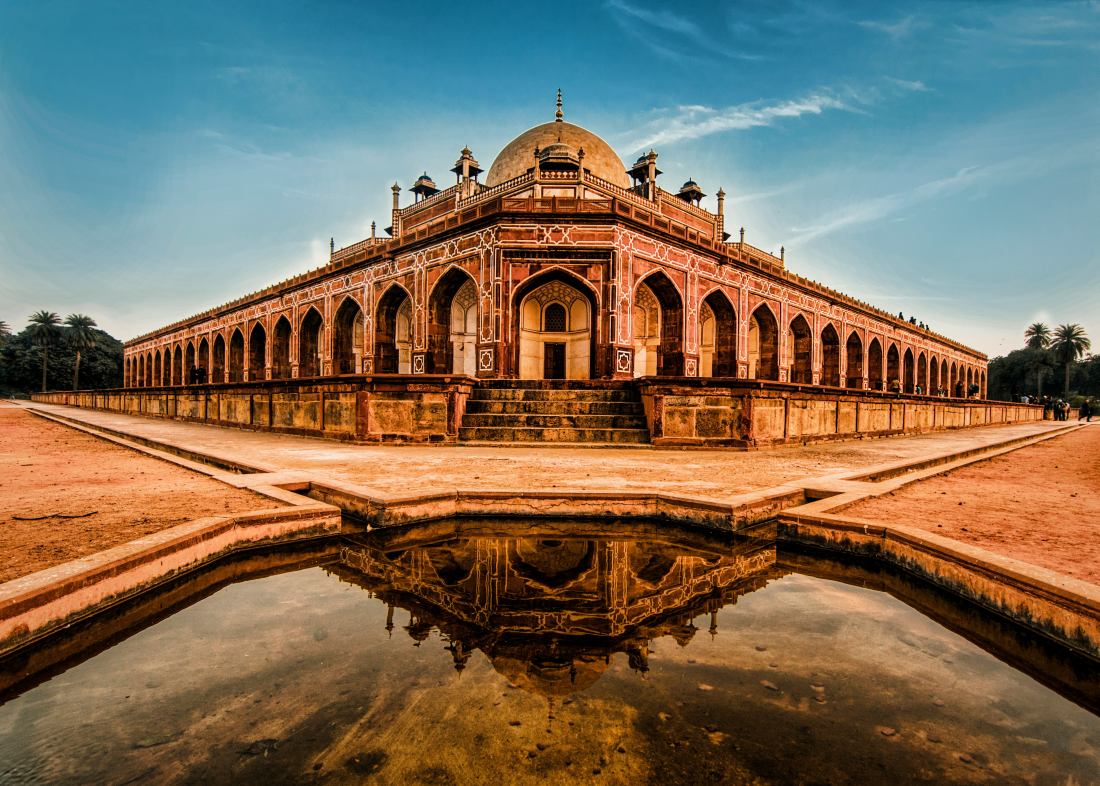
The Humayun’s Tomb is one of the finest examples of 16th-century Mughal architecture and is considered the precursor to the Taj Mahal. The symmetrical domed mausoleum rising from the centre of a manicured garden is also a UNESCO site.
The India Gate is a 42-metre-high triumphal arch built in memory of Indian soldiers who fell in the First World War. The surrounding park is one of Delhi’s most popular public spaces, especially in the evenings.
What are the most popular foods and drinks in Delhi?
Delhi is world-famous for its Mughlai cuisine and street food. The most well-known local dishes include butter chicken, biryani, paratha, chaat and pani puri, while the most popular drinks include lassi, chai and nimbu pani.
Murgh makhani is perhaps Delhi’s most famous dish: tender chicken simmered in a spiced tomato sauce with a creamy, aromatic flavour. Dal makhani (black lentils cooked in butter) is also an iconic dish.
Biryani is a spiced one-pot dish made with basmati rice, served with chicken, lamb or vegetables. In Delhi, the Delhi-style biryani has a milder spice level but is extremely aromatic.
Chaat is the queen of Indian street food: a snack assembled from various fried, cooked and fresh ingredients, drizzled with spicy, sweet and sour sauces. It is available at every corner in Delhi.
Among drinks, lassi (a refreshing yoghurt-based drink), masala chai (spiced milky tea) and nimbu pani (lemonade) are the most popular. In summer, fresh sugarcane juice is also a must-try.
What are the important festivals and celebrations in Delhi?
Throughout the year, numerous important festivals and celebrations are held in Delhi. The most well-known include Diwali, Holi, Eid, Republic Day and Independence Day.
Diwali (Festival of Lights) takes place in October–November. At this time, the entire city lights up with oil lamps, candles and fireworks. The bazaars are at their busiest during this period, and gift-giving is a traditional custom.
Holi (Festival of Colours) is celebrated in February–March. People spray each other with water and coloured powder, and the streets turn into a vibrant kaleidoscope of colour within a single day. Tourists can also participate, though it is advisable to protect more valuable clothing.
Republic Day (26 January) is a special event in Delhi: a grand military parade is held in front of India Gate, attended by the Indian Army, Air Force and Navy.