
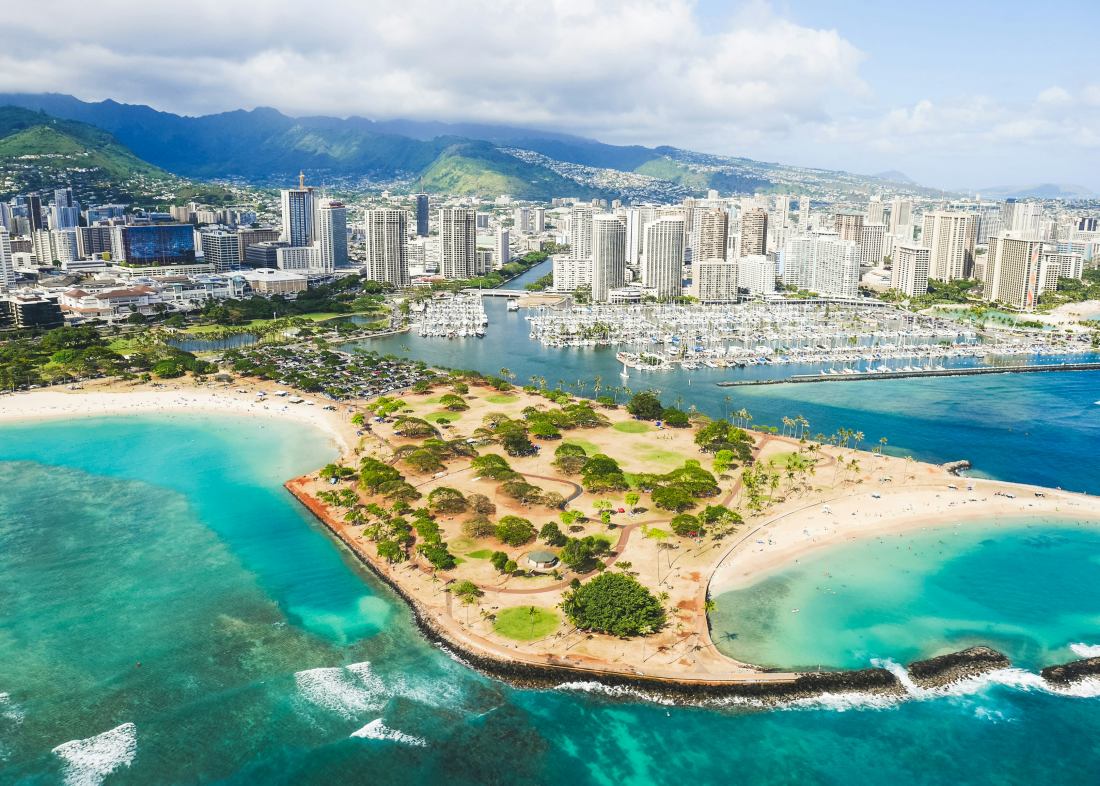
Honolulu, the capital of Hawaii, is one of the most attractive destinations in the world: it boasts volcanic mountains, turquoise seas, and a rich Polynesian heritage.
The city is located on the southern shore of Oahu island, which belongs to the USA, and uniquely combines a relaxed island atmosphere with modern metropolitan life. Honolulu appeals to travelers interested in history, nature, and gastronomy alike: here on the shores of the Pacific Ocean, elements of Asian, American, and Polynesian culture converge.
Table of Contents
Honolulu attractions
Waikiki Beach
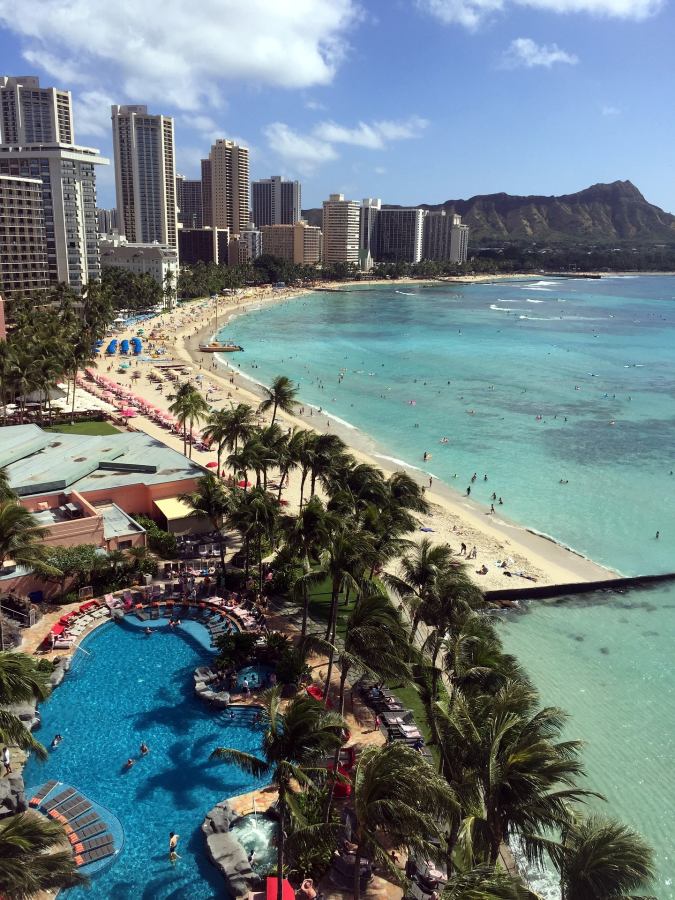
Honolulu’s iconic beach has been one of the most famous seaside resorts in the Pacific since the early 1900s. The two-kilometer-long white sandy beach stretches at the foot of the Diamond Head volcanic crater and now welcomes approximately 5–6 million visitors per year.
Its gradually deepening shallow water is ideal for beginner surfers, but it offers the full range of water sports: stand-up paddleboarding, snorkeling, kayaking, and catamaran tours are all available. The world’s very first surf schools were founded here in the early 20th century, making Waikiki the cradle of modern surf culture.
The promenade surrounding the beach, Kalakaua Avenue, is lined with restaurants, bars, and luxury hotels, and enchants visitors in the evening with live music and hula performances.
Diamond Head State Monument
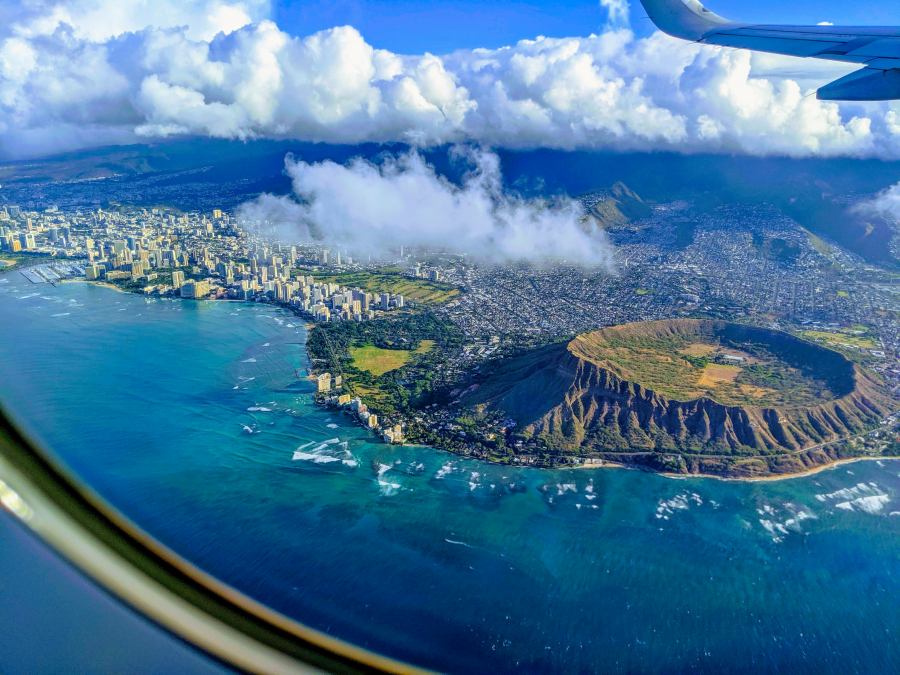
One of Hawaii’s most recognizable natural symbols is this 232-meter extinct volcanic crater, which native Hawaiians named Ka Leahi (the brow of the tuna). The distinctively shaped mountain was named Diamond Head by British sailors in the early 1800s after they found calcite crystals on its slopes, which they mistakenly believed to be diamonds.
The trail leading to the crater rim is 1.6 kilometers long, with approximately 560 meters of elevation gain. Along the way, the hiker passes through military tunnels and old staircases, as a military observation post was established on the summit in the early 1900s, the remains of which are still visible today.
From the summit, a breathtaking 360-degree panorama opens up: from Waikiki beach to the blue Pacific Ocean and the entire southern Oahu plain. It is best to start the hike in the morning, although the view at sunset is equally stunning.
Pearl Harbor National Memorial
One of history’s most memorable sites, where on December 7, 1941, the Japanese Air Force attacked the Americans’ Pacific fleet base, directly triggering the United States’ entry into World War II. The memorial features four different visitor centers presenting the events.
The most iconic site is the USS Arizona Memorial, a white bridge-shaped structure built over the wreck of the attacked battleship. On the battleship, 1,177 sailors lost their lives, the majority of whom still rest beneath the ship’s remains.
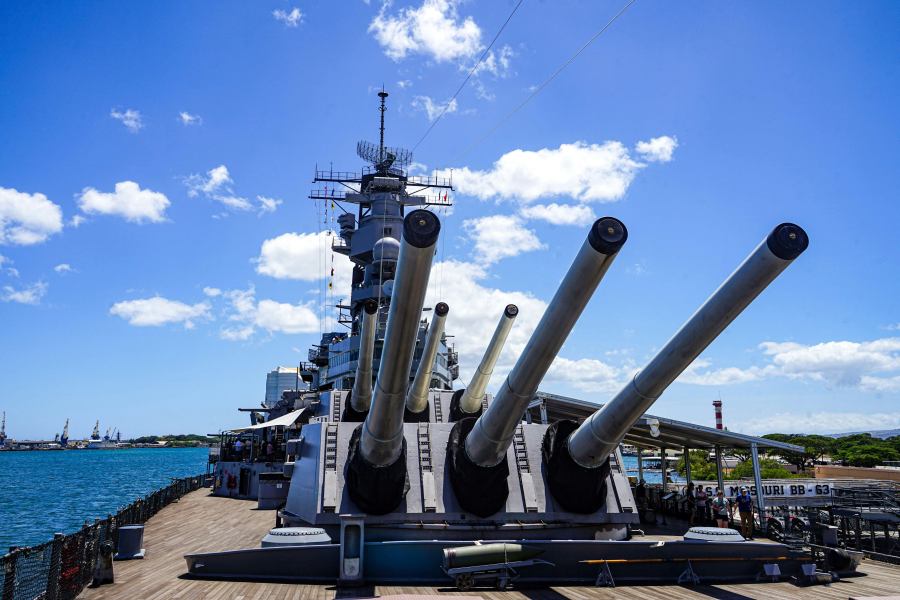
On the USS Missouri battleship, also open to visitors, Japan’s unconditional surrender was signed in 1945. The entire Pearl Harbor complex can be explored both by land and by water, and advance online ticket purchase is strongly recommended to avoid long queues.
Iolani Palace
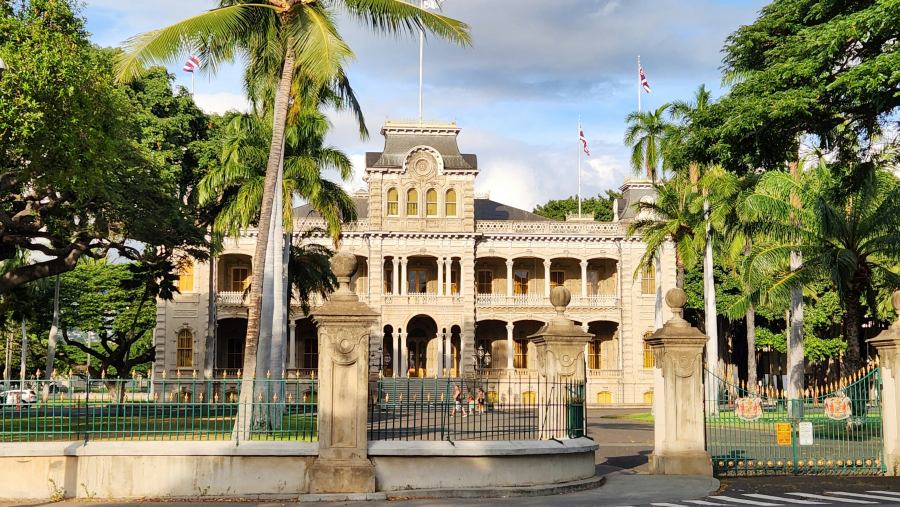
The only royal palace in the entire United States, built in 1882 on the commission of King Kalakaua. The building was constructed in a unique style known as American Florentine, which combines elements of Tuscan Renaissance and the Victorian era with Hawaiian traditions.
The palace had electric lighting and a telephone as early as the 1880s – electricity was introduced to the White House at the same time, meaning Hawaii was ahead of the presidential residence of the United States. In the former throne room, dining room, and royal bedrooms, visitors can view the original 19th-century furnishings and crown jewels.
In 1895, Queen Liliuokalani was held captive here after US forces overthrew the Kingdom of Hawaii. The palace is at once a symbol of Hawaiian cultural heritage and colonial history.
Chinatown Honolulu
A historic district in the downtown area, settled in the second half of the 19th century by Chinese workers who arrived to work on sugar plantations. The neighborhood burned down in 1886 and again in 1900, then was rebuilt and still retains its original character today.
The Maunakea Street flower market and Kekaulike Market offer fresh tropical fruits, tofu, leafy greens, and live shellfish; it is most lively around 6 in the morning. The streets are filled with the scent of fragrant frangipani, incense smoke, and the aromas of Asian kitchens.
In recent years the neighborhood has undergone significant renovation: galleries, cocktail bars, and fine dining restaurants have opened in the old buildings, making Chinatown today a favorite district of the local creative class and food tourists alike.
Punchbowl Crater
This extinct volcanic tuff cone is located on the edge of downtown Honolulu. It takes its English name from its characteristic bowl-like shape.
It was a sacred place for ancient Hawaiians, but today it is best known as the home of the National Memorial Cemetery of the Pacific. This dignified site is the final resting place of more than 50,000 veterans of the US armed forces, including heroes from World War II, the Korean War, and the Vietnam War.
From the crater rim, a breathtaking panorama opens over Honolulu and the nearby Diamond Head.
Cathedral Basilica of Our Lady of Peace
The oldest Catholic church in Hawaii and the center of the local diocese.
The building, consecrated in 1843, is one of the oldest continuously operating cathedrals in the United States. Located in downtown Honolulu, it holds special significance for the faithful as it is where Saint Damien, the Apostle to the Lepers, was ordained a priest in 1864.
The building’s simple, classicist style and walls built from coral limestone reflect the island’s unique architectural heritage. In 2014, Pope Francis elevated it to the rank of „minor basilica”.
Kapiolani Regional Park
Hawaii’s largest urban park was founded in 1877 by King Kalakaua and named in honor of his wife, Queen Kapiolani. The 170-hectare park stretches from Waikiki beach to the foot of Diamond Head.
The park is home to the Honolulu Zoo, whose tropical enclosures feature African elephants, lions, and Hawaiian wildlife birds. The Waikiki Shell outdoor amphitheater hosts all kinds of events, from Hawaii Symphony Orchestra summer concerts to rock concerts.
On weekends, picnickers and kite surfers create a pleasant atmosphere in the park. Around the Kapiolani Bandstand pavilion, free hula performances are held on Sunday mornings.
Ala Moana Beach Park
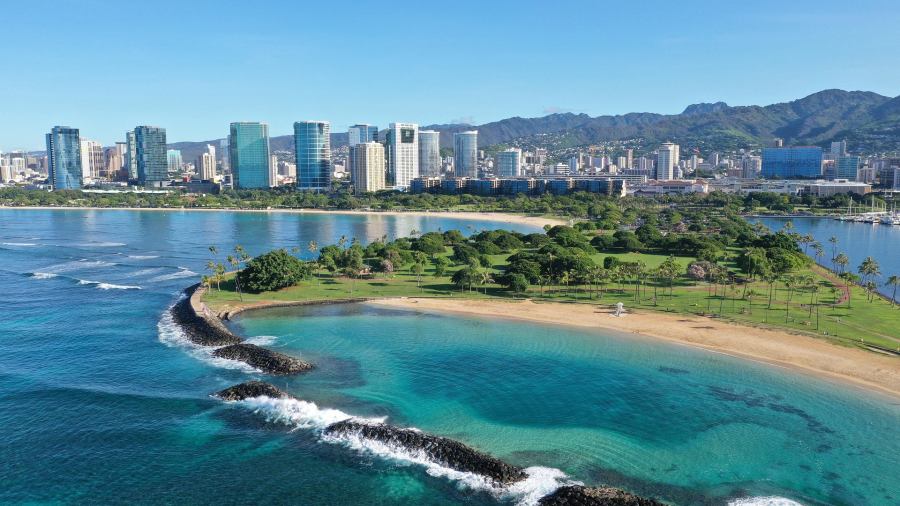
The park is an artificially reclaimed 50-hectare beachfront park, opened in the 1930s in an area adjacent to Waikiki. The sandy beach has shallow, current-free water, making it especially popular among local families.
A short walk from the beach stands Ala Moana Center, one of the largest shopping centers in the USA on Oahu, where more than 350 shops and restaurants await visitors.
Lyon Arboretum
This 194-hectare botanical garden, founded in 1918 in the upper Manoa Valley, now belongs to the University of Hawaiʻi and collects nearly 5,000 species of tropical plants. The garden’s primary purpose was initially to restore watershed forest in previously destroyed areas.
The collection includes representatives of all native Hawaiian plant species, themed gardens (bamboo grove, ginger garden, bromeliad collection), and rare palm species. Walking along the trails, the sounds of the rainforest – birdsong, wind, dripping water – completely detach you from the urban world.
The Lyon Arboretum is an ideal starting point for the Manoa Falls hike; the garden itself can also be visited free of charge, though a small parking fee is charged. Open Monday through Saturday, closed on Sundays.
Manoa Falls Trail
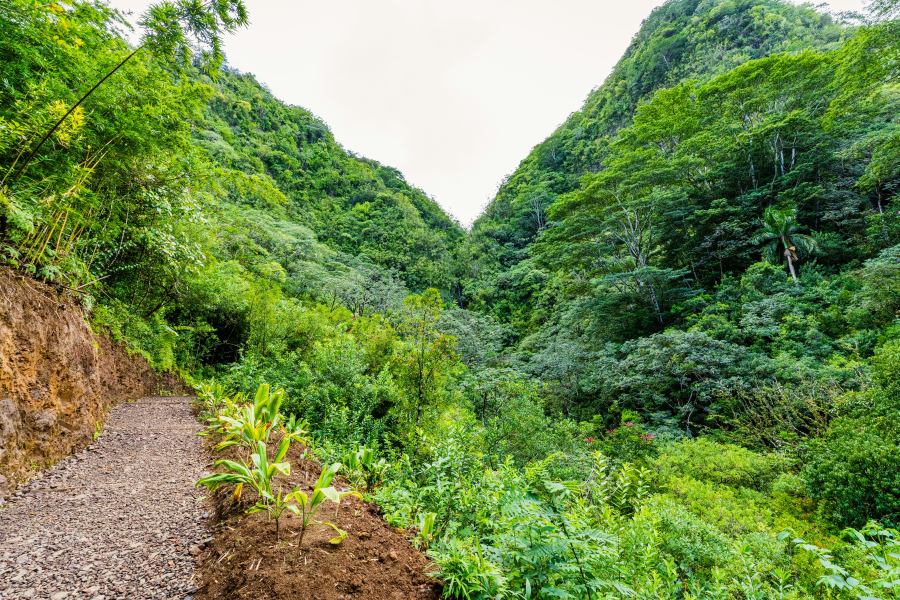
Just 8 kilometers from Honolulu, this easy 2.5-kilometer trail leads through the jungle-like rainforest of Manoa Valley. At the end of the hike, a 24-meter waterfall awaits visitors, at the base of which a small pool has formed.
The trail passes through bamboo forests, giant ginger plantations, and frangipani groves; after rain, the vegetation is especially beautiful and the waterfall is particularly atmospheric. The valley’s climate is considerably wetter than the coastal areas, so bringing a rain jacket is strongly recommended.
Nearby is the Lyon Arboretum, the botanical garden of the University of Hawaiʻi. The hike and a visit to the arboretum together fill an entire morning.
Nu’uanu Pali Lookout
From this lookout point situated on a 360-meter cliff edge, an unparalleled panorama opens toward the entirely wind-exposed Windward Coast, across the emerald-green Ko’olau Mountains. Due to the strong, constantly blowing wind, tourists wear capes and jackets even in summer.
In 1795, the defenders of Oahu were cornered at the base of the Pali cliff face and suffered defeat at the hands of King Kamehameha I’s army, with many plunging into the depths from the rock. This battle made possible the unification of the Hawaiian islands, making Nu’uanu Pali one of the pivotal sites in Hawaiian history.
Several trails are also accessible along the Pali Highway leading to the lookout, including the Old Pali Road, which winds along the former stone-paved section through the rainforest.
Best museums in Honolulu
Honolulu Museum of Art
One of the largest and most prestigious fine arts museums in the Pacific region, founded in 1927. The original building was constructed in Mediterranean style and has since been expanded with several modern wings, which have preserved the courtyard and garden layout.
The collection includes more than 50,000 works from Asia, Europe, Africa, and the Pacific Island world; it is particularly rich in Japanese painting and East Asian decorative arts. The museum also houses Diego Rivera’s frescoes and James Michener’s renowned Japanese woodblock print collection.
The museum goes beyond its galleries: the café opening onto the inner courtyard and the museum shop are also worth a visit, and the film and performance program offers several hundred cultural events each year.
All information can be found here!
Bishop Museum
Founded in 1889 by Charles Reed Bishop in memory of his wife, Princess Pauahi. Today it houses the world’s largest collection of Hawaiian and Polynesian natural and cultural heritage. The basalt Victorian building complex holds the Hawaiian kingdom’s coronation jewels, stone carvings, and more than 25 million natural history specimens.
The museum’s Hawaii Hall presents Hawaiian lifestyle, mythology, and society, while Polynesian Hall illustrates the cultural diversity of the entire Pacific Island world. A special attraction is the Science Adventure Center’s interactive exhibition, which explores the themes of volcanism and oceanology.
Planetarium shows, the museum garden’s tropical plants, and regular cultural demonstrations (such as traditional Hawaiian dance and crafts) enrich the visitor experience.
All information can be found here!
Hawaii State Art Museum
Operating in the heart of the capital within the Capitol District, this state art museum has been the most important exhibition venue for Hawaiian fine arts since 2002. The Spanish Mission-style building erected in 1928, the No. 1 Capitol District Building, was previously home to the Army YMCA.
The collection contains approximately 5,000 works exclusively by Hawaiian or Hawaii-connected contemporary and modern artists; paintings, sculptures, ceramics, and textile works are all represented. Admission is free, and the annually changing temporary exhibitions always offer something new to discover.
All information can be found here!
Honolulu weather: when is the best time to visit?
Honolulu has a tropical oceanic climate with no marked seasonal changes: the average annual temperature hovers around 26–27 degrees Celsius. The two main seasons of the year are the summer dry season (May–September) and the winter rainy season (October–April), although the number of sunny days remains high even in winter.
Dry Season (May–September):
The hottest months last from July to September, when daytime high temperatures can reach 32–33 °C. The sky is mostly clear, the wind is gentler, and beach conditions are ideal for surfers and swimmers. Rain is rare, although brief tropical showers can occasionally occur.
Rainy Season (October–April):
Temperatures moderate to 23–27 °C, and rain is more frequent but rarely lasts long. Winter is the peak of whale watching season, when humpback whales heading toward Alaska’s southern waters can be spotted off the shores of Oahu. Tourist traffic is lower and hotel prices are more favorable.
Best time to visit to Honolulu:
The best time to visit Honolulu falls in the April–May and September–October months. During these periods, the weather is pleasant with temperatures around 25–28 °C, the beaches are less crowded, prices are more favorable compared to peak season, and you are between the end of the whale watching season (January–March) and before the rainy season begins. For those specifically planning whale watching, January–March is best, while those focused on surfing should note that large waves arrive from November to February on the northern shores (North Shore, Banzai Pipeline).