

Most people would probably say that Paris is the most beautiful sight in France, but after reading this article, many might change their opinion. France offers many great attractions beyond its capital!
France is the country with the 5th highest number of UNESCO World Heritage sites, making it a leading tourist destination. In every aspect, it is one of the world’s leading powers.
It is among the few countries that possess overseas territories, such as French Guiana in South America, as well as numerous islands in the Atlantic, Pacific, and Indian Oceans.
Table of Contents
Best places in France
French Riviera / Cote d’Azur
Let’s start with one of my favorites, the Riviera along the Mediterranean coast. The Cote d’Azur itself is worth a trip of several days.
The coastal stretch from the Italian border to Saint-Tropez is famous for its pleasant climate, charming towns, and glitter. Rows of luxury cars and houses can be found here.
One of its centers is the world’s second smallest country, Monaco. A residence for many celebrities and wealthy people, where the casino, the square in front of it, and the marina are popular tourist spots.
But the French Riviera is not just Monaco. Moving on, we find the center, Nice. The city, known for its flower carnival, has one of the most famous seaside promenades, the Promenade des Anglais.

Paris
Obviously, the capital, one of the world’s most visited cities, Paris, is on the list.
No need to write much about it, as everyone knows the most famous sights: the Eiffel Tower, Arc de Triomphe, Champs-Élysées, Louvre, Seine. And I could go on with the list.
I want to highlight the huge palace, Versailles. From the 17th and 18th centuries, kings of France ruled from here. It is also called the pinnacle of European castle architecture.

Bordeaux
As one of the homelands of red wine, wine lovers will feel right at home. I had the luck to spend two days in February 2020, one afternoon of which went to tasting red wines. 🙂
The Cité de Vin, a modern museum, is one of the notable sights related to wine. Besides, the charming city center and a row of Gothic and Baroque buildings make Bordeaux a very pleasant destination.

Castles of the Loire Valley
The Loire region is famous not only for its vineyards but also for its magnificent castles. More than a hundred castles can be found along France’s longest river!
One of the most visited is the Château de Chambord, a prominent building of French Renaissance architecture.
Of all the castles along the Loire, perhaps Chenonceau is the most outstanding, the most picturesque, and the most charming. It is also called the „castle of six ladies” because six women played a significant role in the castle’s history.
The Royal Château de Blois, a favorite residence of French kings, deserves mention too. With its varied architectural styles, the castle is an excellent example of French architecture from the 13th to the 17th century.

Provence
The Provence-Alpes-Côte d’Azur region is a sunny, Mediterranean area in southern France, between the sea and mountains.
The region is primarily known for its lavender and remnants from the Roman era. Many small but charming towns can be found between Italy and the Rhône River.
One of the most beautiful towns is Roussillon, which stands on red rocks, creating an impressive sight.
Its natural attractions are also stunning, the most famous being the Verdon Gorge. Often referred to as the European Grand Canyon, it’s considered one of Europe’s most beautiful gorges. The most beautiful section lies between the towns of Castellane and Moustiers-Sainte-Marie, where the river has carved a 700-meter-deep canyon in the limestone mountains.

Marseille
France’s largest port city, which can be a great starting or ending point for a Cote d’Azur trip.
Although there are not many sights in the city, its unique atmosphere makes it a popular tourist destination. The Notre Dame de la Garde basilica and the Château d’If, known from The Count of Monte Cristo, are iconic places in Marseille.
Additionally, the city’s gastronomy offers a unique experience, with seafood complementing French cuisine, befitting a port city.

Annecy
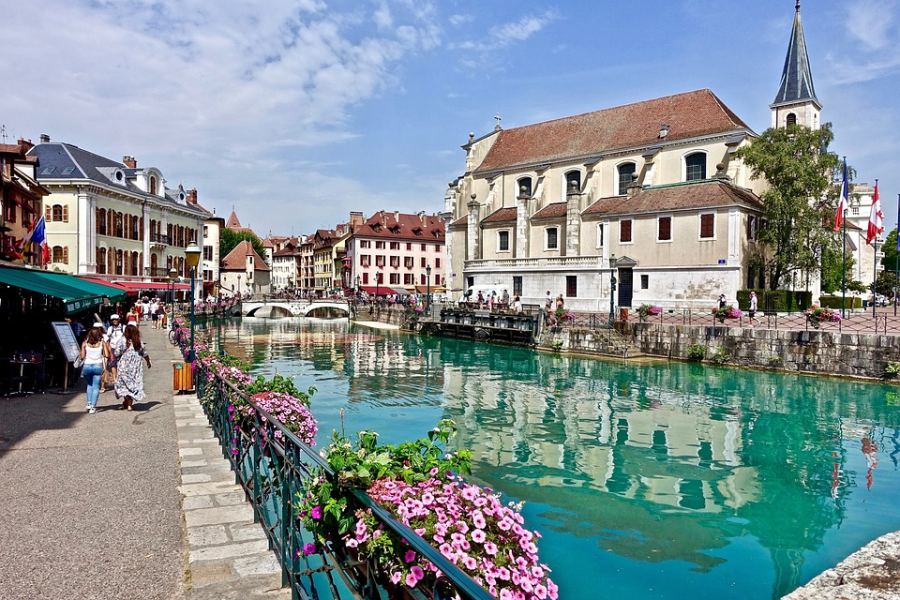
The town in the French Alps, located between Lyon and Mont Blanc, is known as the „Venice of Savoie” and the „Pearl of the Alps”.
Annecy, situated on the shore of the lake with the same name, is a popular destination due to its city center and the beauty of the surroundings. As a center of the Savoys, several buildings connected to them can be admired, such as the Palais de I’Isle mint and the Château d’Annecy castle.
Lake Annecy is the third-largest lake in France and the cleanest in Europe. Therefore, it’s worth exploring the area!
Mont Saint-Michel
You’ve surely seen this wonderful building in pictures, which stands out not only for its exterior.
Mont-Saint-Michel is an island formed by a 78-meter-high granite rock at the mouth of the Couesnon River in the English Channel, exactly 1 km from the coast of Normandy, France. The island and its Benedictine abbey were among the first to be listed as UNESCO World Heritage Sites in 1979.
Mont-Saint-Michel is a typical tidal island. It can be reached on foot at low tide, but becomes a real island at high tide. As a result, the monastery built on the island of Mont-Saint-Michel had a mystical significance. The island is connected to the mainland by a bridge.

Carcassonne
Located between Toulouse and Montpellier, the city is home to one of Europe’s largest medieval castles.
Its size is impressive: the double-wall perimeter is 3 km, and nearly 50 towers protect the walls. Inside the castle is another castle part, the Château Comtal, which has stood since the 12th century.
If you’re planning a trip to Southern France, don’t miss this castle!

Rocamadour
The city, built on high cliffs above the Alzou River north of Toulouse, has buildings in several rows atop each other.
The town is a famous pilgrimage site, thus a popular attraction in France. A legend is also associated with the town: Saint Amadour witnessed the deaths of Saint Paul and Saint Peter and moved here to live as a hermit.

Lourdes
Lourdes is a small town in Southwest France, at the foot of the Pyrenees.
It’s also an important pilgrimage site, which developed after a local girl, Bernadette Soubirous, saw an apparition of the Virgin Mary. It’s believed that the spring water flowing from the cave, the site of the Virgin Mary apparition, has healing properties.

Strasbourg
The town, known as the cultural and historical city of France, is the seat of the European Parliament, the Council of Europe, and the European Court of Human Rights.
Strasbourg’s most important sight is the historical city center (Grand Ile) on the Ill Island, which was listed as a UNESCO World Heritage Site in 1988.
Strolling through the city, crisscrossed with canals, is very atmospheric, giving a feeling similar to that in Bruges.
Strasbourg attractions, museums, weather

Corsica
Corsica, France’s largest island located north of Sardinia, is also known as the birthplace of Napoleon Bonaparte.
The island features rugged mountain ranges, valleys with wild, crystal-clear mountain streams, rocky coasts continuously battered by sea waves, sandy coves suitable for swimming, and towns exuding a unique historical ambiance.
For those who love hiking, the GR20, one of Europe’s most beautiful hiking trails, is a must. The 180 km long trail with about 10,000 meters of altitude difference is recommended for physically fit hikers. In return, they will experience unparalleled beauty.
Corsica attractions, beaches, weather

Colmar
Located near the German border in Alsace, the city is considered the „most Alsatian”.
Colmar, rich in history, is a popular town in France for sights. A favorite city of kings since Charlemagne, it got its name from one of the towers of the royal palace, the Pigeon Tower. Its colorful houses make the city very atmospheric.
The country’s one of the most significant museums is here. The Musée d’Unterlinden houses the most important collection of late medieval and early Renaissance Alsatian art, including works by artists like Martin Schongauer and Matthias Grünewald.

Biarritz
Although France’s coastline stretches along the Atlantic Ocean, it’s not famous for that. But if we want to enjoy the seaside, we should head south to the Bay of Biscay.
The center of the coastal stretch near the French-Spanish border is Biarritz. This area is a favorite spot for European surfers. The annual Biarritz Surf Festival is Europe’s largest event of its kind.
It’s also worth visiting Saint-Jean-de-Luz, 13 km away. The town on the shore of a small bay is a truly French-style town, also known as the origin of the macaron sweet.

Arles
Situated at the delta of the Rhône River, Arles holds the title of a cultural and historical city of France.
It boasts a rich Roman and medieval history, reflected in numerous well-preserved monuments. Among these, the most famous is the amphitheater built in the 1st century. Once accommodating 20,000 spectators, it is now used for various events.
The town’s artistic significance is highlighted by the fact that Vincent van Gogh lived and worked here. During this period, he created several paintings and drawings, many inspired by the local landscapes and scenes.

Toulouse
A key city in several fields, Toulouse is home to a prestigious university founded in 1229, making it one of the oldest in Europe.
The city features many churches, notably the Saint Sernin Basilica, founded in the 11th century.
Often called „La Ville Rose” or „The Pink City”. Toulouse is renowned for its buildings made of distinctive terracotta bricks, which take on a pink hue at sunset. These bricks are a defining element of the local architecture, used since the Middle Ages.

Tours
Located southwest of Paris, Tours is known as the gateway to the Garden of France, marking the beginning of the most beautiful part of the Loire.
The historic city center is dominated by the Saint-Gatien Cathedral. Built over several centuries, it blends Gothic and Renaissance architectural styles. The cathedral is famed for its stunning stained glass windows and intricate carvings.
Another highlight of the city center is Plumereau Square. The well-preserved medieval and Renaissance buildings, particularly the half-timbered houses, create a charming atmosphere in the square.

Avignon
Often referred to as the City of the Popes, Avignon served as the seat for several popes and antipopes during the 14th and 15th centuries. The city is listed as a UNESCO World Heritage site.
Its most famous landmark is the Papal Palace, the largest Gothic medieval building, which symbolized Western Christianity in the 14th century. The palace consists of two parts: the old palace of Benedict XII, a true fortress, and the new palace of Clement VI, the most luxurious of Avignon’s papal buildings.
Another notable attraction is the Pont d’Avignon, or the Avignon Bridge, one of France’s most famous bridges. It is actually a half-bridge, as it was repeatedly damaged by floods and never fully rebuilt.

Montpellier
Near the Mediterranean coast, the large city of Montpellier is renowned for its medical university, which has been world-famous for over six centuries.
The old town hides numerous medieval buildings and palaces, constructed in Renaissance and Classical styles over time. Notable structures include the Hôtel des Trésoriers de France, a Jewish ritual bath, and the Saint Peter’s Cathedral.
The city also boasts a triumphal arch, the Porte du Peyrou, built at the end of the 17th century in honor of King Louis XIV.
Surrounding Montpellier is a ring of châteaux, with the Château d’Eau, la Mosson, l’Engarran on the west, and Flaugergues and la Mogère on the east being among the most beautiful.
