
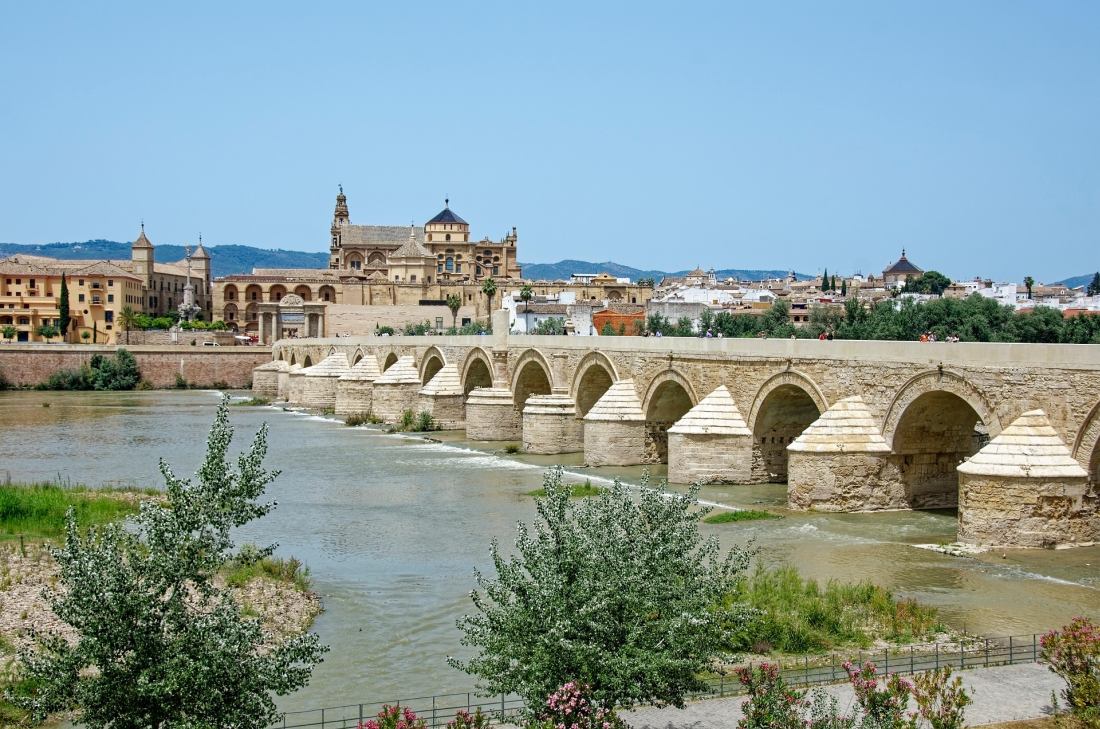
Córdoba is one of Spain’s most significant historical cities, where traces of Roman and Arab rule are still felt today.
The city was once the seat of a caliphate, when in the 10th century it was considered one of the largest and most advanced cities in the Western world. Andalusia’s third-largest city after Seville and Málaga.
Table of Contents
Córdoba attractions
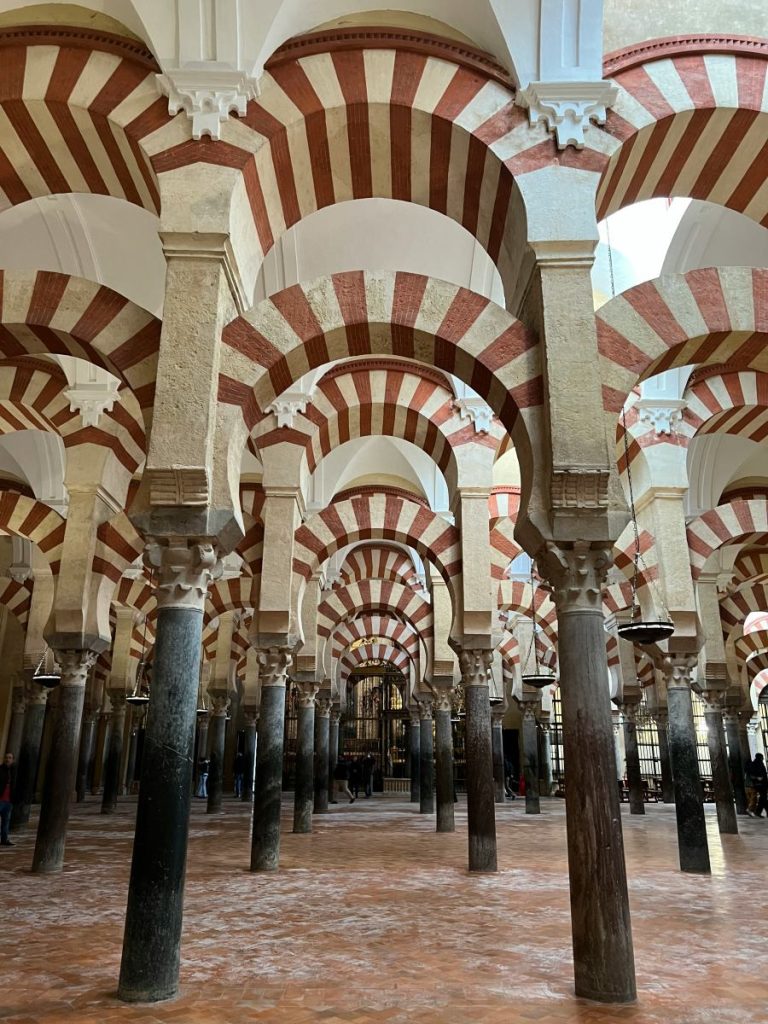
The Great Mosque-Cathedral of Córdoba (Mezquita-Catedral)
One of the world’s most unique sacred buildings, it remarkably combines Islamic and Christian architecture. Founded in 784, the mosque offers a stunning visual experience with its 856 red-and-white striped columns and horseshoe arches. The massive prayer hall’s forest-like space creates an unparalleled atmosphere, where columns stand in endless rows.
The building’s history mirrors the city’s history: originally a Roman temple, then a Visigothic temple stood on the site before Emir Abd ar-Rahman I converted it into a mosque. After the Reconquista in 1236, Christians took it over, and in the 16th century they built a Renaissance-style cathedral in the middle of the mosque. This unusual combination makes the structure unique.
The mihrab, the prayer niche facing Mecca, boasts unparalleled mosaic decoration created by Byzantine masters from gold and glass. The UNESCO World Heritage Site attracts several million visitors every year.
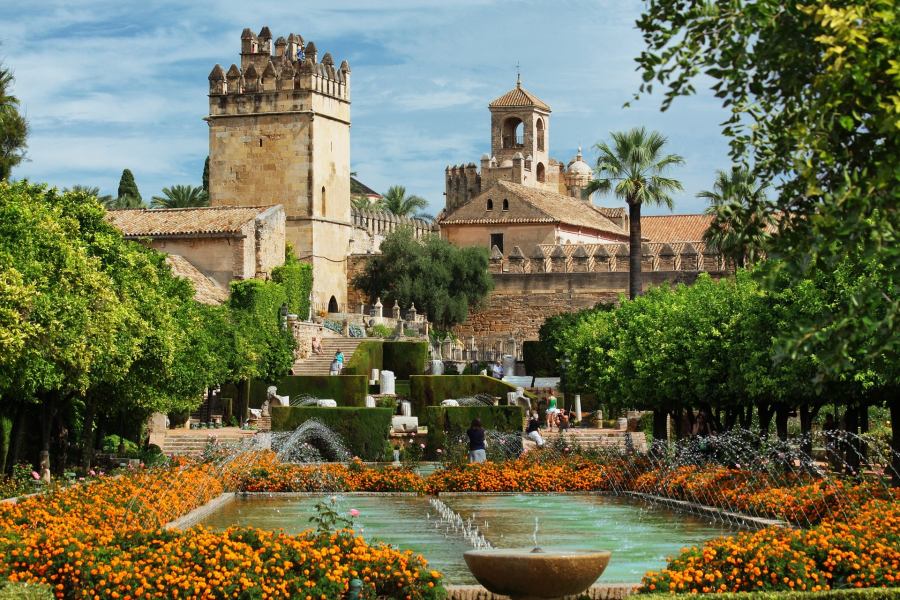
Palace of the Christian Monarchs (Alcázar de los Reyes Cristianos)
This impressive fortress-palace was built in 1328 by order of King Alfonso XIII and served as the Andalusian residence of Christian rulers. Within these walls, Isabella V and Ferdinand II decided in 1486 to support Christopher Columbus’s expedition. The palace was a protected complex with four corner towers, surrounded by Moorish-style gardens.
The building’s inner courtyards and halls are adorned with beautiful tile decorations, mosaics, and fountains that evoke Moorish architectural traditions. The Baths are particularly noteworthy with Roman and Arab bath remains. The walls and towers offer unparalleled views of the city and the Guadalquivir River.
The greatest treasure, however, is the garden spread across terraces with palm trees, orange groves, and pools. The water surfaces and vegetation arranged along visual axes are perfect examples of Moorish garden architecture. The evening light show makes the place particularly spectacular.
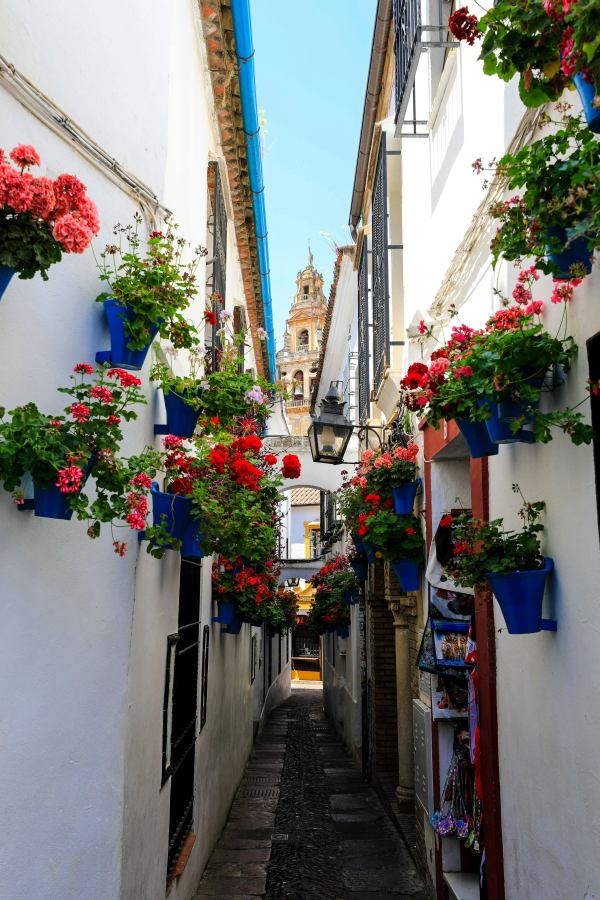
Barrio Judío
Home to the medieval Jewish community, today it’s Córdoba’s most enchanting neighborhood, where history can be felt in every corner. During its golden age from the 10th-14th centuries, one of Europe’s largest and most influential Jewish communities lived here. The philosopher Maimonides was also born here in 1135, whose statue stands in Tiberiades Square.
Walking through the narrow, winding streets among whitewashed houses, we experience the atmosphere of the Middle Ages. The walls of buildings are decorated with flowerpots, which are particularly colorful in spring. Calleja de las Flores (Alley of the Flowers) is one of the most photographed locations, from where the mosque tower is also visible among the flowers.
At the heart of the quarter is the Synagogue, built in 1315, one of Spain’s three synagogues surviving from the Middle Ages. The small but beautiful interior space features stucco decorations that are mixtures of Hebrew inscriptions and geometric patterns.
Roman Bridge (Puente Romano)
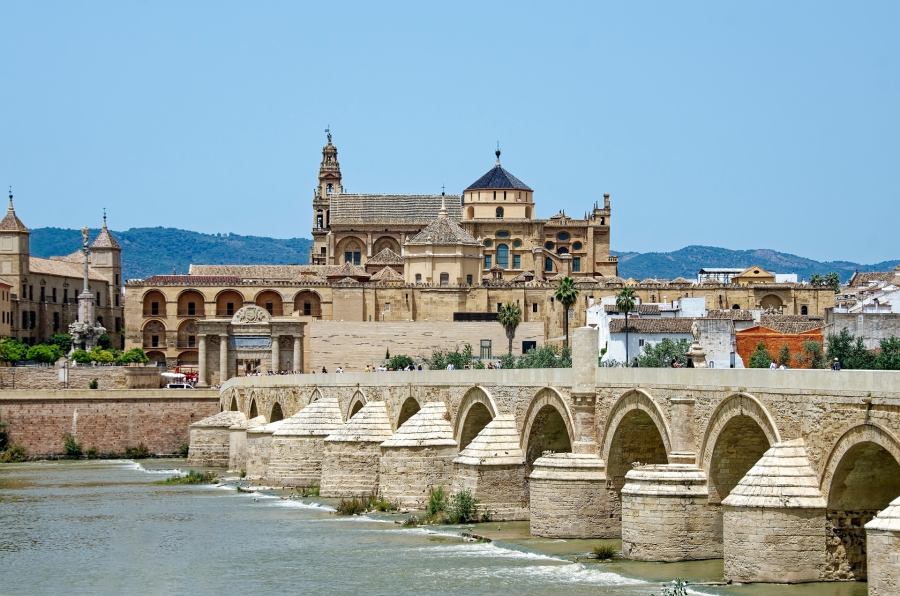
The bridge spanning the Guadalquivir River was built in the 1st century during the reign of Augustus Caesar and was the city’s only bridge for nearly two thousand years. The 247-meter-long structure originally boasted a 17-arch design, of which 16 have survived. The panorama is particularly spectacular when viewed from the Mezquita.
In the middle of the bridge stands the statue of Archangel Saint Raphael, Córdoba’s patron saint, who according to legend saved the city from the plague. Crossing the bridge, we reach the Calahorra Tower, which originally served the city’s defense and now houses a museum. At the southern end of the bridge is also the building of a Moorish-era water mill.
At dusk, the view is most spectacular, when the bridge and the mosque-cathedral rising in the background create a stunning picture. Today the bridge is only open to pedestrians, making it an excellent spot for peaceful walks and photography.
Torre de la Calahorra
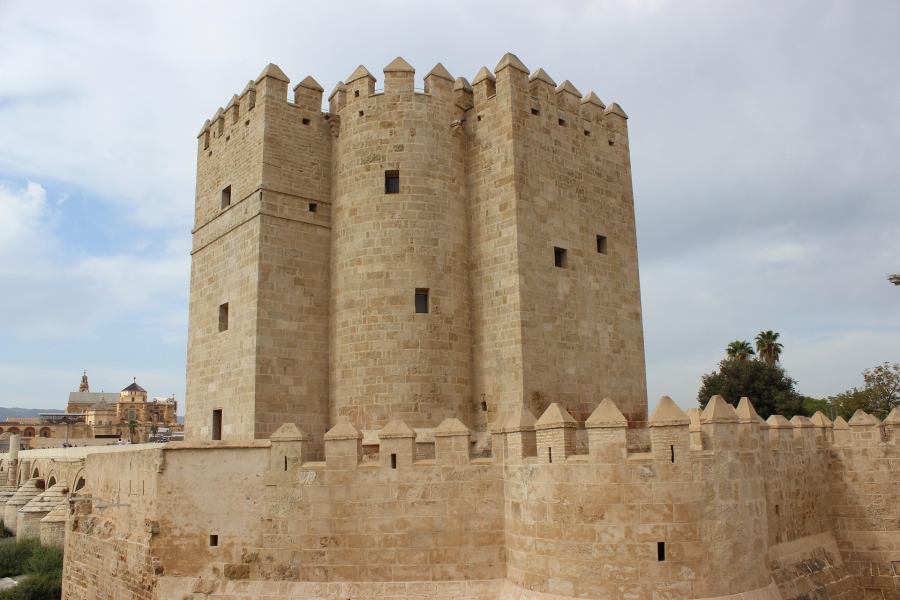
The fortress tower standing at the southern end of the Roman Bridge was built in the 12th century to protect the city from attacks from the south. As a characteristic example of Moorish architecture, it was a strategically important defensive point. The tower’s structure, with its cruciform floor plan and massive walls, performed a perfect defensive function.
Today the tower houses the Living Museum of Three Cultures, which presents the coexistence of Córdoba’s Roman, Jewish, and Islamic traditions using multimedia tools. The exhibition pays particular attention to the period when the city was the capital of the caliphate and functioned as a center of religious tolerance. Through interactive demonstrations, we can learn about everyday life in medieval Córdoba.
From the tower’s upper level, there’s a stunning panorama of the Roman Bridge, the Mezquita, and the historic city center. It’s especially recommended to visit at sunset.
Palacio de Viana
This 15th-century aristocratic palace is famous for its twelve beautiful courtyards (patios), each designed in a different style and atmosphere. The Viana family residence was an inhabited building until 1980, when it was converted into a museum. The building complex covers 6,500 square meters and is one of Córdoba’s finest examples of Andalusian palace architecture.
Each patio has a unique character: there’s the Naranjos patio filled with orange trees, the Jardín patio decorated with Mediterranean plants, or the Archivo patio with geometric patterns. The careful arrangement of fountains, pottery, and flowers is visible everywhere. Visiting the patios is a true Andalusian experience, where the splashing of water, the scent of flowers, and cool shade make the atmosphere perfect.
Inside the palace is a richly furnished museum displaying the aristocratic family’s furniture, paintings, carpets, and porcelain collection. The library preserves more than 7,000 volumes. Every detail of aristocratic life comes alive in the magnificent halls.
Medina Azahara
The brilliant capital of the Córdoba Caliphate, a palace city built by Abd ar-Rahman III between 936-940, located on the western edge of the city, about 8 kilometers away. Named after the caliph’s favorite wife, Azahara, the city once housed 10,000 people, was built on three terraces on the hillside, and competed with Baghdad and Constantinople in its luxury and beauty.
The city stood for barely 70 years before Berber troops plundered and destroyed it in 1010. For centuries it fell into oblivion, its ruins were reused as building materials. Archaeological excavations began in the 20th century, continuously revealing new details of the former splendor.
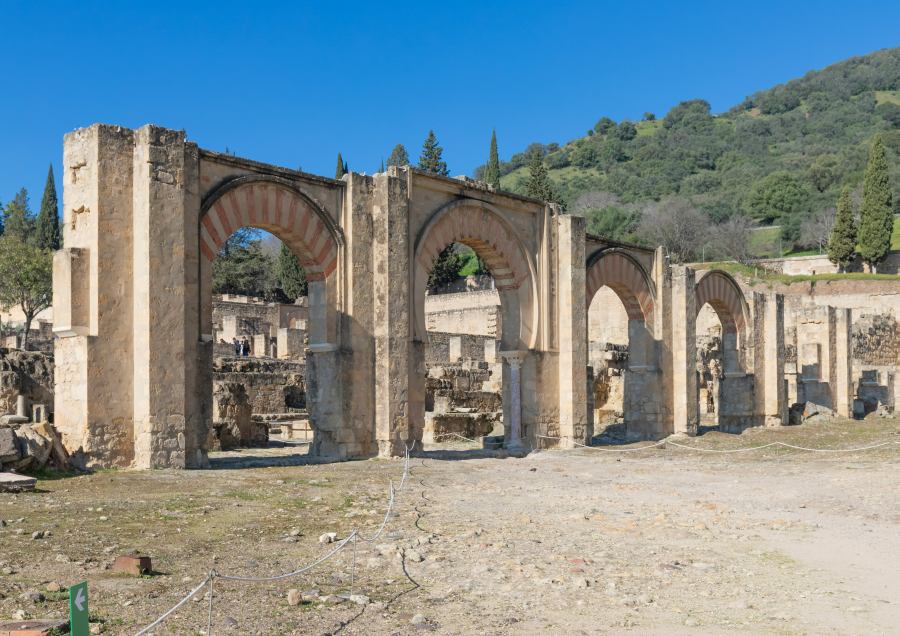
The restored remains of the Great Portico, the Throne Room, and the House of Baghdad give a taste of the city’s former greatness. The richly carved stucco decorations, marble columns, and water basins are still impressive. The museum on site displays excavated finds – statues, coins, ceramic objects – helping to understand the culture of the Umayyad Caliphate. UNESCO World Heritage Site since 2018.
Royal Stables (Caballerizas Reales)
King Philip II founded this massive stable complex in 1570 with the aim of creating the purebred Andalusian horse. The building was designed in Renaissance style by Hernán Ruiz II, with huge vaulted halls that can still accommodate 40 horses today. The purpose of the royal stables was not only breeding but also training noble horses.
Today, spectacular horse shows are held in the stables every week, combining the art of classical Spanish riding, dressage elements, and flamenco dance. White and black Andalusian horses perform in traditional costumes in choreography showcasing Spanish equestrian traditions.
In the museum section of the building, we can learn about the history of Spanish equestrian culture, equestrian equipment, and horse breeding traditions. Walking around the surrounding area, horse statues and well-maintained gardens are also visible.
Plaza de la Corredera
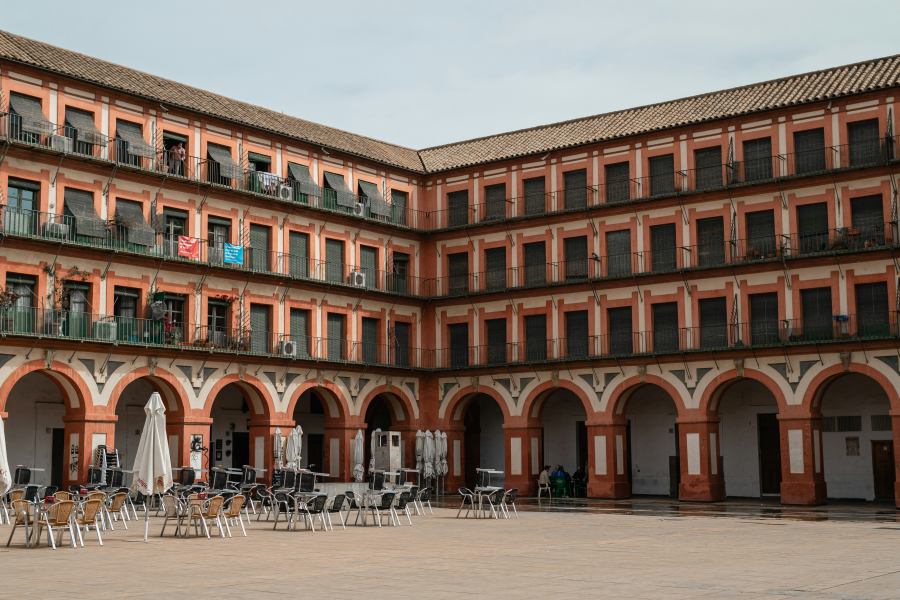
Andalusia’s only completely enclosed, square-shaped main square was built in 1683 in Spanish Baroque style, modeled after Madrid’s Plaza Mayor. The brick-colored, four-story buildings embrace the square, beneath whose arcades shops and restaurants line up. The square’s history is full of events: bullfights, public executions, and markets were held here.
Over the past centuries, the square’s function has changed: in the 19th century it operated as a marketplace, then in the 20th century it became a residential neighborhood. The renovation carried out in the 1990s restored its original beauty, and today it has become a favorite meeting place for locals. On Saturday mornings, a flea market also operates here, where antiques and handicraft products are available.
The square’s cafés and tapas bars are particularly lively in the evening, when locals sit on terraces to chat. The central area is open, where concerts and cultural events are often held.
Templo Romano
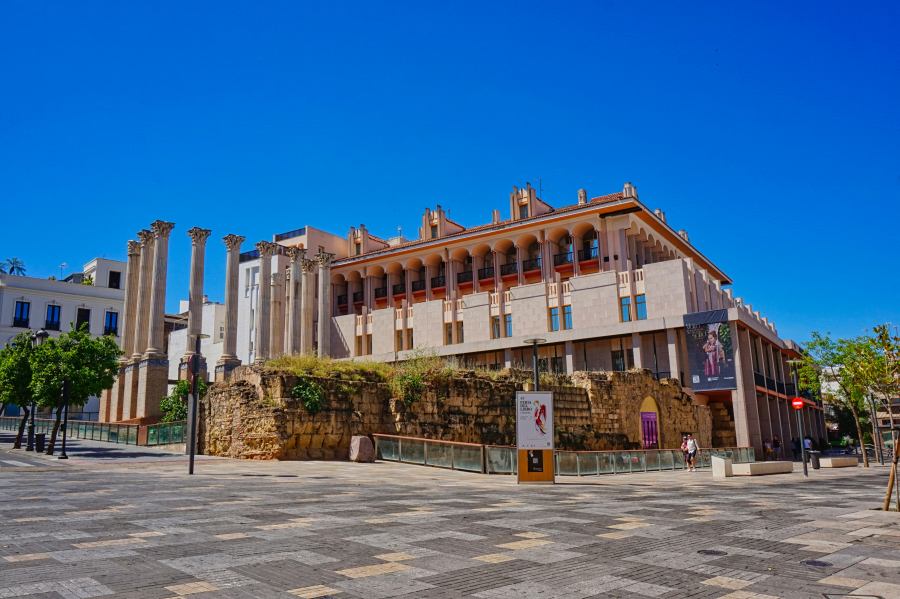
The remains of the Roman temple in the heart of the city were built in the 1st century during the reign of Emperor Claudius. Only a fragment of the once massive structure remains, but the tall Corinthian columns are still impressive. The temple stood in the Forum Provinciae area, which was the religious and administrative center of the province of Hispania Baetica.
The ruins came to light in the 1950s during the expansion of the city hall, when archaeologists were surprised to discover the massive column remains. Excavations and reconstructions carried out since then have restored ten columns, which were parts of the original 32-column building.
The current cityscape presents an oddly beautiful contrast of the modern Ayuntamiento building and the ancient ruins. The temple is particularly imposing when illuminated at night. The area is freely accessible and an excellent site for understanding Córdoba’s Roman past.
Palacio de la Merced
The Baroque-style monastery founded in the 16th century fulfilled its original function as a monastery for the Mercedarian monks.
The central patio of the imposing building complex is surrounded by a two-story arcade decorated with huge white marble columns, considered one of Andalusia’s most beautiful inner courtyards. In the 19th century, after the dissolution of religious orders, it functioned as a prison, then in the late 20th century it regained its original beauty through comprehensive renovation.
Today it’s the administrative seat of Córdoba Province, housing the offices of the Diputación Provincial. Freely accessible on weekdays, where fountains, orange groves, and monumental architecture create a magical atmosphere. The palace’s rich stucco decorations and painted ceilings are excellent examples of Baroque art.
Best museums in Córdoba
Museo Arqueológico de Córdoba
The museum, housed in the Renaissance Páez de Castillejo Palace, has been collecting archaeological treasures from Córdoba and its surroundings since its foundation in 1867.
The building itself has art-historical significance, its inner patio is typical Andalusian style, where the exhibition displays objects thousands of years old. The museum achieved its current form through continuous expansions and renovations.
The collection chronologically presents the region’s history from prehistoric times to the Middle Ages: from the Paleolithic to the Visigothic period. Particularly rich are the Iberian, Roman, and Islamic-era materials, which include bronze statues, mosaics, vessels, and jewelry. The Roman-era sarcophagi and Moorish-era bronze statues are among the most valuable pieces. The Iberian Hall on the museum’s ground floor features a particularly spectacular collection, while Moorish-era objects dominate on the upper floor.
All information available here!
Museum of Fine Arts (Museo de Bellas Artes de Córdoba)
The art museum opened in 1862 in a Renaissance hospital building is one of Andalusia’s oldest art institutions. The former Hospital de la Caridad building has a patio, where the former chapel is now the museum’s most imposing exhibition space. The building’s history is intertwined with Córdoba’s charitable institutions’ past.
The collection focuses on Spanish painting from the 14th century to the present, with special emphasis on Córdoba masters. The works of Julio Romero de Torres, Córdoba’s most famous painter, received a separate room where female nudes and Andalusian-themed works dominate. The museum also preserves works by Murillo, Zurbarán, and Valdés Leal.
Visitors can learn about Baroque religious paintings, Renaissance altarpieces, and 19th-20th century Spanish artists. The sculpture collection features works by Mateo Inurria and other local sculptors.
All information available here!
Museo Julio Romero de Torres
The museum set up in the former home of the Córdoba artist (1874-1930) uniquely presents Romero de Torres’s life work. The museum opened in 1931 includes the originally furnished home where the painter lived and worked.
The collection preserves Romero de Torres’s most significant works, who painted Andalusian female figures, flamenco themes, and Córdoba atmosphere in his unique style. His works – such as „La Chiquita Piconera” or „Naranjas y Limones” – which move between symbolism and realism are iconic pieces of Spanish art. The portraits of the artist’s models convey particularly intense emotions.
Part of the visitor experience is viewing the original studio, where the painter’s palette, personal belongings, and memorabilia are also visible. The museum’s audiovisual presentations help understand Romero de Torres’s artistic world and the cultural environment of early 20th-century Córdoba.
All information available here!
Córdoba weather: when is the best time to travel?
Córdoba has a Mediterranean-continental climate, which means hot, dry summers and mild, rainy winters. The city is located inland in Andalusia, far from the coast, so temperature fluctuations are greater than in coastal cities. The four seasons of the year are well distinguished, though spring and autumn are particularly pleasant.
Spring (March-May):
The most beautiful time of the year, when nature comes alive and the famous flower festival, Patios de Córdoba, takes place in May. The temperature ranges between 15-25°C, ideal for pleasant walks. The city is at its most colorful then, every patio fills with flowers.
Summer (June-August):
An extremely hot period when the temperature often exceeds 40°C, in July and August it can even reach 45°C. Locals take siestas during midday hours, life only picks up in the evening. Tourist attractions can be visited comfortably in the morning and late afternoon.
Autumn (September-November):
The temperature gradually decreases to 25-15°C, September is still warm, but from October it becomes more pleasant. Some rainy days can be expected, but generally sunny, pleasant weather is characteristic. An excellent alternative to the crowded spring months.
Winter (December-February):
A mild but rainy period with daytime temperatures of 10-15°C. At night it can cool below 5°C. Frost occurs rarely, snow almost never falls. Tourist numbers are low, the city is calmer.
Best time to travel Córdoba:
The most ideal time to visit Córdoba is between April-May and October-November when the temperature is between 20-28°C and sunny days dominate. The May flower festival is a special experience, although the city is more crowded then. Autumn is quieter, with fewer tourists, while offering pleasant temperatures and lower prices.
Only choose summer months if you can handle the heat and plan early morning and evening activities. Winter is an economical choice, but you should expect occasional rain and cooler weather.