
Vientiane, Laos’s quiet and friendly capital, lies on the banks of the Mekong River, its downtown dotted with gilded stupas, Buddhist temples, and French colonial buildings.
As one of Southeast Asia’s smallest and most laid-back capitals, Vientiane feels more like an oversized small town than a metropolis. Its history stretches back to the 16th-century Lan Xang Kingdom, while the French colonial era left behind wide boulevards and café-lined streets that still shape the atmosphere of the city center today.
Table of Contents
Vientiane attractions
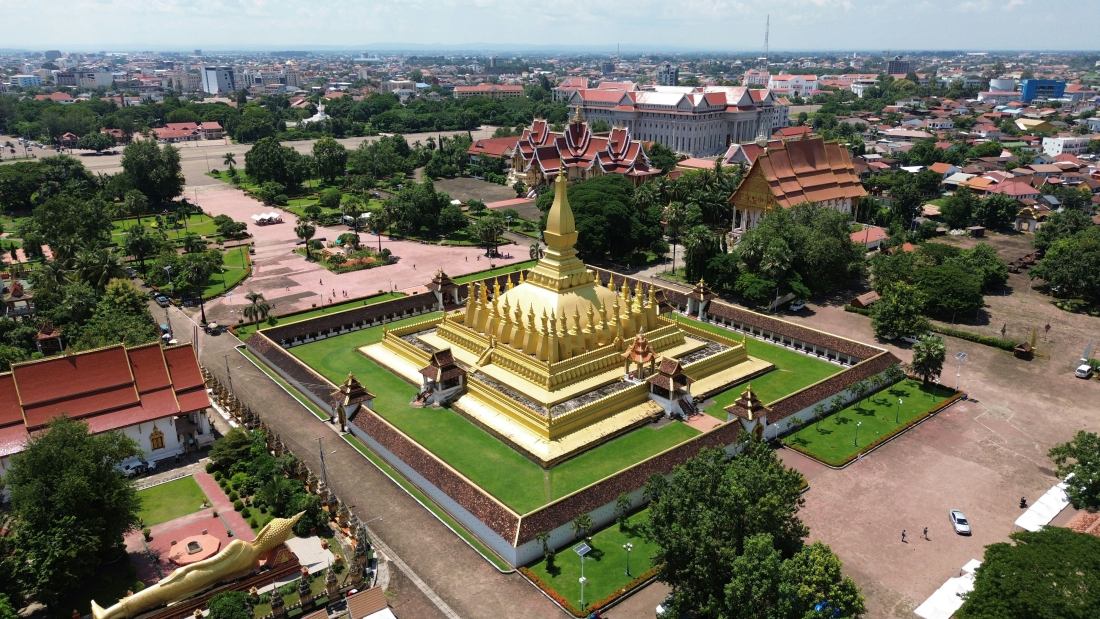
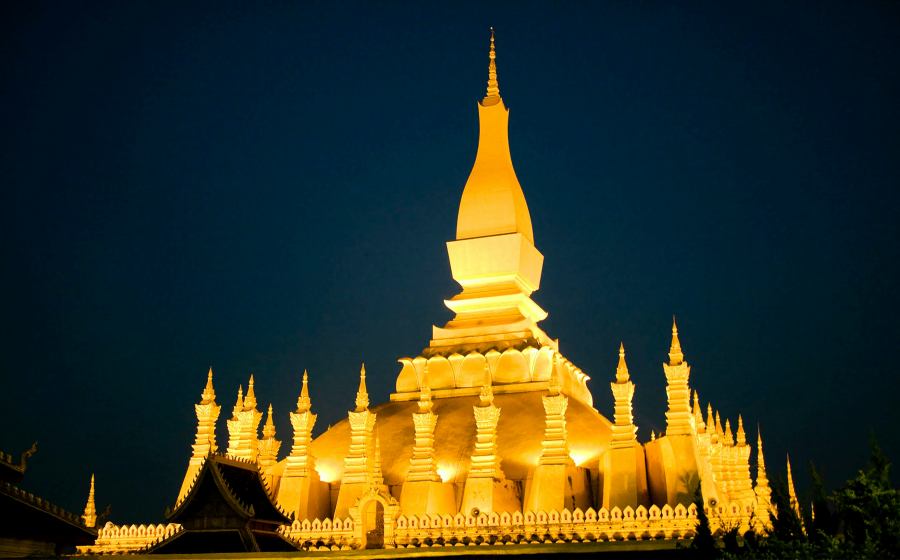
Pha That Luang
Laos’s most important national and religious monument, a symbol of the country’s Buddhist identity. Tradition holds that a shrine already stood on this site in the 3rd century, but the current gilded stupa was built in the 16th century under King Setthathirath, after the capital was moved from Luang Prabang to Vientiane.
The 45-metre-tall structure, entirely covered in gold, consists of three stacked terraces symbolizing the stages of Buddhist enlightenment. The central stupa is surrounded by four gates and a high wall, and the complex includes several smaller shrines and monasteries.
The building is also central to locals’ everyday religious life: every November it hosts the That Luang Festival, Laos’s largest Buddhist celebration, drawing thousands of monks and pilgrims. The stupa is at its most striking early in the morning or at sunset, when its golden surface glows in a special light.
Patuxai
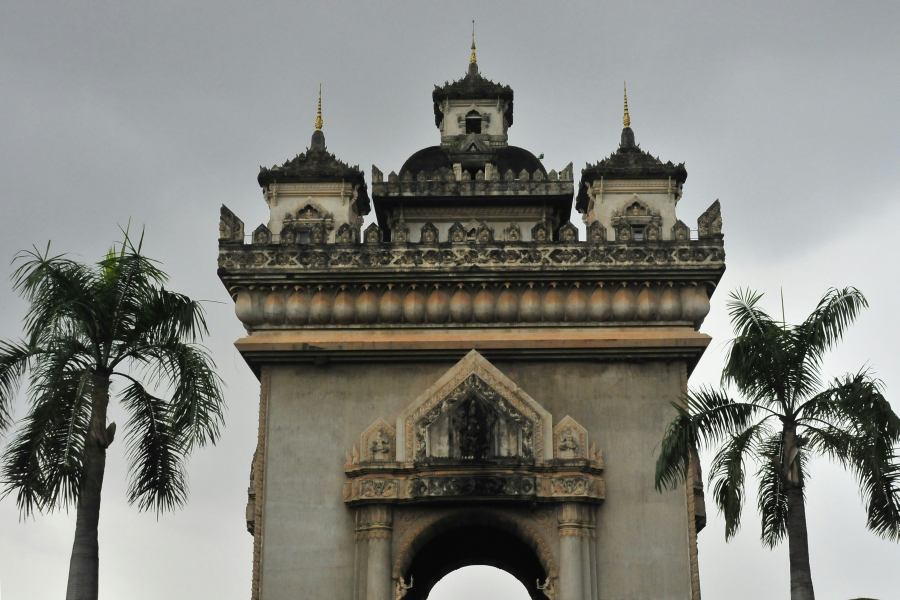
One of Vientiane’s best-known landmarks, often called Laos’s Arc de Triomphe, since its shape clearly echoes the one in Paris. The monument was built in the 1960s in memory of soldiers who died fighting for independence from the French.
The five-towered gate is a striking blend of Western and traditional Lao architecture: its structure is made of concrete, while its decoration – naga serpents, apsaras, and floral motifs – is purely Lao in style. Inside, a staircase leads to the roof, offering a panoramic view over the city and the Mekong.
The park surrounding the monument is a popular place for a stroll, and in the evenings its fountain and lighting create a special atmosphere. On the gate’s lower level there’s a small bazaar selling local handicrafts.
Wat Sisaket
Vientiane’s oldest Buddhist temple still standing in its original form, built in 1818 under King Anouvong. It is notable as the only shrine to survive the Siamese occupation of 1828, when the army destroyed nearly the entire building stock of the city.
More than two thousand small Buddha statues line the walls of the cloister surrounding the temple, while larger seated Buddha figures – some dating back to the 13th century – sit in niches on the ground floor. Frescoes inside the main building depict scenes from the life of the Buddha.
Built in the Siamese style, the temple’s multi-tiered roof and colonnade clearly show Thai influence, setting it apart from Vientiane’s other, traditionally Lao shrines. The site sits right next to the Presidential Palace, making it easy to combine with a stroll through downtown.
Wat Si Muang
One of Vientiane’s most popular living Buddhist temples, visited mainly by locals seeking good luck or praying before important decisions. Legend has it that a young woman named Si Muang sacrificed herself to appease the spirits when the temple’s foundation stone was laid.
At the heart of the main building stands a sandalwood pillar, regarded as the soul of the city, surrounded by gilded decoration. The shrine is thronged daily by worshippers offering flowers, incense, and gold leaf.
The temple courtyard also holds old stone remains and a Khmer-origin statue fragment, hinting at an earlier Hindu temple on the site. Thanks to its lively, everyday religious life, Wat Si Muang offers excellent insight into the daily practice of Lao Buddhism.
That Dam (Black Stupa)
One of downtown’s most mysterious monuments, its exact construction date unknown, though tradition holds it was built centuries ago. It gets its name from the fact that the gilding that once covered it has almost completely worn away, leaving the old brick and plaster in a dark, mossy hue.
According to local legend, a seven-headed naga serpent lives inside the stupa and protected the city during the Siamese invasion of 1827–28. This myth lends a distinctive, mystical atmosphere to what is otherwise a simple, round public space.
That Dam is a quiet, less crowded spot, best visited early in the morning or late afternoon, when the light falls beautifully on the old stone surface. Nearby streets are lined with French colonial-style villas that nicely illustrate the city’s two-sided history.
Wat Ong Teu Mahavihan
Also known as the Temple of the Heavy Buddha, this shrine was founded in the 16th century under King Setthathirath, during Laos’s Buddhist golden age. The original buildings were destroyed during the Siamese occupation of 1827–28, and the temple took its present form during a rebuilding in the early 20th century, in the French era.
The temple takes its name from a massive bronze Buddha statue about 6 metres tall, flanked by two standing Buddha figures. The statue is shown in the traditional earth-touching hand gesture, symbolizing the moment of enlightenment.
The complex is also one of Laos’s most important centers of Buddhist education, home to the country’s monastic college, where monks from across the country come to study. The finely carved wooden doors and colorful frescoes make it well worth exploring in detail.
Presidential Palace
Originally built in the early 20th century as the residence of the French colonial governor, the building in the city center later became the state’s protocol building after Laos gained independence.
The grey-white, columned palace blends French and traditional Lao architectural elements, with a large Lao flag flying in front. The interior is not open to visitors, but it makes for excellent photos from outside.
Wat Sisaket and the Haw Phra Kaew museum stand right next to the palace, so all three sights can easily be covered on a short walk. In the evening, the illuminated façade is especially striking.
Talat Sao (Morning Market)
Vientiane’s largest and best-known traditional market, located downtown along Lan Xang Avenue. Its name means “morning market,” although in practice it stays open until early afternoon.
In the traditional section of this two-storey, multi-hall complex, vendors sell textiles, silver jewelry, handicrafts, and food, while the adjoining modern Talat Sao shopping mall houses air-conditioned shops and electronics stores.
The market is a great place to experience local everyday life and try your hand at bargaining, and the ground-floor food court serves Lao specialties. Local buses to Buddha Park and other out-of-town destinations also depart from near the market.
Mekong Riverside Promenade
Running along the Mekong River on the city’s western edge, this roughly two-kilometre promenade is one of Vientiane’s most beloved public spaces, where locals gather in large numbers at sunset to walk, exercise, and socialize.
The park’s centerpiece is a massive bronze statue of King Chao Anouvong, erected in 2010, honoring the last ruler of the Kingdom of Vientiane. In the evenings the space between the statue and the river turns into an outdoor aerobics venue and meeting point.
After sunset, the red-roofed stalls of the night market light up along the promenade, offering clothes, handicrafts, and street food. The sunset over the river, as the sun disappears over the water toward Thailand, is one of the city’s most beautiful sights.
Nam Phu Square
This circular square in the heart of downtown is a legacy of the French colonial era, and one of the city’s most attractive neighborhoods – full of cafés and restaurants – grew up around it.
The fountain at the center of the square creates a special atmosphere when lit up in the evening, surrounded by restored colonial buildings housing French bistros, bakeries, and boutiques. The area is easy to explore on foot and offers a sharp contrast to the city’s Buddhist temples.
The neighborhood is also home to Vientiane’s Sacred Heart Cathedral, another visible reminder of the French presence. In the evenings, the streets around the square come alive as locals and tourists alike enjoy drinks on the terraces.
Wat That Luang Tai
Located right next to Pha That Luang, this still-active monastery’s monks take part daily in ceremonies around the great stupa and in receiving worshippers.
The temple’s most distinctive sight is a huge reclining Buddha statue set outdoors, depicting the moment of the Buddha’s death, or final enlightenment. Smaller shrines and monks’ living quarters stand alongside the statue.
Since most tourists visit only the neighboring Pha That Luang, this site offers a far calmer, more authentic atmosphere, where it’s easy to observe monks’ daily life. A visit here can easily be combined with the Great Stupa on the same walk.
Buddha Park (Xieng Khuan)
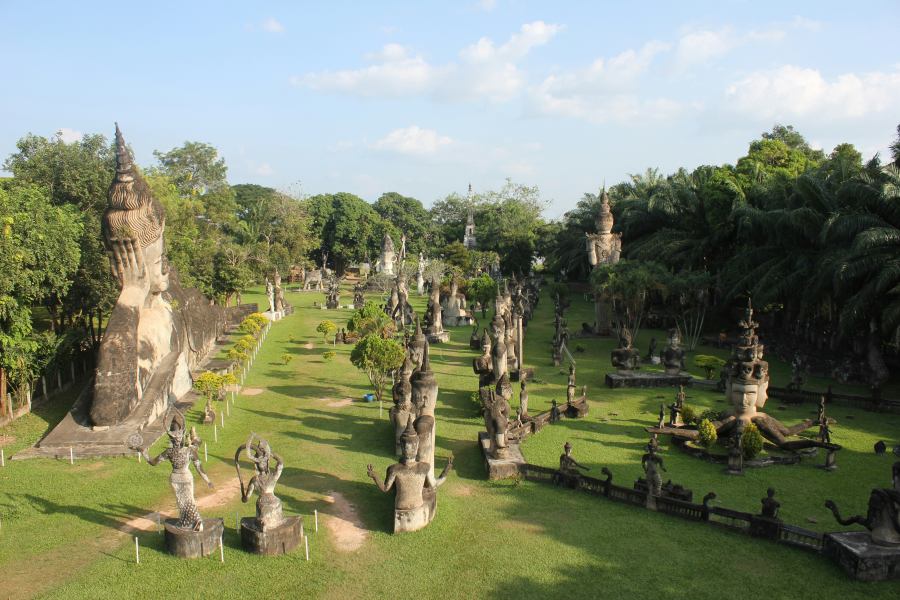
This sculpture park, about 25 kilometres from the city on the banks of the Mekong, was created in 1958 based on the vision of a monk-artist named Luang Pu Bounleua Sulilat, who blended Buddhist and Hindu philosophy in his unique creations.
The collection of roughly 200 concrete sculptures depicts Buddha figures alongside Hindu gods, demons, and mythical creatures. The park’s best-known feature is a huge pumpkin-shaped spherical structure that can be climbed through three levels inside, with a view over the whole site from the top.
The statues vary enormously in size and pose: alongside a reclining Buddha several metres long stand grotesque, frightening figures representing the torments of hell and earthly existence. The park is also easy to explore by bicycle, and there’s a café nearby with a terrace overlooking the Mekong.
Best museums in Vientiane
Lao National Museum
Housed in a classic French colonial-style building, the museum was created to present the history of Laos from prehistoric times to the modern independence movement.
The exhibits – archaeological finds, traditional textiles, photographs, and period documents – trace the country’s development, with particular emphasis on the French colonial period and the war of independence. Several rooms are devoted to traditional Lao life and to the cultures of the country’s various ethnic groups.
Although some of the exhibits feel a little dated, the museum’s building and location – right next to the Talat Sao market – make it an excellent addition to a day of downtown sightseeing.
COPE Visitor Centre
This museum addresses the lasting impact of unexploded ordnance, including cluster bombs, dropped on Laos during the Vietnam War – a danger that still threatens rural communities today.
Through interactive installations, films, and survivors’ personal stories, the exhibition conveys the scale of the problem, along with the work of the COPE organization, which provides prosthetics and rehabilitation services to injured civilians. One of the best-known exhibits is an artistic installation of prosthetic legs made from unexploded bomb casings.
The visit makes for a deeply thought-provoking experience and, for many, becomes one of the most memorable parts of a trip to Vientiane. Admission is free; donations support the organization’s work, and there’s a café on site.
Haw Phra Kaew
Built in 1565 by King Setthathirath as a royal temple, specifically to house the Emerald Buddha he brought from Luang Prabang. The precious statue was later seized by the Siamese army during the wars of the 18th century and is now kept in Bangkok.
The building was destroyed and rebuilt several times, taking its current form in the mid-20th century under French supervision. It no longer functions as a temple but serves as a museum of religious art, bringing together Laos’s finest Buddhist statues and ritual objects.
The exhibition halls display bronze and wooden Buddha statues, old inscribed stone tablets, and period ritual objects, while the building’s façade is richly decorated with carved columns and reliefs. The quiet, shaded garden offers a pleasant place to rest during sightseeing.
Vientiane weather: when is the best time to visit?
Vientiane has a tropical savanna climate, defined by two main periods – a long rainy season and a dry season – with little temperature variation throughout the year. Most rainfall occurs between May and October, while November through April sees very little rain, and within the dry season there’s a clearly distinguishable cooler stretch and a hot stretch.
Cold, dry season (November–February):
This is Vientiane’s most pleasant period, when daytime temperatures range between 18–29°C and nights are notably cool, sometimes dropping to as low as 15°C. Skies are nearly cloudless and rainfall is minimal, making this the most popular travel season.
Hot, dry season (March–April):
Temperatures climb rapidly in the spring months, with April being the hottest month, when daytime highs can reach 37–38°C. Because of the high humidity and strong midday sun, it’s best to plan shaded activities for the afternoon hours.
Rainy season (May–October):
The southwest monsoon arrives around May and lasts until the end of October. Rainfall typically comes as short, intense afternoon downpours, often followed again by hot, humid weather. The wettest month is August, when it can rain on as many as 20 days.
Best time to travel to Vientiane:
The best time to visit Vientiane is the dry, cool November–February period, when the weather is pleasant, sights such as Pha That Luang and the Mekong riverside promenade are easy to explore, and sunsets are at their most beautiful under clear skies. Although this is when most tourists arrive, the mild temperatures and low rainfall more than make up for the bigger crowds.
Frequently Asked Questions about Vientiane
Vientiane lies in Laos’s time zone (ICT, UTC+7), and the country does not observe daylight saving time.
The official language of Laos is Lao. English is widely spoken at tourist sites, hotels, restaurants, and travel agencies, but this is less common at local markets and smaller shops. Knowing a few basic Lao phrases can make communication easier.
The official currency is the Lao kip (LAK). Cash is accepted almost everywhere, though larger hotels, restaurants, and shopping malls also take credit cards. Some tourist-oriented businesses accept US dollars and Thai baht as well, but it’s worth always carrying some local currency. A currency converter calculator can be found here!
Types A, B, C, E, and F outlets are most common in Vientiane. European-standard type C and F plugs generally work without an adapter. The mains voltage is 230 V, 50 Hz.
The city is served by Wattay International Airport (VTE), just a few kilometres from downtown. The center can be reached quickly by taxi, airport transfer, or ride-hailing app. Scheduled bus routes also run, but most tourists choose a taxi.
Vientiane is a relatively small city, so many sights can be reached on foot. For longer distances, taxis, tuk-tuks, and ride-hailing services are the most convenient option. Bicycles and scooters can also be rented if you’d like to explore the city on your own.
Vientiane is considered one of Southeast Asia’s calmer capitals. Violent crime is rare, but pickpocketing and minor scams can occur in tourist-frequented areas. It’s worth keeping an eye on your valuables, especially at markets and in the evening hours.
Most tourists stay downtown near the Mekong River, where numerous restaurants, cafés, and sights are found. The area around Nam Phu Square is also a good choice, being centrally located and easy to get around. The riverside neighborhoods are especially pleasant for evening walks and dinners.
Pi Mai Lao (the Lao New Year, in mid-April) is the country’s most important festival, celebrated with water festivities and religious ceremonies.
Boun That Luang (November) is Vientiane’s most significant religious festival, centered around the golden Pha That Luang stupa.
Boun Ok Phansa (October) marks the end of the Buddhist fasting period, celebrated with lantern- and candlelit festivities.
Laap: A spicy salad of minced meat or fish with fresh herbs.
Tam Mak Hoong: Spicy green papaya salad, one of Laos’s best-known dishes.
Khao Niew: Sticky rice, the staple of almost every meal.
Or Lam: A traditional Lao one-pot dish of meat and vegetables with aromatic spices.
Khao Piak Sen: A rich, homemade rice-noodle soup, often eaten for breakfast.