
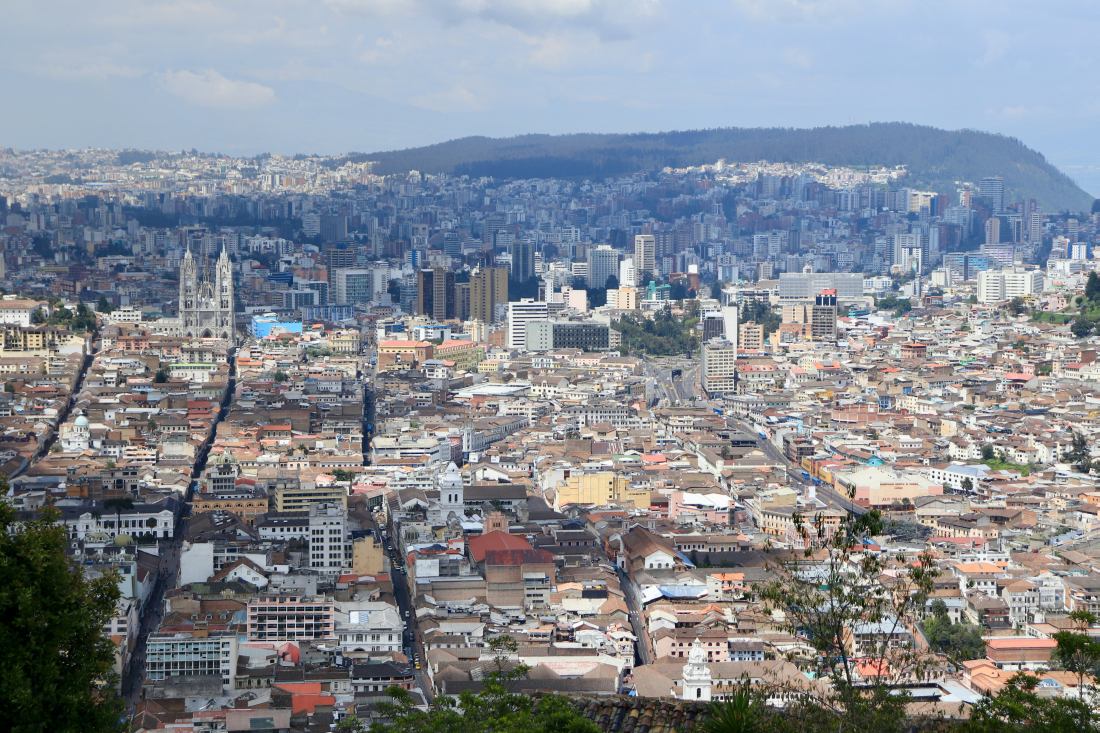
Quito is a colonial old town perched high in the Andes, where baroque churches, volcano panoramas and the imaginary line of the equator all meet.
Ecuador’s capital sits at about 2,850 meters above sea level, in a narrow Andean valley ringed by volcanoes on both sides. In 1978, together with Kraków, it became the first city ever awarded UNESCO World Heritage status, thanks to being one of the best-preserved colonial old towns on the continent. The city’s atmosphere comes from the hush of its monasteries, its bustling markets and the distinctive freshness of the mountain air.
Table of Contents
Quito attractions
Plaza Grande
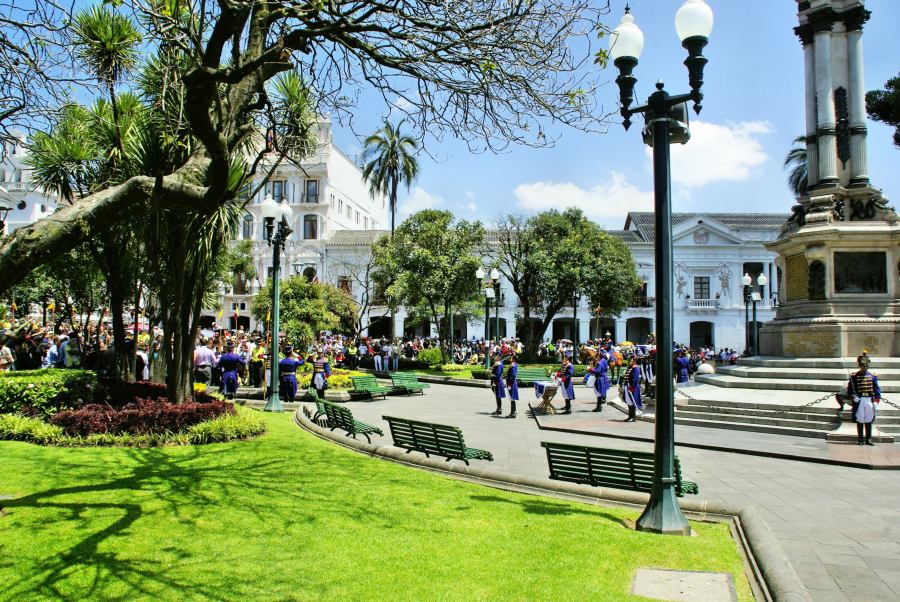
The heart of the old town has held its central role since the city’s founding in 1534, and has been the setting for the most important decisions of both the colonial and republican eras. The square is enclosed on four sides by buildings of power and faith: the Carondelet Palace, the seat of the presidency, the Quito Cathedral, the archbishop’s palace, and the city hall.
The Independence Monument in the middle of the square was built in 1906, topped with a condor symbolizing victory over the Spanish crown. The president of the day regularly greets the gathered crowd from the balcony of the presidential palace, while former presidents of Ecuador rest inside the cathedral.
Cafés and shoe-shine stands line the arcades around the square, and street musicians fill the cobblestones in the evenings. Most walking tours also start from here, since every major sight in the old town is just a few minutes’ walk away.
Basílica del Voto Nacional
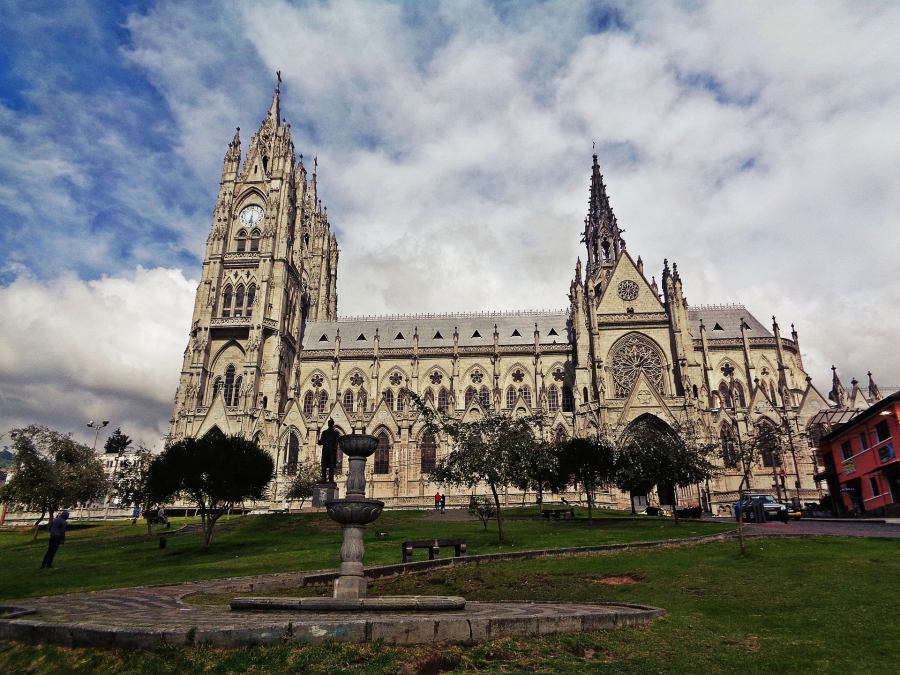
Construction of the largest neo-Gothic basilica in the Americas began in 1892, built from stone quarried on the Pichincha volcano, and to this day it remains unfinished. According to local legend, if it were ever completed the world would end, so part of the towers has deliberately been left unfinished.
The 115-meter twin towers can be climbed via steep stairs and iron ladders, and the view is breathtaking: from up there the entire old town and the volcanoes towering above it come into view. The gargoyles decorating the façade depict not the usual dragons but iguanas, turtles, caimans and armadillos.
The stained-glass windows are shaped like native orchids, and the interior, with its soaring columns, delivers a true cathedral experience. In the evenings the façade glows in blue and green light, making it one of the old town’s most photographed night-time sights.
La Compañía de Jesús Church
Construction of the Jesuits’ church began in 1605 and took almost 160 years, finishing in 1765, resulting in Quito’s most magnificent baroque building. The façade’s Solomonic columns and rich stone carvings represent the pinnacle of Spanish colonial architecture.
The interior is covered in nearly seven tons of 23-karat gold leaf, which illuminates everything from ceiling to altar. The dome and walls are covered in Mudéjar-style decoration and paintings depicting heavenly scenes, blending Spanish, Moorish and Andean influences.
The church is known as Quito’s most photographed interior, although photography is not actually permitted inside, which only adds to the site’s special atmosphere. It stands just a few steps from Plaza Grande, so it’s easy to include on an old-town walking route.
San Francisco Church and Monastery
Ecuador’s oldest church and South America’s first Franciscan monastery was built in 1535, on the foundations of an Inca temple that are still clearly visible on the monastery’s lower levels. The adjoining square is one of the city’s largest and busiest colonial-era squares.
The baroque interior is adorned with gilded carvings, paintings and side chapels, while a series of colonial-era paintings along the monastery’s corridors tells the story of the order. The complex also includes a museum showcasing masterpieces of the Quito school of painting.
The staircase leading down from the square is a popular meeting spot and resting place, offering a great view of the church’s two bell towers. On Sundays craft vendors fill the square, so religious and everyday life are closely intertwined here.
La Ronda
This cobblestone street is one of the oldest quarters of colonial Quito, home for centuries to poets, musicians and craftsmen. Renovated in the early 2000s, the street is now one of the old town’s most popular spots for an evening out.
The ground floors of the low, colorfully fronted houses are lined with guitar-making workshops, craft shops and traditional pastry shops, where you can try the local specialty, canelazo, a warm cinnamon-and-rum drink. Many of the houses are still lived in, which keeps the quarter authentic and alive.
In the evenings, cafés with live music and small galleries open their doors, and impromptu street performances can often be heard along the narrow street. The atmosphere is at its most magical around dusk.
El Panecillo
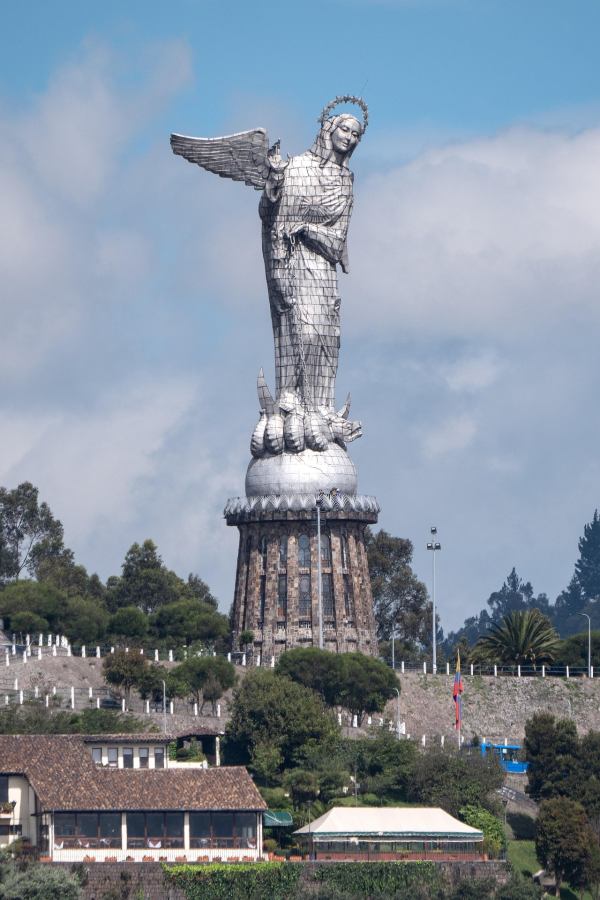
On the hill above the old town stands a 41-meter aluminum statue of the Virgin of Quito, erected between 1975 and 1976 based on an 18th-century wooden statue by the Quito sculptor Bernardo de Legarda.
The statue is the only winged Madonna in the world, standing over a dragon that evokes a scene from the Apocalypse. Its base houses a small museum and a viewing terrace offering a 360-degree panorama over the old town and the distant volcanoes.
It’s best to reach the hill by taxi or on an organized tour, since walking in the area is less safe in the evenings. Sunset is the best time to come up.
TelefériQo
Opened in 2005 on the slopes of the Pichincha volcano, this is one of the highest-climbing cable cars on the continent, carrying visitors in barely twenty minutes from 3,050 meters to nearly 4,050 meters, up to the viewpoint known as Cruz Loma.
Along the 2.5-kilometer route, the cabins leave the edge of the city, cross the tree line, and then glide on above the high-altitude páramo vegetation. On a clear day, the snow-capped peaks of Cotopaxi, Cayambe and Antisana are visible from the upper station.
Because of the high altitude, it’s worth preparing gradually for the trip and bringing warm clothing. Further hiking trails set off from the viewpoint along the volcano’s slopes, and horseback tours are also available.
Mitad del Mundo
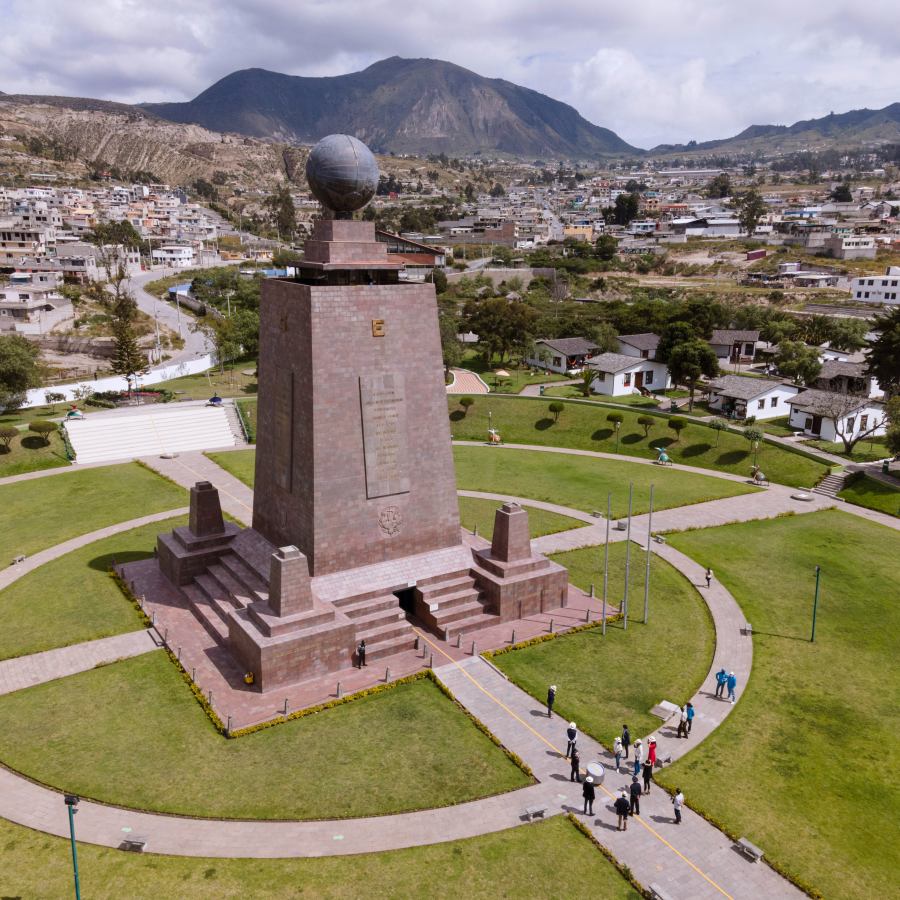
The monument marking the middle of the world takes its name from the fact that the equator runs through Quito. The current 30-meter obelisk, topped with a globe, was unveiled in 1979 in honor of the 18th-century French-Spanish geodesic expedition.
The complex built around the yellow line includes an ethnographic museum, restaurants and gift shops, and visitors can stand with one foot in each hemisphere for a photo. According to modern GPS measurements, the true equatorial line actually runs about 240 meters further north.
The site lies within Quito’s administrative boundaries, in the San Antonio de Pichincha district, about half an hour’s drive from the old town. The visit can often be combined with the neighboring Intiñán Museum, which is built right on the true equatorial line.
Parque La Carolina
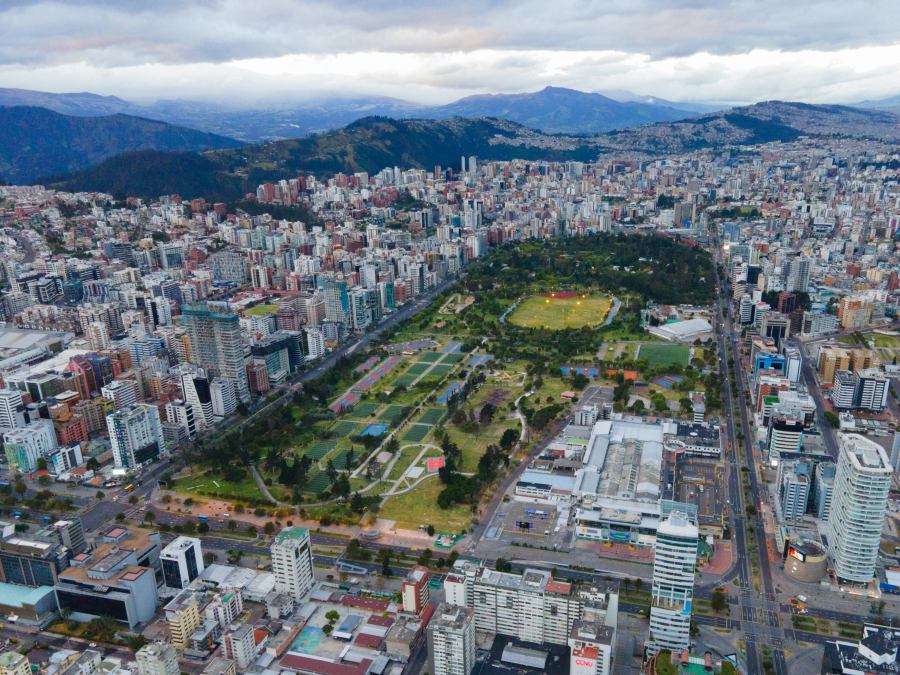
Known as the green lung of the new town, this park is a favorite spot among locals for relaxing and exercising, with running tracks, bike paths and sports courts lined up side by side.
The park is also home to a botanical garden, a natural history museum and an artificial lake where you can rent a boat. On weekends, crowds of families fill the grassy areas for picnics and bike outings.
The shopping district surrounding the park offers plenty of restaurants and cafés to stop at, making it easy to build a full day’s program around it. In the evenings the running tracks are lit up, making them suitable for exercise even late at night.
Guápulo Quarter
Tucked into the side of a steep canyon on the eastern edge of the old town, this quarter looks as though a separate Andean village had slipped into the edge of the big city. Its cobblestone streets wind their way down toward the Cumbayá valley.
At the heart of the quarter stands the 17th-century Sanctuary of Guápulo, whose baroque altars and statues are partly attributed to Manuel Chili, the famous Quito master carver. The viewing terrace above the church offers a stunning panorama of the valley.
Over the years, artists and musicians have discovered the quarter for themselves, so today galleries, small workshops and family restaurants add color to its streets. The atmosphere is calmer and more village-like than in the more crowded parts of the old town.
Parque Itchimbía
This park, spread over a hilltop above the old town, was once a garbage dump but has since been transformed into one of Quito’s most beautiful viewpoints and green spaces.
The park’s central building is a 19th-century iron-and-glass pavilion, originally intended as a market hall, later dismantled and transported piece by piece to its current location. Today it functions as an exhibition space and cultural center.
The hilltop offers an unmatched panorama over the old town’s church towers and the silhouette of the Basílica del Voto Nacional. The park’s paths are also popular among locals for running and walking dogs.
Best museums in Quito
Capilla del Hombre and Guayasamín Museum
The complex was conceived by Oswaldo Guayasamín, Ecuador’s best-known painter, as a tribute to his own life’s work and to the suffering of the peoples of Latin America. Construction began in 1995, but because the painter died in 1999, its doors did not open, posthumously, until 2002.
The block-like building was designed by Guayasamín himself together with his nephew, Handel Guayasamín, drawing inspiration from the shape of an Inca temple. Inside are the painter’s large, dramatic frescoes and painting cycles, including the unfinished “Potosí” series and the eternal flame burning for human rights and peace.
Besides the Capilla, the visit also includes the artist’s former home and studio, the Casa Museo, as well as an archaeological site made up of 13 pre-Inca tombs.
Full information here!
Casa del Alabado Pre-Columbian Museum
The colonial house that hosts the museum is one of the oldest buildings in the old town; an inscription dated 1671 above its gate preserves the memory of its founding. Located near Plaza San Francisco, the building served for centuries as a private residence and later as an apartment house.
The 17th-century mansion was converted into a museum by the Fundación Tolita, which holds around five thousand archaeological artifacts, five hundred of which can be seen in the permanent exhibition. The objects are grouped not by period but by conceptual themes, such as the notions of the underworld and the world above.
Visitors can explore the eight exhibition rooms, two quiet inner courtyards and a garden hiding a century-old fig tree, either with an audio guide or on a guided tour.
Full information here!
Museo Nacional del Ecuador (MuNa)
Founded by the Central Bank of Ecuador in 1969, originally occupying two floors of the bank’s headquarters. The core of the collection was built up from pre-Hispanic gold objects that the bank had acquired as part of its gold reserves.
The museum moved to its current home in the 1990s, into the “Mirrors Building” of the Casa de la Cultura Ecuatoriana, and after a lengthy renovation reopened its doors in 2018. Its six permanent galleries showcase around 14,000 years of Ecuadorian history, from the earliest artifacts through to modern and contemporary art.
Visitors can view pre-Columbian ceramics, gold objects, and masterpieces of colonial and republican-era painting free of charge. The museum is located in an easily accessible part of the new town, close to a metro station.
Full information here!
Museo Intiñán
This small museum dedicated to researching the middle of the world was founded in 1961 by the teacher and journalist Humberto Vera Herrera, who devoted his life to studying the indigenous peoples of the equatorial zone and the exact location of the equator.
This open-air, ethno-ecological complex is built on the true, GPS-measured equatorial line, about 240 meters north of the neighboring Mitad del Mundo monument. The grounds feature faithful replicas of the traditional huts of indigenous communities, including the Shuar and the Huaorani.
Bilingual guides use interactive experiments to demonstrate the equator’s unusual effects: here an egg can be balanced on a nail, and here you can watch water drain without forming a vortex. Thanks to its hands-on, playful presentation, it’s especially recommended for families traveling with children.
Full information here!
Quito weather: when is the best time to visit?
Quito’s climate is determined mainly by its elevation of 2,850 meters above sea level rather than by latitude: temperatures stay nearly constant all year round, and instead of the usual four seasons there are just two, a dry season and a rainy season.
Dry season (June–September):
This is when the weather is sunniest and most predictable, with daytime highs averaging 19–22°C and nights cooling to 7–9°C. Rainfall is lower and the skies are often clear, so the volcanoes and viewpoints are easier to see.
Rainy season (October–May):
Even though this is the longer period, it doesn’t mean constant rain – rather, expect short afternoon showers following sunny mornings. Daytime temperatures still hover around 15–21°C, with March and April being the wettest months.
Best time to travel to Quito:
The best time to travel is between June and September, when rainfall is lowest and the chances of clear skies for the volcano panoramas and the TelefériQo viewing route are highest. Ecuadorians like to say that in Quito you can experience all four seasons in a single day, which is why an umbrella and layered clothing remain useful travel companions all year round.
Frequently Asked Questions about Quito
Quito is located in the Ecuador Time (ECT, UTC–5) zone, and Ecuador does not observe daylight saving time.
Ecuador’s official language is Spanish, and it is also used in everyday life in Quito. Many people speak English at tourist attractions, hotels, and larger restaurants, but most locals communicate only in Spanish. Knowing a few basic Spanish phrases can make your trip easier.
Ecuador’s official currency is the US dollar (USD). You can pay by card in most shops, restaurants, and hotels, but smaller stores, markets, and street vendors often accept only cash. It’s worth keeping some smaller bills on hand.
Type A and B outlets are used in Quito. The mains voltage is 120 V, so an adapter is needed for European type C and F plugs, and it’s worth checking whether your electrical devices support 120 V.
Quito’s international airport, Mariscal Sucre International Airport (UIO), is located about 35 kilometers from the city. The city center can be reached by airport shuttle bus (Aeroservicios), scheduled bus, taxi, or Uber. The airport bus is a comfortable and affordable option, while a taxi is faster, especially with larger luggage.
Quito’s modern metro is a fast and convenient way to get around, complemented by trolleybuses and a dense bus network. Taxis and Uber can also be used safely, especially in the evening or for longer trips. The historic center is best explored on foot.
Like other major South American cities, Quito is generally safe for tourists, but it’s worth being cautious. Getting around the historic center and popular tourist neighborhoods is generally safe during the day, though pickpocketing can occur in crowded areas. At night, it’s advisable to use a taxi or Uber.
The La Mariscal district is one of the most popular choices for tourists, with numerous restaurants, bars, and hotels. The historic center (Centro Histórico) is excellent for those who want to stay close to the main attractions. The area around La Carolina Park is a modern, safe neighborhood with good transport links and high-quality accommodations.
Fiestas de Quito (early December) celebrates the founding of the city with concerts, parades, and cultural events.
Semana Santa (March–April) is one of Ecuador’s most significant religious holidays, featuring spectacular processions in the historic center.
Carnaval (February or March) is a popular holiday celebrated throughout the country, accompanied by festivals and street events in Quito as well.
Locro de papa: Creamy potato soup with cheese and avocado.
Hornado: Slow-roasted pork with potatoes and corn.
Fritada: A traditional pork dish served with corn and plantain.
Llapingachos: Cheese-stuffed potato patties, often served with meat and eggs.
Empanadas de viento: Cheese-filled fried pastry dusted with powdered sugar, one of Quito’s most famous street snacks.