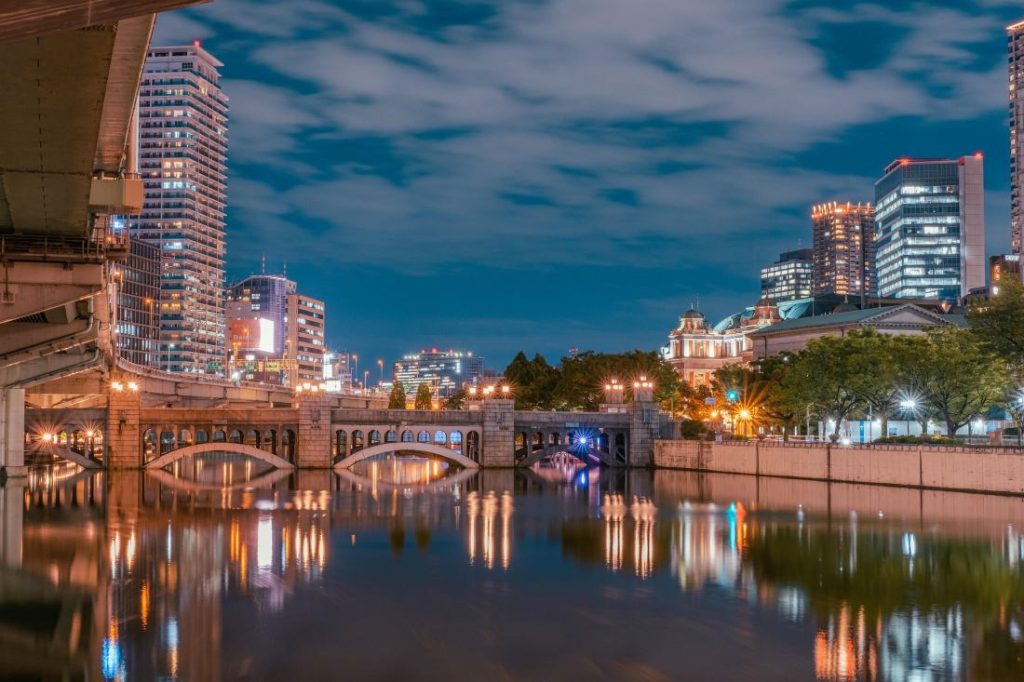
Osaka, similar to Tokyo, is a very exciting metropolis full of wonderful attractions and programs. When visiting Japan, it’s mandatory to come here!
Often referred to as Japan’s second largest city, Osaka has been the country’s commercial center throughout history. It is frequently called the „nation’s kitchen” and „Japan’s gastronomic capital”.
You can read my report about Osaka here!
Table of Contents
Osaka attractions
Osaka Castle
One of Japan’s most famous and significant historical monuments.
The castle, originally built in 1583, was erected by Toyotomi Hideyoshi, one of the country’s most important military commanders and political leaders, with the aim of unifying the country. It has been destroyed and rebuilt several times throughout history; its current form was completed in the 20th century, with a modern structure and museum function.
The impressive five-story main building stands on a high stone foundation surrounded by wide moats and massive stone walls. The interior exhibitions display historical documents, weapons, and armor from the Toyotomi era, while the top floor offers breathtaking views of Osaka. The castle surroundings are also special: in spring, the park becomes a magnificent sight with thousands of cherry trees in bloom.
The park around the castle is a popular resting place for both locals and tourists. There are lakes, walking paths, and picnic areas, as well as the Nishinomaru Garden, which is an excellent location for hanami, the tradition of cherry blossom viewing.

Shitennō-ji
The oldest Buddhist temple in Osaka and one of Japan’s most important religious sites.
The temple was founded in 593 by Prince Shōtoku, who played a key role in spreading Buddhism in Japan. Over the centuries, the temple has been rebuilt multiple times, but always following the original layout and style.
The temple consists of a large complex with the pagoda, the main hall (Kondō), and the lecture hall (Kōdō) at its center. The pagoda has five levels and is traditionally a symbol of Buddhism. The inner sanctuary houses a Buddha statue venerated by Prince Shōtoku, while important historical documents and artworks are kept in the surrounding buildings.
Gardens and ponds can be found in the temple grounds. The Gokuraku garden is particularly attractive to visitors as a traditional Japanese garden.

Sumiyoshi Taisha
One of Osaka’s oldest Shinto shrines, dedicated to the Sumiyoshi deities who are the protectors of sailors and travelers.
The building’s uniqueness lies in its traditional Japanese shrine architecture style (Sumiyoshi-zukuri), which has not been influenced by other external factors. One of its most iconic parts is the Taiko-bashi, a red arched bridge that spans the pond at the entrance. The bridge symbolizes purification and entry into the sacred place.
The complex encompasses several smaller shrines where different gods are worshipped and hosts numerous religious rituals. The first day of the new year (Hatsumōde) and the Sumiyoshi Matsuri are particularly popular events. During these times, both locals and tourists visit the shrine to pray for good fortune and happiness.

Umeda Sky Building
One of Osaka’s most modern and spectacular architectural wonders.
The skyscraper consisting of two towers was built in 1993, and they are connected by a spectacular floating bridge on the 39th floor. Due to its uniqueness and futuristic design, it has become one of the city’s most iconic attractions.
The Floating Garden Observatory is located on the upper floors and offers a stunning 360-degree panorama of Osaka, especially at sunset and at night when the city lights shine in all their glory. The observatory terrace is open-air.
On the ground floor, there is an interesting retro-style dining area that evokes Japanese streets from the 1920s. It’s an excellent place where visitors can taste authentic Japanese dishes.

Tsūtenkaku Tower
One of Osaka’s most recognizable symbols located in the heart of the Shinsekai district.
The original tower was built in 1912, modeled after the Eiffel Tower in Paris, but it was destroyed during World War II. The current 103-meter-high tower was rebuilt in 1956.
There is an observatory at the top of the tower, offering excellent views of the city. Inside the building, there are shops and exhibitions, including the famous Billiken statue, which is a symbol of luck and happiness in Japan. Visitors traditionally touch the statue’s feet to bring them good luck.

Abeno Harukas
A defining element of Osaka’s modern cityscape and Japan’s tallest building.
The 300-meter-high skyscraper is located in the Abeno district and serves multiple functions: offices, shops, a luxury hotel, and an art museum are all located within it. The building was designed to become one of the city’s new symbols.
One of the biggest attractions for visitors is the Harukas 300 observatory on the 60th floor. The observation deck with glass walls offers breathtaking panoramic views, and on clear days, even the distant Kansai region is visible. The view is particularly magnificent at night.
One of the interesting features of the building is the Kintetsu Department Store, one of Japan’s largest department stores. The multi-floor shopping center offers a wide selection of premium brands, local designers’ products, and mouthwatering foods.

Dotonbori
One of the liveliest and most iconic districts is the center of nightlife and gastronomy.
The promenade along the Dotonbori Canal is lined with giant neon advertisements, bustling restaurants, and unique entertainment venues. One of the most famous attractions is the large illuminated „Glico Man” advertisement, which has been a symbol of Osaka for more than half a century.
The district is also famous for its gastronomic offerings. Visitors can taste the city’s most famous dishes here, such as takoyaki (octopus balls) and okonomiyaki (Japanese pancake). One of its most famous restaurants is Kani Doraku, known for its huge, moving crab figure, and offering high-quality seafood.

Amerikamura
Osaka’s youthful and bohemian district is the city’s alternative cultural center.
The neighborhood near Shinsaibashi gets its name from the strong Western, especially American, influence present here. In the narrow streets, vintage clothing stores, unique designer shops, and street artists’ creations make the atmosphere special.
One of its most well-known locations is Sankaku Koen (Triangle Park), a favorite meeting place for local youth and artists. Street performances, live music concerts are often held here, and fans of unique fashion styles also frequently gather. The streets are decorated with colorful graffiti and modern installations on the walls.
Minoo Park
This picturesque valley is a paradise for nature lovers, where dense forests, crystal-clear streams, and an impressive waterfall await visitors.
The park’s most famous attraction is the Minoo Waterfall, which plunges from a height of 33 meters. The path leading to the waterfall is pleasantly winding, and along the way, small shrines, traditional teahouses, and local vendors’ stands make the hike even more atmospheric. One of the most unique local delicacies is momiji tempura, which is crispy maple leaves coated in batter and deep-fried.
It is attractive not only for its natural beauty but also for its rich wildlife. Squirrels, birds, and even wild monkeys can appear in the forested area. The park is especially magical in autumn when maple trees drape the landscape in red and gold colors.

Tennoji Park
One of the city’s most important green areas is also an important part of Osaka’s historical and cultural heritage.
One of the most popular parts of the park is the Keitakuen Garden, which is a traditional Japanese garden with ponds, carefully maintained plants, and small bridges. The Osaka Zoo is located here, which is home to many exotic animals, including elephants, giraffes, and red pandas.
Additionally, one of the city’s most important art institutions, the Osaka City Art Museum, is also located here.

Nagai Botanical Garden
One of Osaka’s most beautiful natural attractions is located in the southern part of the city, within the area of Nagai Park.
With its diverse flora and carefully designed green spaces, the 24-hectare garden is a perfect place to relax and discover the beauty of nature. As the seasons change, the garden’s appearance also continuously transforms; in spring, cherry blossoms, and in autumn, the red and gold shades of maple trees make it special.
There are several thematic sections in the garden, showcasing different vegetation zones of the world. One of the most popular attractions is the rose garden, where hundreds of rose species bloom with fragrance. Visitors can also walk along a lakeside promenade that showcases various aquatic plants and local bird life. Part of the garden is designed to display medicinal plants and traditional Japanese plants, allowing visitors to learn about the local botanical heritage.
Kuromon Ichiba Market
One of Osaka’s most famous and bustling gastronomic centers.
The name „Kuromon” means „black gate”, referring to the market’s location near one of the city’s historical entrances. The market, featuring more than 190 shops and stalls, has been serving locals and tourists for centuries.
The seafood available at the market is particularly famous: visitors can taste freshly grilled oysters, shrimp, sea urchin roe, and the famous Osaka fugu, or pufferfish. Local vendors are fond of preparing ingredients selected by customers, so visitors can taste freshly prepared foods on the spot.
Osaka Museum of History
The museum is located on the former grounds of the Naniwa Palace, which was one of the most significant buildings in Osaka’s ancient capital.
The museum’s goal is to present the city’s history in detail from ancient times to the modern era through interactive exhibitions and impressive reconstructions. The windows offer a beautiful view of the castle, further enhancing the historical atmosphere.
The visit starts from the top floor, where a full-scale reconstructed imperial throne room awaits visitors. Moving downward, the exhibition presents different eras, from the ancient Naniwa merchant town through the samurai era to Osaka’s modern development. The collection includes archaeological finds, old maps, period utensils, and traditional costumes.
All information can be found here!
Osaka Museum of Housing and Living
This unique museum reconstructs an entire street from 19th-century Osaka, where visitors can gain insight into the everyday life of the period’s urban environment.
The museum is located on the upper floor of a modern building, where visitors can walk among traditional houses as if they had traveled back in time.
The exhibition showcases the dwellings of different social classes, merchants’ shops, and traditional Japanese interiors. Visitors can also enter the houses, where they can admire period furniture, tools, and household items. In the authentic environment, periodic performances and craft demonstrations also take place.
All information can be found here!
Osaka Aquarium
Also known as Kaiyukan, it is one of Japan’s largest and most spectacular marine life centers.
The aquarium’s specialty is showcasing the Pacific Ocean’s ecosystem in huge, impressive water tanks. The most famous attraction is the central tank, where a giant whale shark swims above visitors’ heads.
The different exhibition spaces display the diversity of the world’s marine life, including tiny tropical fish, jellyfish, penguins, and seals. Visitors descend in a spiral shape, gradually immersing themselves in the beauty of the deep-sea world.
The aquarium also offers interactive experiences; for example, visitors can pet rays and smaller sharks in a separate pool.
All information can be found here!

Universal Studios Japan
One of Osaka’s most popular tourist attractions offers exciting adventures for film fans and entertainment seekers alike.
One of the park’s biggest attractions is The Wizarding World of Harry Potter, where visitors can enter the famous wizarding world. Hogwarts Castle has been recreated with impressive detail.
Another iconic area is Super Nintendo World, which brings the world of famous Nintendo games to life. In the Jurassic Park zone, you can ride a huge water roller coaster. Visitors can encounter lifelike dinosaurs up close, including the dreaded Tyrannosaurus Rex.
There are numerous restaurants and cafes in the park where you can taste foods related to the worlds of films and games.
All information can be found here!

Osaka weather: when is the best time to travel here?
Osaka has a four-season, humid subtropical climate that includes hot, rainy summers and mild, occasionally cool winters.
Spring (March-May):
Spring is pleasantly warm and gradually becomes sunnier. The average temperature ranges between 10-22°C, and the amount of precipitation gradually increases in spring. In April and May, the cherry trees’ blossoming gives a special atmosphere to the city, making this one of the most attractive periods for tourists.
Summer (June-September):
Summer in Osaka is hot and extremely humid, with frequent rain and storms. The average temperature ranges between 25-35°C, but due to the high humidity, it can feel even hotter. The rainy season begins in June, bringing heavy showers, while typhoons can occur in August and September.
Autumn (September-November):
Autumn is one of the most pleasant seasons in Osaka. The weather is milder, the average temperature ranges between 15-25°C, and the amount of precipitation significantly decreases compared to the summer months. The fresh air, pleasant temperature, and autumn foliage colors make this period ideal for sightseeing and outdoor activities.
Winter (December-February): Osaka’s winter is moderate and relatively dry, with average temperatures between 3-12°C. Although sno
wfall rarely occurs, on cold, windy days it can feel colder. During the winter months, the city is illuminated with festive lights, and numerous seasonal events await visitors.
Best time to travel:
The most ideal time to visit Osaka is spring (March-May) and autumn (September-November), when the weather is pleasant, precipitation is moderate, and the city’s natural beauty can be best enjoyed.