
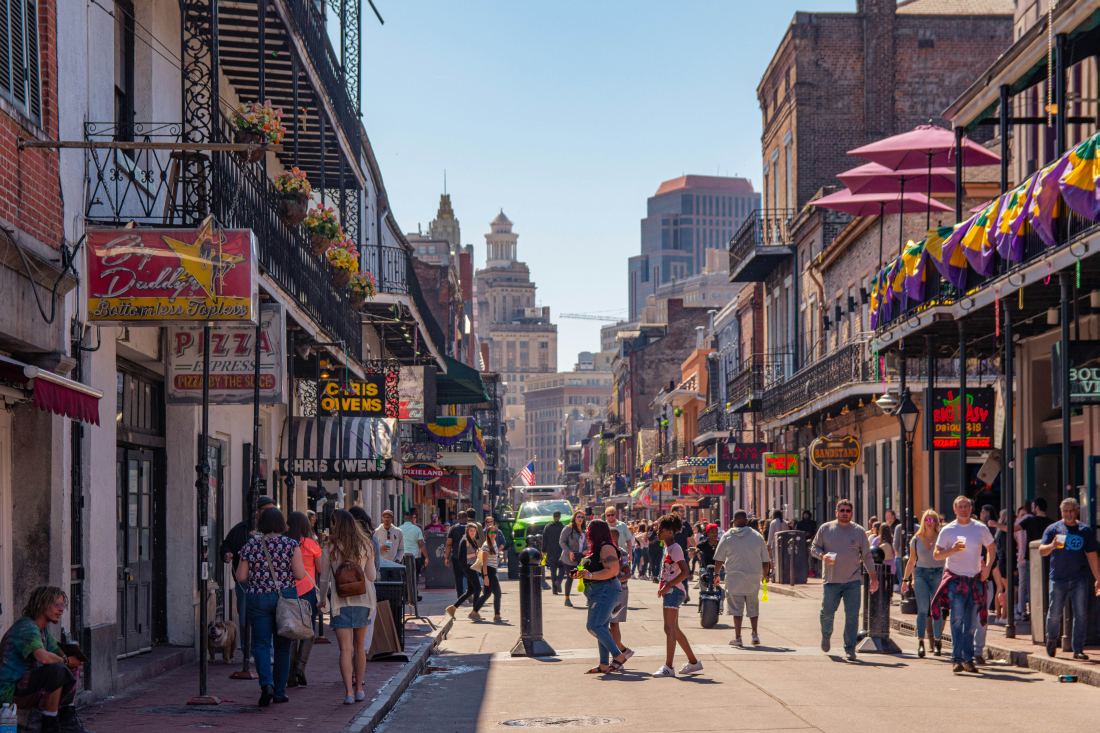
New Orleans is the birthplace of jazz, the cradle of French and Creole culture, and home to colorful festivals. Located in southern Louisiana, this historically significant city is a must-visit destination because of its unique atmosphere and rich heritage!
The city is one of the most diverse settlements in the USA: it was founded by the French but was also under Spanish rule. As New Orleans was an important port, it became the main center of the slave trade during the antebellum period. These influences continue to define the city’s character today.
Table of Contents
New Orleans attractions
French Quarter (Vieux Carré)
The oldest and most famous district of the city, with roots dating back to the 18th century. One of the most unique historical quarters on the American continent, it still preserves the architectural heritage of the French and Spanish colonial period.
The colorful buildings lining the narrow streets feature characteristic balconies decorated with cast-iron railings. Most of the historic houses were built in the Creole style, with inner courtyards and gardens. Walking through the streets, we can encounter street musicians at every turn, keeping the city’s musical heritage alive.
The French Quarter is not only historically significant but also serves as the city’s cultural and entertainment center. A colorful variety of restaurants, bars, art galleries, and shops await visitors. The area is particularly magical at night.
Bourbon Street
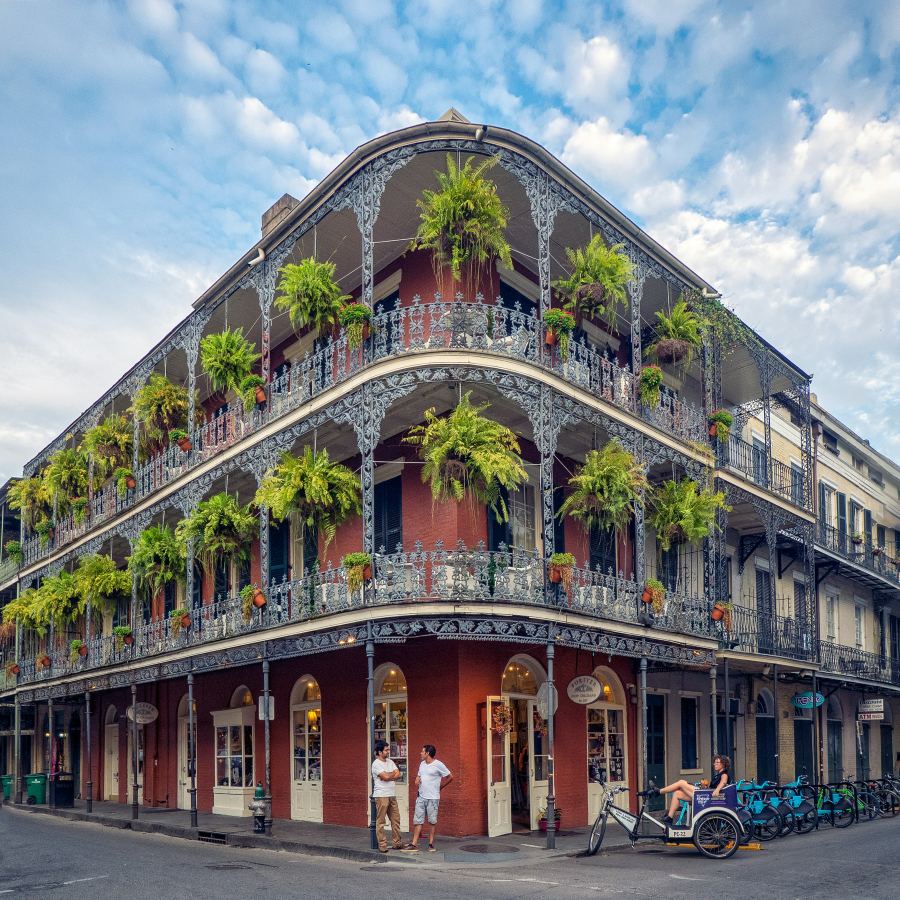
New Orleans’ most famous and bustling street is located in the heart of the French Quarter. Approximately thirteen blocks long, the street is the center of nightlife, where entertainment venues, bars, and music clubs are lined up one after another.
The street is lively during the day, but its true character only unfolds after sunset. Here you’ll find several legendary jazz clubs where the memory of the genre’s greats lives on. Thanks to the so-called „go-cup” practice, taking drinks outside is permitted, allowing the street to transform into a true carnival.
Its historical significance is also noteworthy, as it is home to numerous old buildings, including former brothels, gaming halls, and speakeasies from the Prohibition era.
Royal Street
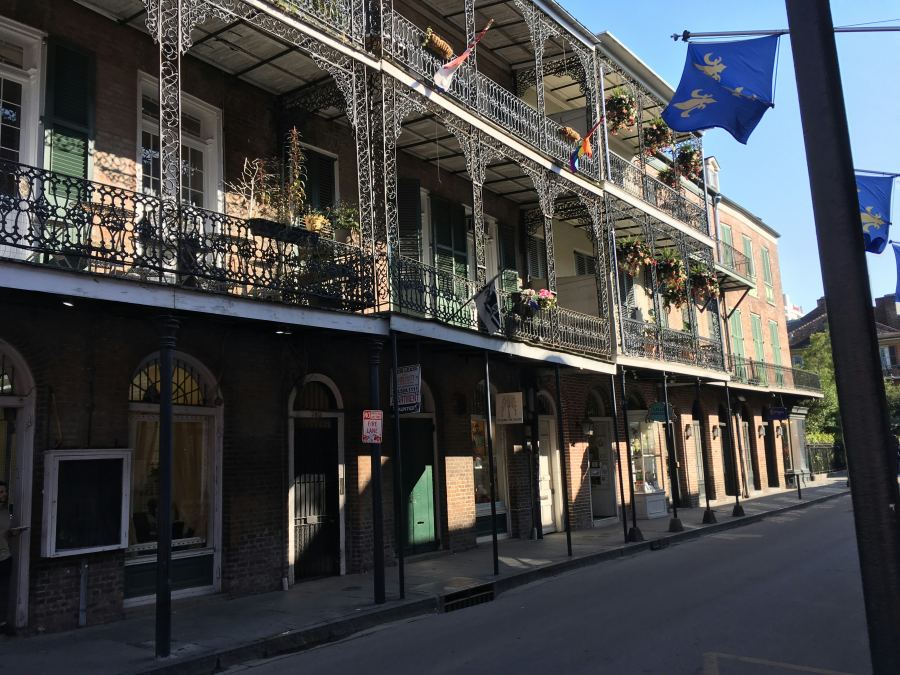
Located just a block away from the noisy hustle and bustle of Bourbon Street, this elegant street exudes a completely different atmosphere. It is a paradise of refined art, antique shops, and historical architecture.
The street’s main attractions are exclusive art galleries, antique shops, and jewelry stores. During the day, certain sections of the street are closed to vehicular traffic, allowing street musicians and performers to freely entertain the walking public.
Among its architectural treasures are the Gallier House, the Lalaurie Mansion, and many other historically significant buildings. The meticulously restored facades, beautiful balconies, and courtyards visible from the street offer a glimpse into New Orleans’ golden age. The street offers a quieter, more sophisticated alternative to the bustle of Bourbon Street.
Jackson Square
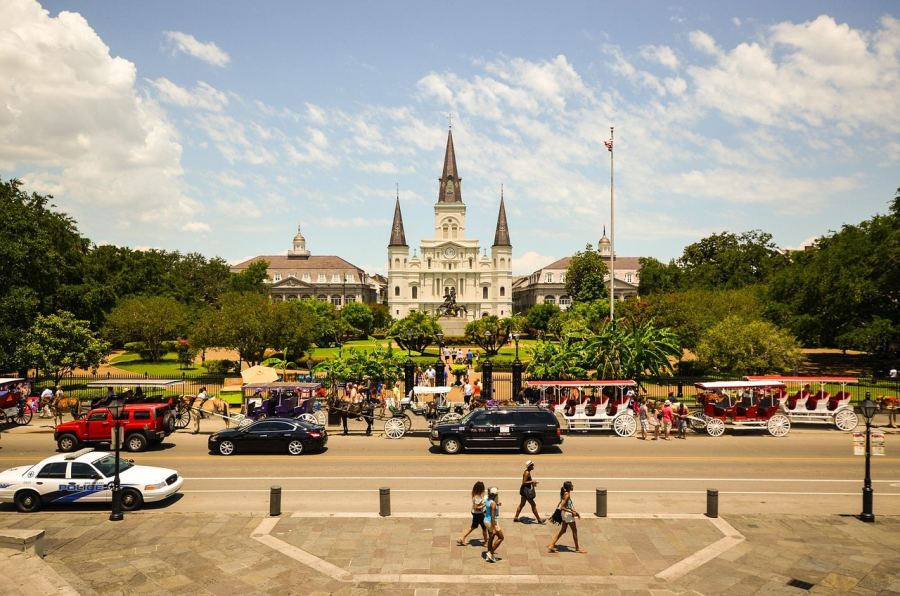
This historic square in the French Quarter was formerly known as Place d’Armes.
The beautiful park was designed in the 18th century modeled after the Parisian Place des Vosges. It was named after American President Andrew Jackson, whose equestrian statue is the central element of the square.
Surrounding the square is the Pontalba Building, the oldest continuously operating apartment building in the United States, with shops and cafes on the ground floor. The square is bordered on three sides by imposing historic buildings, the most notable being the St. Louis Cathedral.
It is not only historically significant but also an important center of the city’s cultural life. The park is populated by fortunetellers, street artists, and musicians who lend a unique atmosphere to the place. Artists sell their works hung on the park fence, transforming the square into an open-air gallery.
St. Louis Cathedral
One of America’s oldest cathedrals towers on the northern side of Jackson Square.
The current building was constructed in 1794 after the original church burned down in the great fire. The cathedral’s white facade and three slender towers form one of New Orleans’ most iconic sights.
The interior of the church is just as impressive as its exterior. The ceiling frescoes, colorful stained glass windows, and the intricate details of the carved altar reflect the influence of European sacred art. The massive chandelier at the center of the cathedral is a special element of the interior space.
The cathedral functions as an active parish church but is also open to tourists. In the museum next to the church, we can learn about the closely intertwined threads of the cathedral’s and the city’s history. The view of the French Quarter and the Mississippi River from the cathedral’s towers is amazing.
Garden District
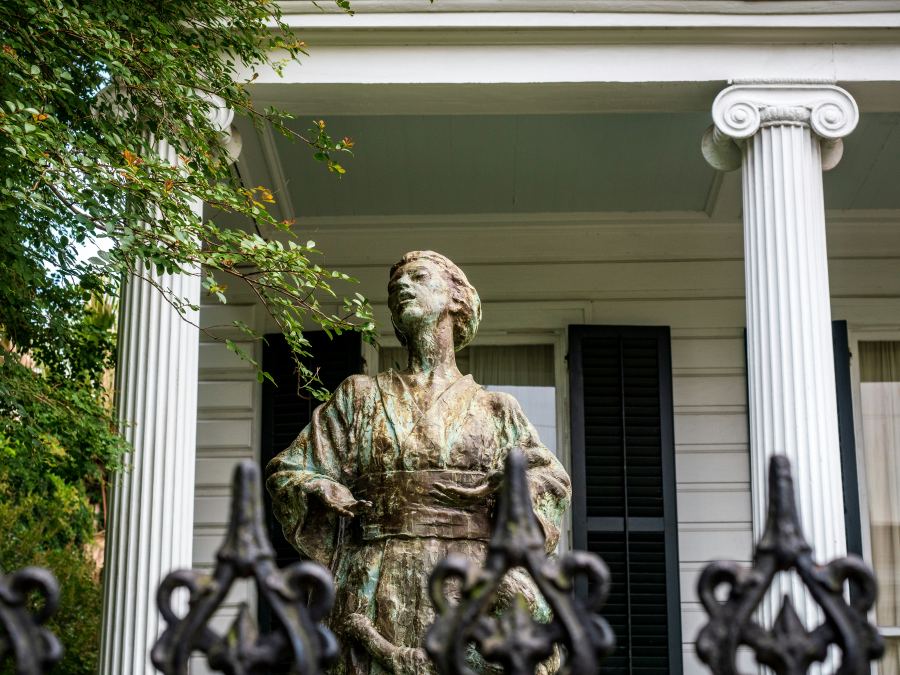
One of the city’s most beautiful residential areas developed in the 19th century when wealthy Americans did not wish to settle in the Creole-inhabited French Quarter. The area along St. Charles Avenue is one of the best-preserved historic garden suburbs in the United States.
Its characteristics include beautiful antebellum villas, Victorian mansions, and Greek Revival style homes surrounded by meticulously maintained gardens. The neighborhood is also home to celebrities – numerous film and series stars have chosen the area as their residence, including Sandra Bullock and author Anne Rice.
The best way to explore the district is on a walking tour, during which we can view iconic houses such as the Walter Robinson House, the Anne Rice House, or the Victorian building of the Commander’s Palace restaurant.
Faubourg Marigny
This bohemian neighborhood is located directly on the eastern side of the French Quarter and originally served as the estate of Creole plantation owner Bernard de Marigny in the early 19th century.
The area is now one of the most important centers of New Orleans’ musical and artistic life, particularly famous for the jazz clubs on Frenchmen Street. Its architecture is similar to that of the French Quarter, but less visited by tourists, thus exuding a more authentic atmosphere. At the heart of the district is Washington Square Park, a popular venue for local community events and festivals.
Jazz clubs, bars, and restaurants line Frenchmen Street. Musical venues here, such as the Spotted Cat or d.b.a., are real meeting places for local musicians, where visitors can experience authentic New Orleans jazz, funk, and blues music.
Lafayette Cemetery No. 1
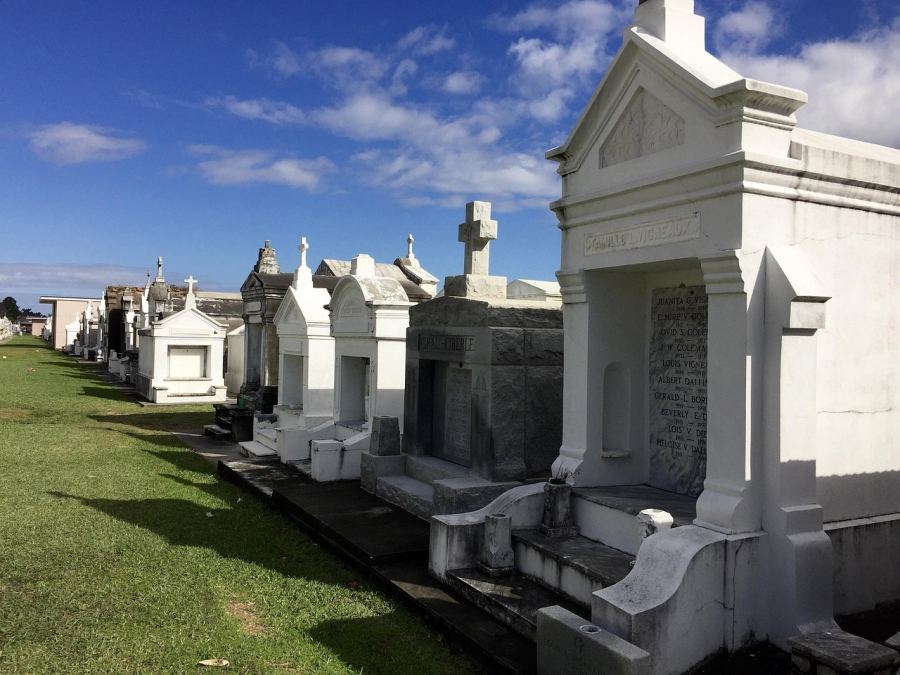
One of New Orleans’ most famous cemeteries is located in the heart of the Garden District and opened in 1833.
The cemetery follows the so-called „city of the dead” layout, where graves are placed in above-ground mausoleums and family crypts due to the swampy soil. The white-washed crypts and moss-covered tombstones create a special contrast.
Special attractions include the Firemen’s Tomb, which preserves the memory of firefighters who served in the 1800s, as well as numerous epitaphs commemorating victims of the 19th-century yellow fever epidemics. It has been a filming location for numerous famous films and television series, including the adaptation of Anne Rice’s „Interview with the Vampire”.
Steamboat Natchez
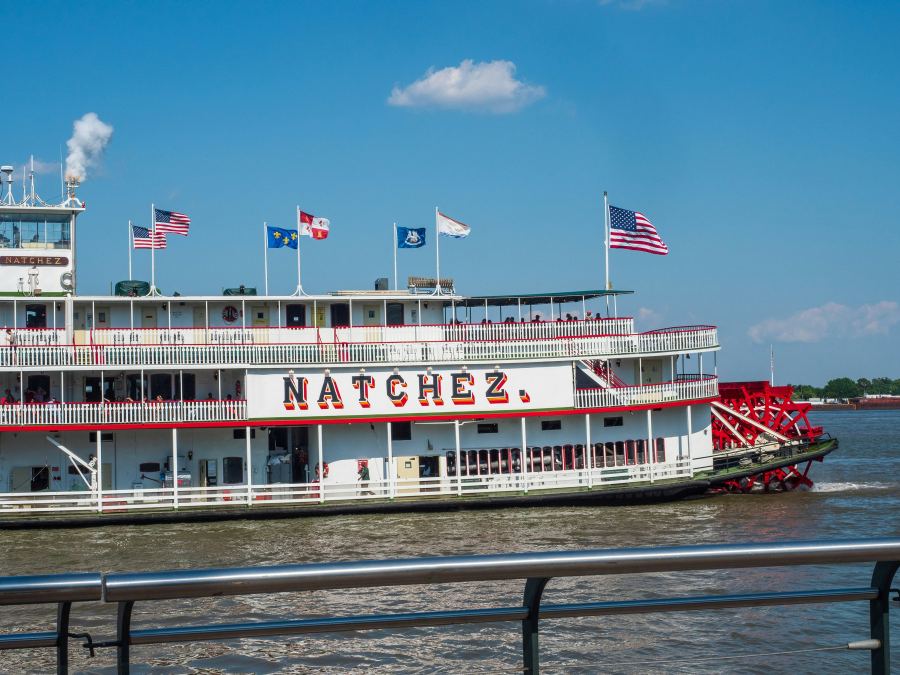
The last authentic steam-powered paddle wheeler on the Mississippi River is a living memory of the old southern river navigation. The Natchez is the ninth vessel to bear this name.
The steam organ operating on the ship’s deck still sounds the original calliope (steam organ), one of New Orleans’ characteristic sounds. The restaurant on the middle deck offers a special experience where guests can admire the views of the Mississippi riverbank.
During the two-hour sightseeing cruise, skilled guides narrate the history of the river and the city, including the significance of southern plantations, the Civil War, and commerce in the region’s development. Visitors can also view the ship’s engine room, where they can observe the operation of the massive steam engines.
Preservation Hall
One of the most authentic sanctuaries of New Orleans jazz music opened in 1961 with the aim of preserving, protecting, and spreading traditional local jazz music.
The small, non-air-conditioned hall can accommodate just 100 visitors who listen to the music sitting on benches or on the floor. The walls of the building are decorated with black-and-white photographs of jazz legends, including many musicians who once played on the Preservation Hall stage.
Several concerts are held every evening, featuring the Preservation Hall Jazz Band or other local musicians. Due to its special atmosphere and the authenticity of the musical experience, visiting this place is a must for all jazz enthusiasts.
New Orleans City Park
One of the city’s largest public parks spans more than 1,300 hectares and is among the oldest parks in the country.
Founded in the 1850s, the park is famous for its ancient oak trees, many of which are more than 800 years old, with their moss-covered branches providing a fairy-tale sight. The park encompasses numerous special gardens and facilities, including the New Orleans Botanical Garden and the Sculpture Garden, which features more than 90 sculptures in an outdoor setting.
The Storm King playground, rebuilt after Hurricane Katrina, is one of the largest and most innovative playgrounds in the entire region. Also worth mentioning is the Carousel Gardens amusement park, where a carousel more than a hundred years old still turns.
Louis Armstrong Park
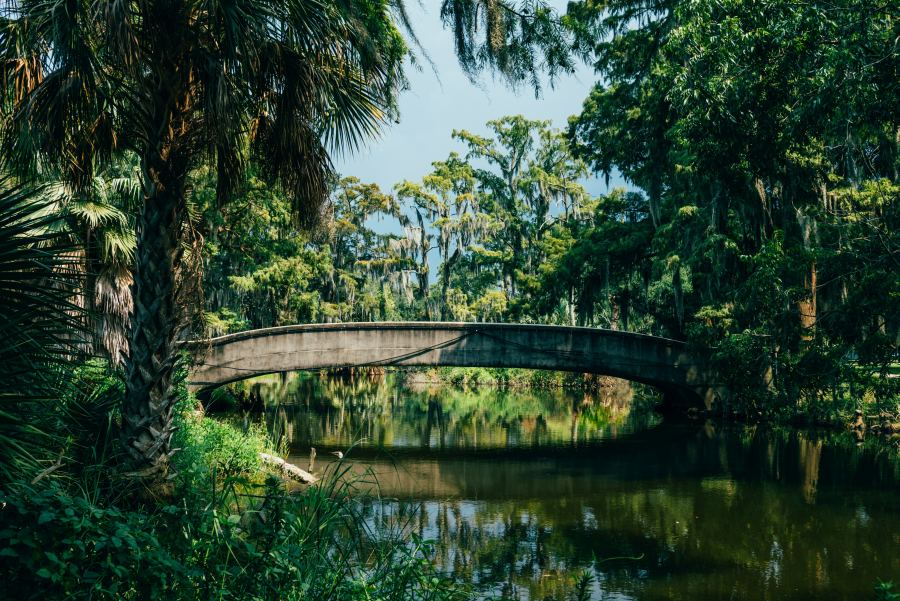
Located in the French Quarter neighbourhood, Louis Armstrong Park commemorates the city’s famous jazz heritage.
The park is named after the legendary trumpeter Louis Armstrong, a native of the city. Its centrepiece is Congo Square, historically a meeting place for African slaves and their descendants – the birthplace of jazz and other African American musical styles.
The green space is home to sculptures, lakes, bridges and walking paths, and is a frequent venue for concerts and cultural events.
French Market
The oldest continuously operating market in the United States boasts more than 200 years of history.
It originally served as a trading place for Americans, then developed further under the French and Spanish. The market stretches six blocks long and includes numerous pavilions, shops, restaurants, and performance venues.
At the Farmer’s Market section, we can purchase fresh, local products, while at the Flea Market area, we can browse through handcrafted items, jewelry, clothing, and souvenirs. Besides being an important tourist attraction, it is also a favorite meeting place for locals. It houses many famous food vendors, including the Central Grocery, where the original muffuletta sandwich was invented.
Café du Monde
This iconic café has been operating on the edge of the French Market since 1862 and is one of New Orleans’ most famous gastronomic institutions.
The café is primarily known for beignets, which are square-shaped, deep-fried French doughnuts generously sprinkled with powdered sugar. This traditional delicacy is typically served with distinctive chicory coffee, prepared according to a recipe dating back to the French colonial era. Adding chicory to coffee became widespread during the Civil War when coffee was scarce, and this tradition has persisted to this day.
Café du Monde is open 24 hours, closing only on Christmas and during hurricanes. The open pavilion-style building with a white and green roof is located near the Mississippi River, providing an unparalleled view.
Audubon Aquarium
This modern aquarium located on the banks of the Mississippi River is one of the city’s most important natural science institutions.
Operated by the Audubon Nature Institute, the facility is home to more than 15,000 aquatic animals representing 250 different species. Its most impressive part is the Great Caribbean Reef exhibit, a 400,000-gallon tank where sharks, rays, and colorful tropical fish swim over visitors’ heads in an underwater tunnel.
The Mississippi River exhibit offers a special insight into the local freshwater ecosystem, while the Gulf of Mexico exhibit showcases the region’s marine wildlife, including endangered sea turtles. In the Amazon rainforest section, we can admire piranhas, anacondas, and other tropical species, while the penguin and seal exhibits feature inhabitants of colder climates.
All information can be found here!
New Orleans Jazz Museum
Showcasing the city’s musical heritage, housed in the historic Old U.S. Mint.
Its exhibitions chronologically and thematically chart the evolution of jazz, from its African and Caribbean roots to its 19th century birth in New Orleans to its modern-day roots. The second floor auditorium hosts regular concerts featuring local and international musicians.
Its collection is one of the largest in the world, with more than 25,000 items. At the core of the collection are more than 12,000 instrumental artefacts, including Louis Armstrong’s first cornet, Sidney Bechet’s clarinet and the personal instruments of many other legendary musicians.
The museum’s sound archive contains more than 4,000 rare recordings, including early wax cylinders, 78rpm records and unique concert recordings. Particularly valuable is the William Ransom Hogan Jazz Archive, which includes interviews with the first generation of musicians of the genre.
All information can be found here!
New Orleans Museum of Art (NOMA)
Located in City Park, this is one of New Orleans’ most important cultural institutions, which opened its doors in 1911.
The impressive neoclassical building houses one of the most significant art collections in the southern states. It preserves more than 40,000 artifacts spanning five millennia of artistic creation. The collection is particularly strong in French and American fine arts, as well as African and Oceanic tribal art. One of the museum’s prides is the works of Edgar Degas.
The museum also includes the Sydney and Walda Besthoff Sculpture Garden, which spans five hectares and displays more than 90 sculptures by modern and contemporary artists such as Henry Moore, Louise Bourgeois, and Isamu Noguchi.
All information can be found here!
Mardi Gras World
This unique attraction provides a behind-the-scenes look at the world-famous New Orleans carnival, Mardi Gras.
During the visit, we can learn about the history and traditions of the carnival while viewing the massive, colorful figures, floats, and decorations up close. In the workshop, we can also observe the work of artists and craftsmen as they create the giant papier-mâché figures, masks, and ornaments. As part of the tour, visitors can even taste a slice of traditional King Cake, which is one of the characteristic sweets of Mardi Gras.
The facility, open every day of the year, houses thousands of carnival props and costumes that featured in previous celebrations in its warehouses. Visitors can try on some costumes and take photos in front of iconic backgrounds.
All information can be found here!

Voodoo Museum
One of America’s most unusual museums is located in the heart of the French Quarter. It showcases the history and practice of the voodoo religion, which is an important part of New Orleans’ cultural heritage.
The religion originated in West Africa and was brought to the New World through the slave trade, where it mixed with Catholic traditions. Visitors can learn about the life and legacy of Marie Laveau, the famous New Orleans voodoo queen, as well as the rituals, symbols, and objects of the religion. The altars, amulets, bones, and ceremonial items in the museum demonstrate the authentic practice of voodoo.
Visitors can participate in guided talisman-making workshops or consult with a practicing voodoo priest. The museum also aims to dispel misconceptions about voodoo and showcase its true spiritual and cultural significance.
All information can be found here!
New Orleans weather: when is the best time to visit?
New Orleans has a subtropical climate characterized by hot, humid summers and mild winters. The city’s weather is significantly influenced by its proximity to the Gulf of Mexico.
Spring (March-May):
Spring is an ideal time to visit New Orleans. The average temperature ranges between 18-25°C, and the air is not yet too humid. Flowering plants, especially azaleas and magnolias, dress the city in beautiful colors. Spring is also the season of important festivals, including the French Quarter Festival and the Jazz & Heritage Festival, which provide additional attractions for visitors.
Summer (June-August):
Summer in New Orleans is extremely hot and humid, with average temperatures often exceeding 32°C, and the high humidity making it feel even hotter. Afternoon showers and thunderstorms are common.
This period coincides with hurricane season, which officially runs from June 1 to November 30, with the greatest activity in August and September.
Fall (September-November):
The second half of autumn, especially October and November, offers pleasant weather for exploring New Orleans. The average temperature ranges between 15-26°C, and humidity gradually decreases. Towards the end of hurricane season, the risk decreases, but September still requires attention.
During this period, the city hosts numerous cultural events and festivals, such as the Voodoo Music + Arts Experience and the Krewe of Boo Halloween parade.
Winter (December-February):
Winter in New Orleans is mild, with average temperatures ranging between 10-18°C. Although colder days may occur, frost is a rare phenomenon. This period is ideal for exploring the city, especially due to the Mardi Gras season, which begins in January and culminates around February/March with the famous Fat Tuesday celebration.
Best time to travel:
The most ideal periods for visiting New Orleans are spring (March-May) and the second half of autumn (October-November), when the weather is pleasant, the number of festivals is high, and natural beauty can be enjoyed at its best.