
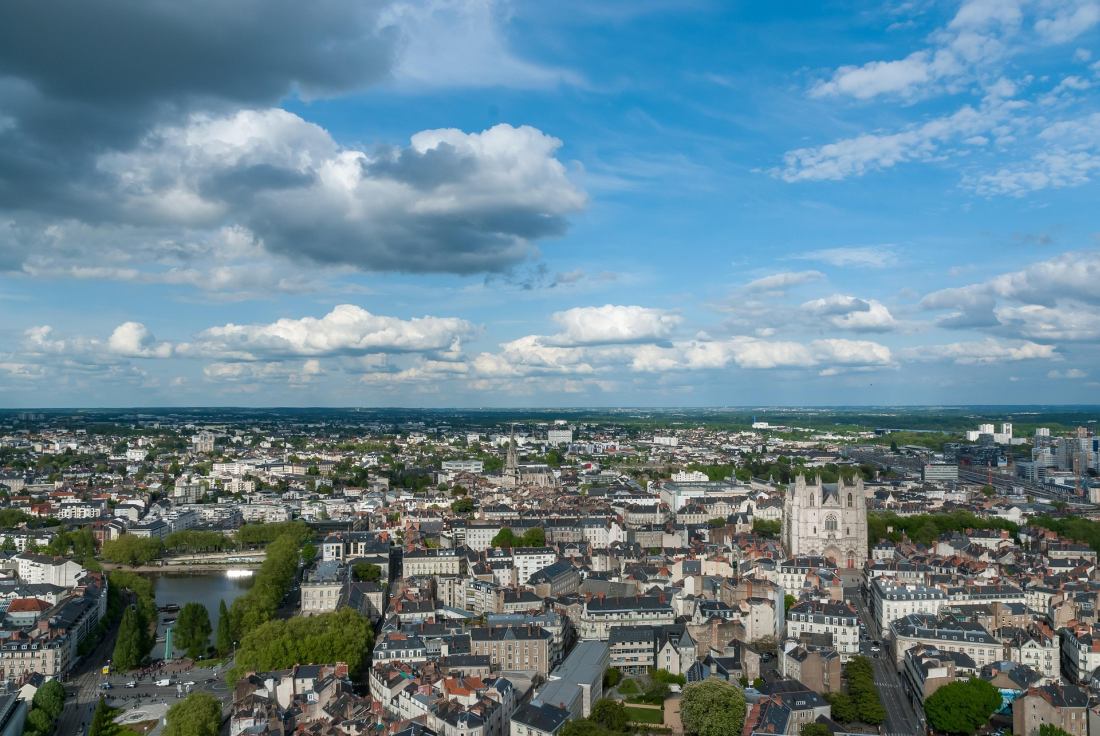
Nantes, the French city on the banks of the Loire, is becoming ever more popular with tourists. Thanks to its many attractions, it is one of the most appealing travel destinations in the country.
As the capital of the Pays de la Loire region, Nantes was once the seat of the Dukes of Brittany, and today it is regarded as one of the greenest and most creative large cities in France.
The narrow streets of the historic quarters are enlivened by contemporary art installations and surprising industrial heritage, while the banks of the Loire have a truly special atmosphere.
Table of Contents
Nantes attractions
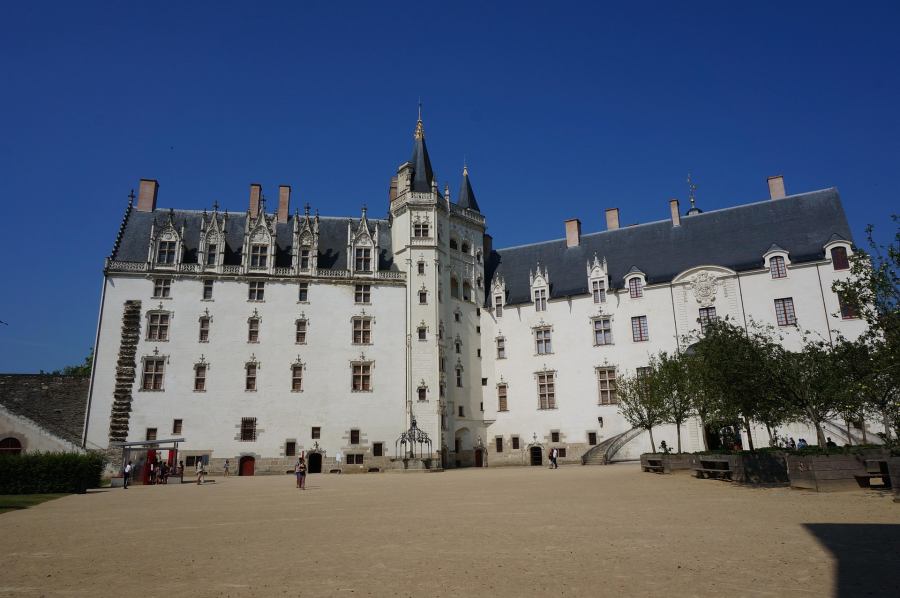
Château des Ducs de Bretagne
One of the most important and best-known historic buildings in Nantes, it was the residence of the Dukes of Brittany for centuries.
The current castle was built between 1465 and 1500 by François II, the last independent Duke of Brittany, and completed by his daughter, Duchess Anne. It stands on the site of an earlier fortress raised in 937 under Alain II Barbetorte, of which only the polygonal Old Keep survives today. In 1598, King Henry IV of France signed the Edict of Nantes here, and over the centuries the castle also served as barracks, an arsenal and a prison.
Visitors are struck by the castle’s imposing size: it is surrounded by seven towers and about 500 metres of ramparts, once protected by a moat and topped by a continuous sentry walkway. The Grand Logis and the Golden Crown Tower in the courtyard represent the transition between Flamboyant Gothic and the Renaissance, while the smaller and larger governor’s buildings bear witness to continuous use in the 16th–18th centuries.
Today the castle houses a museum presenting the history of Nantes and the Nantes region, where more than 850 objects and numerous multimedia installations in 32 rooms bring the story of the port city to life. The ramparts and the courtyard can be visited freely and free of charge, so even passing tourists can catch a glimpse of the ducal past without buying a ticket.
Cathédrale Saint-Pierre-et-Saint-Paul
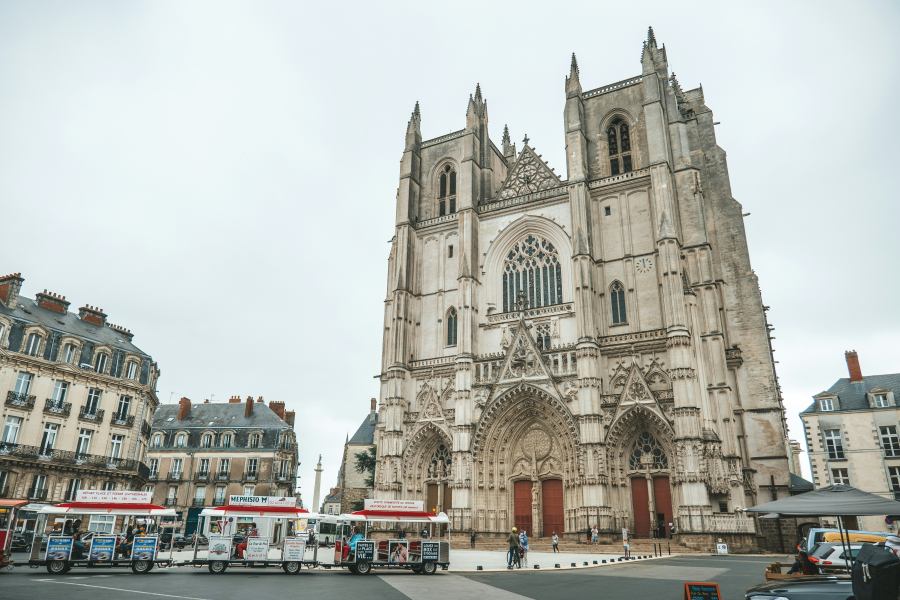
Standing in the heart of Nantes’ old town, the cathedral is one of the most outstanding French examples of Flamboyant Gothic, and its construction took an unusually long time: 457 years.
The foundation stone was laid in 1434 by John V, Duke of Brittany, but the building only received its final form in 1891. Despite the long construction period, the cathedral’s style remained unified, because the successive architects followed the original plans throughout.
The facade of white tuffeau stone is framed by two massive towers, and the interior is breathtaking: the vault of the nave soars to a height of 37.5 metres, higher than that of Notre-Dame in Paris. In the right transept stands the Renaissance tomb of Francis II, Duke of Brittany, and his wife, Margaret of Foix, commissioned by Duchess Anne from the sculptor Michel Colombe in the early 16th century and carved from Carrara marble.
The cathedral has had a turbulent history: it was damaged during the French Revolution, hit by a bomb in 1944, its roof structure was destroyed by fire in 1972, and in 2020 an arson attack claimed the 17th-century organ and several historic stained-glass windows. Since autumn 2025 the building has been gradually reopening to visitors, although part of the restoration work is still under way.
Les Machines de l’île
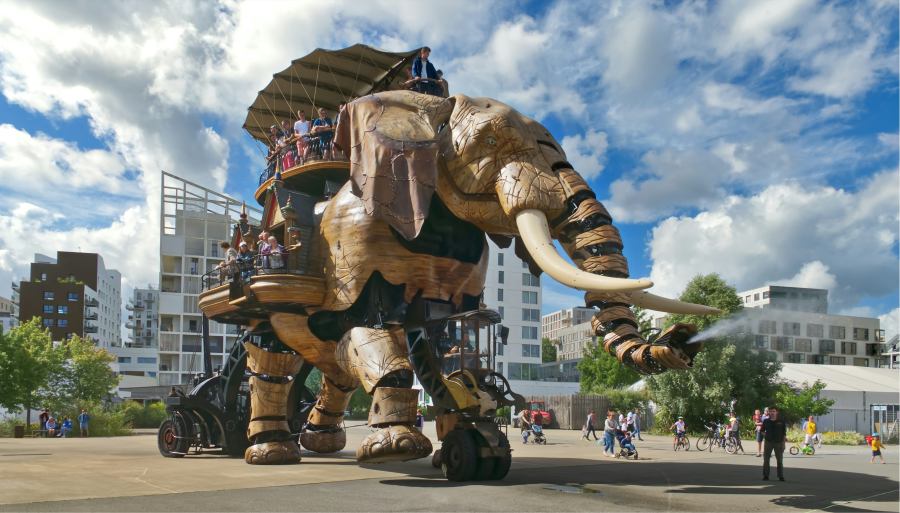
One of the most unusual and most popular attractions in Nantes is a mechanical wonderland created on the site of the former shipyard, born from the imagination of François Delarozière and Pierre Orefice.
The project combines the imaginary worlds of Jules Verne, the engineering genius of Leonardo da Vinci and Nantes’ industrial past in a single place. Since 2007, the huge elephant built of wood and metal has become the symbol of the city, and it has been walking in the Chantiers park every summer ever since.
The Great Elephant, 12 metres tall, 8 metres wide and weighing 45 tonnes, can carry up to 50 passengers on its back on a 30-minute walk, spraying water from its trunk at onlookers along the way. The Marine Worlds Carousel, 25 metres tall and opened in 2012, parades 36 remarkable sea creatures on its three levels – including a giant crab and a squid – while in the Gallery of the Machines visitors can even marvel at the creative workshop itself.
The park is constantly being expanded: the new project currently under construction is called the Heron Tree (Arbre aux Hérons), which will include a giant mechanical tree and birds. With its stunning views towards the Loire and the island quarter, as well as its family-friendly programmes, the attraction is a must-see stop on any visit to Nantes.
Passage Pommeraye
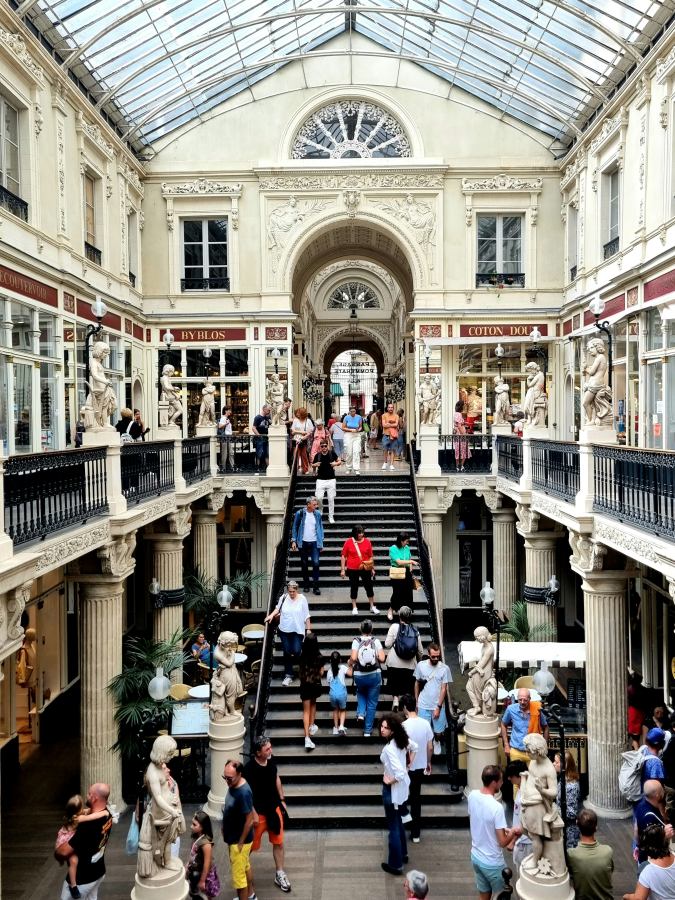
This three-level covered shopping arcade in the heart of the city centre is one of the most elegant and most photogenic buildings in Nantes, and it is often compared to the passages of Paris.
Construction of the arcade began at the end of 1840 on the initiative of a young notary, Louis Pommeraye, with the works partly financed by the sugar refiners. The passage opened on 4 July 1843 between rue de la Fosse and rue Santeuil, bridging the level difference of nearly 9.4 metres between the two streets.
The designers, Jean-Baptiste Buron and Hippolyte Durand Gasselin, created a richly decorated building in a neoclassical and Renaissance style: beneath the iron and glass roof, a monumental staircase adorned with allegorical statues connects the levels, while the walls are clad in tuffeau stone.
The passage has been a listed monument since 1976, and it is not only a favourite promenade of the people of Nantes but has also inspired numerous artists, including the film director Jacques Demy and the comic artist Jacques Tardi. It struggled financially during the economic crisis of 1846–47, but today fashionable shops and restaurants welcome visitors once again.
Île Feydeau
Now an island in name only, this was the elegant residential district of 18th-century Nantes shipowners, and Jules Verne was also born here in 1828.
Development of the district began in the 1740s on a sandbank surrounded by two arms of the Loire; the river arms were filled in during the interwar period, so the island has by now merged organically into the city.
Many of the white-fronted, richly decorated townhouses have distinctively leaning walls, because the sandy subsoil has sunk beneath them over the centuries. The wrought-iron balconies are decorated with carved mascarons with cheerful or stern expressions, and a whole row of shipowners’ mansions lines quai Turenne.
Behind the splendour of the district lies a dark history: the families living here made most of their fortune from the Atlantic slave trade, as in the 18th century Nantes was France’s leading slave-trading port. Today, green lawns stretch where the filled-in riverbed once lay, and on sunny days students and office workers relax there during their lunch breaks.
Quartier du Bouffay
The medieval core of Nantes, the Bouffay quarter is the cradle of the city, where place du Bouffay was once the site of the administration of justice.
The famous French military commander Gilles de Rais was also held here in the notorious Nantes prison before his execution. Over the centuries the quarter was a centre of everyday trades, which the street names still preserve today.
The narrow, cobbled pedestrian streets – such as rue des Chapeliers (Hatters’ Street) or rue des Bastions – are lined with half-timbered houses, tiny shops, bars and restaurants. By day the quarter is calm and quiet, and it is easy to get lost in the medieval street network.
In the evenings the Bouffay shows a completely different face: it is a favourite haunt of students and young people, full of buzzing cafés and lively terraces. Thanks to its central location, it is also a perfect starting point for exploring the castle and the cathedral.
Les Anneaux (Quai des Antilles)
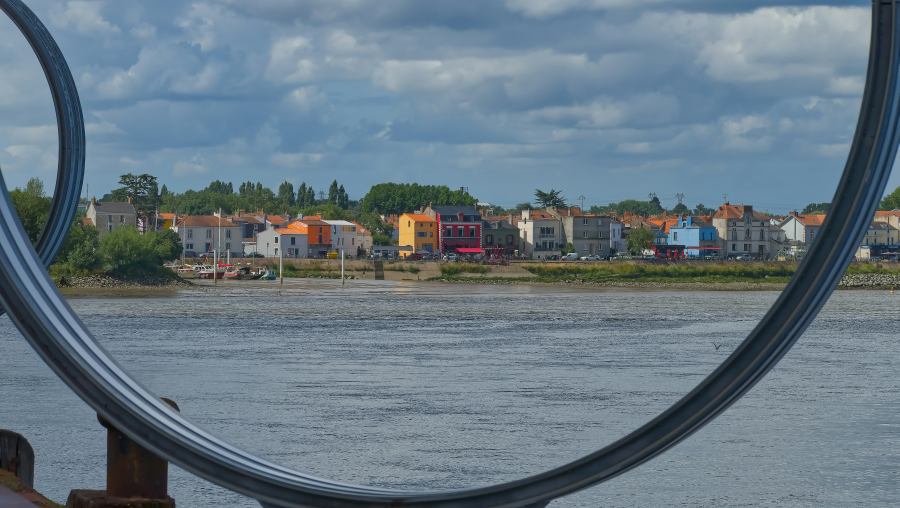
One of the best-known works of contemporary public art in Nantes was conceived by the artist Daniel Buren and the architect Patrick Bouchain.
The work was created in 2007 as part of the first edition of the Estuaire festival, and it has welcomed visitors ever since as a permanent installation on the riverside promenade.
Each of the 18 metal rings in the series faces the Loire, framing the view of the river and the estuary as if in a picture frame. The rings offer a double perspective: they open onto the architectural line of the quay on the one hand and onto the river itself on the other.
After dark the rings glow with red, blue and green light, giving the place a completely different atmosphere. Nearby stands the Hangar à Bananes, once a warehouse for bananas and pineapples arriving from Guadeloupe and Africa, which today is occupied by restaurants, bars and a contemporary exhibition space.
Mémorial de l’abolition de l’esclavage
Located on quai de la Fosse, the memorial is the largest in the world dedicated to the abolition of slavery, and it recalls the painful past of Nantes: about 45 percent of French slave-trading expeditions departed from the city.
The memorial was designed by the Polish artist Krzysztof Wodiczko and the Argentine-American architect Julian Bonder, and it was inaugurated on 25 March 2012.
Along the 7,000-square-metre memorial walk stretching along the riverbank there are 2,000 glass plates, 1,710 of which bear the names and departure dates of slave ships. Beneath the quay runs a meditative underground passage, whose 90-metre glass wall is inscribed with historical texts on the struggle for abolition.
The Mémorial is free to visit and open all year round, and it is the only memorial in mainland France dedicated exclusively to slavery. A twelve-panel city walk symbolically links it to the History Museum of Nantes in the castle.
Jardin des Plantes
Spreading out near the railway station, the botanical garden is one of the most significant plant collections in France, created in its present form in 1806 under the direction of Jean Alexandre Hectot. It became municipal property in 1820 and opened to the general public in 1829, and under the director Jean Marie Ecorchard it was transformed into an English-style park with about 2,500 plant species.
The pride of the garden is the Hectot magnolia planted in 1807, which is now one of the oldest southern magnolias in Europe, with a trunk circumference of 2.3 metres. Nantes is also home to the national collection of camellias: of the 1,300 varieties found in the city, 600 can be seen here, and in the greenhouses visitors can also see cacti, palms and the rare Wollemi pine, discovered only in 1994.
The park is free to visit, except for the greenhouses, where an admission fee is charged. Besides the ponds, waterfalls and carefully trimmed flower beds, a children’s playground and a petting zoo also await families, making it an excellent outing not only from a botanical but also from a recreational point of view.
Tour Bretagne
Rising above the city centre, the 144-metre, 32-storey skyscraper was for decades one of the most distinctive and most controversial buildings in Nantes.
It was designed by the architect Claude Devorsine, work began in 1971, and the tower opened on 18 November 1976. The building was born on the initiative of the then mayor, André Morice, who wanted to erect a symbol of modern Nantes.
The terrace on the top, 32nd floor, the “Nest” (Le Nid), was reopened to the public in 2012 after more than a decade of closure, offering a 360-degree panorama of the city, the Loire and the surrounding countryside.
The tower is currently facing a major transformation: the owner is looking for new functions and a new image for the building, so that it can once again become a central venue of city life. Even so, it remains one of the most recognisable landmarks of Nantes, visible from afar.
Île de Versailles
This tiny artificial island on the Erdre river was created in 1831 during the dredging works linked to the construction of the Nantes–Brest canal, and it was originally worked by tanners and shipbuilders. It took on its present appearance in 1983, when it was converted into a Japanese garden, and it was officially opened to the public in September 1987.
In the Japanese garden of just 1.7 hectares, rock gardens, waterfalls, ponds full of koi carp, cherry trees, maples and bamboo groves evoke the atmosphere of the Far East. The site also includes the Maison de l’Erdre, which hosts exhibitions on the history of the river.
Admission is free all year round, and the island attracts about 1.2 million visitors a year, making it the second most popular park in Nantes even though it is the smallest of the city’s large parks. Just a few steps from the noise of the city centre, it offers meditative calm.
Quartier Graslin
This elegant quarter, built in the late 18th century, came about on the initiative of Jean-Joseph-Louis Graslin, the chief receiver of the royal tax farms, who wished to create a stately, bourgeois district in Nantes. The Nantes-born architect Mathurin Crucy was commissioned with the design, and he conceived a neoclassical ensemble of buildings around today’s Place Graslin.
The central building of the quarter is the Opéra Graslin, the city’s main opera house, which still functions as an active cultural centre today. Nearby runs the tree-lined Cours Cambronne promenade, flanked by elegant bourgeois mansions.
The cafés of Place Graslin – including the historic La Cigale brasserie – are favourite meeting places for the people of Nantes. The quarter can easily be combined in one walk with the Passage Pommeraye and the riverside quai de la Fosse district.
Best museums in Nantes
Fine Arts Museum (Musée d’Arts de Nantes)
It was founded in 1801 with the purchase of the Cacault collection, and it has been continually expanding its holdings with works by living artists ever since – a rarity among French fine arts museums. Its current late-19th-century palace was remodelled and extended between 2009 and 2017 by the British firm Stanton Williams with a contemporary art wing, the Cube.
The collection presents more than 900 works from the 13th century to the present day, with pieces by masters such as Perugino, La Tour, Ingres, Delacroix, Courbet, Monet, Picasso, Kandinsky and Soulages.
In the building near the cathedral and the Jardin des Plantes, visitors are also welcomed by a café run by Eric Guérin’s Michelin-starred chef.
Musée Jules Verne
It opened in 1978 to mark the 150th anniversary of the birth of the writer Jules Verne, on the initiative of the painter Jean Bruneau and the library director Luce Courville. The city acquired the building gradually: the upper part in 1965 and the lower part in 1973, and it was fully renovated in 2005 for the centenary of Verne’s death.
The white 19th-century villa stands on the Sainte-Anne hill above the Loire – although Verne himself never lived here, as his parents’ house stood nearby in Bas-Chantenay – and in its eight themed rooms original furniture, manuscripts, first editions and models of his inventions evoke the author’s world.
From the rock platform there is a stunning view of the river and the island quarter, where the mechanical monsters of the Machines de l’île can also be seen.
Natural History Museum (Muséum d’histoire de Nantes)
Its roots go back to 1799, when the pharmacist François-René Dubuisson created a cabinet of curiosities from his own private collection; the museum officially opened its doors in 1810. It moved to its present home, the former Hôtel de la Monnaie, in 1875 to plans by the architect Gustave Bourgerel, and it was extended with a terrarium in 1955 and with an adjoining wing in 1970.
The zoology gallery displays more than a thousand vertebrate specimens, including a huge whale skeleton, while the earth sciences collection holds minerals, fossils and one of the richest meteorite collections in France. About twenty species of live reptiles can be seen in the terrarium.
The modern, recently renewed exhibition spaces receive nearly 120,000 visitors a year. The museum is located near the Jardin des Plantes and Place Graslin, on an easily walkable route.
Weather in Nantes: when is the best time to visit?
Nantes has a temperate oceanic climate with four clearly distinct seasons. Owing to the proximity of the Atlantic Ocean, the weather is relatively mild and balanced all year round, with summers that are not too hot and winters that are rarely harsh, although for most of the year you should expect showers of varying length.
Spring (March–May):
During spring the daytime temperature gradually rises to between 5 and 19 degrees, while rainfall slowly decreases. May is one of the most pleasant months: milder weather, fewer tourists and gardens in bloom – including the Jardin des Plantes – await visitors.
Summer (June–August):
The warmest and sunniest season, with July the most favourable month: daytime temperatures reach 24 degrees and around 16 degrees at night, with 13–14 hours of sunshine a day and only about 25 percent of days rainy. This is also the period of the Voyage à Nantes summer art festival, when the city’s installations, including Les Anneaux, come especially alive.
Autumn (September–November):
In September you can still expect pleasantly warm days of 22–23 degrees, but October is already one of the wettest months, with nearly 100 millimetres of rain and about 20 rainy days. The autumn light and the smaller number of tourists nevertheless make this period ideal for quieter sightseeing.
Winter (December–February):
Thanks to the oceanic influence, winters are mild, and even in January, the coldest month, the average temperature ranges only between 3 and 9 degrees. Snowfall is rare, but rain can often be expected even then, so it is worth packing a waterproof jacket.
Best time to travel:
The period between May and September is ideal for visiting Nantes, when the weather is pleasant, rainfall is moderate, and the city’s museums, parks and summer festivals can all be enjoyed at their best.