
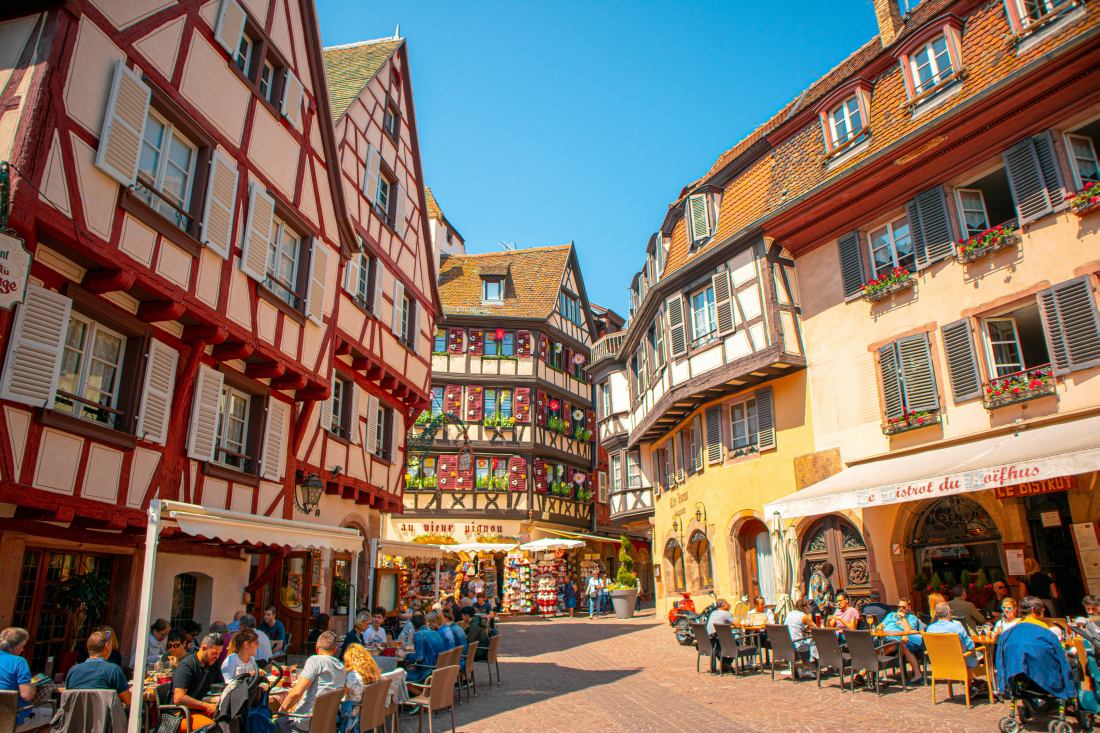
Strasbourg is a uniquely architectural and cultural city, largely thanks to its location. Although most people know it for the Council of Europe, it also has countless attractions that draw large numbers of tourists.
Lying in the northeastern corner of France on the banks of the Rhine, directly along the German border, the city belonged alternately to France and Germany for centuries, and today this dual identity forms its main charm. Strasbourg’s historic city centre, the Grande Île, is a UNESCO World Heritage Site, and the city also plays an important role on the continent as one of the official seats of the European Union and as the home of the Council of Europe and the European Court of Human Rights.
Table of Contents
Strasbourg attractions
Strasbourg Cathedral (Cathédrale Notre-Dame-de-Strasbourg)
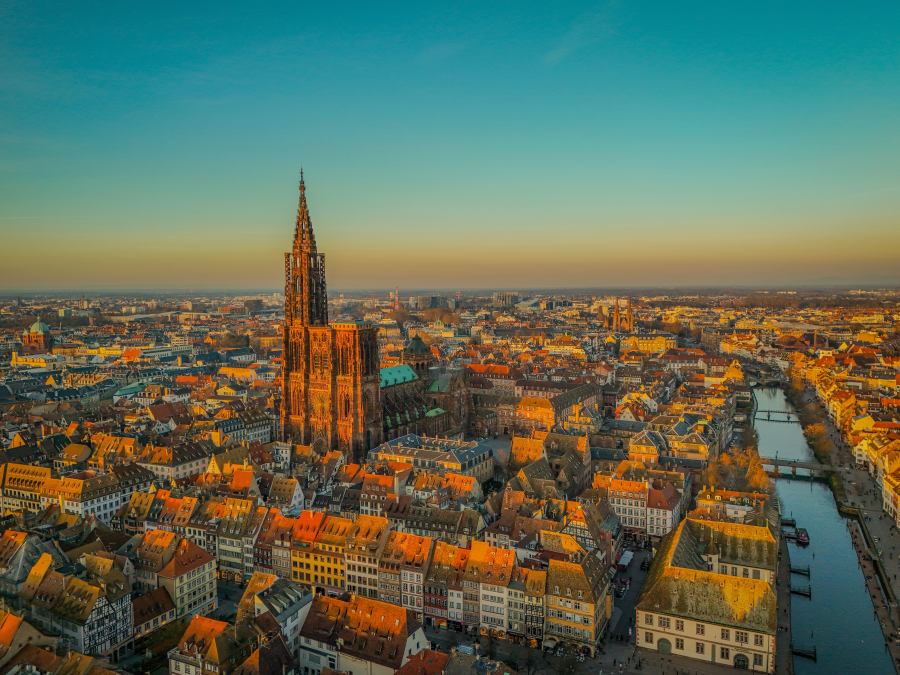
Built of pinkish Vosges sandstone, the cathedral is one of France’s most imposing Gothic structures, and for centuries was considered the tallest building in the world. Construction began in the 11th century on earlier Romanesque foundations, and the church acquired its lace-like façade during the 13th–15th centuries; the single completed tower, at 142 metres, held the title of „tallest building” until 1874.
Inside, visitors are greeted by stunning medieval and Renaissance stained-glass windows, as well as the 16th-century astronomical clock, whose moving figures display the time of day at 12:30pm. Climbing the tower’s 332 steps rewards visitors with a panoramic view of the old town, and on clear days, all the way to the Black Forest.
The square in front of the cathedral is one of the busiest spots in the city, home to the most important stalls of the Christmas market in December. Thanks to the finely carved sculptures on the façade and the reliefs of the western portal, the church is often called „lace carved from stone”.
Petite France
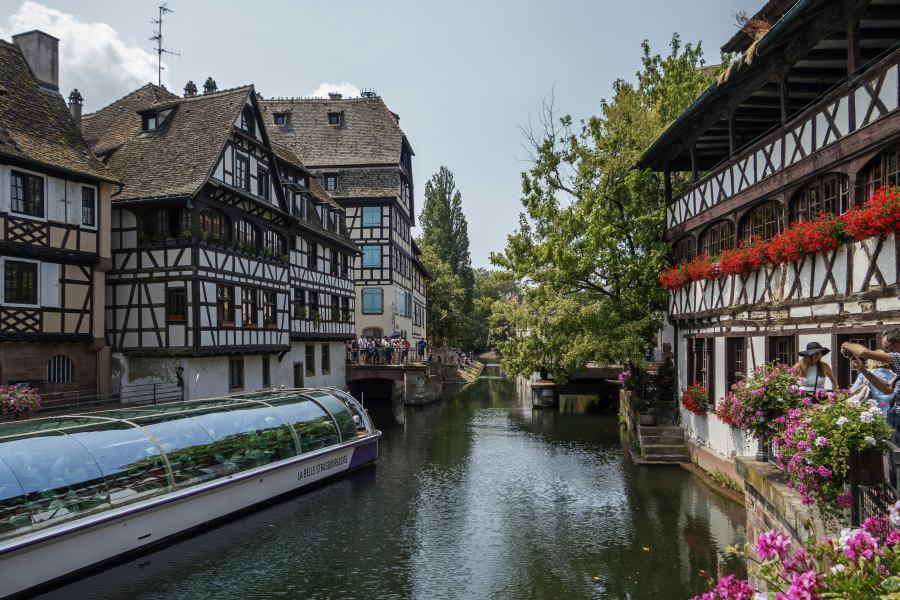
The district, crisscrossed by a network of canals, was home to tanners, millers and fishermen in the Middle Ages, which is also where its French-sounding but disputed name originates. With its many half-timbered houses and flower-decked windowsills, the quarter is among the most photographed spots in Strasbourg.
The narrow streets winding between the houses, tiny bridges and timber-framed façades leaning over the water create a picturesque atmosphere, especially at dusk, when the canals reflect the illuminated buildings. At the heart of the district stands the Tanners’ House, which today operates as a restaurant.
Petite France is also Strasbourg’s culinary hub: traditional Alsatian restaurants along the canals serve sauerkraut dishes and flammkuchen. As part of the Grande Île, the area is a UNESCO World Heritage Site.
Covered Bridges, Vauban Dam
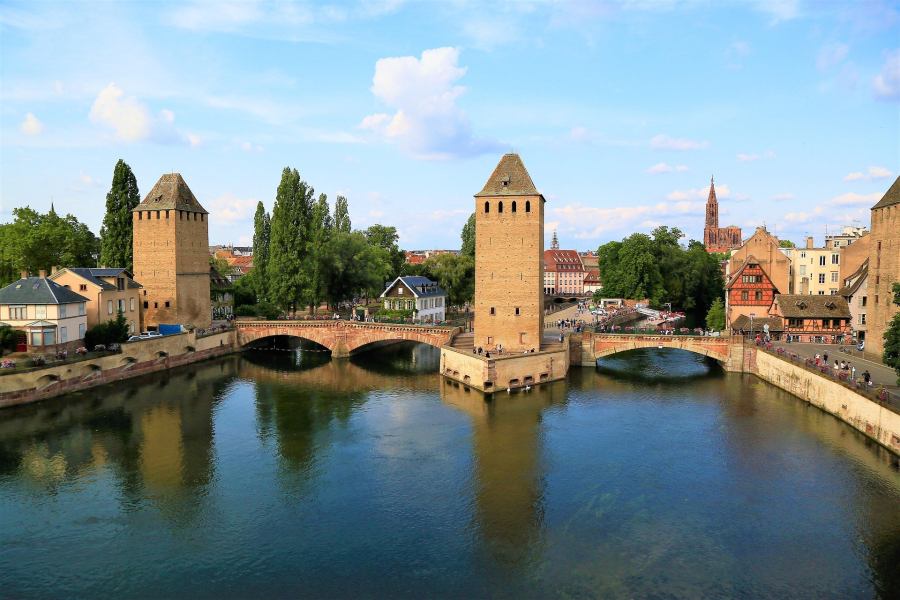
The Ponts Couverts, or Covered Bridges, were originally built in the 13th century as part of the city’s defensive system, with four medieval towers guarding the city from the west. Although the wooden bridges’ roofs have long since disappeared, the name has remained, and the towers still define this corner of the cityscape today.
The Vauban Dam next to the bridges was built according to the plans of the 17th-century fortress architect Sébastien Le Prestre de Vauban, originally for defensive flooding purposes. The panoramic terrace atop the dam offers a 360-degree view of the cathedral, Petite France and the covered bridges alike.
The site is especially popular at sunset. The terrace is free to visit, and the city’s sightseeing boats pass beneath the bridges.
Place Kléber
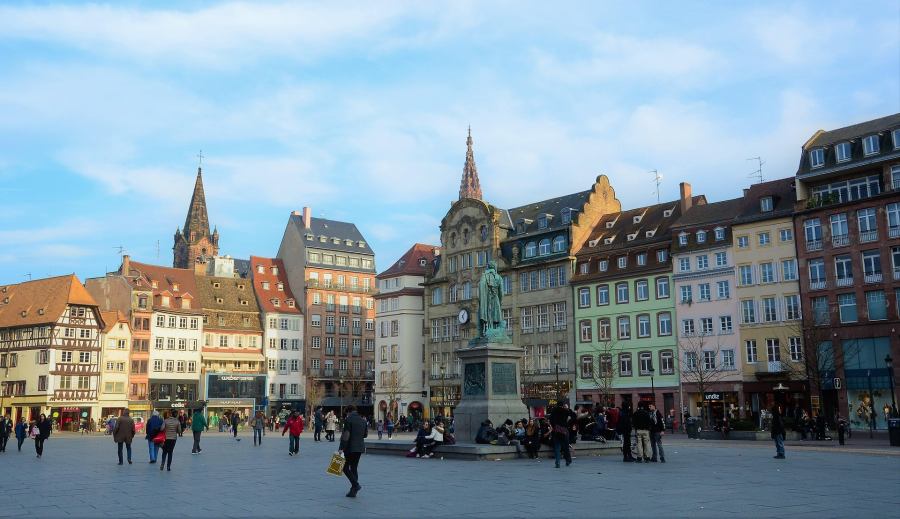
Strasbourg’s largest and liveliest square is named after the Napoleonic general Jean-Baptiste Kléber, whose bronze statue stands at its centre. Framed by 18th-century buildings, the square has been the heart of city life for centuries.
On the square’s northern side stands the Aubette building, whose interiors, designed in the 1920s by avant-garde artists Hans Arp, Sophie Taeuber-Arp and Theo van Doesburg, are one of the earliest examples of contemporary art fully integrated into a space.
At Christmas, Place Kléber hosts the city’s huge decorated fir tree and one of the largest rows of market stalls, while in summer café terraces and street musicians fill the square with life.
Place Gutenberg
The square preserves the memory of Johannes Gutenberg, who lived and worked in Strasbourg in the years before he invented printing. The statue at its centre, made in 1840, depicts the inventor holding printed pages.
The square is framed by Renaissance and Neoclassical buildings, including the former seat of the Chamber of Commerce. The antique carousel on the corner is one of the square’s favourite photo spots and a hit with families travelling with children.
In summer, one of the city’s largest book fairs is held here, while in winter the Christmas market’s craft stalls showcase local trades.
Kammerzell House
Standing at the foot of the cathedral, this building is one of the most ornate examples of late-Gothic and Renaissance half-timbered architecture in France. Its lower, stone-built level dates from 1427, while the upper timber floors were added in 1589.
The carved figures covering the façade – allegorical figures, musicians, biblical scenes – are outstanding examples of Renaissance-era craftsmanship. The building now operates as a restaurant, serving Alsatian dishes in its historic rooms.
Together with the neighbouring cathedral, the house forms one of the most photographed views of Strasbourg’s old town, especially when lit up in the evening.
Rohan Palace
This 18th-century Baroque palace was built by the Rohan family, former cardinal-bishops of Strasbourg, as a representative residence. Facing the river and adorned with a wrought-iron gate, the building today houses three permanent museums.
The Museum of Fine Arts displays paintings by old masters, the Archaeological Museum showcases regional finds from prehistory to the Middle Ages, and the Museum of Decorative Arts presents the famous Strasbourg porcelain and faience collection, together with the original furnishings of the ducal apartments.
The palace’s courtyard and riverside façade are attractions in their own right, and the promenade leading to the cathedral is one of the old town’s most beautiful stretches.
European Parliament Building
The Louise Weiss building stands in the eastern part of Strasbourg, in the European quarter, and hosts the European Parliament’s monthly plenary sessions. The semi-circular, glass-fronted building was inaugurated in 1999.
Visitors can view the horseshoe-shaped chamber and the Parlamentarium Simone Veil exhibition space, which interactively presents how European decision-making works, on free guided tours. Opening hours may change during plenary sessions.
The park surrounding the building and the riverside promenade are a pleasant addition to the visit, and the modern architecture stands in sharp contrast to the old town’s medieval streets.
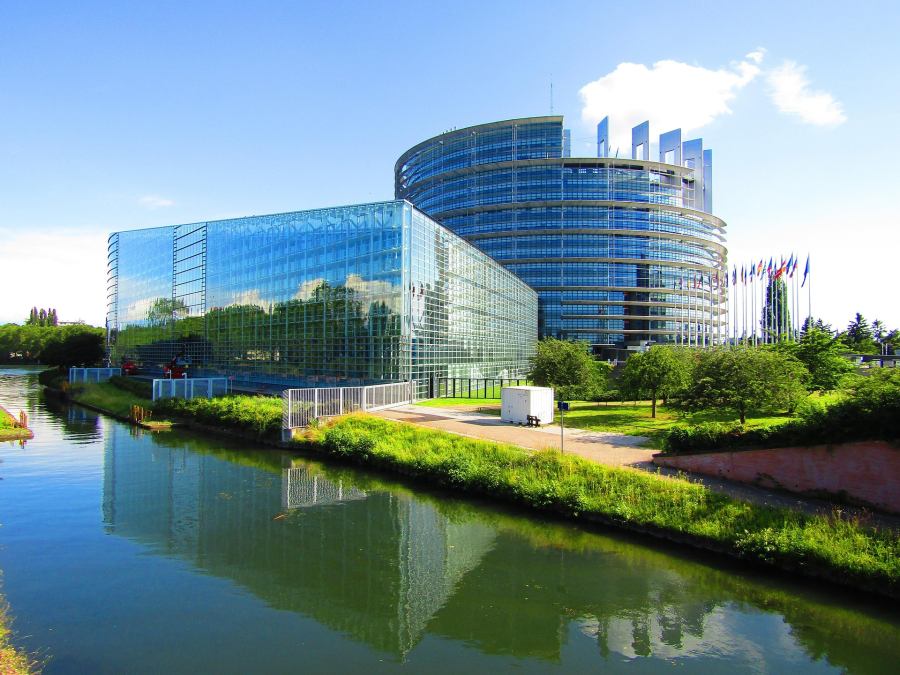
European Court of Human Rights
The building housing the Council of Europe and the European Court of Human Rights was designed by the British architect Richard Rogers, who was also one of the creators of the Pompidou Centre in Paris. Inaugurated in 1995, the cylindrical structure is a symbol of international law.
The court oversees compliance with the European Convention on Human Rights among member states, giving the building considerable political and legal significance. The interior can be visited on guided tours, by prior registration.
Its riverside location and glass-and-steel structure make it one of the most photogenic buildings in the modern part of Strasbourg, illustrating the city’s international role.
Parc de l’Orangerie
Strasbourg’s oldest and most popular park was originally laid out in 1692 in the style of Le Nôtre, then expanded and named in 1804 in honour of Empress Joséphine, after the orangery built at the time.
Alongside its ponds, promenades and flowerbeds, the park is also home to a small zoo, where storks – Alsace’s symbolic bird – and other local species live. The pavilion at the centre of the park regularly hosts cultural events.
In summer it is a concert venue, and it is also a favourite spot for locals for picnicking and jogging.
Neustadt
Built during German rule between 1871 and 1918, the Neustadt district is one of the best-preserved examples of imperial German architecture from the period, and has been a UNESCO World Heritage Site since 2017.
The public buildings arranged around Place de la République – including the Rhine Palace and the National and University Library – were built in monumental neo-Renaissance and neoclassical styles, surrounded by broad avenues and green spaces.
The district is easy to explore on foot and offers an exciting contrast to the old town’s medieval streets, illustrating Strasbourg’s dual French-German identity.
Saint-Paul’s Church (Église Saint-Paul)
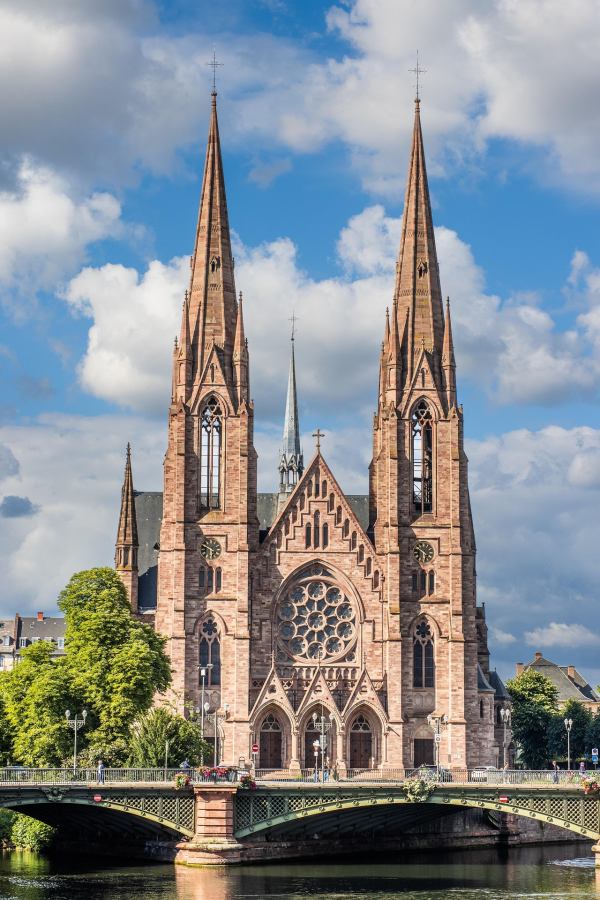
One of the city’s most striking neo-Gothic buildings stands in the Neustadt district, at the tip of Sainte-Hélène Island, surrounded by the Ill and Aar rivers.
Built between 1892 and 1897, the church is known for its two towers, each 76 metres tall, and its huge 8-metre-diameter rose window. Originally serving as the Protestant church of the German garrison, its history is closely tied to Strasbourg’s German era.
Inside, visitors can admire valuable stained-glass windows, rich decoration and a monumental organ.
Boat Trip on the Ill
Modern glass-roofed sightseeing boats depart year-round from the pier next to Rohan Palace, taking around 70 minutes to tour the most important sights of the old town and the European quarter.
During the trip, a multilingual audio guide tells the story of Petite France, the covered bridges, the cathedral and the European Parliament, while the buildings appear in an entirely different perspective from the water.
On evening departures, the illuminated façades and quiet canals create a romantic atmosphere, making the trip popular with couples and families alike.
Strasbourg Christmas Market (Christkindelsmärik)
Held since 1570, this is France’s oldest Christmas market, welcoming visitors every year from late November to the end of December across numerous squares in the city.
Alongside the huge fir tree on Place Kléber, the light shows on Place Broglie and the decorative lighting of Petite France, hundreds of wooden chalets offer local handicrafts, mulled wine and Alsatian pastries.
Because of the event, Strasbourg is often called „the capital of Christmas”; visitor numbers multiply during this period, so it is worth booking accommodation in advance.
Best museums in Strasbourg
Museum of Fine Arts (Musée des Beaux-Arts)
One of the city’s most important art attractions is located on the first floor of the historic Palais Rohan.
Its collection presents the history of European painting from the Middle Ages to around 1870. Visitors can see works by masters such as Giotto, Botticelli, Raphael, El Greco, Rubens, Van Dyck, Canaletto, Tiepolo, Goya, Delacroix and Courbet. The collection of European still lifes is particularly valuable. The museum’s iconic work is Nicolas de Largillière’s portrait La Belle Strasbourgeoise.
The permanent exhibition, spread across roughly 1,300 m², displays nearly 300 paintings and twenty sculptures, making the museum an outstanding part of Strasbourg’s cultural programme.
All information here found!
Le Vaisseau
One of Strasbourg’s most interesting family attractions, introducing children to the world of science and technology in a playful, interactive way.
The centre is designed primarily for children aged 3–12, though its programmes offer entertainment for the whole family. Visitors can experiment in several themed areas, such as water, light, mathematics, nature and digital technology.
One special feature of the exhibits is that visitors are specifically encouraged to touch and try out the devices on display. Le Vaisseau also has a garden, temporary exhibitions, workshops and science programmes.
All information here found!
Musée de l’Œuvre Notre-Dame
Standing opposite the cathedral, this museum houses medieval and Renaissance works of art related to the construction and decoration of the cathedral, in a building complex that itself dates from the 14th–16th centuries.
The collection is centred on the cathedral’s original sculptures, stained-glass windows and architectural drawings, including several original sculptures from the western façade damaged by the weather, which have been replaced on-site by copies.
The museum’s courtyards and rooms are themselves relics of medieval civic architecture, so a visit offers both an art-historical and an architectural experience.
All information here found!
Musée Alsacien
Founded in 1907, the museum occupies three interconnected half-timbered townhouses and presents Alsace’s traditional folk culture and everyday life in the 18th–19th centuries.
The exhibition rooms display furnished rooms, traditional costumes, ceramics and religious objects, while visitors explore the museum through a labyrinth of old staircases and inner courtyards.
Thanks to its cosy timber-beamed rooms and river-facing façade, the museum building itself is a fine example of the Petite France quarter.
All information here found!
Strasbourg weather: when is the best time to visit?
Strasbourg has a temperate, semi-continental climate, characterised by warm summers, cold winters and relatively low rainfall due to the rain-shadow effect of the Vosges Mountains. The city experiences four clearly distinct seasons, so the timing of a trip greatly influences the experience.
Spring (March–May):
Spring starts mild and gradually warms up, with average temperatures ranging between 8–18°C. From April onwards, sunny spells become more frequent, while rainfall remains moderate. By late May, the parks and trees along the canals burst into bloom, providing a pleasant backdrop for sightseeing.
Summer (June–August):
Summer is warm, sometimes downright hot, with average temperatures between 18–27°C; in July and August, daytime highs can exceed 30°C. Rainfall is relatively rare, occurring mostly as short, intense summer storms. This is the busiest season, when terraces and riverside walks are most popular.
Autumn (September–November):
Early autumn is still warm and sunny, with average temperatures between 8–19°C, though the weather turns cooler by November. Rainfall gradually increases, and morning fog along the river is common. At the end of the season, in the last week of November, the Christmas market opens its gates, lending the city a special atmosphere.
Winter (December–February):
Winter is cold and often foggy, with average temperatures between −3 and 5°C; snow is less frequent but occurs regularly. February is the harshest month, when daytime temperatures often stay close to freezing. Despite this, in December the lights and scents of the Christmas market make even the cold feel festive.
Best time to travel to Strasbourg:
For visiting Strasbourg, late spring (May) and early autumn (September–October) offer the most pleasant weather, with mild temperatures, less rainfall and blooming or colourful foliage awaiting visitors. Those who prefer the Christmas atmosphere should travel in the first three weeks of December, while the summer months offer the longest days and the liveliest street life, at the cost of heavier tourist traffic.