
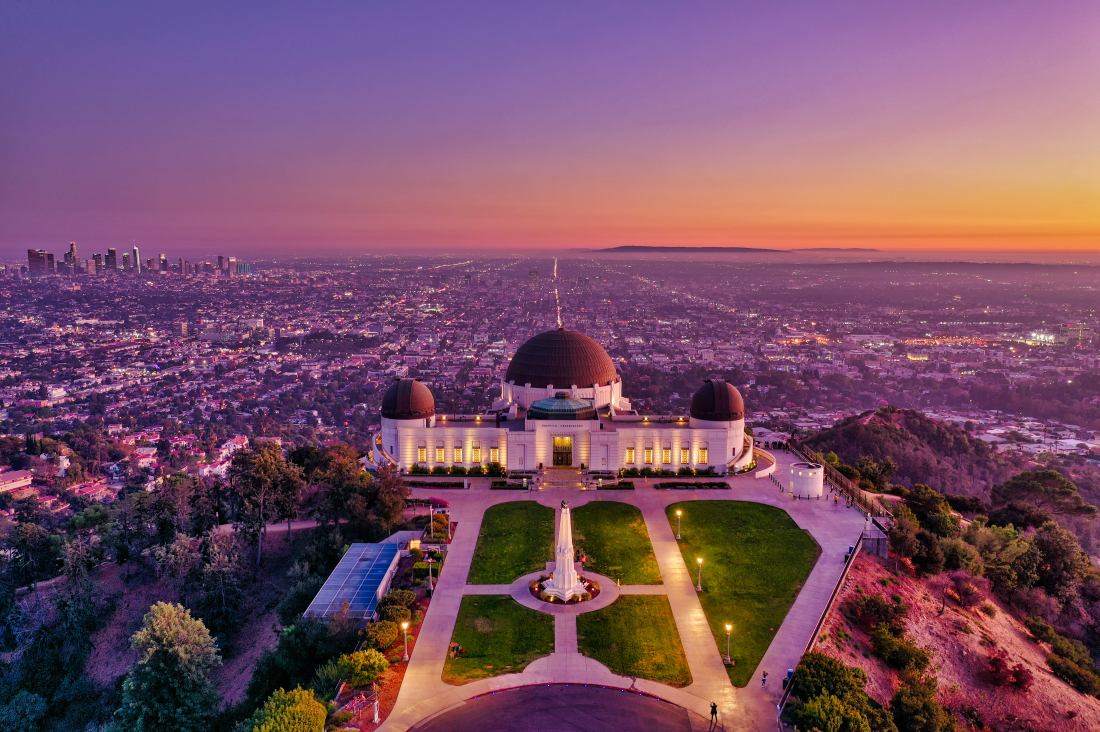
Los Angeles is California’s largest city and a place defined by the film industry, sunshine, and an endless coastline. The questions and answers below will help you navigate the essentials, whether it’s about visas, transportation, or the best time to travel.
Table of Contents
Basic information
Why is it worth traveling to Los Angeles?
Los Angeles is where the film industry, sun-drenched beaches, and a diverse mix of cultures come together, offering both big-city experiences and a relaxed Californian way of life.
From the Hollywood Walk of Fame to the Santa Monica Pier to the stunning art collection at the Getty Center, you’ll stumble upon familiar locations at every turn, since the city has served as the setting for countless films and TV shows. Coastal neighborhoods like Venice and Malibu represent the surf and laid-back lifestyle, while Beverly Hills and Rodeo Drive showcase a world of luxury and glamour.
The food scene is equally outstanding: from Mexican taco stands to the restaurants of Koreatown to Michelin-starred fine dining, virtually every cuisine can be found in the city.
When is the best time to travel to Los Angeles?
Los Angeles enjoys a pleasant, Mediterranean-style climate year-round, but spring and fall (March–May and September–November) are considered the most ideal travel seasons.
During these months, daytime temperatures typically hover around 20–26°C (68–79°F), rainfall is minimal, and tourist numbers are more moderate than during the summer peak season. Summer (June–August) is warm and dry, often crowded at beaches and popular attractions, while the winter months (December–February) tend to be mild and rainier, although even then the amount of rainfall is well below typical European winter levels.
It’s also worth mentioning that neighborhoods close to the coast (e.g., Santa Monica, Venice) frequently experience morning and early-afternoon haze and cloud cover, known as „May Gray” and „June Gloom” which usually clears up by midday.
How many days is it worth spending in Los Angeles?
It’s generally recommended to allow at least 4–5 days to explore Los Angeles, since the city is extremely spread out and attractions are often far apart from one another.
In 3–4 days you can fit in the most important spots – Hollywood, Santa Monica, Venice, and Downtown – but the schedule will be tight due to travel time. With a 5–7 day stay, you can comfortably fit in a day at Universal Studios, a stroll through Beverly Hills, a museum visit at the Getty Center, and even a day trip to San Diego or Joshua Tree National Park, all at a more relaxed pace.
What is the official currency in Los Angeles?
In Los Angeles, as in the entire United States, the US dollar (USD) is the official currency.
Card payments are widely accepted almost everywhere, from restaurants to taxis, and in many places contactless payment and mobile wallets (Apple Pay, Google Pay) are fully standard as well. It’s worth carrying cash mainly for small tips or for a few street vendors.
What type of power outlet and voltage is used in Los Angeles?
Los Angeles uses Type A and Type B outlets, and the mains voltage is 120 volts, compared to Europe’s 230 volts, so a travel adapter will be needed for European devices.
Most modern electronics – phone chargers, laptops, camera chargers – automatically support a voltage range of 100–240V, so a simple adapter without voltage conversion is sufficient for these. Higher-power devices designed exclusively for 220–240V (such as some hair dryers and hair straighteners) may require a voltage converter as well.
How does internet access and SIM card use work in Los Angeles?
Internet access in Los Angeles is extensive and reliable – the vast majority of hotels, cafés, and restaurants offer free Wi-Fi, and for continuous mobile data access it’s worth getting an eSIM or a local SIM card.
eSIMs can already be purchased and activated online before the trip, so mobile internet is available immediately upon arrival. Physical SIM cards can also be obtained at the airport and at carrier stores in larger shopping centers (e.g., AT&T, T-Mobile, Verizon), though a passport and sometimes a local address may be required.
Is tipping customary in Los Angeles?
Yes, tipping is expected in the United States, including in Los Angeles – in restaurants, 18–20% of the bill is the customary amount.
In American hospitality, tipping isn’t just a courtesy but an integral part of service workers’ pay, since base wages are often well below minimum wage and tips make up a large portion of income. At restaurants and bars, 18–20% is standard; for taxis and rideshare services (Uber, Lyft), 15–20%; and for hotel bellhops, $1–2 per bag is considered acceptable. At some restaurants, a service charge is automatically added to the bill for larger parties (typically over 6 people).
Travel and transportation
How do I get from the airport to downtown Los Angeles?
Los Angeles’s main airport is Los Angeles International Airport (LAX), located roughly 25–30 kilometers from downtown, reachable by bus, rail, or car ride-share service.
The LAX People Mover automated train connects the terminals to the Metro C Line and K Line at the Airport Metro Connector station, from where you can continue on to many parts of the city – this is one of the most cost-effective options. The FlyAway bus provides a direct, fast connection between the airport and Union Station, as well as other parts of the city. For most tourists, however, Uber and Lyft are the most convenient option, with a designated pickup point at the airport (LAX-it). Official taxis are also available, but this is usually the most expensive option.
What is the most convenient way to get around Los Angeles?
Los Angeles is an extremely sprawling, car-centric city, so for most visitors a rental car is the most convenient way to get around, although the Metro rail and bus network, as well as Uber and Lyft, also provide good alternatives.
The city’s neighborhoods – Hollywood, Santa Monica, Downtown, Beverly Hills – are often 20–40 minutes apart by car, and this time can increase significantly by public transit. If renting a car, it’s worth planning around traffic jams, especially during the morning and afternoon rush hours, as well as parking fees, which can be high in popular areas. For those who’d rather not drive, Uber and Lyft offer the most flexible solution, and the Metro rail lines – particularly the routes between Downtown, Hollywood, and the coast – are also quite usable.
Accommodation and safety
Is Los Angeles a safe city?
Los Angeles is a vast metropolis, so perceptions of safety strongly depend on which part of the city you’re in; the neighborhoods visited by tourists are generally safe, especially during the day.
As in any major city, it’s worth exercising basic caution here as well: don’t leave valuables visible in the car, avoid less busy streets after dark, and use an official taxi or ride-share service if you need to travel farther.
Which neighborhoods are considered safe?
Among the areas most often chosen by visitors and considered safe are Santa Monica, Beverly Hills, West Hollywood, Culver City, and Pasadena.
These neighborhoods typically see heavy tourist traffic, have a strong police presence, and have lively, well-lit streets even in the evening.
How safe is it at night?
In the neighborhoods visited by tourists, restaurants and bars remain open in the evening as well; nevertheless, it’s worth sticking to well-lit, busy streets and avoiding certain parts of Downtown (e.g., around Skid Row) at night.
Which area is worth staying in when visiting Los Angeles?
Among the most popular and convenient areas for tourists to stay are Santa Monica, Hollywood, Downtown, and Beverly Hills, each offering a different experience and location.
Santa Monica is a popular choice for its proximity to the coast and relaxed atmosphere, with easy access to the pier, the beach, and the bike path toward Venice. Hollywood is the symbolic center of the film industry and entertainment, with numerous hotels and nightlife, and also a good starting point for visiting the Griffith Observatory and the Walk of Fame. Downtown is the neighborhood of modern skyscrapers, museums, and restaurants, with good rail connections. Beverly Hills and nearby West Hollywood are home to luxury hotels and exclusive shopping streets (Rodeo Drive) – a good fit for anyone looking for an elegant, quiet area to stay.
Health information
Are any vaccinations required to travel to Los Angeles?
There are no mandatory or officially recommended vaccinations for most travelers heading to Los Angeles or elsewhere in the United States.
Since individual use of the American healthcare system can involve extremely high costs, it’s definitely worth taking out adequate health and accident insurance before traveling.
Is the tap water safe to drink in Los Angeles?
Yes, tap water in Los Angeles is safe to drink, as the city’s water utility treats and monitors it in accordance with strict quality standards.
Even so, many locals and tourists prefer bottled or filtered water due to a possible difference in taste, but this is more a matter of preference than a health concern.
Experiences
What are the must-see attractions in Los Angeles?
Among the best-known attractions in Los Angeles are the Hollywood Walk of Fame, the Griffith Observatory, the Santa Monica Pier, the Getty Center, and Universal Studios Hollywood.
The Hollywood Walk of Fame is a sidewalk lined with stars honoring famous figures of the film and entertainment industry, stretching along Hollywood Boulevard. The Griffith Observatory sits atop Griffith Park, offering a stunning view of the city and the Hollywood Sign, and also hosts free stargazing programs in the evenings.
The Santa Monica Pier is the classic symbol of the Southern California beach experience, with its amusement park and Ferris wheel, and not far from it lies the laid-back, bohemian Venice Beach. The Getty Center is a museum with breathtaking architecture perched on a hilltop, where admission – and the accompanying view – is free, with only parking requiring payment.
Universal Studios Hollywood’s film-themed park welcomes visitors with a studio tour and attractions, while Beverly Hills’s Rodeo Drive is a must for fans of luxury brands and the glamorous lifestyle.
What are the most popular foods and drinks in Los Angeles?
Los Angeles’s culinary scene is remarkably diverse: from Mexican tacos to Korean barbecue to healthy Californian cuisine, nearly every style can be found in the city.
Tacos and burritos are the backbone of the city’s street food scene, offered by countless food trucks and taquerías at nearly any time of day. In Koreatown, Korean barbecue (Korean BBQ) can be enjoyed in its authentic form, while restaurants downtown and in the coastal neighborhoods offer modern Californian cuisine – dishes built around fresh vegetables, fruits, and seafood.
In-N-Out Burger is a local favorite and a symbol of Californian fast-food culture, and among drinks, besides fresh fruit juices and smoothies, craft coffee culture also plays a significant role in the city.
What important holidays and festivals take place in Los Angeles?
Los Angeles hosts many important holidays and festivals throughout the year, including the Rose Parade on January 1st, the Fourth of July celebration of American independence, and Día de los Muertos festivities.
The Rose Parade takes place every year on January 1st in nearby Pasadena, featuring floats decorated with flowers, and is one of the best-known American New Year’s traditions. On July 4th, American Independence Day, the city and its coastal neighborhoods celebrate with barbecues, concerts, and spectacular fireworks.
In October and November, thanks to the city’s large Mexican community, Día de los Muertos (Day of the Dead) is marked with colorful parades, altars, and street festivals, especially around Olvera Street downtown. During the Christmas season, light displays and holiday markets appear in several neighborhoods, and the Hollywood Christmas Parade has been a beloved December tradition for decades.