
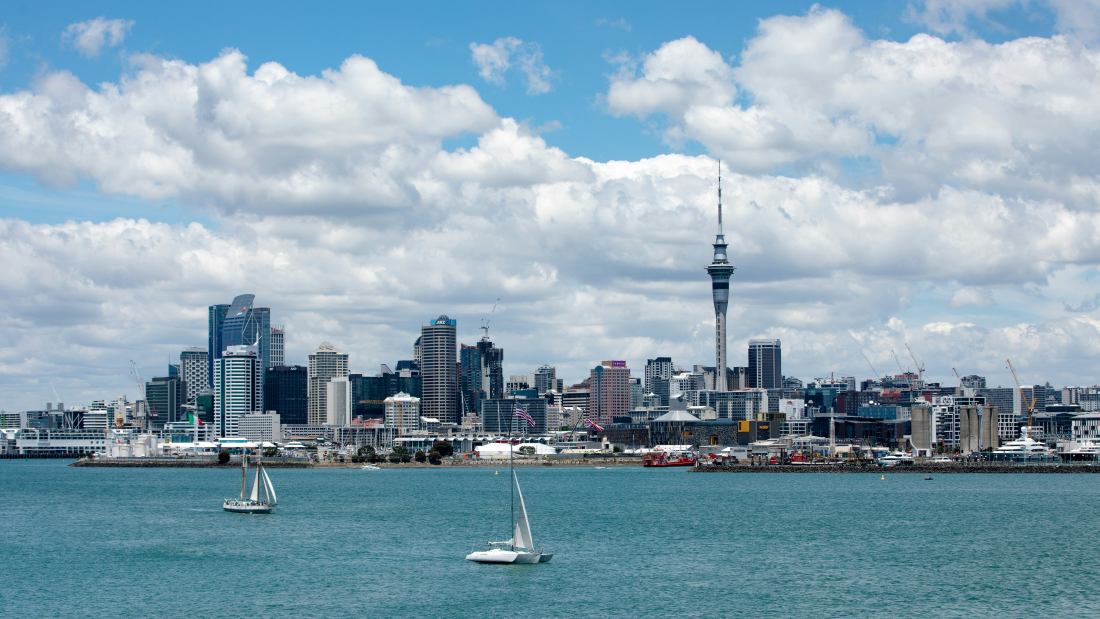
Auckland is New Zealand’s largest and most diverse city, and a popular destination in the Oceania region. The questions and answers below will help you navigate the most important things to know, from entry requirements to transportation and the best time to travel.
Table of Contents
Basic information
Why is Auckland worth visiting?
Auckland is New Zealand’s most populous and diverse city, often called the “City of Sails” because of the countless yachts filling the Waitematā Harbour and the Pacific Ocean beyond it. The city is surrounded by more than 50 dormant volcanic cones, several of which – Mount Eden, for example – can easily be climbed on foot, rewarding visitors with a stunning view over the city and the Hauraki Gulf.
The city’s unique advantage is that it sits between two seas, the Pacific Ocean and the Tasman Sea, so within just a few hours you can reach black-sand beaches on the west coast or the calmer, bay-dotted beaches on the east coast. Auckland is also an excellent base for exploring the vineyards of Waiheke Island and the many islands of the Hauraki Gulf.
What time zone is Auckland in?
Auckland lies in the New Zealand time zone (NZST, UTC+12), which shifts to UTC+13 during daylight saving time (NZDT). Clocks are set back an hour in spring and forward an hour in autumn – the opposite of what happens in Europe.
When is the best time to travel to Auckland?
Auckland lies in the Southern Hemisphere, so the seasons run in the reverse order compared to Europe and North America. The most popular time to travel is between December and February, when it’s summer and daytime temperatures typically hover around 22–25°C.
Autumn (March–May) and spring (September–November) are also pleasant periods: the weather is still mild, but there are fewer tourists and prices are lower. Winter (June–August)is the rainiest and coolest season, with daytime temperatures typically around 14–16°C, though this is when flights and accommodation are cheapest.
How many days should you spend in Auckland?
Generally, 3–4 days are recommended to explore Auckland if you only want to get to know the city itself and its immediate surroundings. That’s enough time to comfortably fit in downtown, the Sky Tower, the Auckland Museum, and a half-day trip to Devonport or Waiheke Island.
If you’d like to explore the islands of the Hauraki Gulf, the black-sand beaches of the west coast, or the surrounding wine regions in more depth, it’s worth setting aside 5–7 days for Auckland, since the region is extremely diverse and most excursions take half a day or a full day.
What is the official currency in Auckland?
New Zealand’s official currency is the New Zealand dollar (NZD), which is used throughout the country. Prices are shown in NZD almost everywhere, and foreign currencies – such as euros or forints – are not accepted for everyday purchases.
Card payments are extremely common in Auckland, and many places barely use cash at all. Contactless payment (by card or phone) is available almost everywhere – in shops, restaurants, and on public transport alike.
Here is a currency converter calculator!
Is English spoken in Auckland?
Yes, English is one of New Zealand’s official languages, and in Auckland – the country’s most populous and highly multicultural city – it’s spoken practically everywhere, whether in hotels, restaurants, or on public transport.
Māori and many other communities, particularly Pacific Island and Asian communities, also call the city home, so you’ll often hear other languages on the street, but the language of communication remains English everywhere. It’s worth learning a few Māori words (such as kia ora – hello), as locals are happy to hear visitors use them.
What type of power outlet is used in Auckland?
New Zealand – including Auckland – uses Type I outlets, the same as those used in Australia. European plugs don’t fit these outlets, so a travel adapter will be needed.
The mains voltage is 230 volts at a frequency of 50 Hz, which matches Europe’s mains voltage. Most electronic devices (phone chargers, laptops) are automatically compatible with this voltage.
How does internet and SIM card use work in Auckland?
Internet connections in Auckland are generally good and fast, with free Wi-Fi available in the vast majority of hotels, cafés, and restaurants. If you need continuous mobile data during your stay, it’s worth buying a local SIM card or eSIM.
Local SIM cards are easy to get at the airport and in city shops, and the larger providers (such as Spark, One NZ, and 2degrees) offer good coverage in and around Auckland. Many travelers buy and activate an eSIM online before their trip so that mobile data is ready to use the moment they arrive.
Is it customary to tip in Auckland?
In New Zealand – unlike many other Western countries – tipping is not a common custom and it isn’t expected. Service charges and workers’ wages are typically already built into prices, so locals rarely leave tips.
For outstanding service, especially in larger cities like Auckland, guests may sometimes leave a smaller amount (5–10% of the bill) as a tip, but it’s by no means required, and no one will think it strange if you don’t tip.
Travel and transportation
How do I get from the airport to central Auckland?
Auckland International Airport (AKL) is located about 20 kilometers from the city center. Since the city has no direct rail link to the airport, most travelers get into town by bus, taxi, or ride-share app (Uber).
The SkyDrive Express bus is the most popular and cheapest convenient option: it takes about 25–30 minutes to reach downtown. The cheapest option is combining public transport (the AirportLink bus plus the train from Puhinui Station to Britomart), which costs about 7–10 NZD but can take up to an hour. A taxi or Uber takes 30–45 minutes..
What is the most convenient way to get around Auckland?
Downtown Auckland is easy to explore on foot, with most major attractions (the Sky Tower, Viaduct Harbour, Britomart, Queen Street) located close together. To get between neighborhoods, locals and tourists alike mainly use buses, trains, and ferries.
For public transport, it’s worth getting an AT HOP card, which offers discounted fares on buses, trains, and local ferries. Ferries are especially popular, since they’re the way to reach Devonport, Waiheke, or Rangitoto Island. Anyone heading further afield, such as to the west coast or the countryside, should consider renting a car, keeping in mind that in New Zealand you drive on the left.
Accommodation and safety
Is Auckland a safe city?
Auckland is generally considered a safe city, and the neighborhoods visited by tourists can be explored without trouble for most of the day. New Zealand is one of the safest countries in the world, and violent crimes against tourists are rare.
Most problems tend to involve minor theft and car break-ins, especially in the parking areas of popular viewpoints (such as Mount Eden), where it’s best not to leave any valuables visible in the car.
Which neighborhoods are considered safe?
Among the areas most commonly chosen by visitors as safe are the CBD, meaning downtown with the Sky Tower and Viaduct Harbour, Ponsonby, known for its cafés and shops, the calmer, Victorian-era Parnell, and the cozy, family-friendly Devonport, located across the harbor.
These areas see heavy tourist traffic, have good street lighting, and remain lively even in the evening.
How safe is it at night?
The main streets of downtown, such as Queen Street, stay lively at night on weekends, but at those times it’s more about alcohol-related disorder than crime. After midnight, it’s advisable to stick to well-lit main streets, and to take a taxi or ride-share instead of walking if you need to go further.
Which neighborhood is best to stay in Auckland?
Among the most popular and convenient areas for tourists to stay in Auckland are downtown (CBD), Britomart, Ponsonby, Parnell, and Devonport. They’re well located, safe, and have plenty of restaurants and cafés.
- The CBD and Britomart are the most convenient choice for exploring the main sights on foot, with good access to the ferry terminal as well.
- Ponsonby is popular with younger travelers for its trendy cafés and restaurants, while Parnell offers a calmer, more upscale setting.
- Devonport is ideal for those who prefer a quieter, seaside town and don’t mind taking the daily ferry into downtown.
Health information
Are any vaccinations required to travel to Auckland?
Traveling to Auckland or New Zealand does not require any mandatory vaccinations for most travelers. The country has advanced healthcare infrastructure and is not considered a high-risk destination for infectious diseases.
That said, it’s definitely worth taking out comprehensive travel insurance before your trip, since healthcare in New Zealand can be expensive, especially in the case of an accident or hospital treatment.
Is tap water safe to drink in Auckland?
Yes, in Auckland and most of New Zealand tap water is safe to drink, and water quality is high and regularly monitored. Locals typically drink tap water too, buying bottled water mainly for convenience.
It’s worth paying attention to strong sun exposure, though: because the ozone layer is thinner, UV radiation is more intense in New Zealand than in Europe, so it’s recommended to use sunscreen, a hat, and sunglasses even on cloudy days, especially during outdoor activities and hikes.
Experiences
What are the must-see sights in Auckland?
Auckland’s best-known sights include the Sky Tower, the Auckland War Memorial Museum, the volcanic Mount Eden, charming Devonport, and nearby Waiheke Island. These places showcase the city’s natural setting, culture, and history.
- The Sky Tower is the tallest freestanding structure in the Southern Hemisphere; its observation decks offer 360-degree panoramic views over the city, the harbor, and the islands of the Hauraki Gulf. Bolder visitors can even “walk” down the outside of the tower (SkyWalk) or jump off it on a rope (SkyJump).
- The Auckland War Memorial Museum is one of the country’s most significant museums, giving pride of place to Māori and Pacific culture as well as New Zealand’s natural and military history.
- Mount Eden (Maungawhau), one of Auckland’s most accessible volcanic cones, can be climbed via a short walk, with a stunning view from the top over the huge crater and the city.
- Devonport, just a 12-minute ferry ride from downtown, offers a pleasant half-day trip with its Victorian buildings, shops, and cafés, and the viewpoints at North Head also provide a great panorama over the harbor.
- Waiheke Island is about a 40-minute ferry ride from Auckland and is home to more than 30 wineries, as well as beautiful beaches and viewpoints that are popular with visitors.
What are the most popular foods and drinks in Auckland?
Auckland’s cuisine shows strong British influences while also embracing the flavors of Māori and immigrant communities – especially Asian and Pacific cuisines. The most popular local foods include the meat pie, fresh seafood, and hangi, while New Zealand wine and beer stand out among the drinks.
- The meat pie is one of the most popular New Zealand fast foods: a crispy pastry filled with rich, juicy meat stew, sold in almost every bakery and café.
- Hangi is a traditional Māori dish cooked in a pit dug into the ground using heated stones, made with meat, vegetables, and kumara (sweet potato). It’s not an everyday dish, but it can be tried at some restaurants and cultural events.
- Because of Auckland’s coastal location, fresh seafood such as green-lipped mussels and crayfish are also common dishes, while pavlova, a meringue cake decorated with fruit, is one of the most popular desserts.
- Among the drinks, Sauvignon Blanc and other New Zealand white wines are world-famous and can be tasted locally at the wineries of Waiheke Island and the surrounding wine regions. Craft beers from New Zealand are also becoming increasingly popular in Auckland.
What important holidays and festivals take place in Auckland?
Auckland and all of New Zealand celebrate many important holidays and festivals throughout the year. The best known include Waitangi Day, Matariki (the Māori New Year), and summer outdoor festivals such as Splore.
- Waitangi Day is celebrated every year on February 6, marking the Treaty of Waitangi signed in 1840, an agreement between the British Crown and Māori tribes. Cultural events, concerts, and commemorations are held at many locations across the country on this day.
- Matariki, the Māori New Year marked by the rising of the Pleiades star cluster, is typically celebrated around June–July. This period is about remembrance, community celebration, and new beginnings, and many events are held around it in Auckland too.
- In summer, typically around February, the Splore Festival is held at Tapapakanga Regional Park, east of Auckland, featuring live music, art installations, and family-friendly programs for visitors.