

Costa Rica is one of the smallest countries in Central America, yet it is incredibly rich in natural treasures. Here I present 18 amazing attractions!
Nicaragua borders it to the north, Panama to the south, the Caribbean Sea to the east, and the Pacific Ocean washes its shores for about 1,200 km to the west. More than 25% of the country’s territory is protected area, national park, or nature reserve. Its biodiversity is outstanding: its ecological habitats range from the Caribbean coast through mountainous rainforests to the Pacific Ocean.
Table of Contents
Best places in Costa Rica
San José
Costa Rica’s capital is located in the Central Valley (Valle Central) at an altitude of 1,200 meters above sea level. The city was founded in 1738 and later became the country’s political and cultural center.
One of its most important attractions is the National Museum, which is housed in a former fortress. A special feature of the building is that bullet holes from the 1948 civil war are still visible on its outer walls. The museum provides a comprehensive picture of the country’s history from pre-Columbian times to the present day and has a rich archaeological and ethnographic collection.
The center of San José is Parque Central and the historic buildings around it, including the neoclassical Metropolitan Cathedral and the National Theater, which was built at the end of the 19th century based on European opera houses. The interior spaces of the theater built in the golden age are impressive: marble floors, gilded decorations, and imposing murals amaze visitors.

Playa Carrillo
This wonderful beach is located on Costa Rica’s Pacific coast, on the Nicoya Peninsula.
Located just a few kilometers south of the popular Samara beach, it is still a much calmer and less crowded destination. It is famous for its golden sand, calm waters, and the palm trees that line the shore. The special feature of the beach is that there are no large hotels, shops, or restaurants directly along the shore.
It’s an ideal choice for those who enjoy peaceful relaxation and less crowded beaches.

Manuel Antonio National Park
One of Costa Rica’s smallest but most diverse national parks is located on the Pacific coast, south of the city of Quepos.
Although it covers only 1,680 hectares, it is one of the country’s most popular tourist destinations thanks to its breathtaking beaches and rich wildlife. There are four beautiful beaches in the park: Espadilla Sur, Manuel Antonio, Escondido, and Playita. These are characterized by white sand, crystal clear turquoise water, and palm trees, along which numerous hiking trails lead.
The park’s most famous animals are the white-faced capuchin monkeys, howler monkeys, and ten sloths, which often approach tourists. In addition, more than 100 mammal species and 184 bird species live here, including toucans, hummingbirds, and parrots.

Corcovado National Park
The park located on the Osa Peninsula is, according to National Geographic, „the most biologically intense place on Earth”.
The park was founded in 1975 and covers more than 41,000 hectares. It is home to extremely diverse ecosystems: tropical rainforests, swamps, mangrove forests, beaches, and coral reefs can be found here. This biological diversity is home to more than 500 tree species, 140 mammal species, 400 bird species, 116 reptile species, and 40 fish species. The most well-known representatives of the fauna include jaguars, pumas, tapirs, anteaters, toucans, and scarlet macaws.
Well-established hiking trails lead through the park, along which visitors can get a closer look at this magical ecosystem. The most popular route is the area around the Sirena Ranger Station, where rare animal species can be observed with the highest probability. However, visitors must be prepared for difficult terrain conditions and high humidity, which can be a serious challenge for less fit tourists.
Playa Conchal
One of Costa Rica’s most beautiful beaches is also located on the Nicoya Peninsula.
It gets its name from the tiny white and pinkish shell fragments that cover the shore instead of traditional sand. The sea is usually calm as the beach is located in a protected bay, making it perfect for swimming and relaxation.
It’s not far from the popular town of Tamarindo, from where the beach is easily accessible. Many consider Playa Conchal to be the most beautiful beach in the area.

Isla del Coco
Located about 550 kilometers off the coast of Costa Rica in the Pacific Ocean, the island has been a national park since 1978 and a UNESCO World Heritage Site since 1997. It is an uninhabited island that can only be visited with permission, mainly for divers and scientists.
The island is famous for its special geological formations and rich marine ecosystem. It is of volcanic origin and was formed several million years ago. Its shores are lined with steep cliffs and waterfalls, while its interior is covered with dense tropical forest. In the waters around the island, there are more than 30 endemic fish species and marine creatures that are found nowhere else in the world.
It is particularly known for its huge shark populations, including hammerhead sharks, which gather in large groups in the waters around the island. The island inspired Michael Crichton’s famous novel, Jurassic Park, and according to many, also Robert Louis Stevenson’s classic, Treasure Island.
Arenal National Park
This national park in the northwestern part of the country is dominated by the imposing Arenal volcano, which was one of Costa Rica’s most active volcanoes after the 1968 eruption.
The 1,633-meter-high cone-shaped peak of the Arenal volcano is recognizable from a distance, although it has been in a dormant state since 2010. There are eight different ecological zones in the area that are home to more than 850 bird species, as well as jaguars, tapirs, and various monkey species. There are 14 kilometers of well-established hiking trails in the park, along which visitors can discover lava fields, waterfalls, and unique flora.
At the foot of the volcano is Lake Arenal, Costa Rica’s largest artificial lake, which was created in 1973 as part of a hydroelectric project. One of the park’s biggest attractions is the numerous thermal springs that were formed as a result of volcanic activity. These natural spas offer water of various temperatures, and many attribute healing effects to the water with high mineral content.

La Fortuna Waterfall
This impressive 70-meter-high waterfall is located at the foot of the Arenal volcano, about 5.5 kilometers south of the town of La Fortuna.
The Río Fortuna river originates from the side of the Chato volcano and plunges through the dense rainforest into a former volcanic crater. A path of 500 steps leads to the waterfall, which passes through the Reserva Ecológica Catarata Río Fortuna conservation area. Along the way, the impressive flora and fauna of the rainforest unfold, including colorful butterflies, birds, and occasionally monkeys can be observed. The descent takes about 15-20 minutes.
At the bottom of the waterfall, a crystal clear, emerald green pool welcomes visitors, providing an excellent opportunity for refreshment. The water temperature is pleasant, although swimming is only recommended at the edge of the pool due to the strong current. The waterfall is particularly spectacular during the rainy season when the water flow increases significantly.

Guayabo National Monument
Costa Rica’s most important archaeological site is located about 19 kilometers from the city of Turrialba.
The area preserves the remains of a pre-Columbian settlement that was inhabited from approximately 1000 BCE to 1400 CE. The 232-hectare archaeological park is the only national monument in the country that showcases the culture of ancient civilizations.
In the excavated area, stone streets, water supply system, circular and rectangular based buildings, tombs, and the remains of a central acropolis can be seen. Particularly noteworthy are the petroglyph depictions carved from stone and the drainage system, which is still functional today, proving the advancement of ancient engineering knowledge.
The cultural significance of the city of Guayabo is invaluable. It demonstrably proves that complex societies existed in the territory of Costa Rica even before the arrival of Europeans. Based on archaeological findings, the settlement may have been an important commercial and religious center.
Río Celeste
The river located in the Tenorio volcano area means „Heavenly Blue River” in Spanish. It was named after its intense turquoise blue color, which provides a unique sight in the green environment of the dense rainforest.
Its special color is caused by the meeting of two transparent rivers. When the Quebrada Agria and the Río Buenavista converge, an optical illusion is created: volcanic sulfur and calcium carbonate particles scatter in the sunlight in such a way that the water shines in an intense blue color. According to the scientific explanation, the water itself is not blue, but the scattering of light on the mineral substances floating in the water creates this magical phenomenon.
A 3.5-kilometer hiking trail leads to the river through the Tenorio Volcano National Park, during which visitors can discover not only the blue river but also several natural attractions.
„Los Teñideros” is the meeting point of the two rivers, where we can observe the formation of the color. In addition, during the tour, we can see thermal springs, an impressive 30-meter-high waterfall, and a small lake called „Laguna Azul”, where the water shines in a particularly intense blue color.

Irazú National Park
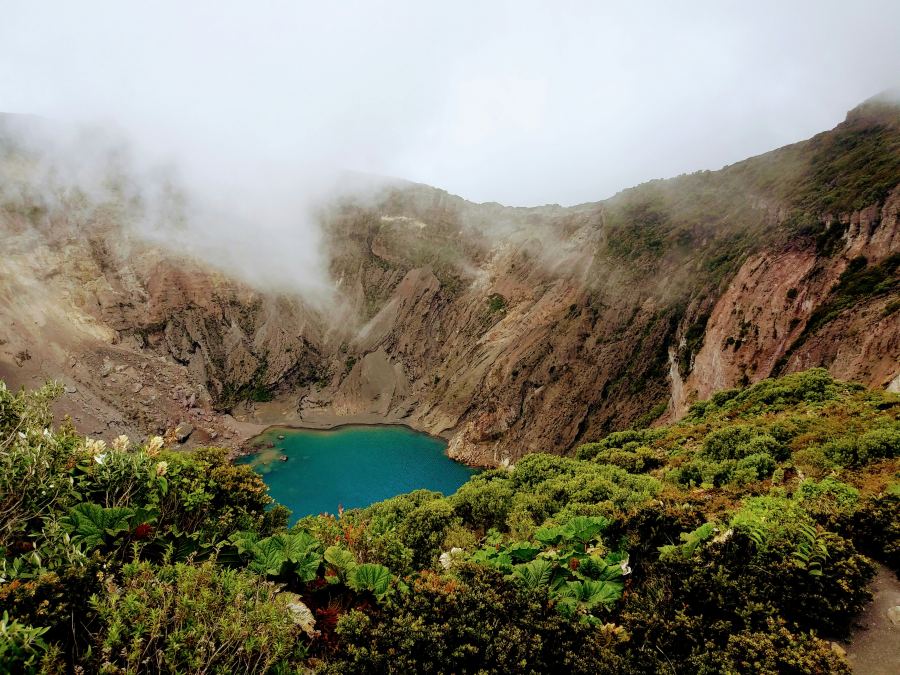
This popular national park is located just two hours east of the capital, San José. Its central element is the Irazú volcano, Costa Rica’s highest active volcano, which rises 3,432 meters above sea level.
The name of the volcano comes from the language of the indigenous Indians, meaning „mountain of fury and thunder”. Its last significant eruption occurred between 1963-1965, beginning on the day of John F. Kennedy’s visit to Costa Rica. The most special feature of the park is the crater at the top of the volcano, which has a diameter of 1,050 meters and a depth of 300 meters. At the bottom of the crater, there is an acidic, emerald green lake, the color of which often changes depending on volcanic activity and weather, sometimes taking on reddish or grayish hues.
On clear days, however, there is an unparalleled view from the summit: both the Atlantic and Pacific Ocean coastlines can be seen simultaneously. In the area called „Playa Hermosa”, we can admire the moonlike landscape formed by volcanic ash and lava, where special rock formations and volcanic formations can be found.
Monteverde Cloud Forest Reserve
One of Costa Rica’s most spectacular natural attractions is located in the Tilarán Mountains, at an altitude of approximately 1,400 meters. Thanks to its special microclimate, it is characterized by a mystical cloud forest that is constantly shrouded in mist.
The reserve is home to more than 400 bird species, including the rare quetzal. The quetzal, with its vibrant green and red plumage, is one of the most beautiful birds in the world. The humid rainforest, full of huge trees, moss cushions, and hanging lianas, offers adventurous hikes.
It is famous for its jungle walks with suspension bridges and adventure parks, where you can admire the canopy of the trees up close. Due to the mystical cloud forest, rich wildlife, and exciting adventure programs, it is a must-see attraction!

Cahuita
This charming settlement is located on the Caribbean coast, in the province of Limón. The Afro-Caribbean cultural influence is strongly felt in the settlement, making it unique compared to other parts of Costa Rica.
The main attraction of Cahuita is the national park, which encompasses 1,100 hectares of terrestrial and 22,400 hectares of marine ecosystem. One of the most spectacular elements of the park is the 600-meter-wide coral reef, which is Costa Rica’s most developed coral reef. The reef is home to more than 35 types of coral and is an ideal place for snorkeling and diving. In the crystal clear water, colorful tropical fish, sea urchins, crabs, and occasionally sea turtles can be observed.
On the land areas, easily accessible paths lead between the white sandy beaches and the lush rainforest. The park has rich wildlife: white-faced capuchin monkeys, howler monkeys, sloths, raccoons, and numerous bird species live here.
The settlement of Cahuita itself also exudes an attractive Caribbean atmosphere: colorful wooden houses, reggae music, and authentic Caribbean dishes prepared by the locals – such as rice and beans cooked in coconut milk or fish dishes wrapped in palm leaves – await visitors.
Poás National Park
The main attraction of this popular national park is the Poás volcano, one of the largest and most active volcanoes in Costa Rica.
The volcano rises 2,708 meters above sea level, and its main crater boasts impressive dimensions: nearly 1.5 kilometers wide and 300 meters deep. At the bottom of the crater, there is an acidic lake, which is one of the most acidic natural water lakes in the world, with a pH value close to zero. The color of the lake changes depending on volcanic activity, from emerald green to opaline turquoise. Next to the main crater is the already extinct Botos crater, in which a cold, clear water lake has formed, surrounded by lush rainforest.
Visitors are now allowed to stay at the crater viewpoint for only a limited time (approximately 20 minutes), and protective helmets are also provided for them. Several paths lead through the park area, showcasing different ecosystems, including dwarf forest and high mountain rainforest.

Punta Uva
One of the most picturesque sections of Costa Rica’s Caribbean coast is located southeast of the settlement of Puerto Viejo de Talamanca. The name of the area means „Grape Point” in Spanish, referring to the grape trees found on the coast.
Punta Uva consists of two main parts: Punta Uva Playa and Playa Arrecife. Both sections are breathtakingly beautiful, with white sandy beaches, turquoise water, and palm trees lining the coastline. The beaches are mostly calm and quiet. The coral reefs along the shores provide an excellent opportunity for snorkeling and diving, where colorful tropical fish, rays, and coral formations can be observed.
The land areas are characterized by rich biodiversity. Walking along the coastal paths, we often encounter sloths, howler and white-faced monkeys, iguanas, and numerous bird species. One of the favorite activities in the area is kayaking in the coastal mangrove swamps or in open water.
It is also an interesting cultural site: nearby is the reservation of the indigenous BriBri Indians, where we can learn about their traditional lifestyle, knowledge of medicinal herbs, and cocoa cultivation practices. There are numerous organic cocoa farms operating in the area, where demonstrations and tastings are organized for visitors.

Nauyaca Waterfalls
This stunning natural wonder is located about 15 kilometers from the coastal town of Dominical, in the southern Pacific region.
The waterfalls are located on the Barú River and consist of two imposing cascades with a total height of about 80 meters. The lower waterfall is 20 meters high and 60 meters wide, with a natural pool of approximately 1,000 square meters underneath, which is ideal for swimming. The upper waterfall is even more impressive, 45 meters high and continuously pouring down the rock face. Between the two waterfalls, there are additional smaller pools where you can also bathe.
The area is privately owned, owned and managed by the local Don Lulo family, who organize horseback rides to the waterfall, combined with a traditional Costa Rican breakfast. There are three ways to reach the waterfalls: on foot via a 4-kilometer hiking trail, by off-road vehicle, or with the mentioned horseback tour.

Orosí Valley
This picturesque valley is located in the province of Cartago, about 35 kilometers southeast of the capital, San José.
It is crossed by the Orosí River and surrounded by steep mountains on all sides. The valley is situated at 1,000-1,400 meters above sea level and has a pleasant, spring-like climate all year round.
The Orosí Valley is primarily famous for its coffee cultivation: the green carpet of coffee plantations covering the slopes offers a breathtaking sight. The coffee grown in the region is among the best in the world, thanks to the volcanic soil, appropriate altitude above sea level, and favorable climate. Many coffee plantations welcome visitors, where they demonstrate the coffee-making process from cultivation to roasting.
One of the valley’s outstanding attractions is the Lankester Botanical Garden, which is home to more than 3,000 plant species, including 800 orchid species. Also noteworthy is the Orosí Church (Iglesia de San José de Orosí), which is one of Costa Rica’s oldest colonial churches still in use, built in 1743. Next to the church is the Museum of Religious Arts, which showcases religious artifacts from the Spanish colonial period.
The Tapantí National Park is also located in the valley, which boasts rich biodiversity and welcomes nature lovers with numerous hiking trails. The park’s specialty is that it is one of the country’s most rainy areas, which nourishes its extremely lush vegetation and numerous waterfalls.
Playa Flamingo
One of Costa Rica’s most beautiful beaches is located in the Guanacaste region, on the Pacific Ocean coast.
The approximately 1.5-kilometer-long white sandy beach with its crystal clear turquoise water and palm-lined shore is one of the tourists’ favorite destinations. The beach was not named after flamingo birds but after the special pinkish shade of the sand, which takes on an even more intense color at sunset.
The shallow, calm water is ideal for swimming, and the nearshore coral reefs provide an excellent opportunity for diving and snorkeling. The area around Playa Flamingo has a developed tourism infrastructure.
The nearby Marino Las Baulas National Park is famous as a nesting site for giant turtles, so during the appropriate season, there is an opportunity to observe these impressive animals.


