
Bangkok is the capital of Thailand, where ancient temples and modernity coexist. The following questions and answers will help you navigate the most important information, whether it concerns safety, transport, or the best time to visit.
Table of Contents
Basics
What time zone is Bangkok in?
Bangkok is in the Indochina Time zone (ICT, UTC+7). Bangkok’s time zone remains constant throughout the year, as Thailand does not observe daylight saving time.
When is the best time to visit Bangkok?
The best time to visit Bangkok is generally the dry, cooler season from November to February. The weather is pleasant, humidity is lower, and conditions are ideal for exploring the city.
The dry season runs from November to February and is the most comfortable period for travel. Daytime temperatures are around 28–32 °C, while evenings bring a pleasant coolness. Humidity is lower, which makes a significant difference in this climate.
The hotter dry season lasts from March to mid-May. Temperatures can reach 35–40 °C and humidity rises again. This is the hottest season, but still suitable for tourism if you do not mind the heat.
The rainy season runs roughly from mid-May to October. It is characterised by intense but brief tropical downpours that usually do not last all day. There are fewer tourists during this season, prices are lower and the city is greener – but you should be prepared for heavy rain and possible flooding.
How many days should you spend in Bangkok?
To explore Bangkok, it is generally recommended to spend at least 3–4 days. The city is enormous and enormously varied – the temples, markets, street food, and nightlife each deserve their own exploration.
In 3 days you can fit in the key attractions: the Grand Palace and Wat Phra Kaew, Wat Arun, Khao San Road, a canal boat trip, and one or two local markets.
The stay of 4–5 days allows you to explore the city at a more relaxed pace. This gives you time for the more modern districts (e.g. Sukhumvit), enjoyable shopping, a spa visit, and even a day trip, for example to Ayutthaya, the former capital.
What is the official currency in Bangkok?
The official currency of Bangkok is the Thai baht (THB), which is used throughout the country.
Thai baht is used almost everywhere in Bangkok. Card payments are generally accepted in tourist-oriented shops, hotels, and larger restaurants, but at local markets and street food vendors you will nearly always need cash. ATMs are available throughout the city, but they typically charge high transaction fees for foreign cards.
Here is a currency converter calculator where you can check the current exchange rate!
Do people speak English in Bangkok?
Yes, in Bangkok’s tourist areas – hotels, restaurants, museums, and popular shopping malls – you can generally get by with English. However, at local markets and smaller restaurants, English skills may be limited.
On the public transport network (BTS Skytrain, MRT metro), signs and announcements also appear in English, which is very helpful for orientation. Many taxi drivers and tuk-tuk drivers speak little or no English, so a translation app on your phone or having your destination written out in Thai can be very useful.
What type of plug is used in Bangkok?
Thailand mainly uses Type A, B, and C plugs. European (Type C, Euro) plugs are generally compatible with Thai sockets, although an adapter is a safer option.
The mains voltage in Thailand is 220 Volt, 50 Hz, which matches the European standard. This means most electronic devices – mobile phone chargers, laptops – can be used without any issues. However, it is worth noting that Thai sockets sometimes grip plugs loosely, so a travel adapter is recommended for a secure connection.
How does internet and SIM card usage work in Bangkok?
Bangkok has excellent mobile internet coverage, and free Wi-Fi is available in most hotels, cafés, and shopping malls. If you need continuous mobile internet, it is worth buying a local SIM card or eSIM.
Prepaid Thai SIM cards are available to buy immediately at the airport, typically valid for 30 days with unlimited data, and at very reasonable prices. All three major Thai mobile providers (AIS, DTAC, True Move) offer tourist packages.
More and more people are also using eSIMs, which can be purchased and activated online before the trip – so you have internet access as soon as you land at the airport.
Is tipping customary in Bangkok?
Tipping in Thailand is not obligatory, but is becoming increasingly common, especially in the tourism sector. In restaurants, 10–15% of the bill is the expected tip, if a service charge is not already included.
At local Thai restaurants and street food vendors, tipping is not expected but is warmly appreciated. For massage therapists, 50–100 baht is standard; for taxi drivers, rounding up the fare is customary. For hotel staff such as porters, 20–50 baht is the appropriate amount.
Travel and transport
How do I get from the airport to the centre of Bangkok?
Bangkok has two international airports: Suvarnabhumi (BKK) is the arrival point for major flights and is about 30 km from the city centre. The smaller Don Mueang (DMK) airport mainly serves low-cost airlines.
The Airport Rail Link express train runs directly from Suvarnabhumi airport to the heart of the city centre, Phaya Thai station. This is the fastest and most affordable option, reaching the city centre in about 30 minutes.
The taxi is also available from both airports. From Suvarnabhumi, metered taxis into the city can be found at the raised taxi stand, operating at reasonable prices and reliably. The Thai equivalent of Uber is the Grab app, which is also available at both airports.
What is the most convenient way to get around Bangkok?
Bangkok’s transport network is highly developed. For tourists, the BTS Skytrain, the MRT metro, river ferries, and the Grab app combination provides the best solution.
The BTS Skytrain (Bangkok Mass Transit System) is an elevated rapid transit system spanning the city, connecting the most important tourist districts – Siam, Sukhumvit, Silom. It is fast, air-conditioned, and easy to use, with English signs at stations to help with navigation.
The MRT (metro) runs underground and complements the BTS lines. The two systems provide interchange points at several stations.
River and canal boats offer a cheap and memorable alternative, especially on the Chao Phraya river. Some temples and attractions can be reached directly by water.
The tuk-tuk is a distinctive Bangkok vehicle, but it is better thought of as a tourist experience than a practical mode of transport – you should always negotiate the fare.
Accommodation and safety
Is Bangkok a safe city?
Bangkok is fundamentally a safe tourist destination, especially in the neighbourhoods popular with visitors. The violent crime rate is low, but it is worth staying alert to pickpocketing and scams targeting tourists.
One of the most common scams is the „tuk-tuk scam”: they offer a cheap tour, but the real goal is to take you to overpriced souvenir shops. An important rule: never accept help from a stranger who tells you that an attraction you planned to visit is currently closed – this is almost always a scam.
Which neighbourhoods are considered safe?
The areas most frequently chosen by visitors include:
- Sukhumvit – a modern, upscale district with restaurants, shopping malls, and a vibrant nightlife
- Silom / Sathon – a business and entertainment district with many hotels
- Rattanakosin – the historic city centre, home to the most important temples and the Grand Palace
- Riverside – a charming neighbourhood along the riverbank with elegant hotels
These areas have high tourist traffic and a strong police presence.
How safe is it at night?
Bangkok’s nightlife is lively and diverse. In the Sukhumvit and Silom districts, the city buzzes with activity even at night, with many restaurants and bars open late. That said, it is advisable to avoid less well-known streets, and if you need to travel further, the Grab app is the safest and most transparent option.
Which neighbourhood is best to stay in Bangkok?
The most popular and most convenient accommodation areas in Bangkok include Sukhumvit, Silom, Rattanakosin, and the Riverside. These areas are well located, easily accessible by public transport, and surrounded by many restaurants and attractions.
The Sukhumvit is Bangkok’s most cosmopolitan district, where most expats live and travel. The BTS Skytrain connects almost all major points, and there is an abundance of hotels, restaurants, and shopping malls here.
The Silom/Sathon district is important both for business and culture. It is close to the river, Lumpini Park, and the famous Chatuchak Market. It is characterised by air-conditioned shopping malls and a lively street scene.
The Rattanakosin is the historic heart of the city: this is where you will find the Grand Palace, Wat Phra Kaew, and Wat Arun. If you want to explore the historic sights on foot, this is the best base.
The Riverside, along the Chao Phraya river, is a romantic and quieter choice. Elegant boutique hotels, pleasant promenades, and river ferry services await travellers here.
Health information
Are any vaccinations required for travel to Bangkok?
For travel to Bangkok, there are generally no mandatory vaccinations required for European travellers. However, some vaccinations may be recommended, especially for longer stays or trips to rural areas.
Recommended vaccinations may include hepatitis A and B, typhoid, and others if you plan to visit rural areas. It is advisable to visit a travel medicine clinic before your trip, where you will receive personalised advice on vaccinations and malaria prevention.
Is tap water safe to drink in Bangkok?
Drinking tap water is not recommended anywhere in Bangkok. Even locals primarily drink bottled or filtered water, and hotels generally provide bottled water as well.
Although Bangkok’s water supply is technically treated, it can become contaminated as it travels through old pipework, which may cause stomach upset – particularly for those unaccustomed to local water. Bottled water is very inexpensive and available everywhere. Most tourists use tap water for brushing teeth, but if you have a sensitive stomach, bottled water is the better choice.
Experiences
What are the must-see attractions in Bangkok?
Among Bangkok’s most famous attractions are the Grand Palace and Wat Phra Kaew, Wat Arun, Wat Pho, Chatuchak Market, and the network of river canals. These places beautifully showcase Bangkok’s rich history, culture, and vibrant everyday life.
Grand Palace (Wat Phra Kaew)
Bangkok’s most iconic sight and one of the most important places of pilgrimage. The palace complex, together with Wat Phra Kaew temple, houses the Emerald Buddha, Thailand’s most sacred relic. Tickets are required and dress code rules must be followed.
Wat Arun (Temple of Dawn)
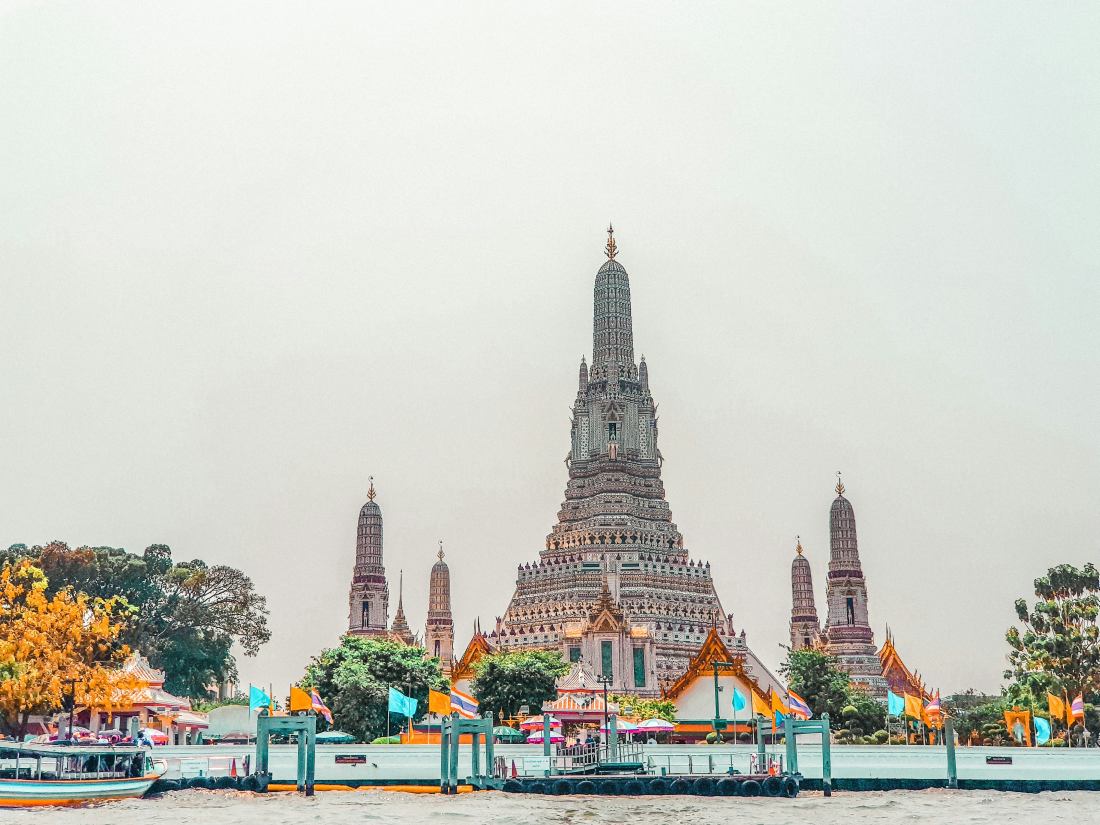
Also known as the Temple of Dawn, Wat Arun rises on the western bank of the Chao Phraya river. Its mosaic-covered tower is particularly spectacular to see at sunrise and sunset.
Wat Pho (Temple of the Reclining Buddha)
The Temple of the Reclining Buddha, where a 46-metre-long, gold-lacquered Buddha statue can be seen. Wat Pho is also considered the birthplace of traditional Thai massage.
Chatuchak Weekend Market
One of the world’s largest open-air markets, where thousands of stalls sell everything from clothing to antiques to street food. It is only open at weekends.
River and Canal Boat Trip
A unique way to discover the city. The express boats on the Chao Phraya river stop at many important temples and districts, while the side canals (khlongs) evoke the atmosphere of old Bangkok.
What are the most popular foods and drinks in Bangkok?
Bangkok is world-famous for its street food culture. The best-known local dishes include pad thai, som tam, khao man gai, and mango sticky rice, while for drinks, fresh coconut, Thai tea, and Chang beer are the most popular.
The pad thai is perhaps the world’s most famous Thai dish: stir-fried rice noodles with egg, prawns or chicken, peanuts, and lime. It is available on almost every corner of Bangkok’s streets.
The som tam is a green papaya salad that combines spicy, sour, sweet, and salty flavours. One of the most popular everyday dishes among Thais, it is usually served with grilled chicken (gai yang) and sticky rice.
The khao man gai is Thai „chicken rice”: tender, poached chicken served with fragrant rice – a light yet satisfying dish.
The mango sticky rice (khao niao mamuang) is one of the most widespread Thai desserts: glutinous rice flavoured with coconut milk, served with ripe mango. During its season (usually March–June) it is an unmissable treat.
The thai tea (cha yen) is strong black tea with coconut condensed milk, served in an iced glass – simultaneously sweet, creamy, and refreshing in the sweltering heat.
What are the important holidays and festivals in Bangkok?
Throughout the year, Bangkok hosts numerous important holidays and festivals. The most well-known include Songkran (Thai New Year), Loy Krathong, and the King’s Birthday.
Songkran (13–15 April) is the celebration of Thai New Year, marked as a gigantic water fight. Out on the streets, everyone armed with buckets and water pistols soaks each other – it is at once a symbolic purification and a huge party. Bangkok holds its water battles on specially designated streets for the occasion.
The Loy Krathong (novemberben, teliholdkor) is one of the most beautiful Thai festivals: as part of an evening ceremony, small flower- and candle-decorated baskets (krathong) are released onto the water, carrying away misfortune and troubles. Crowds gather along the riverbank and release lotus lanterns into the sky.
The King’s Birthday (5 December) is a national holiday throughout Thailand. In Bangkok, festive illuminations and parades make the city centre special, and locals celebrate dressed in yellow.