
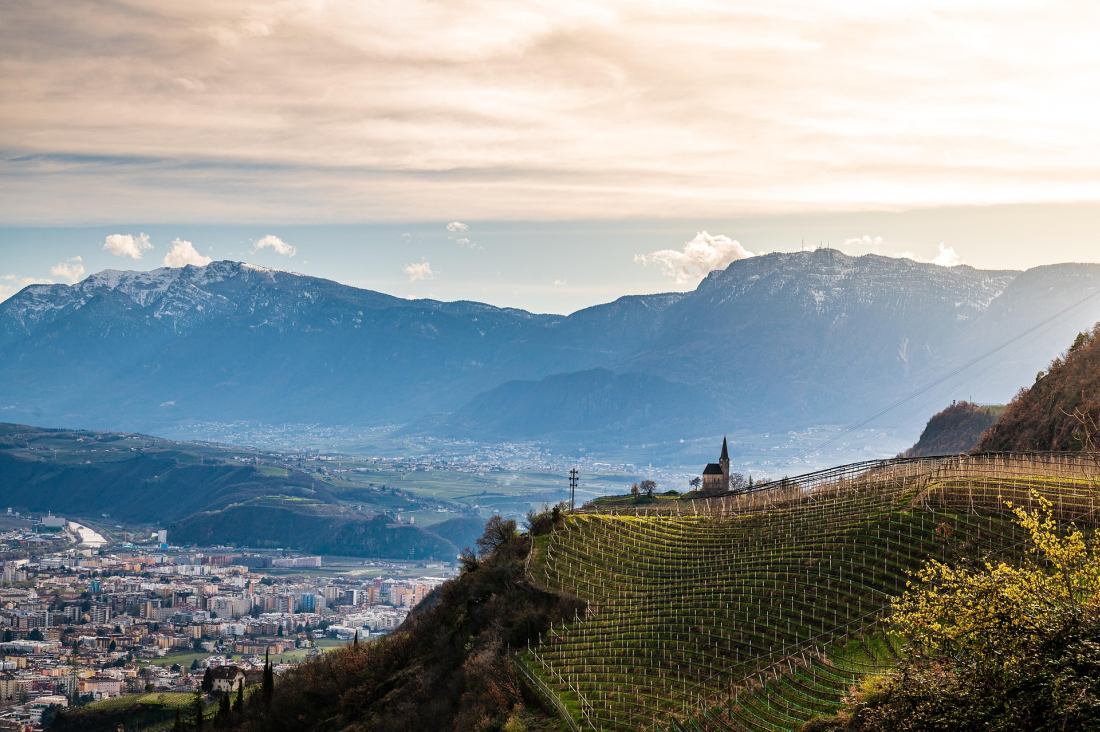
Bolzano, the capital of South Tyrol, is the central city of the Dolomites, where the blend of Italian and Austrian style has created a wonderful atmosphere.
Having belonged at different times in its turbulent history to Austria and to Italy, the city is today greeted by its residents in three languages – Italian, German, and Ladin – and this cultural blend permeates the atmosphere of its streets, its cuisine, and its architecture alike. Embraced by mountains, the sunny old town has not by chance ranked among Italy’s most livable cities in several surveys in recent years.
Table of Contents
Bolzano attractions
Piazza Walther
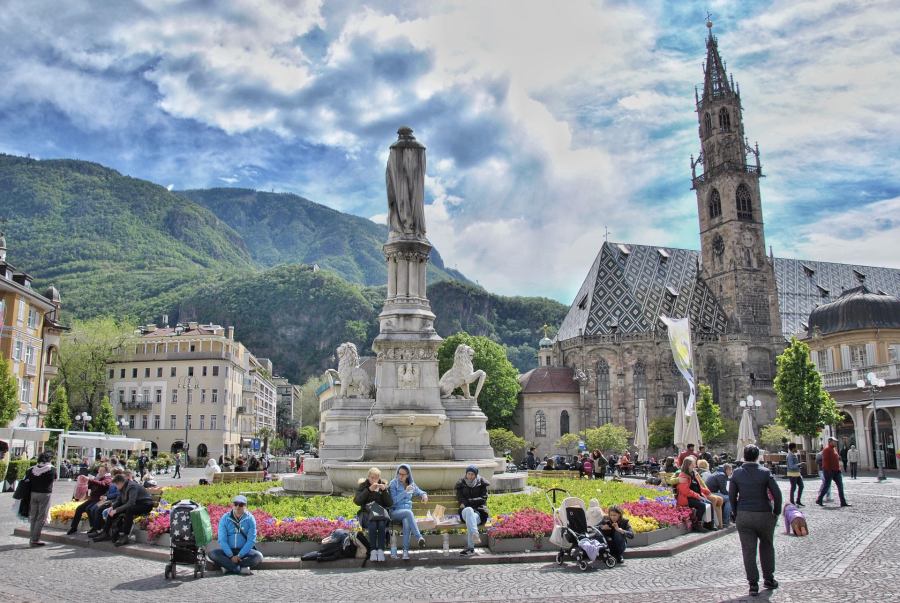
The city’s main square is also the stage for everyday life, where locals sip coffee in the morning and crowds of tourists gather in the shadow of the cathedral in the afternoon.
The square, laid out in the early 19th century, was named after the medieval German-language poet Walther von der Vogelweide, whose white marble statue has dominated its center since 1889. The square, lined with pastel-colored townhouses, has been renamed several times over the centuries as the city’s allegiance shifted between Austria and Italy.
In spring a flower market and in December one of Italy’s largest and oldest Christmas markets fill the square with life, when the scent of pine and mulled wine drifts through the air. During the day, the bustle can be comfortably watched from café terraces, while the peaks of the Dolomites rise in the background.
Bolzano Cathedral (Duomo di Bolzano)
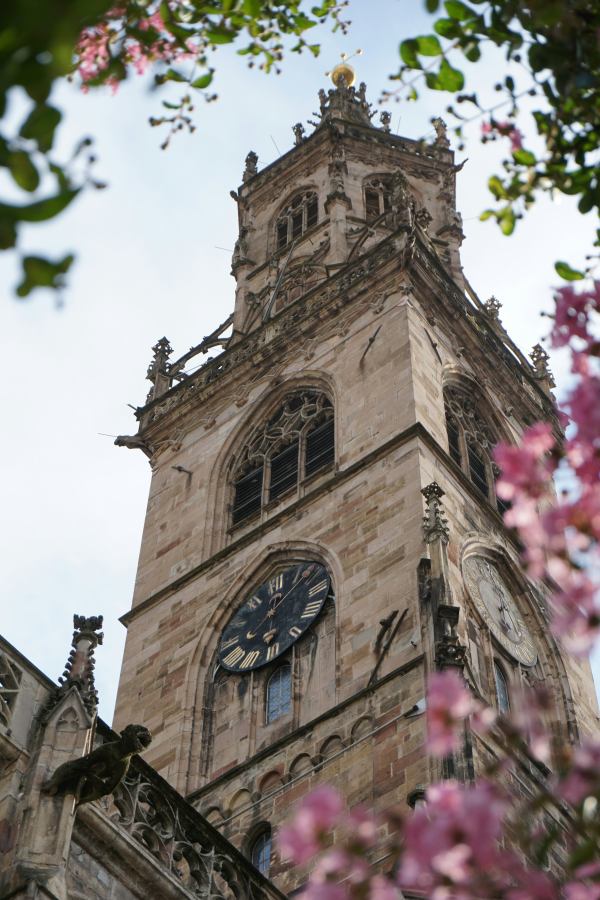
The church dominating the main square is recognizable from afar by its green, white, and yellow diamond-patterned roof tiles, one of the most striking features of the Gothic-style building.
A predecessor of today’s cathedral already stood on this site in the 12th century; most of the current Gothic structure was built in the 14th–15th centuries, and its bell tower was completed in the early 16th century with delicate, lace-like stone carving. The church was severely damaged by bombing in the Second World War and was carefully restored afterward.
Inside, visitors are greeted by colorful stained-glass windows, a vaulted ceiling, and numerous altars, and near the entrance a small museum showcasing the cathedral’s treasury can also be visited. The church’s quiet offers a pleasant contrast to the bustle of the square outside.
Via dei Portici (Lauben)
The old town’s main pedestrian street is lined with medieval arcades, beneath which shops and cafés have lined up for centuries.
The street took shape in the 12th century for trading purposes, and the arcades originally offered merchants protection from the elements. Along the narrow, cobblestoned road, many traditional Bolzano townhouses still stand today, their façades reflecting both Italian and Austrian architectural traditions.
The pedestrian street runs from Piazza Walther to Piazza delle Erbe, and along the way shops offering local products, South Tyrolean specialties, and handcrafted gifts await visitors, making the street one of the centers of the city’s shopping scene.
Piazza delle Erbe (Obstplatz)
The picturesque market square has for centuries been the center for selling fresh vegetables, fruit, and local delicacies, and is one of Bolzano’s most colorful spots.
In the middle of the square stands the Neptune Fountain, erected in the 18th century, around which market stalls still operate today from Monday to Saturday. The façades of the surrounding buildings and the atmosphere of the market clearly show how Italian market bustle blends with South Tyrolean precision here.
The stalls offer fresh South Tyrolean apples, cheeses, smoked meats, and seasonal vegetables, while small restaurants and wine bars at the edge of the square await those who want to relax with a glass of local wine after shopping.
Runkelstein Castle (Castel Roncolo)
The castle standing atop a porphyry cliff towering over the city is made special by Europe’s largest and best-preserved collection of medieval secular frescoes.
The castle was built in 1237 by the noble Wangen family, then expanded and decorated at the end of the 14th century by the merchants Niklaus and Franz Vintler with the knightly scenes, hunting images, and literary motifs still visible today, including the story of Tristan and Isolde.
It can be reached on foot from the old town along the promenade or cycle path beside the Talvera River, or by the bus line departing from Piazza Walther. Temporary exhibitions and cultural programs are regularly held in its halls.
Maretsch Castle (Castel Mareccio)
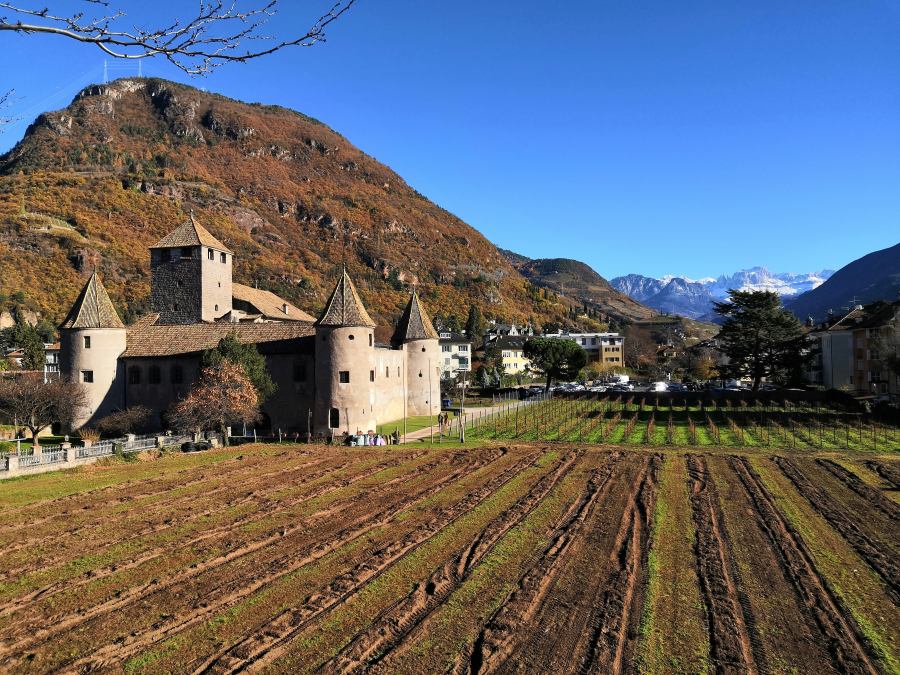
The castle, proud of its four round corner towers, stands at the edge of Bolzano’s old town and today serves mainly as an event venue.
The fortress, built in the 13th century, was originally erected by the Bolzano noble family Maretsch, combining Romanesque and Gothic stylistic features. The vineyards surrounding the castle are still cultivated today, lending a distinctive rural atmosphere to the middle of the old town.
The building today hosts conferences, exhibitions, and concerts, and local restaurants also offer tastings of wine grown in its vineyard. The castle is just a few minutes’ walk from Piazza Walther, so it can easily be worked into a sightseeing route through the city.
Renon Cable Car
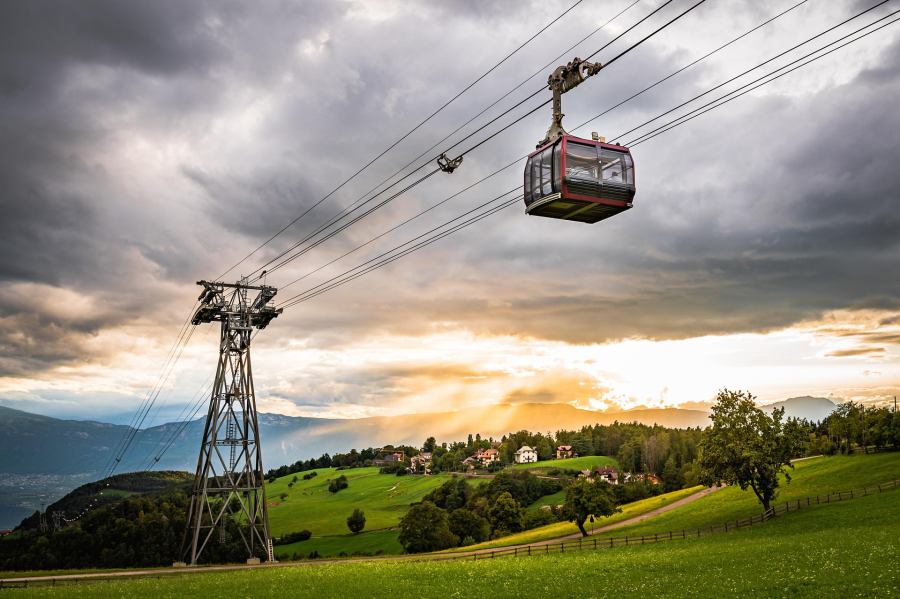
The cable car departing from the city center whisks visitors up to the fresh-air villages of the Ritten plateau in just twelve minutes, with a stunning view of the Dolomites.
A predecessor of today’s cable car was already built in 1966 to connect the city with the plateau, which had previously been accessible only by a rack railway. The cable car passes over the Talvera River and then over dense forests and vineyard-covered hills, offering an ever-widening panorama.
On the plateau lies one of the world’s most spectacular fields of earth pyramids: clay towers, capped with rocks and carved by rain and wind, that can grow to as much as 30 meters tall. The area’s easy walking trails and mountain inns make it a popular destination for locals as well.
Talvera Promenade
The green promenade lining both banks of the Talvera River, which flows through Bolzano, is a favorite spot for locals to relax and exercise, just a few steps from the city center.
The riverside stretch, laid out in the early 20th century, is lined with plane trees and flower beds, and several historic bridges cross the river above, including the Talvera Bridge, which connects the old town with the Gries district. The promenade also leads to Castel Roncolo, so it can easily be combined with a longer excursion.
In the morning, joggers and cyclists populate the riverbank, and on weekends, families do too; the promenade offers pleasant shade in summer and striking autumn foliage colors in fall. On both sides of the river, cafés and small beach bars also stay open during the warmer months.
Victory Monument (Monumento della Vittoria)
The monumental triumphal arch standing on the far bank of the Talvera River is one of the most disputed monuments of twentieth-century Italian history.
Inaugurated in 1928 and designed by Marcello Piacentini, the structure was erected by Mussolini’s fascist regime to commemorate Italy’s victory in the First World War and the annexation of South Tyrol to Italy, which is why the monument remains a subject of controversy among the German-speaking population to this day.
Since 2014, a permanent exhibition in the monument’s basement has presented South Tyrol’s twentieth-century history, including the periods of fascism and National Socialism, from a critical and objective perspective. The visit helps in understanding the region’s complex, bilingual identity.
Firmiano Castle (Castel Firmiano)
The fortress on the rocky plateau above Bolzano is one of the best-preserved castle complexes in South Tyrol, offering a breathtaking view of the city and the mountains.
The castle’s history dates back to the 10th century, and thanks to its strategic location it was for centuries one of the region’s most important strongholds, overseeing the roads leading into Bolzano. It was also used for military purposes in the 19th century before being renovated in the early 21st century.
Its halls today house one of the stations of the mountain museum created by the famous mountaineer Reinhold Messner, and the walking paths and viewpoints around the castle are themselves well worth the excursion. The building can be reached by car, by bicycle, or by the bus departing from the city center.
Muri-Gries Abbey
The calm atmosphere of the Gries district, on the far bank of the Talvera and dotted with villas and vineyards, stands in sharp contrast to the bustle of the old town.
The district’s central building is the Muri-Gries Cistercian Abbey, whose monks still produce wine on the monastery’s estate today, continuing one of South Tyrol’s oldest traditions. In the nearby Gries parish church, Michael Pacher’s Gothic winged altarpiece and a distinctive Romanesque crucifix can also be viewed.
Walking through the district’s quiet streets, it becomes clear what the surroundings of Bolzano must have looked like before today’s city center grew up around it in the 20th century: here, vineyard plots and villa gardens still alternate in the shadow of church towers.
Kohlern Cable Car (Funivia del Colle)
The wooded plateau rising southeast of the city is a peaceful excursion spot, connected to the city by a technological-history curiosity: a cable car built in 1908.
It went down in history as the world’s first cable car built for passenger transport, and although it has since been modernized, its route remains the same as it was a hundred years ago. The plateau offers a stunning panorama of Bolzano and the surrounding mountains.
On the plateau, easy, marked hiking trails lead through forests and meadows, offering a pleasant refuge from the summer heat and proving especially popular with photographers in autumn for its foliage colors.
Freedom Boulevard (Corso della Libertà)
The wide boulevard starting from the Victory Monument is a characteristic example of early twentieth-century Italian urban planning, with straight lines and imposing building façades.
The boulevard was built in the 1920s and 1930s, when the fascist government sought to create a new district with an Italian character opposite Bolzano’s old town of German tradition. The rationalist-style buildings, including the massive Palazzo degli Uffici Statali, still clearly reflect this intent today.
Modern shops, offices, and restaurants line the boulevard today, and the wide arcades offer a pleasant place to stroll even on rainy days. The street is also a good starting point toward the Gries district and the Talvera Promenade.
Dominican Church
The church tucked into a quiet corner of the old town, together with its adjoining monastery’s frescoes, preserves one of the region’s most important medieval art treasures.
In the Chapel of St. John of the church, founded in the 13th century, a 14th-century fresco cycle linked to Giotto’s Florentine school of painting can be seen, one of the most important works of southern Alpine painting of its time. Valuable wall paintings also line the monastery’s cloister.
The adjoining square today is lined with cafés and restaurants that spill out into the open air during the summer months, so the church’s quiet and the square’s bustle form a pleasant contrast to one another.
Bolzano Christmas Market
In December, Piazza Walther is transformed into one of Italy’s oldest and most atmospheric Christmas markets, drawing several hundred thousand visitors every year.
The tradition dates back to the early 1990s, when a market modeled on South Tyrolean and Austrian traditions began selling handcrafted gifts, mulled wine, and local flavors from its wooden stalls. Since then, the market has grown into one of the city’s most important tourism events.
Strolling among the pine-scented stalls, visitors can sample roasted chestnuts, gingerbread, and mulled wine, while the huge Christmas tree set up in the square and the illuminated façade of the cathedral create a truly festive atmosphere.
Best museums in Bolzano
South Tyrol Museum of Archaeology
The institution housing one of the world’s most famous Ice Age finds, the 5,300-year-old Ötzi, is Bolzano’s most-visited cultural institution.
The museum opened in 1998, specifically with the aim of providing a fitting home for the iceman found in the Ötztal Alps in 1991, who has since been kept in a special, refrigerated glass chamber on the building’s ground floor. The three-level exhibition presents Copper Age humans through period objects, clothing, and weapons.
Using reconstructions and interactive stations, visitors can learn how Ötzi lived, hunted, and died, while on the upper floors they can also gain insight into the scientific methods used to examine the find.
All the information is available here!
Museum of Modern and Contemporary Art (Museion)
The glass-and-steel building standing on the bank of the Talvera River is Bolzano’s most modern cultural center, home to contemporary visual art.
The museum opened in 2008, based on the winning concept of an international design competition, and its collection presents international and South Tyrolean contemporary art from the 1960s to the present day, from paintings to video installations. The building is itself a spectacle: at night, the glass panels covering its façade, lit from within, function as a light installation.
Alongside its regularly rotating temporary exhibitions, the museum’s rooftop terrace offers a panoramic view of the city and the mountains, and the ground-floor café is a pleasant stop after a museum visit.
All the information is available here!
South Tyrol Museum of Natural Science
The museum presenting the region’s unique geology and wildlife is especially popular with families thanks to its interactive exhibitions.
The institution was founded with the aim of showcasing the formation of the Dolomites, their mineral wealth, and mountain wildlife, from Ice Age animals to species still living in the Alps today. One of its most popular rooms presents the wildlife of mountain streams and lakes in a huge aquarium.
Alongside the child-friendly exhibition space, the museum also offers an earthquake simulator and interactive relief models, which let visitors get a close-up understanding of how the Dolomites were formed.
All the information is available here!
Messner Mountain Museum Firmian
The museum set up in the halls of Firmiano Castle presents the thousands-of-years-old relationship between humans and mountains through the eyes of the world-famous mountaineer Reinhold Messner.
Opened in 2006, the institution is the central station of the six-part museum network created by Messner, in which the history of mountaineering is explored through paintings, relics, and objects from Messner’s own expeditions. The exhibition also touches on themes such as the role of mountains in myths and religions.
The castle’s courtyards and towers are themselves part of the exhibition, and the uppermost levels offer a breathtaking view of the Dolomites and the western ranges of the Alps, making the visit a true experience as the exhibition’s closing note.
All the information is available here!
Bolzano weather: when is the best time to visit?
Thanks to its distinctive, cauldron-like location, Bolzano is one of Italy’s sunniest and driest cities, where Mediterranean influences and a continental Alpine climate mix in a distinctive way, across four clearly defined seasons.
Spring (March–May):
Spring starts out mild, then from April onward becomes increasingly warm and sunny, with average temperatures ranging between 10–20°C. In the valley, fruit trees and vineyards blossom early, while up on the higher Ritten plateau snow may still linger, creating a striking contrast in the landscape.
Summer (June–August):
Summer in Bolzano is hot and typically dry, with temperatures often exceeding 30°C, since the mountains surrounding the city shield it from rain clouds. To escape the heat, locals often retreat to the cooler air of the Ritten or Kohlern plateaus, where temperatures can be several degrees lower.
Autumn (September–November):
Autumn is one of Bolzano’s most beautiful seasons: September and October are still pleasantly warm and sunny, while the grape harvest and the colorful foliage of the vineyard hills lend the city a special atmosphere. November turns cooler and rainier, but the mountain panorama remains stunning even then.
Winter (December–February):
Winter in the valley is relatively mild and dry, with average temperatures often staying above 0°C, and snow rarely settles in the city for long. In the nearby mountains, however, snowfall is abundant, making Bolzano an excellent starting point for South Tyrol’s ski areas.
Best time to travel to Bolzano:
The most ideal time to visit Bolzano is late spring (April–May) and early autumn (September–October), when the weather is pleasant, rainfall is moderate, and the grape harvest or the blossoming offers a special sight. Those who want to experience the Christmas atmosphere should go in early December, while in summer months it’s worth combining sightseeing with mountain excursions.