
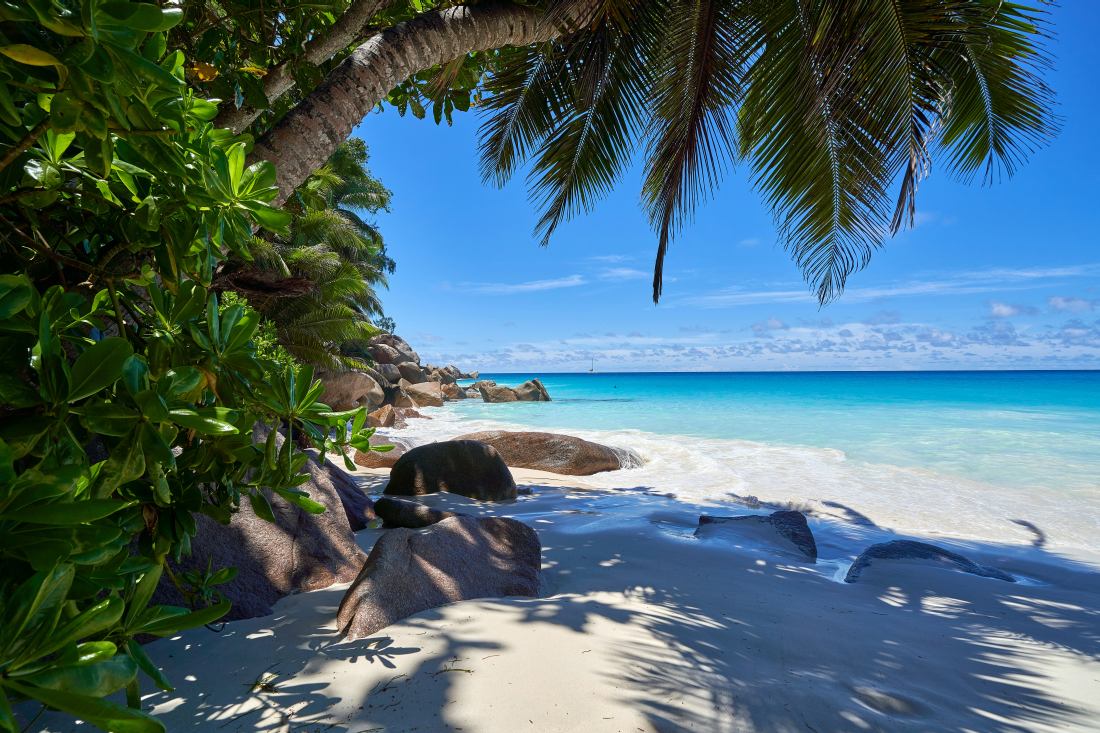
The Seychelles are one of the most dazzling jewels of the Indian Ocean – pristine white sand beaches, crystal-clear turquoise water, and breathtaking natural treasures await travelers. The questions and answers below will help you navigate the most important information, whether it concerns entry requirements, weather, transportation, or health matters.
Table of Contents
Basic information
Why is it worth traveling to the Seychelles?
The Seychelles are one of the most popular and beautiful destinations in the Indian Ocean, where untouched nature, the world’s most beautiful white sand beaches, and an unparalleled rich underwater world combine to make the trip unforgettable.
The archipelago consists of 115 islands of various sizes, most of which are uninhabited and pristine natural treasures. The main attractions include the granite-boulder-lined beaches (such as Anse Lazio or Anse Source D’Argent), the Vallée de Mai nature reserve, part of the UNESCO World Heritage, home to the rare coco de mer palm, and the Aldabra coral atoll, the largest atoll in the world. Giant tortoises, endemic bird species, and stunning coral reefs can also be admired on the islands. The local culture draws from a blend of African, English, French, Indian, and Chinese elements, with music and dance as its main pillars.
What time zone is Seychelles in?
The Seychelles’ time zone is UTC+4 and does not observe daylight saving time.
When is the best time to travel to the Seychelles?
For a first visit, the dry season between late April and mid-October is generally recommended, as it is the ideal beach season. During this period you can expect long sunny days, rain mostly falls after dark, and daytime temperatures are a pleasant 27–30 °C.
With its tropical climate, the Seychelles enjoy pleasantly warm weather year-round – the average temperature is around 30 degrees, and evenings rarely drop below 22 degrees. The dry season lasts from early May to September, while the rainy season runs from October to April. The transitional months (April and October) also have relatively pleasant weather. Peak season is in July and August, as well as during the Christmas–New Year period, when prices are highest.
How many days is it worth spending in the Seychelles?
To explore the Seychelles, at least 7–10 days is generally recommended, so travelers can get to know not just one island but all three main islands (Mahé, Praslin, La Digue).
During a one-week stay, travelers typically spend 2–3 days on Mahé, where the capital Victoria and the island’s wonderful beaches can be explored. The next 2–3 days can be spent on Praslin, where the Vallée de Mai nature reserve and Anse Lazio beach are the main attractions. Finally, La Digue is also worth 1–2 days, where Anse Source D’Argent beach and cycling exploration offer a special experience. For trips longer than 10 days, it is also possible to spend a few days on one of the private resort islands.
What is the official currency of the Seychelles?
The official currency of the Seychelles is the Seychellois rupee (SCR), whose subunit is the cent (1 rupee = 100 cents).
Most hotels, restaurants, and tourist service providers also accept US dollars and euros, but it’s worth paying in local currency at smaller places and markets. Card-enabled ATMs are generally available on the main islands. It is advisable to bring dollars or euros from home and exchange them for rupees on-site, or withdraw cash at a local ATM with a bank card.
Here is a currency converter calculator where you can check the current exchange rate!
What language do people speak in the Seychelles?
The three official languages of the Seychelles are English, French, and Creole. English works well at most tourist locations, hotels, and restaurants.
The country was formerly a British colony (until 1976), so almost everyone understands and speaks English. Locals often speak the local Creole dialect among themselves, which combines French-based Creole with various African, Indian, and Malay elements.
What type of power outlet is used in the Seychelles?
The Seychelles use type G outlets, identical to the triangular, three-pin plugs used in the United Kingdom. A travel adapter will be needed for most European devices.
The mains voltage on the islands is 240 volts, 50 Hz, which matches European voltage – so most electronic devices (chargers, laptops) can be used with just an adapter, without a voltage converter. It’s worth checking the rating label on your devices beforehand to see if they support 240V.
How does internet and SIM card use work in the Seychelles?
Mobile internet is generally available on the main islands (Mahé, Praslin, La Digue), and the vast majority of hotels and restaurants offer free Wi-Fi. On more remote, smaller islands, the internet connection may be more limited.
Local SIM cards can be bought at the airport or in shops in the capital, Victoria, offering affordable mobile data. The two main mobile carriers are Cable & Wireless and Airtel. An eSIM, purchasable online before the trip, is also becoming increasingly popular, allowing internet access from the moment of arrival. For services requiring live streaming or high data usage, it’s worth getting a local SIM, as roaming fees can be high.
Is it customary to tip in the Seychelles?
It is generally customary to tip in the Seychelles, especially at restaurants and for other services. The expectation is usually 10% of the bill if a service charge is not already included in the price.
At many hotels and restaurants the bill already includes a service charge, so it’s worth checking the bill before paying. It is also customary to leave a small amount as a tip for taxi drivers and tour guides. In general, locals appreciate tips, especially at higher-category hotels.
Travel and transportation
How can you get from the airport to your accommodation in the Seychelles?
The Seychelles’ only international airport is located on Mahé, a few kilometers from Victoria. You can reach your accommodation by taxi, rental car, or hotel transfer service.
Taxis and car rental services are available right near Seychelles International Airport (SEZ). Most hotels provide airport transfers on request. If you’re heading to Praslin or La Digue, you can continue on from Mahé by domestic flight (about 20 minutes) or by ferry (Mahé–Praslin: about 1 hour 15 minutes, Praslin–La Digue: about 15 minutes).
What is the most convenient way to get around within the islands?
The most convenient way to get around within the main islands is by rental car or taxi, while on La Digue, bicycles are the most common and pleasant means of transportation.
Local bus services also operate on Mahé and Praslin, offering a cheap alternative, although the schedule isn’t always reliable. Taxis generally don’t have meters, so it’s best to agree on the price before setting off. When renting a car, keep in mind that driving is on the left side (a British tradition). On La Digue, car traffic is heavily restricted, so bicycles are truly the best option there.
Accommodation and safety
Is the Seychelles a safe destination?
The Seychelles are generally considered a safe tourist destination, with good public safety. Violent crime rates are low, but it’s worth watching out for minor theft and pickpocketing even in tourist areas.
The main risks include sea-related hazards (strong currents, jellyfish), so it’s worth checking current conditions before going to the beach. The atmosphere in tourist areas is pleasant both during the day and in the evening.
Which island is best to stay on?
Most travelers stay on Mahé, Praslin, or La Digue, but the most ideal solution is to spend a few nights on two or three islands.
Mahé is the best choice for those who want the most options: it has the most hotels, restaurants, shopping opportunities, and of course, the airport.
Praslin is the favorite of nature lovers and those seeking a quieter retreat, while La Digue offers the most romantic, secluded atmosphere. For those seeking maximum luxury and total seclusion, private resort islands (e.g., North Island, Frégate Island) are available, though these are exclusive and expensive options.
Health information
Are mandatory vaccinations required to travel to the Seychelles?
There are generally no mandatory vaccinations for most travelers to the Seychelles – unless the traveler is arriving from a yellow fever area, in which case proof of yellow fever vaccination is required.
Recommended vaccinations: Hepatitis A, Hepatitis B, diphtheria-pertussis-tetanus (Di-Per-Te), and possibly typhoid vaccination for longer stays. Dengue fever can also occur in the region, for which no widely available vaccine currently exists, so protection against mosquitoes (insect repellent, appropriate clothing) is important. It’s advisable to visit a vaccination center at least 4–6 weeks before travel.
Is tap water safe to drink in the Seychelles?
Drinking tap water is generally not recommended in the Seychelles – bottled or filtered water is recommended for travelers.
Although the water supply is showing an improving trend in more developed and modern areas, it’s safer to drink bottled water. Tap water available at most hotels is generally fine for brushing teeth, but travelers with sensitive stomachs may want to use bottled water for this as well.
What healthcare is available in the Seychelles?
Healthcare in the Seychelles can be considered minimal. The central hospital is located in Victoria (Mahé); only basic care is available on the smaller islands.
In case of more serious health problems, patients are transported to Victoria, or in more severe cases abroad, which can be very costly. In light of this, all travelers are strongly advised to take out comprehensive travel insurance covering accidents and illness – ideally including coverage for evacuation and repatriation – before departure.
Experiences
What are the must-see attractions in the Seychelles?
The most famous attractions in the Seychelles include Anse Lazio and Anse Source D’Argent beaches, the Vallée de Mai nature reserve, the giant tortoise reserves, the natural wonders of the Aldabra Atoll, and the distinctive buildings of the capital, Victoria.
- The Anse Lazio beach on Praslin is one of the most beautiful beaches not only in the Seychelles but in the whole world – granite boulders, palm trees, and turquoise water make it special.
- The Anse Source D’Argent on La Digue is equally iconic, ranking among the most photographed beaches in the world.
- The Vallée de Mai (Praslin) is a UNESCO World Heritage site, home to the endemic coco de mer palms – which produce the heaviest seed found in nature.
- Victoria‘s old town also has the Clock Tower (a 1903 replica of London’s Big Ben), the natural history museum, and the vibrant market, all worth a visit.
- On Mahé, Morne Seychellois National Park is the starting point for many hiking trails, offering panoramic views of the island.
What activities and programs are recommended in the Seychelles?
The Seychelles offer unparalleled opportunities for water sports, hiking, and cultural programs. Diving, snorkeling, kayaking, and deep-sea fishing are all extremely popular.
- Diving and snorkeling are among the best experiences the islands offer – sea turtles, sharks, rays, and countless tropical fish can be seen on the coral reefs.
- On La Digue, cycling around the island is a delightful activity that lets you reach all the major beaches and sights. Whale watching, sea kayaking, and sailing are also popular.
- On land, you can visit the gigantic giant tortoises of Aldabra Atoll, though you can also encounter them at most hotels and reserves. T
- he food market (Sir Selwyn Selwyn-Clarke Market in Victoria) is also a must-see experience, where you can buy local spices, fruits, and handicrafts.
What is the local cuisine like in the Seychelles?
Seychellois cuisine is a true melting pot, combining African, French, Indian, and Chinese influences. Fresh fish, seafood, and tropical fruits are the cornerstones of local dining.
- The most popular local dishes include grilled red snapper (bourgeois), shellfish and shrimp in various curry sauces, and bouillon brède (a soup made from vegetables and fish).
- Ladob is a traditional sweet dish made from boiled banana or breadfruit with coconut milk and vanilla. Dishes are typically spicy and aromatic.
- Tropical fruit juice (mango, papaya, passion fruit) and coconut water are also must-tries.
- Local beers (e.g., Seybrew) and craft rums (e.g., Takamaka Rum) are also characteristic of Seychellois drinking culture.