
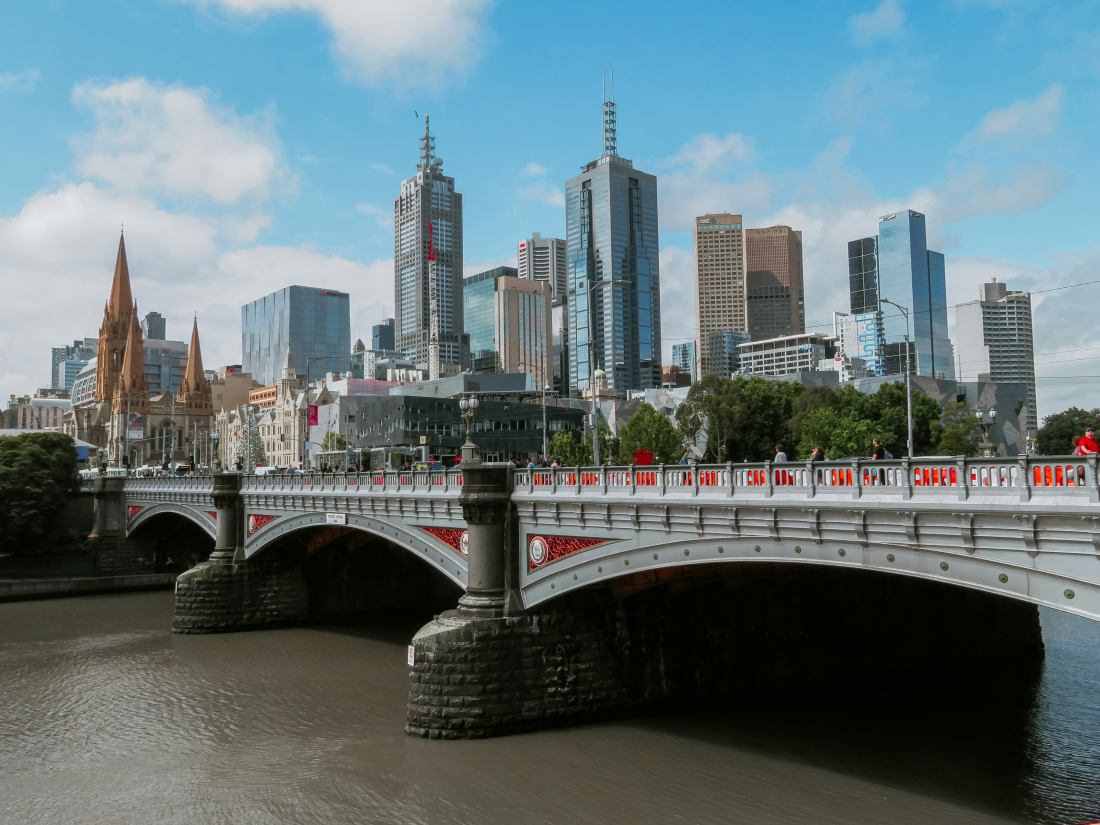
Melbourne is Australia’s other major cultural center alongside Sydney. The following questions and answers will help you navigate the most important information, whether it’s about visas, transportation, or the best time to travel.
Table of Contents
Basic information
Why is it worth traveling to Melbourne?
Melbourne is Australia’s cultural and culinary capital, famous for its atmospheric laneways, coffee culture, and diverse neighborhoods.
The city is often named one of the most livable cities in the world. Its main attractions are Hosier Lane and the other graffiti-covered laneways, the Victorian-era buildings lining the city center, and the modern districts along the Yarra River. Melbourne is also Australia’s sporting capital: it hosts the Australian Open tennis championship, the Melbourne Cup horse race, and the Formula 1 Australian Grand Prix.
Gastronomy deserves its own chapter: from the world-famous coffee culture to multicultural restaurants – from the Italian quarter (Lygon Street) to Vietnamese Footscray – Melbourne is one of the most exciting culinary destinations in the Southern Hemisphere.
What time zone is Melbourne in?
Melbourne is located in the Australian Eastern Standard Time zone (AEST, UTC+10), and observes daylight saving time in summer (UTC+11).
When is the best time to travel to Melbourne?
The most pleasant time to travel to Melbourne is generally during spring (September–November) and autumn (March–May), when the weather is mild.
It’s important to know that the seasons are reversed in the Southern Hemisphere: here, December–February is summer, and June–August is winter. Summer months can be pleasantly warm, reaching up to 25–30°C, and this is when the biggest outdoor festivals and sporting events take place – but it’s also peak season, with higher prices.
Melbourne’s weather is famously unpredictable – it’s often said you can experience „four seasons in one day”. Because of this, layered clothing is recommended almost year-round, even in summer.
The spring and autumn months (September–November and March–May) are ideal for sightseeing: these periods are characterized by fewer crowds, moderate temperatures, and pleasant light.
How many days is it worth spending in Melbourne?
Generally, at least 4–5 days are recommended to explore Melbourne.
In 3 days, you can cover the most important spots in the city center: Federation Square, Queen Victoria Market, the street art of the laneways, and the Royal Botanic Gardens.
With a 4–5 day stay, there’s also room for a day trip near the city, such as to the Great Ocean Road, the Yarra Valley wine region, or Phillip Island for the penguin parade. Those wanting to include these should plan at least a week for the region.
What is the official currency in Melbourne?
Melbourne, and all of Australia, uses the Australian dollar (AUD) as its official currency.
Australia is one of the most card-friendly countries in the world: cards are accepted almost everywhere – in cafés, markets, even taxis – often with contactless payment. Cash is therefore rarely needed, but it can come in handy at smaller markets or with street vendors.
Here is a currency converter calculator where you can check the current exchange rate!
Is English spoken in Melbourne?
Yes, English is Australia’s official language, so English is spoken everywhere in Melbourne.
Melbourne is an extremely multicultural city, and a significant portion of the population also speaks other languages at home, but everyday communication, signage, and official business are all conducted in English. Language difficulties are practically nonexistent.
What type of power outlet is used in Melbourne?
Melbourne, like all of Australia, uses Type I power outlets, which differ from European plugs.
Europlug/Type C plugs don’t fit Australian outlets, so a travel adapter is needed. It’s worth getting one at home, since although they’re also available in local stores, they may be more expensive there.
In Australia, the mains voltage is 230 volts, which matches the voltage in Europe.
How does internet and SIM card use work in Melbourne?
Melbourne has excellent internet connectivity – free Wi-Fi is available almost everywhere, in hotels, cafés, and restaurants.
For continuous mobile internet, it’s worth getting a local SIM card (Telstra, Optus, Vodafone) or an eSIM – the eSIM can even be purchased and activated online before your trip, so mobile internet is available immediately upon arrival.
Is it customary to tip in Melbourne?
Tipping is not required or expected in Australia, but for outstanding service, it’s customary to leave a small gratuity.
Since hospitality workers receive a fixed, generally higher wage than in many other countries, tipping is not a fundamental part of their income. In restaurants, if someone is satisfied with the service, a tip of around 10% can be given, but not leaving one is not considered impolite.
Travel and transportation
How do I get from the airport to Melbourne’s city center?
Melbourne’s main airport is Melbourne Airport (Tullamarine, MEL), located about 23 kilometers from the city center.
The most convenient and popular option is the SkyBus express service, which travels directly from the airport to Southern Cross Station in the city center, in about 30 minutes, with frequent departures around the clock.
Official taxis and rideshare services, such as Uber, are also available, but these are considerably more expensive than SkyBus, and depending on traffic, can also be slower.
What is the most convenient mode of transportation in Melbourne?
In Melbourne, the tram is the most typical and convenient mode of transportation, complemented by train and bus networks.
The city’s tram network is one of the largest in the world, and there’s a Free Tram Zone in the city center where you can travel without a ticket.
For public transport, it’s worth getting a myki travel card, which can be used to pay on trams, trains, and buses alike. The card can be topped up and is significantly cheaper than paper tickets.
The city center is easily walkable, but for more distant attractions and day trips, it’s worth renting a car or choosing an organized tour.
Accommodation and safety
Is Melbourne a safe city?
Yes, Melbourne is one of the safest major cities in the world, and the areas visited by tourists are considered calm both day and night.
Serious crimes are rare; the most common risks are pickpocketing and minor theft in crowded places, markets, or on public transport. With basic caution, these risks can be well managed.
Which neighborhoods are considered safe?
Among the areas most frequently chosen by visitors as safe are:
- CBD (city center) – the central business and entertainment district
- Southbank – a modern riverside district with restaurants and viewpoints
- Fitzroy and Collingwood – atmospheric, alternative neighborhoods with cafés and galleries
- St Kilda – a beachside district with beaches and a lively atmosphere
These areas have good street lighting, lively street life, and dense public transport coverage.
How safe is it at night?
The city center and popular neighborhoods are safe at night too, but as in any major city, it’s worth being cautious.
Staying on well-lit, busy streets, or taking a taxi or rideshare late at night, avoids most risks. Some quieter side streets are best avoided at night.
Which neighborhood is best to stay in in Melbourne?
The most popular and convenient accommodation areas for tourists include the CBD, Southbank, St Kilda, and Fitzroy.
- The CBD (city center) is close to most attractions, shops, and public transport lines, making it the best choice for those who want to explore the city on foot.
- Southbank lies on the banks of the Yarra River, with modern hotels, restaurants, and impressive views of the city center – recommended for those seeking comfortable, high-quality accommodation.
- St Kilda is known for its beachside atmosphere, home to the famous Luna Park. It’s a bit further from the city center, but easily accessible by tram, and offers a relaxed, holiday atmosphere.
- Fitzroy is a young, alternative neighborhood, full of cafés, galleries, and restaurants – recommended for those who want to experience the local, bohemian vibe.
Health information
Are any vaccinations required for travel to Melbourne?
No vaccinations are required for most travelers visiting Melbourne.
Australia is considered a low-risk destination from a health perspective, and tropical diseases are practically nonexistent.
Is tap water safe to drink in Melbourne?
Yes, Melbourne’s tap water is of excellent quality and safe to drink.
The city’s water supply is under strict control, and the taste and purity of the tap water are among the best in the world, so there’s no need to buy bottled water.
Experiences
What are the must-see attractions in Melbourne?
Melbourne’s best-known attractions include Federation Square, Queen Victoria Market, the Royal Botanic Gardens, the street art of Hosier Lane, and the Melbourne Cricket Ground (MCG).
- Federation Square is the cultural heart of the city, home to museums, galleries, and events, on the banks of the Yarra River.
- Queen Victoria Market is one of the largest outdoor markets in the Southern Hemisphere, where you can find everything from fresh produce to local products.
- The Royal Botanic Gardens is Melbourne’s most beautiful green space, where locals and tourists alike enjoy walking and picnicking.
- Hosier Lane and its connected laneways are strongholds of the city’s street art, with constantly changing, striking graffiti.
- The Melbourne Cricket Ground (MCG) is one of the largest stadiums in the world, hosting cricket and Australian rules football matches – it can be visited with a stadium tour regardless of match schedules.
- It’s also worth taking a day trip outside the city: the scenic coastline of the Great Ocean Road, the Yarra Valley wine region, or the penguin parade on Phillip Island are all popular destinations.
What are the most popular foods and drinks in Melbourne?
Melbourne is famous for its coffee culture and multicultural cuisine – from flat white coffee to meat pies, a wide variety of flavors can be found.
- The flat white, a coffee specialty, is associated with Melbourne, and the city has high-quality, locally roasted coffee shops on almost every corner.
- The meat pie is a traditional Australian street food, a pastry filled with meat, often sold at fast food stands and sporting events.
- Due to the city’s multicultural character, excellent Italian cuisine can be found on Lygon Street, authentic Vietnamese food in Footscray, while the Greek precinct is recommended for lovers of Greek gastronomy.
- Among drinks, the Yarra Valley wine region’s pinot noir and chardonnay wines are the best known, and Melbourne is also one of Australia’s craft beer strongholds.
What important holidays and festivals are there in Melbourne?
Melbourne hosts numerous major events throughout the year, the best known of which are the Australian Open, the Melbourne Cup, and the Melbourne International Comedy Festival.
- The Australian Open tennis championship is held every January, one of the biggest outdoor Grand Slam tournaments of the season, attracting thousands of visitors to the city.
- The Melbourne Cup, also known as „the race that stops a nation”, is held on the first Tuesday of November. Victoria state has a public holiday on this day, and the horse race brings a festive atmosphere to the city.
- The Melbourne International Comedy Festival runs from March to April and is one of the world’s largest comedy festivals, featuring both local and international performers.
- The AFL Grand Final, the championship decider of Australian rules football, is held in September, and is considered almost a national holiday in the city.