
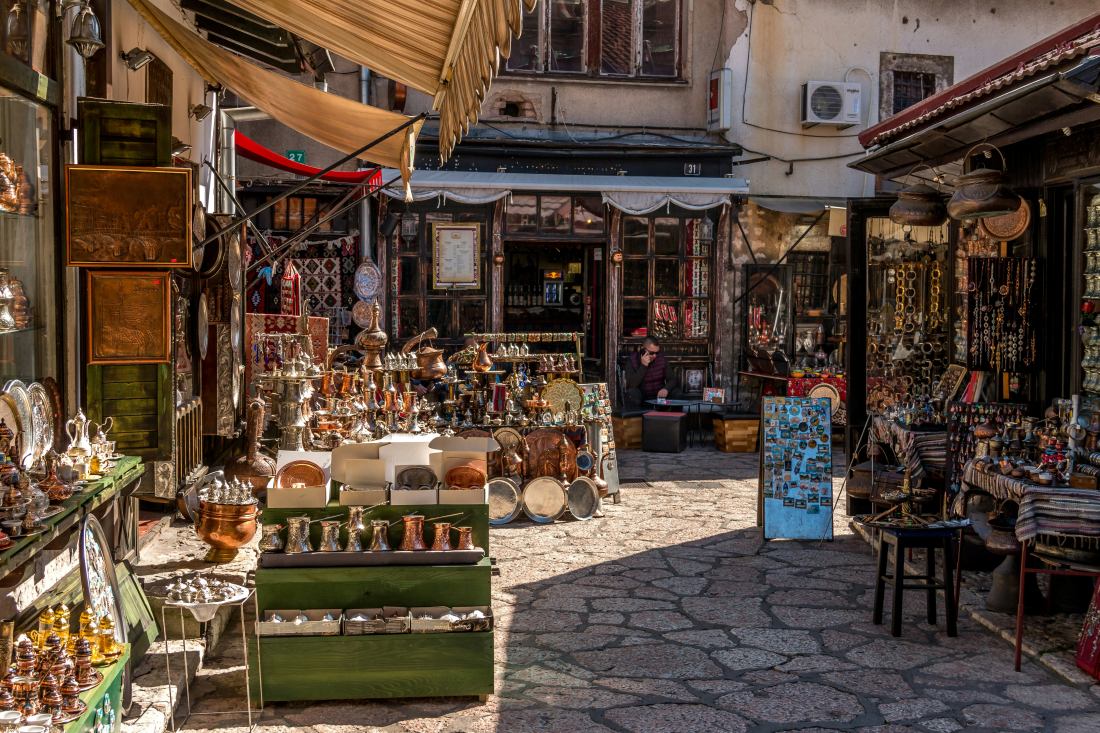
Despite the historical storms of the last century, Sarajevo is now a developing city full of attractions for tourists.
It is the capital and largest city of Bosnia and Herzegovina, located in the Miljacka River valley at the foot of the Dinaric Mountains. The city uniquely blends the traditions of Eastern and Western civilizations. Mosques, Orthodox churches, Catholic cathedrals, and synagogues can all be found in the narrow streets of the old town.
Table of Contents
Sarajevo attractions
Baščaršija
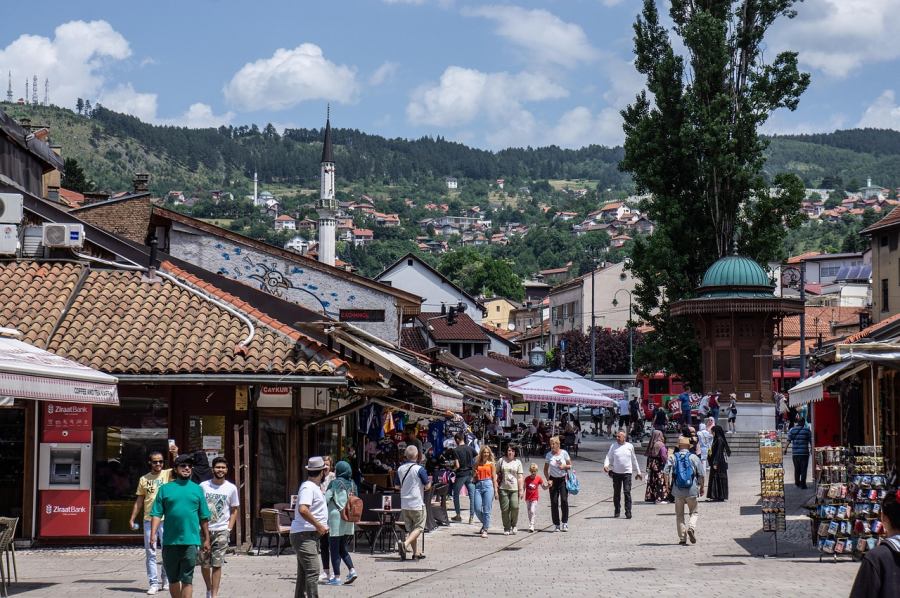
The heart of the old town and Sarajevo’s most famous historical quarter was built in the 15th century when the city was part of the Ottoman Empire. The name Baščaršija comes from the Turkish words „baš” (main) and „čaršija” (market), referring to the quarter’s commercial significance. More than 200 shops, artisan workshops, and coffee houses still operate in the labyrinth of cobblestone streets.
The central point of the quarter is the Sebilj, an Ottoman-style octagonal drinking fountain from 1891, which has become one of the city’s symbols. The surrounding square is always bustling: pigeons, tourists, and local craftsmen fill the space with life. Baščaršija’s most famous street is Kazandžiluk, where traditional coppersmiths offer their products – coffee sets, trays, and various household items.
The quarter’s Eastern charm is evident not only in the architecture but also in the gastronomy. Numerous cevabdžinicas (traditional grill restaurants) and buregdžinicas (burek shops) welcome visitors with authentic Bosnian specialties.
Sebilj
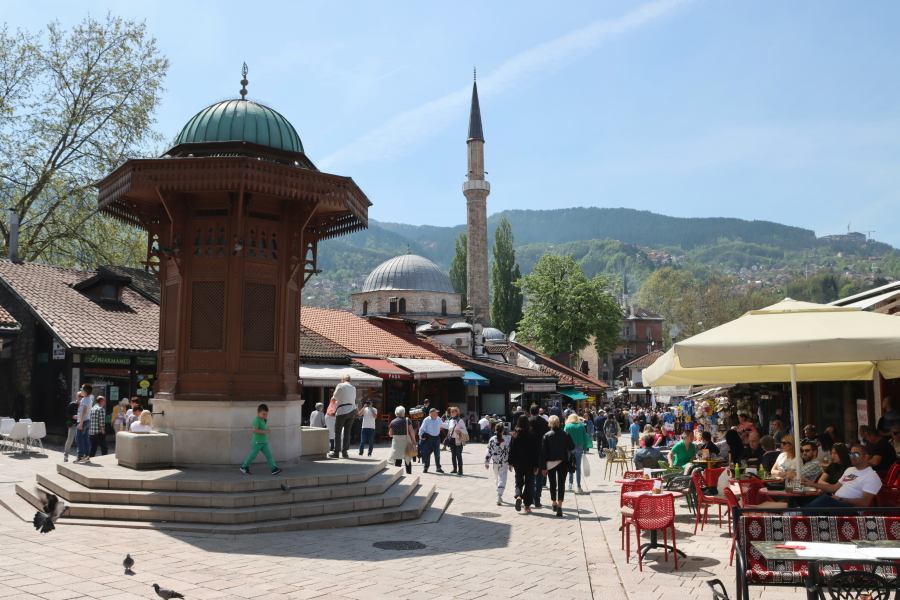
The wooden-pillared, octagonal drinking fountain on the central square of Baščaršija is one of the city’s most emblematic symbols, appearing on every postcard from Sarajevo. The original structure dated from 1753, but the current form was created in 1891 as a gift from Mehmed Pasha Kukavica. The name comes from the Arabic word „sebil,” meaning a public drinking place in Islamic traditions.
The fountain was made in pseudo-Moorish style, with its green copper dome and carved wooden pillars providing a distinctive sight. Fresh mountain spring water flows from small taps in the central basin, freely available to drink. According to Bosnian tradition, whoever drinks from the Sebilj water will surely return to Sarajevo.
The square around the Sebilj is the pulsating center of city life: locals meet here, city tours begin here, and many film scenes have been shot here. In the evening, the fountain’s illumination creates a special atmosphere.
Latin Bridge
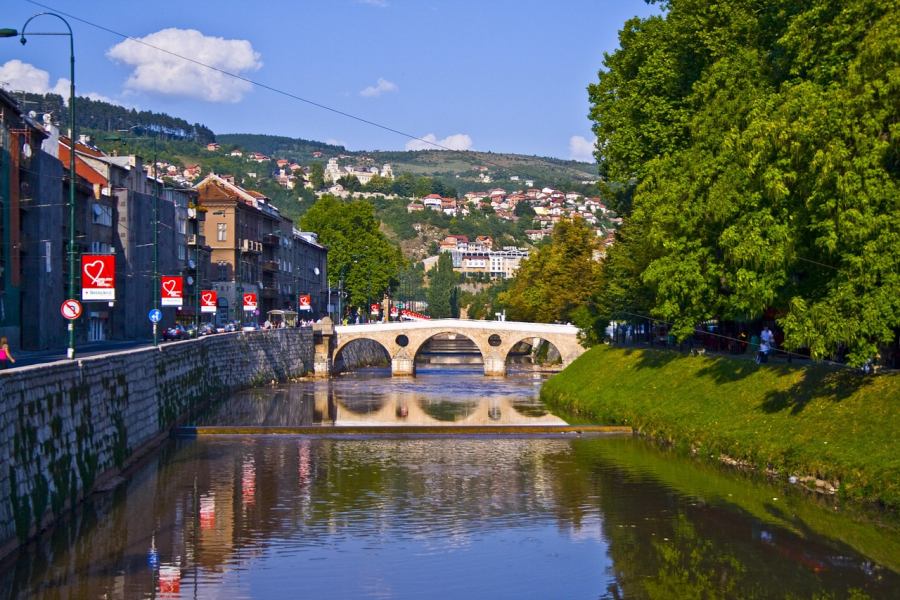
The stone bridge over the Miljacka River, built in 1798, is one of the most significant sites in modern history.
On June 28, 1914, Serbian nationalist Gavrilo Princip assassinated Archduke Franz Ferdinand and his wife Sophie here, an event that became the direct cause of the outbreak of World War I. The bridge’s original name was Princip Bridge, but it later regained its original name.
On the northern side of the bridge, a memorial plaque and footprints mark the spot where Princip stood at the moment of the assassination. A museum dedicated to the assassination operates in the nearby corner building, presenting the event’s background and consequences in detail. The bridge is only 10 meters long, but its significance far exceeds its physical dimensions.
Today, the Latin Bridge is a popular meeting place and tourist attraction. The surrounding buildings exude an Austrian–Hungarian atmosphere, with coffee houses lining the riverbank. The view along the river is particularly beautiful from here.
Gazi Husrev-bey Mosque
One of the Balkans’ most significant Islamic buildings was built between 1530-1531 in classical Ottoman style, commissioned by Gazi Husrev-bey, the sanjakbey (provincial governor). The mosque’s architect was Adzem Esir Ali, who successfully combined Byzantine and Ottoman architectural elements. The 45-meter-high minaret still defines the city’s skyline.
The mosque’s interior is impressive: the central prayer hall’s dome is 26 meters high, with hand-knotted carpets covering the floor below. The walls are decorated with arabesques and calligraphic verses from the Quran. The mihrab (prayer niche) and minbar (pulpit) are adorned with fine limestone carvings. The original 16th-century chandelier is still in use.
The complex includes a madrasa (Islamic school), a library with more than 50,000 handwritten books and documents, and the türbe (mausoleum) of the mosque’s founder. In the courtyard, there is a unique water clock (sahat-kula) powered by water, which still shows time according to the lunar calendar. The mosque is a functioning religious center, so visitors should observe Islamic protocol: women receive headscarves at the entrance, and shoes must be removed.
City Hall (Vijećnica)
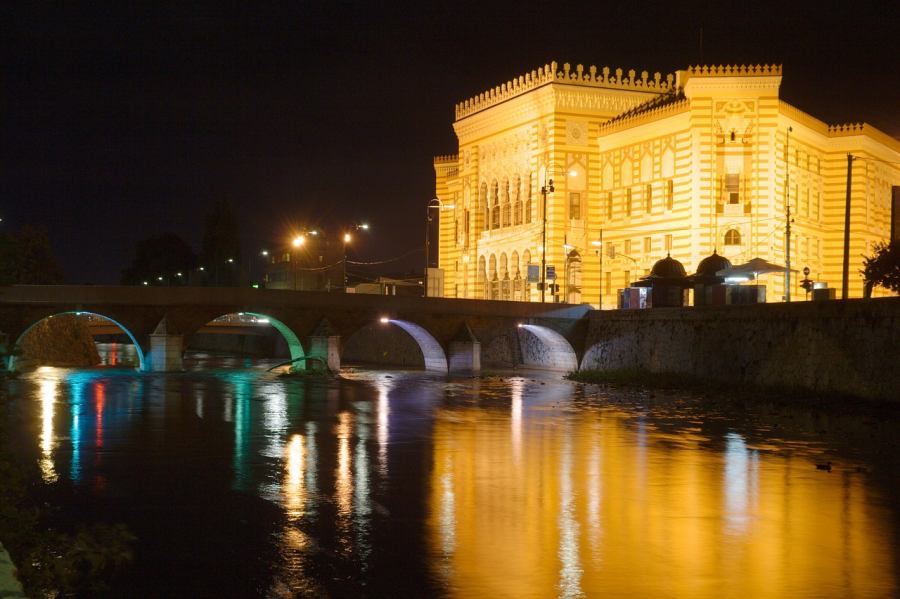
The neo-Romanesque-Moorish style building built in 1896 is one of Sarajevo’s most magnificent architectural masterpieces. Created during the Austro-Hungarian rule, it originally functioned as a city hall but later became home to the National and University Library.
In 1992, during the Bosnian War, the building was hit by Serbian artillery fire and was almost completely destroyed. More than 2 million books, 100,000 manuscripts, and rare documents burned in the fire, an irreplaceable loss to the world’s cultural heritage. Restoration work began in 1996, but the building only reopened in 2014 with ceremonial celebrations.
Today, the restored Vijećnica operates as a cultural center and museum, hosting various exhibitions and cultural events. The building’s facade is decorated with colorful tiles, stucco ornaments, and clover-shaped windows reminiscent of Alhambra architecture.
Vrelo Bosne Park
This natural wonder in the southwestern part of the city, near the settlement of Ilidža, is the source region of the Bosna River. The 600-hectare park was created in 1891 during the Austro-Hungarian period and became one of Sarajevo’s most beloved recreation areas. The park is bordered by a tree-lined avenue more than 3 kilometers long, which can traditionally be traversed by horse-drawn carriage.
The central attraction is the spring group itself, where crystal-clear water forcefully emerges from the ground, branches into several small streams, and then converges. Wooden bridges arch over the springs, while plane trees and ash trees provide shade. The water temperature is around 10 degrees Celsius at any time of year.
The park is an excellent place for picnics, walks, or simply relaxing after the urban hustle. On weekends, it’s a popular excursion spot for local families. From the park, the city center can be easily reached by tram or horse tram.
Yellow Fortress (Žuta Tabija)
The fortification located at 730 meters above the city was built in the 18th century as part of the Ottoman defense system. The fortress got its name from the yellow-colored stones from which it was built.
The structure, originally with a military function, is now considered one of the city’s best panoramic points. There is a 360-degree view of Sarajevo: the entire old town, the meandering Miljacka River, modern districts, and surrounding mountains are visible. The view is particularly stunning at sunset when the city lights begin to come on. During Ramadan, cannon fire traditionally signals the end of the daily fast at the fortress, a ceremony that tourists can also witness.
The road to the fortress is steep, but during the walk, we pass characteristic Bosnian houses that reflect the city’s Turkish heritage.
White Fortress (Bijela Tabija)
Next to the Yellow Fortress, located somewhat higher, is its sister fortress, which was also part of the 18th-century Ottoman defense system. It got its name from the light-colored stones from which it was built. The fortress is somewhat larger than the Yellow one and is in better preserved condition. It originally functioned as an artillery position and, together with the surrounding hills, formed a comprehensive defense system.
From the fortress, there is an even more stunning view of the city than from the Yellow Fortress because it is located somewhat higher. It’s a less touristy place, so it offers a quieter experience. The walls are partially intact, allowing you to climb on them and walk along the fortress’s perimeter. Information boards on the fortress grounds present the operation and history of the defense system.
The road to the fortress is steeper than to the Yellow Fortress, requiring about 30-40 minutes of walking from the old town. Along the way, we pass through a picturesque area: among vineyards, orchards, and small cemeteries. It’s a popular hiking destination among locals, with families also walking up on weekends. There is also a path between the two fortresses, so it’s possible to visit both viewpoints during one hike.
Sarajevo Brewery
Founded in 1864, the brewery is Bosnia and Herzegovina’s oldest operating factory and an important cultural monument. The building was erected during the Austro-Hungarian period and still produces beer today. The brewery building represents typical 19th-century industrial architecture: characterized by red brick walls, tall windows, and huge fermentation tanks.
A visitor center operates at the brewery where you can look into the beer production process. During the tour, visitors can learn about the entire process from malt production to bottling, as well as the brewery’s history, which is closely intertwined with the city’s history. Interestingly, during the siege of the 1990s, the brewery became the city’s most important drinking water source: when the water supply wasn’t working, residents came here for water.
At the end of the visit, there is also an opportunity to taste various products from the brewery: light and dark beers, premium selections can all be sampled. Sarajevska Pivara beer is one of Bosnia and Herzegovina’s best-known brands, recognized throughout the Balkans.
Avaz Twist Tower
Built in 2008, the 172-meter-high skyscraper is Sarajevo’s tallest building and one of the Balkans’ most spectacular modern architectural works. The tower is the headquarters of the BH Dani newspaper, but its upper floors house an observation deck. The building’s name refers to the fact that the tower’s upper third is twisted 45 degrees relative to the lower part, creating a unique visual effect.
The observation deck on the 36th floor, at a height of 142 meters, offers a breathtaking 360-degree panorama of the city and surrounding mountains. On clear days, you can see up to 50 kilometers away. The observation deck consists of covered and open-air sections, the latter of which can be accessed depending on weather conditions.
The tower is particularly spectacular in the evening when it is illuminated with LED lighting and visible from afar. The building itself has become a symbol of modern Sarajevo: it shows that in addition to historical heritage, the city is developing and modernizing in the 21st century.
Bjelašnica
The 2,067-meter-high mountain near the city is part of the Dinaric Mountains and was one of the main venues for the 1984 Winter Olympics. The mountain offers a stunning panorama of Sarajevo and the surrounding valleys. In winter, it’s a popular ski resort: 8 ski slopes and 5 lifts await winter sports enthusiasts. The longest slope is 3.2 kilometers, with a vertical drop of 1,000 meters.
In summer, Bjelašnica offers excellent hiking trails of all difficulty levels. The hike to the summit is moderately difficult, taking about 3-4 hours. Along the hiking trails, shepherds’ traditional huts (katun) can be found, where local cheese and other products can be purchased.
The mountain also has historical significance: in the 1990s, front lines ran here, and there are still areas where mines may be present, so it’s important to stay on marked paths. At the foot of the mountain, there are small villages with guesthouses and restaurants welcoming visitors. Bjelašnica is accessible by car or organized tour, about 25 kilometers from the city center.
Best museums in Sarajevo
National Museum
The country’s largest and oldest museum opened in 1888 at the initiative of the Austro-Hungarian government. The building, built in Italian Renaissance style, consists of four pavilions surrounding an inner garden.
The collection is extremely rich and diverse: archaeological finds from prehistoric times to the Middle Ages, ethnographic objects, a natural history exhibition with plant and animal collections, and an art department with paintings and sculptures. The most famous exhibit is the Sarajevo Haggadah, a 14th-century illuminated Jewish manuscript that miraculously survived the vicissitudes of centuries.
The archaeological section presents Bosnia’s prehistory, relics of the medieval Bosnian Kingdom, and Roman-era monuments. From a visitor experience perspective, the natural history pavilion is noteworthy, where the Balkan Peninsula’s unique flora and fauna are visible in stuffed specimens and herbaria.
All information can be found here.
Museum of Sarajevo (Muzej Sarajeva 1878-1918)
The museum presenting the Austro-Hungarian period from 1878 to 1918 is located on the Appel Quay next to the Latin Bridge, precisely in the building from which Gavrilo Princip stepped out before carrying out the fatal assassination.
The exhibition documents in detail Sarajevo’s modernization during the Austro-Hungarian period: the introduction of trams, the appearance of buildings, the development of educational and cultural institutions. A separate room deals with Franz Ferdinand’s visit and the details of the assassination. Original photographs, documents, weapons, and personal items make the experience authentic. The pistol with which Princip carried out the assassination is visible, as well as the Archduke’s bloodstained uniform.
From a visitor experience perspective, the presence of interactive elements is noteworthy: video presentations, period film footage, and detailed maps help understand the historical context. The museum does not only focus on the assassination but shows how this event changed world history. From the attic, there is a beautiful view of the Latin Bridge and the river.
All information can be found here.
Gallery 11/07/95
This museum, opened in 2012, memorializes the victims of the Srebrenica massacre, which occurred in July 1995 and was Europe’s largest mass killing since World War II.
The museum’s name refers to the date of the tragedy. The institution is not a museum in the traditional sense but rather a memorial center that presents events through personal stories.
The exhibition consists of three main parts: documentaries, personal stories of survivors and relatives, and the presentation of events preceding and following the tragedy. Visitors walk through the dark rooms with headphones, where audiovisual installations bring memories to life. The exhibition is deeply moving, with many visitors moved to tears. A separate room preserves victims’ personal belongings: shoes, clothes, photographs.
The museum’s purpose is not only remembrance but also prevention: it draws attention to the dangers of genocide and the consequences of racism. The museum is not recommended for children. Admission is free, but donations are welcome.
All information can be found here.
Tunnel Museum (Sarajevski ratni tunel)
The tunnel under the airport in the southern part of the city was built as a vital connection between the besieged city and free territories during the 1992-1996 siege. The 800-meter-long tunnel was dug by hand in 1993 and played a life-saving role: food, medicine, weapons, and people reached the city through it.
The museum is located in a residential house that stands above one of the tunnel entrances. The exhibition presents the horrors of the siege and the population’s survival strategies with documentaries, photographs, and tangible memories. Visitors can walk about 20 meters into the original tunnel, which is only 1.6 meters high and 1 meter wide – allowing direct experience of the conditions under which people had to travel.
The area still shows traces of the siege: buildings hit by projectiles, memorial plaques honoring the victims. Military equipment and vehicle remains can be found in the museum’s garden.
All information can be found here.
Svrzo House (Svrzina kuća)
This 18th-century residential house from the Ottoman period is located in the northern part of Baščaršija and is one of Sarajevo’s best-preserved historical homes.
The house became a museum in 1950 and fully demonstrates how wealthier Bosnian families lived during Turkish rule. The building is a typical example of local Ottoman residential architecture: characterized by whitewashed walls, brown wooden balconies, and a tiled roof structure.
In the museum, every room is furnished with authentic furniture and household items. On the ground floor, we can enter the men’s area (selamluk), where business and social life took place. The women’s house (haremluk) is on the upper floor, with colorful carpets, cushions, and household utensils. A special feature of the house is the abundantly carved wooden furniture, wall-painted floral patterns, and a collection of old copper vessels.
The house’s courtyard is also accessible, where there is a well, a small garden, and a traditional outdoor oven. During the visit, we gain insight into the Ottoman family model, daily customs, and living conditions of that time.
All information can be found here.
Sarajevo weather: when is the best time to travel?
Sarajevo is characterized by a continental climate with Mediterranean influences, resulting in four distinct seasons. The city is located in a valley, and the surrounding mountains influence the weather: warming it in winter and cooling the air in summer.
Spring (March-May):
The temperature gradually rises from 10 to 20 degrees. Rain is frequent in April and May, but nature becomes beautifully green. Days lengthen, and the city’s parks bloom. Colder periods can still occur occasionally.
Summer (June-August):
Warm but not scorching weather is typical, averaging 25-28 degrees Celsius. Nights remain pleasantly cool. Heavy thunderstorms occasionally occur, especially in the afternoons. The number of sunny hours is high, up to 10 hours daily.
Autumn (September-November):
September is still pleasant with temperatures around 20 degrees, gradually cooling from October. November is already cold, often rainy. Autumn foliage is particularly beautiful in the surrounding mountains. Fog often covers the valley in the mornings.
Winter (December-February):
Cold season with frequent snowfall. The temperature usually ranges between -5 and +5 degrees, but -15 degree frosts can occur. The surrounding mountains provide excellent skiing opportunities. The city fills with Christmas atmosphere, and the Christmas market operates.
Best time to travel Sarajevo:
The most ideal time to visit Sarajevo is late spring (May-June) and early autumn (September). During these months, the weather is pleasant, with temperatures ranging between 18-25 degrees Celsius, and there are fewer tourists than in mid-summer. May is particularly recommended when the city is green and flowery but not yet too hot. Those who want to do winter sports should arrive between December and March, when the ski slopes in the surrounding mountains operate at full capacity.