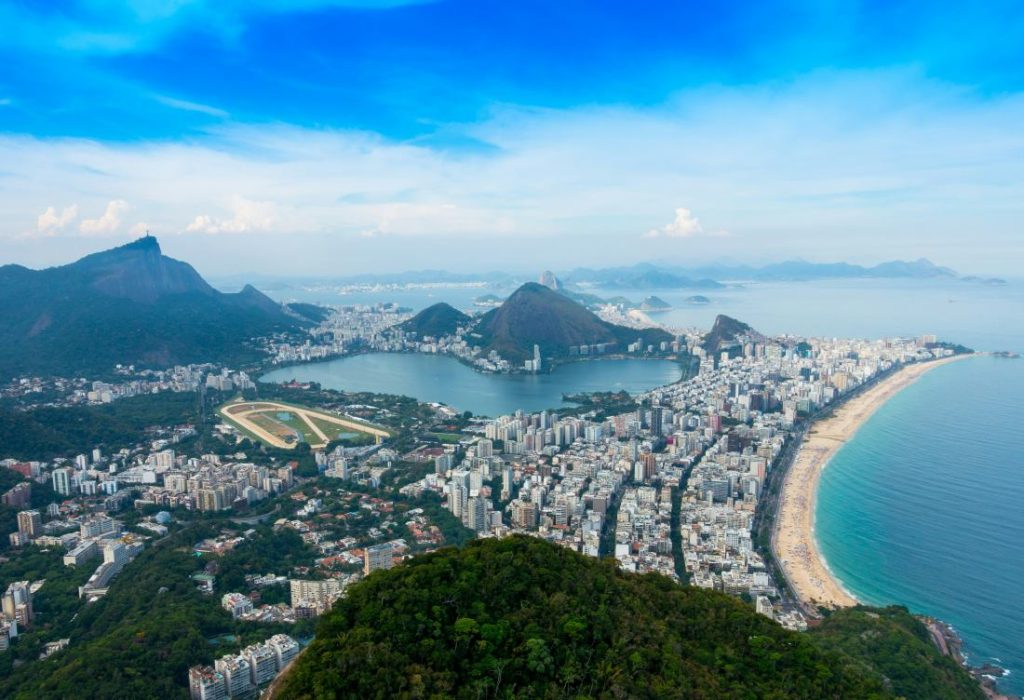
Rio de Janeiro is one of Brazil’s most exciting metropolises, full of stunning attractions and activities. It’s known worldwide for its famous beaches and carnival!
Rio de Janeiro, often called the „Marvelous City” is the country’s cultural and tourist center. Many also refer to it as the „capital of happiness” and the „birthplace of Brazilian samba”.
Table of Contents
Rio de Janeiro attractions
Christ the Redeemer Statue
One of Brazil’s most famous and iconic symbols rises „above” the city.
The imposing 30-meter-tall statue was inaugurated in 1931 after nearly ten years of construction. The Art Deco-style monument standing atop Corcovado Mountain was designed by Heitor da Silva Costa and created by French sculptor Paul Landowski. Its outstretched arms are 28 meters wide and symbolize God’s infinite love through the gesture of embrace.
The statue is located 710 meters above sea level, offering a breathtaking panorama of the city, the Atlantic Ocean, Guanabara Bay, and the surrounding mountains. It was chosen as one of the New Seven Wonders of the World in 2007 and attracts millions of visitors annually.
You can reach the summit through Tijuca National Park by cog railway or minibus, where there’s also a chapel located at the statue’s base.

Sugarloaf Mountain
One of the city’s most recognizable natural formations got its name from its distinctive cone shape.
The 396-meter-tall granite monolith can be reached in two stages using the famous cable car system, which has been operating since 1912 and was the first such system in Brazil. The first station is Morro da Urca, which already offers wonderful views, and from there the second cable car departs to the summit. From the mountaintop, a breathtaking 360-degree panorama unfolds before us.
At the top, you’ll find restaurants, cafés, and souvenir shops. The steep rock faces are popular among rock climbers, and walking along the small trails surrounding the mountain, you might even encounter wild monkeys. The area is also home to rich birdlife, making it an attractive destination for nature lovers.

Copacabana
Rio de Janeiro’s most famous and iconic beach stretches for 4 kilometers through the heart of the city.
The black and white checkered sidewalk reminiscent of shell patterns, the famous Portuguese-style Calçadão, borders the beach and has become one of the city’s symbols. Along the beach, countless hotels, restaurants, bars, and boutiques line up, providing bustling life day and night.
Copacabana offers all forms of sandy entertainment: locals play football, volleyball, build sandcastles, or simply sunbathe and swim in the pleasantly warm ocean. The beach is enclosed by forts at both ends: Copacabana Fort at the northern end and Leme Fort at the southern end.
The New Year’s Eve fireworks and party held here is one of the world’s largest such events, attracting up to 2 million people.

Ipanema Beach
Located next to Copacabana, this fashionable and elegant beach became internationally famous through the world-renowned bossa nova song „The Girl from Ipanema”.
With its perfect white sand and crystal-clear water, it’s one of the locals’ favorite beaches. Different areas of the beach attract characteristic crowds: the „Posto 9” area is a meeting place for artists, celebrities, and young, trendy audiences, while other sections are more family-friendly or preferred by sports enthusiasts.
The Ipanema area is one of Rio’s most expensive and safest neighborhoods, with elegant cafés, exclusive restaurants, and fashionable boutiques. On Sundays, the Ipanema Hippie Fair, a handicraft market next to the beach, offers a special experience with a wide selection of artistic creations, jewelry, and local handcrafted products. Watching the sunset from Arpoador Rock is a special experience.
Praia do Leblon
The elegant continuation of Ipanema Beach is located in one of Rio de Janeiro’s most exclusive neighborhoods.
Leblon Beach connects to Ipanema at the Jardim de Alá canal and together they form one of the city’s most beautiful coastal sections. However, Leblon is generally calmer and less crowded than its famous neighbor, making it ideal for those seeking peaceful relaxation. The beach is particularly popular among local families, and the „Posto 10” and „Posto 11” areas are especially family-friendly.
The Leblon area is one of Rio’s most expensive residential neighborhoods, lined with luxury apartments, excellent restaurants, and exclusive shops. In the streets behind the beach, you’ll find gastronomic gems that rank among the city’s best cuisines. The beach offers wonderful views of the Dois Irmãos mountains.

Lapa District
This historic district, also called the bohemian heart of Rio de Janeiro, is one of the centers of the city’s nightlife and musical culture.
The winding streets among 18th and 19th-century buildings are quiet during the day, but come alive in the evening with countless bars, clubs, and restaurants. Lapa is the home of samba, choro, and bossa nova, where different musical styles blend thanks to the meeting of people from diverse cultural backgrounds. The most famous venue is Rio Scenarium, a three-story club decorated with antique objects where visitors are welcomed with live music.
One of the district’s most important symbols is the Lapa Arches (Arcos da Lapa), an impressive 18th-century aqueduct that originally provided water supply to the convent on Santa Teresa Hill. Today, the city’s oldest and most important tram line, the famous „bondinho”, passes through it toward Santa Teresa.

Selarón Steps
The colorful staircase created by Chilean-born artist Jorge Selarón is one of the world’s most famous public artworks.
The staircase, officially known as Escadaria Selarón, consists of 215 steps and connects the Lapa district with the bohemian artists’ quarter on Santa Teresa Hill. Selarón began renovating the ruined staircase in front of his home in 1990, which gradually became his passion and life’s main work. The artist worked on the staircase for more than 20 years, covering it with more than 2,000 tiles from around the world.
Among the tiles, many are decorated in Brazilian national colors, and numerous pieces sent by famous personalities or fans can be found. Selarón called the staircase „my tribute to the Brazilian people” and what was originally a personal project gradually gained international fame after appearing in music videos and advertisements.
Since the artist’s tragic death in 2013, the staircase has also functioned as a kind of memorial, but it remains one of Rio’s most colorful and most visited attractions.

Botanical Garden
One of the city’s most peaceful and beautiful green spaces boasts more than 200 years of history.
The garden was founded in 1808 by Portuguese King John VI when the royal family moved to Rio de Janeiro fleeing from Napoleon. It was originally created for economic purposes to acclimatize Asian spice plants in Brazil. Today, the 140-hectare garden is home to more than 6,500 plant species, including rarities that have already become extinct in their original habitats.
One of its main attractions is the impressive avenue of royal palms, where 134 majestic palms line up, planted during the founding period. The garden contains an extraordinarily rich collection from the Amazon Basin, a Japanese garden, a sensory garden, and a special orchid collection.
Quinta da Boa Vista
This stunning park and museum complex was once the official residence of the Brazilian imperial family.
The imposing 19th-century palace, which was once the home of Emperor Pedro II, now houses the National Museum, Brazil’s oldest scientific institution. Unfortunately, a devastating fire in 2018 caused significant damage to the museum’s collection, but reconstruction work is ongoing.
The park surrounding the palace was designed according to the plans of English landscape architect John Tyndale, and with its special plants, picturesque lakes, and decorated gardens with bridges, it evokes the atmosphere of 19th-century English gardens.
The park also houses the Rio de Janeiro Zoo, which is home to more than 2,000 animals. The garden is particularly rich in endangered Brazilian species and actively participates in conservation programs. The zoo is a particularly family-friendly facility where interactive demonstrations and educational programs help visitors learn about the diversity of Brazilian wildlife.

Santa Teresa District
Rio de Janeiro’s most charming and bohemian neighborhood is located on a hill rising above the city.
The formerly aristocratic neighborhood is now a favorite residence of artists, musicians, and writers, where colorful villas, art galleries, and atmospheric cafés line the narrow, winding streets. The area’s special appeal lies in preserving the authentic atmosphere of old Rio, which is hard to discover in other parts of the modern metropolis. In the heart of the neighborhood is Parque das Ruinas, a ruined palace converted into a museum and cultural center, offering wonderful views of the city.
Santa Teresa’s most famous means of transportation is the yellow tram, the famous „bondinho”, the only still-operating classic tram in Rio de Janeiro. Although it didn’t operate for years after the tragic accident in 2011, the renovated services now run again, uniquely passing through the Lapa Arches.
One of the area’s most important cultural events is the annually held „Arte de Portas Abertas” (Open Doors Art), when local artists open their studios and workshops to the general public.

National Monument to the Dead of World War II
The monumental memorial located in Flamengo Park commemorates Brazilian war heroes.
The Monumento Nacional aos Mortos da Segunda Guerra Mundial was built in 1960 and, thanks to its designer Marcos Konder, is one of the outstanding examples of modern Brazilian architecture. The memorial’s central element is a 31-meter-tall concrete column surrounded by a huge granite terrace. The clean-lined structure covers an area of 6,850 square meters and includes an impressive marble crypt where the remains of Brazilian soldiers who fell in World War II rest.
Bronze sculpture groups on the steps leading to the memorial depict soldiers from the three military branches (army, air force, and navy). The complex also includes a museum that presents Brazil’s participation in World War II through photographs, documents, and relics, with special attention to the Italian campaign where Brazilian soldiers played a prominent role.
Maracanã Stadium
One of the world’s most famous football stadiums, which is a true symbol of Brazilians’ passion for football.
The Maracanã (officially called Estádio Jornalista Mário Filho), built for the 1950 World Cup, was once the world’s largest stadium, capable of accommodating nearly 200,000 spectators. After renovations for the 2014 World Cup, its capacity decreased, but it still holds nearly 80,000 people in the stands. The stadium also hosted the opening and closing ceremonies of the 2016 Olympic Games.
The Maracanã is not only a venue for sporting events but also an important cultural center where world stars such as Frank Sinatra, Madonna, Paul McCartney, and the Rolling Stones have performed. The stadium museum offers a rich collection of football memorabilia, including items from Pelé and Garrincha.
During tours organized for visitors, you can peek into the locker rooms, walk through the tunnel where players run onto the field, and even try out the bench.
AquaRio
Latin America’s largest marine aquarium is home to more than 3,000 animals representing 350 different species.
The aquarium was designed so that visitors can take a marine journey that leads from Brazil’s coasts through the open ocean to deep-sea ecosystems. One of the visit’s highlights is the 20-meter-long tunnel aquarium, where visitors can enjoy the spectacle of predatory and herbivorous fish, sharks, and rays swimming above their heads.
Visitors can learn about the diversity of marine life and the importance of water quality through interactive demonstrations. The aquarium also offers special programs such as „Mergulho com Tubarões” (Diving with Sharks), where guests with diving licenses can observe these fascinating predators up close.
All information can be found here!
Museum of Tomorrow
The futuristic building designed by world-renowned Spanish architect Santiago Calatrava is located in Rio de Janeiro’s renewed port district.
The Museu do Amanhã building, opened in 2015, is itself an architectural marvel: spanning 30,000 square meters over Guanabara Bay, it looks like a giant spaceship or a huge, moving organism. The structure has environmentally friendly features, such as solar panels that follow the sun’s path and a seawater cooling system.
The museum’s exhibitions explore not the past but the future, examining questions such as humanity’s future, environmental challenges, and the social impacts of technological development. Through interactive installations, audiovisual experiences, and scientific models, visitors can contemplate what kind of world they want to create in the next 50-100 years. The museum’s central theme is the relationship between humans and the planet, aiming to encourage responsible thinking about future generations.
All information can be found here!
Tijuca National Park
The world’s largest urban rainforest is located just minutes by car from the city’s bustling center.
The 32-square-kilometer park was originally part of the Atlantic coastal rainforest, which was largely cleared in the 19th century for coffee plantations. The forest’s current state is due to Emperor Pedro II ordering the area’s reforestation to ensure Rio de Janeiro’s water supply. During replanting, more than 100,000 trees were planted, and today the park is home to numerous endangered species, including jaguars, golden lion tamarins, and tufted capuchin monkeys.
The national park is home to more than 30 waterfalls, the most famous being the 30-meter-tall Cascatinha Taunay. The park contains Corcovado Mountain with the famous Christ statue, as well as several viewpoints such as Vista Chinesa (Chinese View) and Mesa do Imperador (The Emperor’s Table).

Pedra da Gávea
This monumental, 842-meter-tall monolithic rock is one of Rio de Janeiro’s most stunning natural wonders.
The mountain located in Tijuca National Park is one of the world’s largest coastal monoliths, once an important navigation point for sailors. From the rock’s summit, an unparalleled panorama opens up of the city, surrounding mountains, and the Atlantic Ocean. On clear days, you can see Corcovado Mountain with the Christ statue, Sugarloaf Mountain, and Rio de Janeiro’s entire coastline.
Climbing Pedra da Gávea is a moderately difficult hike that takes about 3 hours upward. The route’s final section, the „Carrasqueira”, requires some rock climbing, so it’s recommended to go with an experienced local guide.
The mountain’s specialty is the so-called „Cara do Rei” (The King’s Face), a natural rock formation that resembles a human face and is the source of many legends. Some believe the strange markings on the rock could be ancient Phoenician script, which has sparked numerous theories about the mountain’s visitation by ancient civilizations.
Rio Carnival
One of the world’s largest and most spectacular celebrations.
The carnival officially lasts for four days before the beginning of Lent before Easter, but the city burns with preparation fever weeks in advance. The celebration’s central event is the samba school competition in the Sambadrome, where dancers from surrounding favelas present their productions in dazzling costumes, stunning choreography, and music. Each school chooses a new theme annually and parades with up to 4,000 participants.
Meanwhile, traditional, spontaneous „bloco” parades take place in the city’s streets, where anyone can join the dancers. During carnival, Rio transforms into a true outdoor party.
Rio de Janeiro weather: when is the best time to visit?
Rio de Janeiro has a tropical savanna climate characterized by hot, rainy summers and milder, drier winters.
Summer (December-March):
Summer in Rio de Janeiro is hot and humid, with frequent afternoon showers. The average temperature ranges between 25-35°C, and due to high humidity, the heat index can feel even higher. The number of sunny hours is high, but sudden heavy thunderstorms are also common. This is the high season from a tourism perspective, especially during carnival time (February or March), when the city fills with visitors from around the world.
Autumn (April-June):
The autumn months are more pleasant, with gradually decreasing temperature and humidity. The average temperature ranges between 20-27°C, and rainfall decreases significantly. This period is ideal for exploring the city, as the weather is pleasant and the number of tourists is lower.
Winter (July-September):
Winter in Rio de Janeiro is mild and relatively dry, with average temperatures ranging between 18-25°C. Although this is the coolest period of the year, the days remain pleasantly warm and sunny, only the evenings and early mornings are cooler. Rainfall is lowest during this period, making it also a favorable time for sightseeing and outdoor activities.
Spring (October-November):
During spring months, temperature and humidity gradually increase, with average temperatures ranging between 20-28°C. Rainfall also begins to increase but still falls far short of summer levels. This period can be an excellent choice for those who want to avoid the crowded high season but still enjoy pleasant weather.
Best time to visit to Rio de Janeiro:
The most ideal time to visit Rio de Janeiro is autumn (April-May) and winter (July-August), when the weather is pleasant, rainfall is moderate, and the city’s natural beauty can be best enjoyed.
Frequently asked questions about Rio de Janeiro
Rio de Janeiro is in the Brazilian time zone (BRT, UTC-3), and some parts of the country have occasionally used daylight saving time, but currently do not.
The official language is Portuguese. Knowledge of English is limited, mainly found at tourist attractions, hotels, and restaurants. In smaller shops and markets, people mainly speak Portuguese, so it’s worth learning a few basic expressions.
Brazil’s official currency is the Brazilian real (BRL). Credit card use is common in larger hotels, shopping centers, and restaurants, but it’s advisable to carry cash at markets and smaller shops. Here is a currency converter.
Rio has two international airports: Galeão (Antonio Carlos Jobim) and Santos Dumont. From Galeão airport, buses, shuttle buses, and taxis are available, and downtown can be reached in about 40 minutes. Santos Dumont airport is closer to the central districts, from where the main points of the city can be quickly reached by taxi or bus.
Within the city, the metro is the safest and fastest form of transportation, especially between the coastal districts and downtown. Buses and taxis are also available, but traffic is often heavy. Uber is also available and offers a reliable alternative.
Rio is famous for its bustling atmosphere, but there are security risks. Areas visited by tourists (Copacabana, Ipanema, Sugarloaf, Corcovado) are generally safe, but it’s worth being cautious and not advisable to conspicuously wear valuable items. It’s not recommended to enter favelas without organized tours.
Feijoada: A traditional Brazilian one-pot dish made from black beans and meat, usually served with rice and side dishes.
Pão de queijo: Small cheese bread balls that are popular for breakfast and as snacks.
Moqueca: A flavorful fish or seafood stew with coconut milk and palm oil.
Açaí: Frozen fruit purée, often served with fruits, granola, and honey.
Caipirinha: Brazil’s national cocktail, made with lime, sugar, and cachaça.