
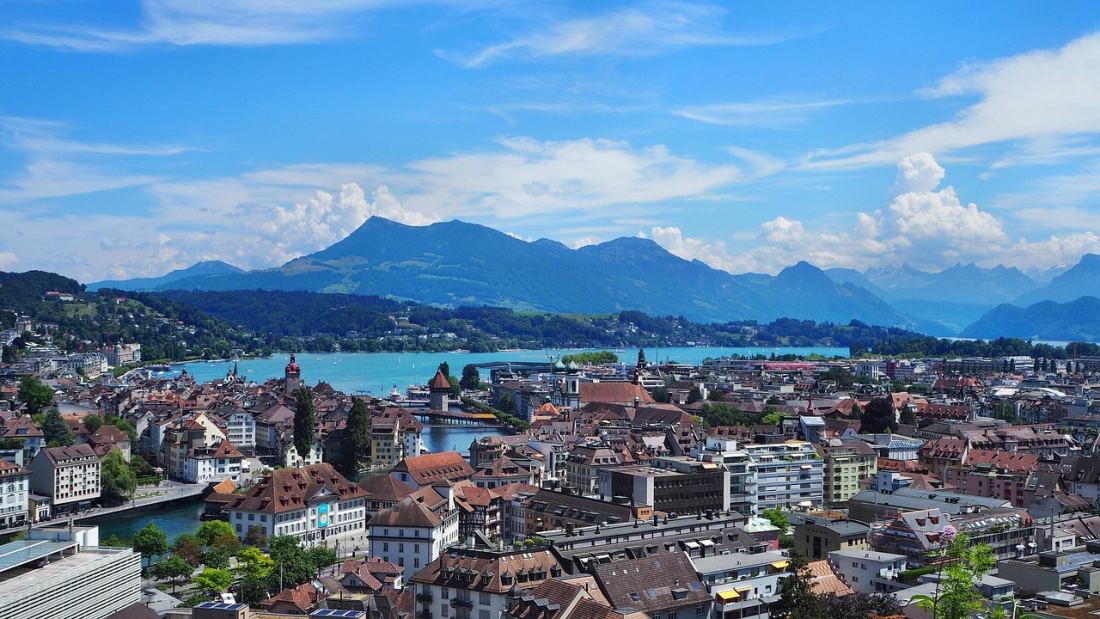
Lucerne, with its historic old town’s narrow streets, medieval bridges, and unique atmosphere, is one of Switzerland’s most beautiful cities.
The city’s atmosphere is a unique blend of Swiss traditions and modern tourist services. The carefully preserved architectural heritage and the meeting of natural beauty make Lucerne one of the most beautiful gems at the gateway to the Alps. Its cultural economy is also significant: numerous museums, concert halls, and festivals make the city attractive to millions of visitors annually.
Table of Contents
Lucerne attractions
Lake Lucerne (Vierwaldstättersee)
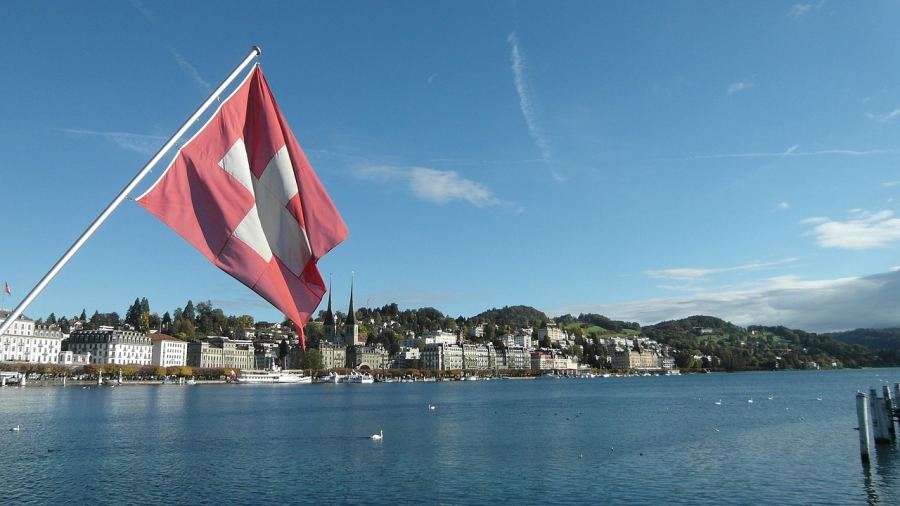
The Vierwaldstättersee is one of Switzerland’s most beautiful and significant lakes. The 114 square kilometer water surface spans across four cantons and, due to its special shape, is one of the country’s most picturesque natural formations.
Lucerne’s historic center is located on the lake shore, from where breathtaking panoramas open up to the surrounding Alpine peaks. The water is crystal clear and pleasantly warm in summer, making it ideal for both swimming and water sports.
The lake’s specialty is the network of steamboat services that connect the lakeside settlements. Historic steamers operating since the 1800s provide romantic travel experiences while allowing us to explore every corner of the lake. With the Wilhelm Tell Express, we can even reach the surrounding mountain ranges.
Old Town
One of Switzerland’s best-preserved medieval city centers, which has been shaped into its current form since the 13th century. The narrow cobblestone alleys and colorful facades of burgher houses radiate an authentic medieval atmosphere.
Among the buildings grouped around Weinmarkt square, there are numerous historically significant houses whose fresco-decorated facades refer to the city’s rich merchant past. Unter der Egg street and Kramenplatz are particularly spectacular sections of the old town.
The old town’s specialty is that it successfully combines historical traditions with modern urban life. A multitude of cafés, restaurants, and boutiques can be found in the ground-floor spaces, while the upper floors of the buildings have retained their original functions.
Chapel Bridge (Kapellbrücke)
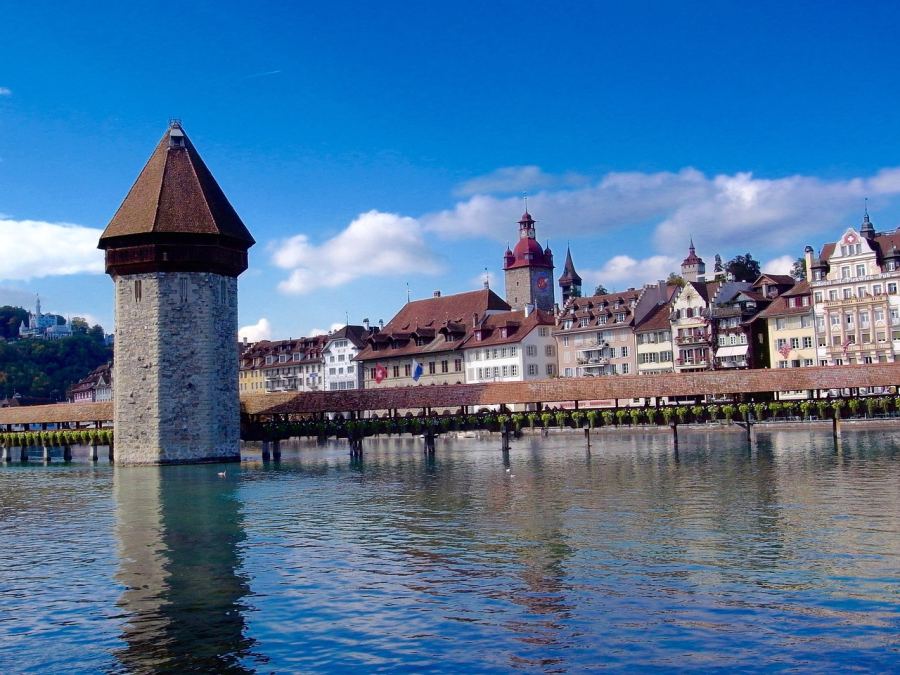
One of the most famous symbols of Lucerne and all of Switzerland, built in 1333 over the Reuss River. This is Europe’s oldest covered wooden bridge, originally 270 meters long, now 204 meters long.
Under the bridge’s roof structure, there are 111 triangular paintings depicting significant events in Lucerne’s and Switzerland’s history. These works from the first half of the 17th century are by Hans Heinrich Wägmann and are valuable pieces of Swiss painting history.
The octagonal Water Tower (Wasserturm) standing in the middle of the bridge was built in the 13th century and was originally part of the city’s fortification system. Today it appears in Lucerne’s official coat of arms and is one of the city’s most photographed motifs.
In 1993, a tragic fire destroyed most of the bridge, but careful reconstruction managed to restore it to its original state. During the restoration, original materials and techniques were used, so the bridge retained its historical authenticity.

Town Hall
The Rathaus was built between 1602-1606 in Renaissance style and is still the center of the city’s administration today. The building’s facade facing Kornmarkt square is particularly imposing, with its richly decorated balconies and coats of arms.
The building’s most characteristic element is the ground-floor arcade, which shows Italian influences and under which markets were formerly held. In the town hall’s inner courtyard is the famous clock, which chimes every hour and is an important timekeeping point for locals.
The town hall’s historical significance lies in the fact that Lucerne’s council sat here for several centuries, and decisions determining the city’s fate were made here. It still performs active administrative functions today, but tourists can visit certain parts of it.
Water Tower
One of Lucerne’s oldest and most characteristic buildings, built around 1300 in the middle of the Reuss River. The 43-meter-high, octagonal tower was originally part of the city’s defense system.
During its history, the tower served many functions: it served as a prison, treasury, archive, and even as a torture chamber. It played a central role in medieval urban life and was a symbol of the city’s power.
It is one of the city’s most famous symbols and, together with the Chapel Bridge, appears in the city’s coat of arms. Although its interior is not accessible to visitors, its external appearance and historical significance make it a mandatory photography point for every tourist. Its specialty is that it stands in the middle of water, providing a special sight from every angle.
St. Leodegar Church (Hofkirche)
One of Lucerne’s most important religious and historical monuments, a defining element of the lakeside landscape.
The church is the city’s most famous temple, built in the 17th century on the ruins of a former Benedictine monastery. Although part of the original church – especially the two characteristic Gothic towers – remained from the Middle Ages, today’s building mainly represents the early Baroque style, which is a rarity in Switzerland.
The church’s richly decorated interior hides impressive altars, intricate wood carvings, and a valuable organ. It is not only a venue for religious events but also frequently hosts classical music concerts.

Musegg Wall
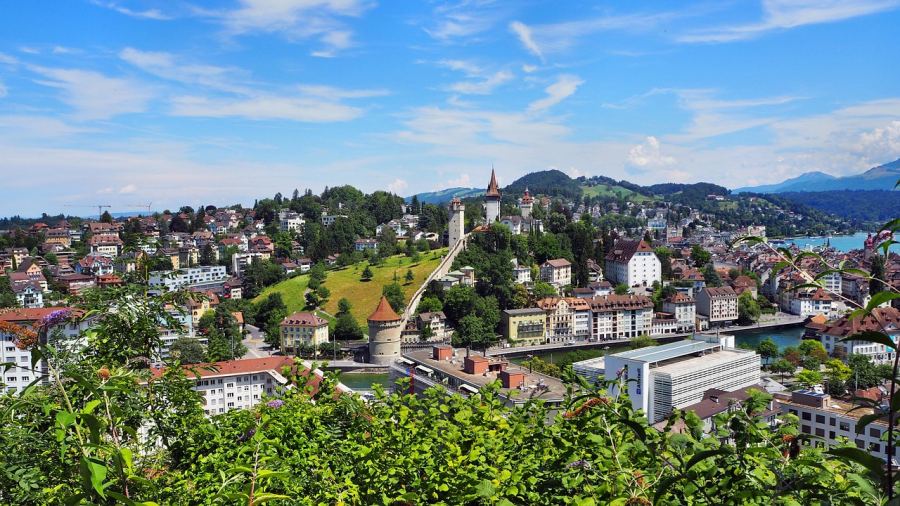
The remaining part of Lucerne’s medieval city wall, built in the 14th century to defend the northern part of the city. The approximately 870-meter-long wall with nine towers is still visible today and is one of Switzerland’s best-preserved medieval fortifications.
Of the nine towers, three – the Schirmer, Zyt, and Männli towers – can be visited from the inside. The Zyt tower is particularly interesting, as it houses Lucerne’s oldest clock from 1535, which still works today and, as a unique privilege, strikes one minute earlier than the city’s other clocks.
The wall’s walkway offers beautiful views of the old town, the lake, and the surrounding mountains. Walking along the wall, we can gain insight into medieval city defense techniques and contemporary architectural solutions.
It is not only historically significant but also an active part of the cityscape today. It is a favorite walking place for locals and a mandatory program point for tourists, especially for those interested in medieval history.
Spreuer Bridge (Spreuerbrücke)
The bridge was built in 1408 over the Reuss River and is Lucerne’s second oldest covered wooden bridge. The 80-meter-long bridge’s name comes from the German word „Spreu”, meaning chaff, because mills were allowed to discharge chaff into the river here.
The bridge’s main attraction is the 67 paintings under the roof structure, which are works by Kaspar Meglinger from the 17th century. These pictures depict the Dance of Death (Totentanz) and are outstanding examples of medieval moralizing art.
The paintings’ specialty is that death affects all social classes equally – king and beggar, young and old all appear in the compositions. This theme was popular in the Middle Ages and reminded people of life’s transience.

Lion Monument (Löwendenkmal)
The monument is one of the world’s most moving sculptures.
The 10-meter-long and 6-meter-high relief was created in memory of the Swiss Guards who fell during the French Revolution. It was designed by Danish sculptor Bertel Thorvaldsen and carved by Lucas Ahorn in 1821 into the side of a natural rock face.
The sculpture depicts a dying lion with a broken spear piercing its body, while protecting a shield decorated with French lilies with its paw. The lion’s head is contorted with pain, its eyes tearful. Mark Twain called the monument „the most mournful and moving piece of stone in the world”.
The monument commemorates the events of August 10, 1792, when 786 of the Swiss Guard defending King Louis XVI at the Tuileries Palace lost their lives. Swiss mercenaries were known throughout Europe for their reputation for loyalty and bravery.

Society of Jesus Church
Built in the 17th century on the banks of the Reuss River, near the Reussbrücke, commissioned by the Jesuit order according to architect Heinrich Mayer’s plans. It is Switzerland’s first major Baroque church.
The church’s facade is impressive Baroque style with two towers that are defining elements of Lucerne’s landscape. The interior is richly decorated with stuccoes and frescoes, which are works by Francesco Antonio Giorgioli and Pietro Antonio Torri from the 18th century.
Its specialty is the main altar, which is partly marble, partly painted wood, creating an optical illusion. The sanctuary’s dome fresco depicts the life of Saint Francis Xavier, who was one of the most famous saints of the Jesuits.
Mount Pilatus
The 2,132-meter-high peak is located in the immediate vicinity of Lucerne and is one of the city’s main natural attractions. The mountain’s name allegedly comes from Pontius Pilate, who supposedly found his final resting place here according to legends.
Getting up the mountain is an experience in itself: the world’s steepest cogwheel railway, the Pilatusbahn, has been carrying visitors up since 1889. The 4.6-kilometer track ascends with a 48% gradient, which is a world record in its category.
From the summit, an unparalleled panorama opens up to the Alps, Lake Lucerne, and several Alpine peaks. On clear days, you can see the Jungfrau, Eiger, and Mönch, which are the most famous peaks of the Bernese Alps.
Its tourist infrastructure is excellent: restaurants, hotels, and numerous hiking trails are available to visitors. In winter, ski slopes operate, while in summer, hiking opportunities await adventure seekers.
Bourbaki Panorama
Located in Lucerne’s city center, in a circular building specially built for this purpose, this wonderful circular painting can be found.
The 112-meter-long and 10-meter-high, 360-degree painting immortalizes one of history’s dramatic episodes: the escape and Swiss internment of a French army of more than 87,000 during the 1871 Franco-Prussian War.
The painting was created by Edouard Castres, who himself participated in the events. The work is not only an artistic masterpiece but also carries a powerful humanitarian message.
All information can be found here!
Richard Wagner Museum
The museum is located in the former residence of the famous German composer, the villa called Tribschen, where Wagner lived with his family from 1866-1872. This was one of Wagner’s most productive periods, where he composed the Siegfried Idyll and The Mastersingers of Nuremberg.
The museum’s collection contains Wagner’s personal belongings, manuscripts, correspondence, and period instruments. Particularly valuable are those documents relating to the composer’s Swiss years, which provide insight into his creative processes.
The villa itself is also historically significant: Wagner’s son Siegfried was born here, in whose honor he composed the famous Siegfried Idyll. The house’s original furnishings have partly remained, so visitors can get a glimpse into 19th-century bourgeois lifestyle.
The museum’s specialty is that it regularly organizes concerts featuring Wagner’s works. The villa’s park offers beautiful views of Lake Lucerne and Mount Pilatus, which could have provided inspiration for Wagner’s music as well.
All information can be found here!
Art Museum (Kunstmuseum Luzern)
Opened in 1932, it preserves Central Switzerland’s most significant fine arts collection. The museum operates at two locations: in the historic building in the city center and in the modern KKL (Kultur- und Kongresszentrum Luzern) building.
The collection focuses on 19th-20th century Swiss and international art. The museum is particularly rich in Swiss Impressionist and Expressionist works, as well as contemporary installations. Works by Ferdinand Hodler, Félix Vallotton, and other significant Swiss artists represent national traditions.
The museum’s program is dynamic and varied: continuously changing exhibitions showcase contemporary art, and thematic displays are prepared on classical periods as well. The institution is an active participant in international artistic life.
The modern exhibition spaces in the KKL building were designed according to architect Jean Nouvel’s plans and provide an ideal environment for presenting contemporary art. The building itself is also an architectural attraction that harmoniously fits into the lakeside.
All information can be found here!
Sammlung Rosengart
One of Lucerne’s most prestigious private collections, showcasing artifacts collected by the Rosengart family over several generations. The collection focuses on masters of classical modernism and impressionism.
The museum’s main treasures are Pablo Picasso’s works: more than 200 drawings, graphics, and paintings from the artist’s various creative periods can be found here. Among these are significant pieces from the 1950s and 1960s, when Picasso was experiencing his best period.
An impressive collection of Paul Klee’s works is also visible: approximately 125 works represent the diverse oeuvre of the Swiss-born artist. Besides Klee and Picasso, works by Cézanne, Monet, Renoir, and Matisse can also be found in the collection.
The Sammlung Rosengart’s specialty is its personal tone: the exhibition’s atmosphere is more reminiscent of a private residence than a traditional museum. Angela Rosengart, the collection’s last guardian, personally knew Picasso, and this connection permeates the entire exhibition.
All information can be found here!
Swiss Museum of Transport (Verkehrshaus der Schweiz)
One of Europe’s largest and most comprehensive transport-themed museums opened in 1959 and has been continuously expanding and modernizing since then.
The museum’s collection covers all transport sectors: rail, road, shipping, aviation, and space exploration are all represented. The Swiss railway history collection is particularly rich, showcasing world-famous Swiss trains and the development of mountain railways.
The institution’s interactive character makes the visitor experience special. Simulators, experimental stations, and practical demonstrations make it possible for visitors to gain their own experiences in the world of transport. The planetarium and IMAX cinema offer additional exciting programs.
The Hans Erni Museum is also located on the museum grounds, showcasing the life’s work of the famous Swiss painter and graphic artist. The entire complex is family-friendly and offers experience-rich programs especially for children, while adults can also learn much about the history and future of transport.
All information can be found here!
Lucerne weather: when is the best time to travel?
Lucerne’s climate is temperate continental, influenced by both the Alpine environment and the presence of Lake Lucerne. Due to the city’s relatively protected geographical location, it has less extreme weather conditions than the higher Alpine regions.
Spring (March-May):
Spring gradually warms up, with temperatures around 8-12°C at the end of March. In April, daytime temperatures of around 15-18°C can be expected, and in May, it can even rise above 20°C. This period comes with beautiful blooming, but occasional showers should be expected.
Summer (June-August):
The weather is most pleasant during the summer months, with average temperatures between 20-25°C. In July and August, temperatures can even rise above 30°C. The lake water is 20-22°C, providing ideal bathing conditions. Afternoon thunderstorms are more frequent in summer.
Autumn (September-November):
Autumn is a long and pleasant period, with temperatures still around 18-22°C in September. In October 12-16°C, and in November 5-8°C are typical. This period is ideal for hiking and sightseeing, but the number of rainy days increases.
Winter (December-February):
During winter months, temperatures around 0-5°C are characteristic. Snowfall is not everyday, but it occurs, especially in January and February. The lake doesn’t freeze, but the surrounding mountains turn snow-white, providing a beautiful winter panorama.
Best time to travel:
The most ideal time to visit Lucerne is between May and September. During this period, the weather is most pleasant, with temperatures around 18-25°C, and most tourist attractions operate fully. The ascent to Mount Pilatus is also certainly possible, and the lake’s pleasant temperature allows for water sports as well.