
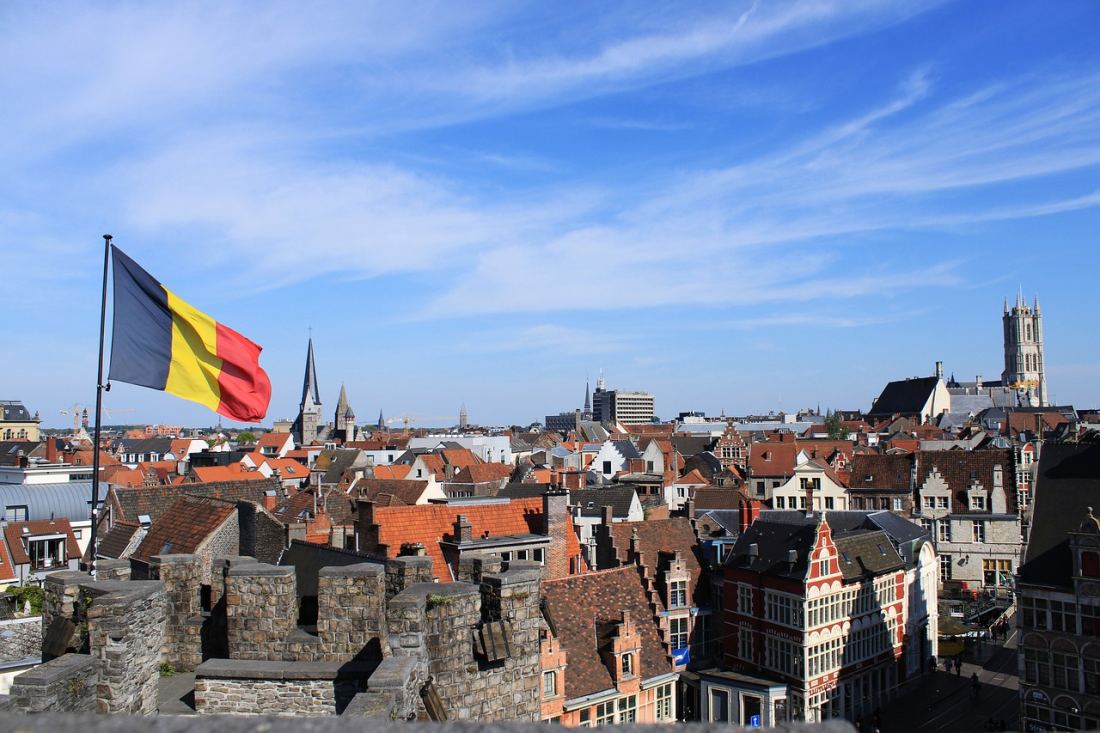
Ghent has a great cultural tradition due to its late medieval wealth. I will present the best museums!
Table of Contents
Best museums in Ghent
Ghent City Museum (STAM)
One of the city’s most important cultural institutions, providing visitors with a comprehensive view of Ghent’s history, development, and cultural heritage.
The museum’s central location is the Bijloke Abbey building. It was built in the 14th century and served as a hospital for many centuries. Walking through the museum, you can see the old Gothic-style parts of the abbey.
Visitors can learn about the city’s development in chronological order. The exhibition begins with medieval Ghent, when the city was one of Europe’s most important trading centers, with a particular focus on the textile industry and the guild system. We can see numerous historical documents, maps, paintings, photographs, and other artifacts.
One of the museum’s most exciting attractions is the huge interactive map placed on the floor, depicting Ghent’s current cityscape.
All information can be found here!
Museum of Fine Arts (Museum voor Schone Kunsten)
Ghent’s most significant art institution, with its main collection focusing on European painting and sculpture.
Founded in 1798, it is one of Belgium’s oldest art museums. The institution was originally established to preserve and showcase artworks confiscated during the French Revolution.
It contains more than 9,000 artworks, including paintings, sculptures, drawings, and prints. The collection provides a comprehensive view of the development of European art, with a particular focus on Flemish and Belgian masters.
One of the most important parts of the museum focuses on the works of medieval and Renaissance Flemish artists. Here we can admire works by famous creators such as Hieronymus Bosch, Pieter Paul Rubens, Jan van Eyck, and Hans Memling. It also has a rich collection of 19th-century Belgian and French art, which includes representatives of Neoclassicism, Realism, and Romanticism. Works by masters such as Théodore Géricault, Gustave Courbet, Jean-François Millet, and Eugène Delacroix can be seen here.
All information can be found here!
Design Museum
The museum showcases changes, innovations, and impacts of design on everyday life through various exhibitions.
It was originally created to showcase applied arts collections, then gradually shifted its focus to design in the 20th century. The collection has continuously expanded and now includes various design trends and objects.
It encompasses more than 22,000 objects representing various areas of design. It places significant focus on furniture design, ranging from 18th-century Baroque furniture to 20th-century modern and postmodern design. Works by iconic designers such as Le Corbusier, Gerrit Rietveld, Charles and Ray Eames, as well as contemporary Belgian designers like Maarten Van Severen can be found here.
Part of the museum’s collection also showcases traditional crafts and applied arts objects that reflect the evolution and technological development of design. It also pays special attention to glass art. Numerous unique and innovative creations can be seen, showcasing various techniques and aesthetic possibilities of glass shaping.
All information can be found here!
Museum of Contemporary Art (SMAK)
The museum is famous for showcasing innovative, avant-garde artworks and is a leading showcase of global art trends in Belgium.
It has more than 2,000 artworks, including paintings, sculptures, video installations, performances, and photographs. It pays special attention to showcasing Belgian art, especially works by renowned artists such as Luc Tuymans, Panamarenko, Raoul De Keyser, and Jan Fabre.
The museum’s collection also includes works by internationally renowned artists such as Joseph Beuys, Andy Warhol, Bruce Nauman, David Hammons, and Marina Abramović.
All information can be found here!
Museum of Industry and Textiles (MIAT)
It showcases the effects of the industrial revolution, especially the development of the textile industry and the life of industrial workers.
The museum is located in a 19th-century textile factory building, which is itself an important industrial monument. It opened its doors in 1979 and focuses on preserving industrial heritage. The city of Ghent was an important textile industry center during the industrial revolution, making the museum particularly relevant to the city’s history.
The museum presents in detail the development of the textile industry from handcraft weaving to large-scale production. One of the most interesting attractions is the period looms and machines, which are still operational today. Steam engines, industrial equipment, and factory worker tools show how industrialization changed production and everyday life.
It not only showcases technological development but also the life and conditions of factory workers. During the industrialization period, workers often worked under difficult conditions, and the museum vividly presents this aspect as well. Visitors can see reconstructions of workers’ homes and workplaces, as well as the history of workers’ social movements.
All information can be found here!
Ethnographic Museum (House of Alijn)
The museum showcases objects, traditions, and culture of ethnography and everyday life.
Its collection focuses on Flemish everyday life, and we can see how people lived, worked, and entertained themselves in the 19th and 20th centuries. The exhibited objects include everyday utensils, clothes, furniture, and toys.
One particularly popular part of the museum is the exhibition showcasing children’s lives and games. Through old toys, dolls, board games, and other objects used by children, visitors can learn about how children spent their everyday lives in the past.
All information can be found here!
Natural Science Museum (De Wereld van Kina)
The museum is located at two sites, both interactively showcasing the world of nature. Its exhibitions mainly focus on children.
Het Huis in the city center has four main themes: prehistoric fossils and dinosaurs, human body, insect world, rocks and minerals.
The other location is De Tuin. Here, the main themes are the world of plants, insects and butterflies, seasons, and geology. Its specialty is that it also has a botanical garden, so we can see numerous plants.
All information can be found here!
Van Eyck Center
The museum pays tribute to the memory and art of Flemish painter Jan van Eyck (1390-1441).
Van Eyck became famous as the painter of the Ghent Altarpiece (Adoration of the Mystic Lamb) located in St. Bavo’s Cathedral. This altarpiece is one of the world’s most famous and significant artistic creations.
The main goal of the center is to preserve and showcase Van Eyck’s artistic heritage. Visitors can learn about the characteristics of Flemish Renaissance painting, the significance of the artist’s work, as well as his technical innovations, such as the use of oil paint, which had a great impact on the development of European art.
All information can be found here!
Arnold Vander Haeghen Museum
The museum showcases the aristocratic lifestyle of the late 18th century.
It is located in a beautiful Baroque-style palace built in the 18th century. The building was originally designed for a wealthy family and was later bought by Arnold Vander Haeghen, who was also a wealthy businessman and collector from Ghent. Its interiors have wonderfully preserved the style features of the aristocratic era, especially the decorated ceilings, carved wood paneling, and elegant furniture.
Through richly furnished rooms, visitors can learn how noble families lived and worked in the late 18th and early 19th centuries. The magnificent furniture, fine porcelain, paintings, and ornaments all reflect that wealth and sophistication.
One of its well-known parts is the Victor Hugo room, which commemorates the visit of the famous French writer. Victor Hugo stayed here in 1837, and the room pays tribute to this visit.
All information can be found here!