
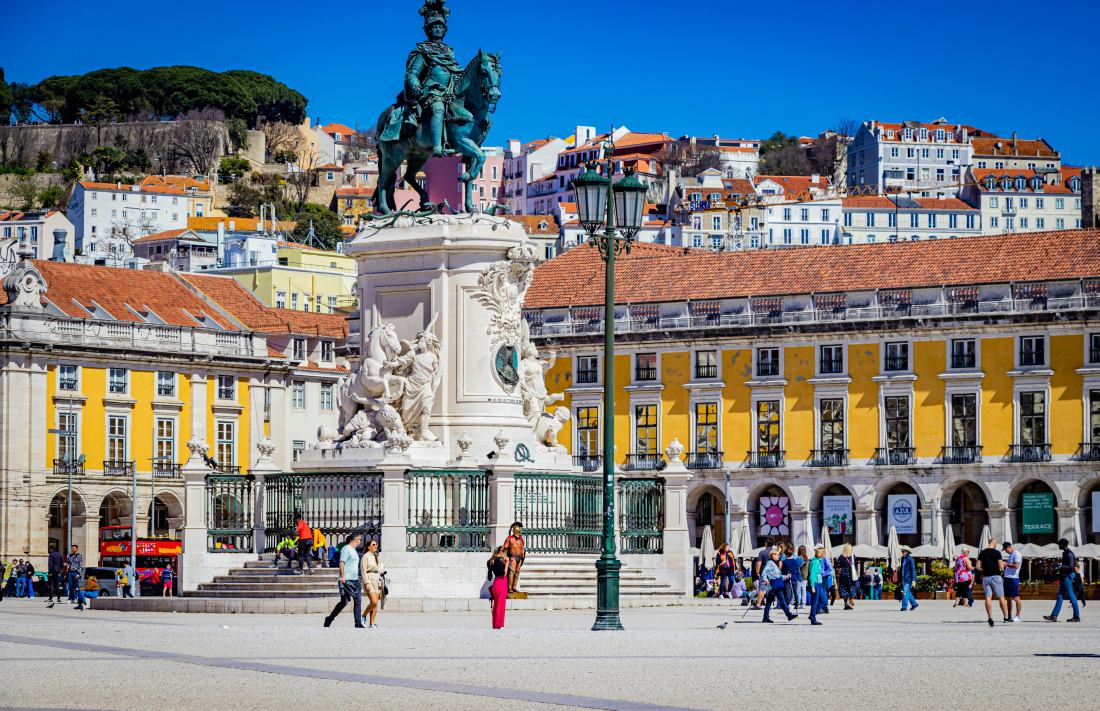
With its cobbled streets, yellow trams and viewpoints, Lisbon is both picturesque and tiring, which is exactly why it pays to plan your visit well. This 3-day Lisbon itinerary helps you see the most important places in a logical order, without rushing!
Table of Contents
Who is this itinerary for?
Three days are enough to experience the highlights of Lisbon, but not enough to see everything. This itinerary is designed for first-time visitors who want to combine the major sights with walks, viewpoints and relaxed lunches.
Each day is built around a clearly defined area: the first covers Belém and the Tagus riverside districts (Jerónimos Monastery, Belém Tower, LX Factory), the second the Alfama and the Baixa (São Jorge Castle, Praça do Comércio, Santa Justa Lift), and the third is a day trip to Sintra (Pena Palace, Quinta da Regaleira).
Plan on 6–9 km of walking a day, with plenty of hills and stairs. The pace is moderate: two or three main sights a day, plus lunch and rest.
Day 1: Belém and the Tagus Riverside
The first day explores the monuments of Portugal’s Age of Discovery on the western edge of Lisbon, then, from the afternoon, shows you the city’s alternative, creative side and the Bairro Alto. Belém lies about 6 km from the city center, but it is easy to reach and the sights can be covered on foot. The total walk is roughly 7–8 km.
Note that the Jerónimos Monastery and Belém Tower are closed on Mondays, so the first day of your itinerary should not be a Monday!
Morning (approx. 8:30–9:30 a.m.): arrival in Belém and Your First Pastel de Nata
From the city center, tram 15E (from the Praça da Figueira or Cais do Sodré stop) takes about 30–40 minutes to reach Belém. Alternatively, the train from Cais do Sodré station toward Cascais takes only about 10 minutes to Belém station. The train is faster, while the tram is more comfortable if you are not in a hurry. Both the tram and the train can be used with the Viva Viagem card (see Practical Tips).
Have breakfast at Pastéis de Belém, maker of Lisbon’s most famous pastel de nata (vanilla custard tart), which has been baking the pastry since 1837. A long line usually snakes out of the entrance, but the dining rooms inside are large and the line moves quickly. If the line outside is too long, the takeaway line by the counter is usually shorter.
Late Morning (approx. 9:30 a.m.–12:30 p.m.): Jerónimos Monastery, Monument to the Discoveries and Belém Tower
From Pastéis de Belém, the entrance of the Jerónimos Monastery is about a 3–5 minute walk.
Jerónimos Monastery
The monastery is a 16th-century Manueline masterpiece and a symbol of Portugal’s golden age. It was built with revenue from Vasco da Gama’s voyage of discovery. The cloister is the highlight: its finely carved stone columns, rope motifs and maritime decorations make it unique. The neighboring Church of Santa Maria is free to enter and holds the tomb of Vasco da Gama. Allow 60–90 minutes.
The cloister is open Tuesday to Sunday, 9:30 a.m.–5:30 p.m. It is closed on Mondays and public holidays.
Ticket prices:
- Full price: €18
- Ages 13–24 and over 65: €9
- Under 12: free
It is worth booking online in advance, because the line can last 1–2 hours. The best time to go is the first half hour after opening.
Ticket booking and all information can be found here!
Padrão dos Descobrimentos (Monument to the Discoveries)
From the monastery, the monument is a 10–15 minute walk along the Tagus, through the railway underpass. Shaped like the prow of a ship, it pays tribute to the Portuguese explorers, and the map mosaic at its foot shows the routes of the voyages of discovery. You do not necessarily need to go up; it is spectacular from the outside, so 10–15 minutes is enough.
Belém Tower (Torre de Belém)
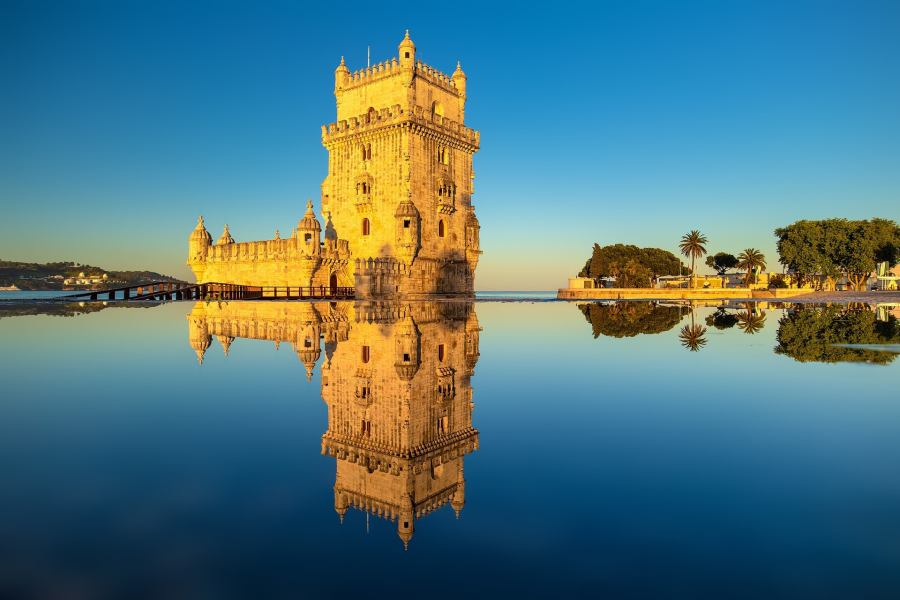
Continuing along the waterfront, you reach the tower in about 15 minutes. The 16th-century fortress tower guarded the mouth of the Tagus and is now one of the city’s best-known symbols. The interior rooms are small, and a staircase leads up to the terrace. The visit takes about 30–45 minutes.
Ticket prices:
- Full price: €15
- Ages 13–24 and over 65: €7.50
- Under 12: free
The tower is open Tuesday to Sunday, 9:30 a.m.–5:30 p.m., and closed on Mondays (and on certain public holidays). Entry is by timed ticket (only a limited number of visitors are admitted every half hour), so book a time slot in advance, ideally between about 11:30 a.m. and 12:00 p.m.
Ticket booking and all information can be found here!
If you have time left: in Belém, the Museu Nacional dos Coches (royal carriage museum) is a good rainy-day option.
Lunch (approx. 12:30–2:00 p.m.): LX Factory, Alcântara
From Belém Tower, the LX Factory is about 10–15 minutes by tram 15E (Alcântara stop) or about 35–40 minutes on foot, so it is worth taking the tram. The LX Factory is a converted industrial complex where restaurants, cafés, a bookshop, design shops and street art sit side by side. The atmosphere is the main attraction here.
Among local dishes, try a version of bacalhau (salted cod), a bifana (spiced pork sandwich), the vegetable soup called caldo verde, or various petiscos (Portuguese tapas). The lunchtime menu (prato do dia) is usually the best value. Opening hours of the complex’s restaurants may vary, and weekends are more crowded.
Afternoon (approx. 2:00–5:00 p.m.): Exploring the LX Factory, then back to the city center
After lunch, spend 45–60 minutes discovering the LX Factory’s smaller shops and galleries and the huge bookshop called Ler Devagar. The Ponte 25 de Abril (a suspension bridge reminiscent of San Francisco’s Golden Gate Bridge) can be seen nearby.
From here, tram 15E takes about 20–25 minutes to the Cais do Sodré stop, where the evening part of the day begins.
Evening (approx. 5:00–9:00 p.m.): Cais do Sodré, Chiado and the Bairro Alto
Time Out Market (Mercado da Ribeira)
Next to Cais do Sodré station you will find the Time Out Market, the city’s popular food hall, where dozens of restaurants serve local food under one roof. It is a good place for an early dinner or a coffee, but expect lines and crowds at peak times. It stays open until late in the evening.
Miradouro de São Pedro de Alcântara
From Cais do Sodré, the viewpoint is about a 15–20 minute walk up steep slopes. If you do not want to climb, you can take the Glória Funicular (Elevador da Glória), which departs from beside Restauradores Square. From the viewpoint you can see São Jorge Castle, the Alfama and the rooftops of the city center, and the view is especially beautiful at sunset.
For dinner, the streets of the Bairro Alto and the Chiado are the places to go. In the evening the district fills with life, and the smaller restaurants and bars stay open into the night. If you would prefer a quieter evening, the Time Out Market or the calmer bistros on the side streets of the Chiado are also a good choice, and they are closer to your accommodation if you want an early night.
Day 2: Alfama, São Jorge Castle and the Baixa
The second day takes place in the historic heart of Lisbon, between the Tagus and the hills. The morning is devoted to the castle and the narrow streets of the Alfama, the afternoon to the flat Baixa and the Chiado. Most of the route can be done on foot, and tram 28E shortens the steepest sections. The total walk is roughly 6–8 km, with many stairs.
The Carmo Convent (Convento do Carmo) is closed on Sundays, so the second day of your itinerary should not be a Sunday!
Morning (approx. 8:00–9:30 a.m.): Tram 28E and the Alfama Viewpoints
Have breakfast at the bakeries around Rossio or Martim Moniz, where a pastel de nata and a bica (Portuguese espresso) are the usual combination.
Tram 28E
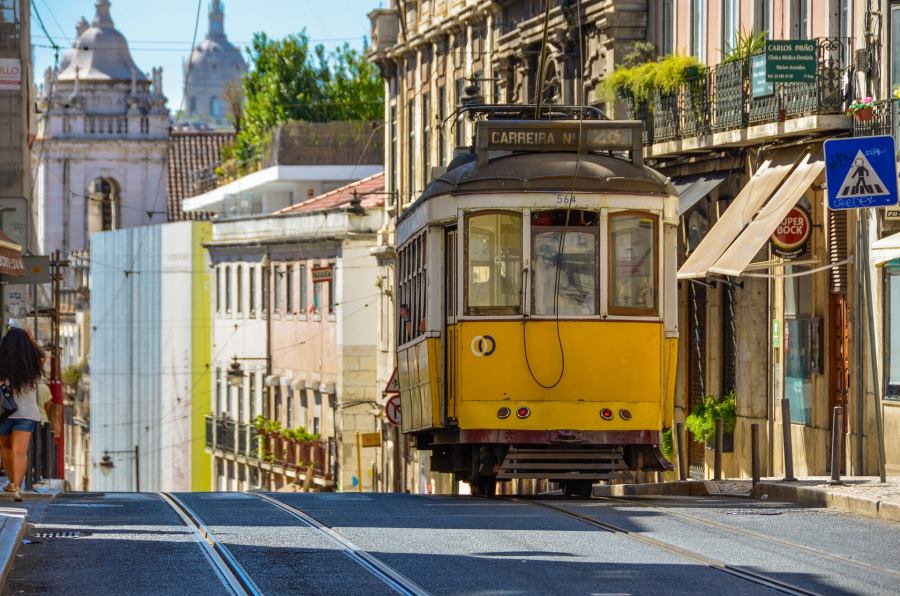
Then board the famous tram 28E at the Martim Moniz terminus, where you have the best chance of getting a seat. The tram takes about 15 minutes to reach the Portas do Sol stop.
Tram 28E is a working public transport line, which is still less crowded early in the morning. A ticket bought on board costs €3.30 and can be paid for in cash only, while with the Viva Viagem card it is much cheaper (see Practical Tips). Pickpockets are common on the tram, so keep your bag in front of you.
Portas do Sol and Santa Luzia Viewpoints
The Portas do Sol and the nearby Santa Luzia viewpoint look out over the red rooftops of the Alfama, the Tagus and the dome of Santa Engrácia. The view is at its best in the morning light, and there are no crowds yet.
Late Morning (approx. 9:30 a.m.–12:30 p.m.): São Jorge Castle and the Cathedral
From the Portas do Sol viewpoint, a 10–15 minute uphill walk along the narrow streets of the Rua de Santa Cruz do Castelo leads to the entrance of São Jorge Castle.
Castelo de São Jorge (São Jorge Castle)
The castle is a Moorish-era fortress at the highest point of the city, offering the best panorama of Lisbon, the Tagus and the Ponte 25 de Abril. You can walk along the walls and climb the towers, and peacocks stroll in the garden. Allow 1.5–2 hours. The castle is less crowded early in the morning.
From November to February the castle is open 9:00 a.m.–6:00 p.m., and from March to October 9:00 a.m.–9:00 p.m. It is closed on January 1, May 1, and December 24, 25 and 31. Buy your online ticket only on the official website; ticket holders do not have to wait in line.
Ticket prices:
- Full price: €17
- Ages 13–25: €8.50
- Over 65: €14
- Under 12: free
Ticket booking and all information can be found here!
Sé de Lisboa (Lisbon Cathedral)
From the castle, the Sé is about a 15-minute walk through the streets of the Alfama. It is Lisbon’s fortress-like 12th-century cathedral. The interior is built of stone and almost monastic in feel. Entry to the nave is usually free, while the cloister and the treasury require a separate ticket. 20–30 minutes is enough here. Tram 28E also passes in front of the Sé.
Lunch (approx. 12:30–2:00 p.m.): Alfama or Around the Sé
The side streets of the Alfama are lined with small family-run restaurants and taverns. Try grilled fish here (the sardine “season” in summer, especially in June, is particularly famous), bacalhau à brás, a dish of salt cod with eggs, caldo verde soup, or arroz de marisco (seafood rice). The restaurants in front of the Sé and next to the Portas do Sol viewpoint are generally aimed at tourists, so it is worth heading further in, into the side streets.
Be careful: in many restaurants the bread, butter and olives (couvert) brought to the table are charged separately. If you do not ask for them, you can safely send them back.
Afternoon (approx. 2:00–5:00 p.m.): Praça do Comércio, Rua Augusta, Santa Justa Lift and the Carmo Convent
Praça do Comércio
From the Alfama to the Praça do Comércio is about a 20-minute walk downhill on an easy route. The yellow-fringed main square opens onto the Tagus, and an equestrian statue of King Joseph I stands in the middle. On its northern side stands the Arco da Rua Augusta triumphal arch, to whose top an elevator also runs (separate ticket).
Rua Augusta
Beneath the arch begins Rua Augusta, the pedestrian main street of the Baixa. Walking along it to Rossio Square takes about 10–15 minutes. On the way you can peek into the little shops and cafés of the area.
Santa Justa Lift (Elevador de Santa Justa)
Next to Rossio stands the Santa Justa Lift, a neo-Gothic iron structure built in the early 20th century that connects the Baixa with Carmo Square. The lift can also be used with the Viva Viagem card. The line is shortest early in the morning and can be long by the afternoon. If the line is long, you can reach the upper panoramic terrace for free by walking from the Carmo Square side, but the very top level requires a ticket.
Carmo Convent (Convento do Carmo)
From the lift, the Carmo Convent is about a 3-minute walk. The 14th-century church was destroyed in Lisbon’s 1755 earthquake, and its roofless Gothic arches stand open to the sky. An archaeological museum also operates next door. Allow 45–60 minutes. From November to April it is open 10:00 a.m.–6:00 p.m. (last admission 5:40 p.m.), and from May to October 10:00 a.m.–7:00 p.m. It is open Monday to Saturday and closed on Sundays.
Ticket prices:
- Full price: €7
- Students with a student ID: €5
- Over 65: €5
- Under 14: free
Opening hours and all information can be found here!
If you have time left: walking through the streets of the Chiado (Rua Garrett), you will find Livraria Bertrand nearby, the world’s oldest bookshop still in operation.
Evening (approx. 5:00–9:00 p.m.): Sunset on the Tagus and Fado
From Carmo Square, you can walk back to the Praça do Comércio in about 15 minutes along Rua Augusta.
The Cais das Colunas, the marble steps leading down to the river on the square, is especially atmospheric at sunset: you can sit at the water of the Tagus, with the Ponte 25 de Abril in the background.
The streets of the Alfama or the Bairro Alto are ideal for dinner and fado. Fado is the music of the Portuguese soul: dark, melancholic songs performed to guitar accompaniment. Restaurants that offer fado (fado houses) generally require a reservation, and the price of dinner often includes a cover charge or minimum spend. Fado performances usually start around 8:00–9:00 p.m.
If you would like a quieter evening, you can have dinner on the side streets of the Baixa or around the Praça do Comércio, and then stroll along the riverfront.
Day 3: Day trip to Sintra
The third day leaves Lisbon, but the palaces and gardens around Sintra make it worthwhile. Tucked among the hills in a romantic landscape, the town was the summer retreat of the Portuguese kings and is now a UNESCO World Heritage Site. It is about 40 minutes from Lisbon by train.
The point of the day: two major sights (Pena Palace, Quinta da Regaleira), with lunch in the center of Sintra between them. The total walk is roughly 6–8 km, with many hills.
Check the prices and opening hours of the Sintra sights on the official Parques de Sintra website, because they change often. Pena Palace is closed on December 25 and January 1. On a cloudy, foggy or rainy day the view is less spectacular, so try to put the third day on the day with the best weather.
Morning (approx. 8:30–9:45 a.m.): From Lisbon to Sintra by train
From Rossio railway station (in the center of Lisbon), trains leave for Sintra about every 20 minutes. The trip takes about 40 minutes, and a ticket costs about €2.55 one way. Tickets can be bought separately at the machines, and you do not need to buy them in advance. It is worth setting off before 9 a.m. to avoid the crowds at the station and the palaces.
From Sintra station, bus 434 takes people up to Pena Palace on a one-way circular route, via the Castelo dos Mouros and Pena Palace stops. Walking up the hill takes about 45–60 minutes of climbing, so it is worth taking the bus.
Late morning (approx. 9:45 a.m.–12:45 p.m.): Pena Palace and Park
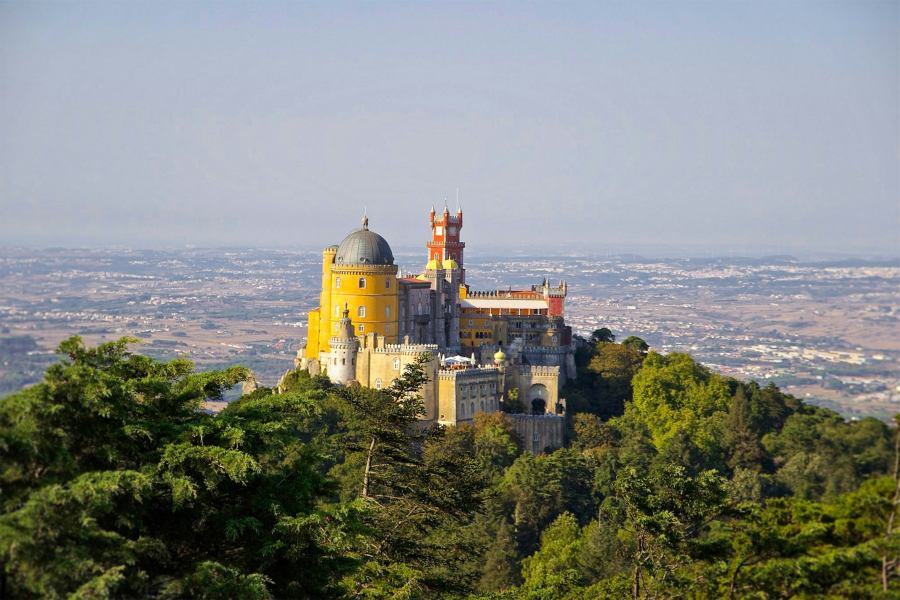
Pena Palace is one of the most colorful creations of 19th-century Romanticism: yellow, red and blue towers, domes, tiles and decorations on top of a hill. King Ferdinand II had it built on the ruins of an earlier monastery. The interiors show the former furnishings of the royal family, and from the terraces you can see the Sintra Mountains, the Castle of the Moors and even the sea. Plan on 1.5 hours for the palace and a further 1–1.5 hours for the park.
Entry is by timed ticket, so book a time slot online in advance, ideally for the first morning slot (around 9:30 a.m.). The palace is generally open 9:30 a.m.–6:30 p.m. and the park from 9:00 a.m., but check the exact times and prices on the official website.
Ticket prices:
- Full price: €13
- Ages 6–17: €10
- Over 65: €10
- Under 6: free
- Family ticket (2 adults + 2 children): €35
Ticket booking and all information can be found here!
If you have time left: the neighboring Castelo dos Mouros (Castle of the Moors) can be visited with a separate ticket. The long walk along its walls offers a beautiful panorama, but it fits into the day’s program only if you finish quickly at Pena Palace.
Lunch (approx. 12:45–2:15 p.m.): Historic Center of Sintra
From Pena Palace, the historic center is about 10–15 minutes by bus 434, or about 40–50 minutes on foot downhill. Small restaurants and pastry shops await in the center. Typical Sintra sweets are the travesseiro (a sugared “pillow” of puff pastry filled with almond cream) and the queijada (cheese tart). Prices are generally higher in the immediate vicinity of the main square when choosing a restaurant or pastry shop, so it is worth looking a few streets away.
The National Palace stands in the center and is recognizable by its two distinctive conical chimneys. In rainy weather the interiors make a good program, but in good weather it can be skipped in favor of Pena and Regaleira.
Afternoon (approx. 2:15–5:30 p.m.): Quinta da Regaleira
From the center, Quinta da Regaleira is about a 10–15 minute walk. The neo-Gothic–Manueline palace and garden, built in the early 20th century, hide many secrets: in the garden, tunnels, grottoes and the steps of the famous Initiation Well (Poço Iniciático) lead down about 27 meters. The tunnels can be dark and damp, so a flashlight (or a phone light) is useful. Allow 1.5–2 hours.
Ticket prices:
- Full price: €20
- Ages 6–17: €15
- Over 65: €15
- Under 6: free
- Family ticket (2 adults + 2 children): €60
All information can be found here!
Evening (approx. 5:30–9:00 p.m.): Back to Lisbon
From Regaleira to Sintra railway station it is about a 20–25 minute walk, or faster by tuk-tuk or taxi. Trains run about every 20 minutes, and the trip to Rossio takes about 40 minutes. The train can be packed, and in the evening hours it is worth choosing a carriage where other tourists are also traveling.
For the evening in central Lisbon, the Baixa and Rossio area and the Chiado are convenient places for dinner. If you are tired, have dinner near your accommodation. The last evening is also a good time to see a fado performance, if it did not fit into the second day.
Practical tips
Tickets and passes for transport
- Viva Viagem / Navegante card: the rechargeable card for Lisbon’s public transport, priced at €0.50. Metro, bus, tram and train tickets can be loaded onto it.
- Single ticket: valid for 1 hour, priced at €1.90.
- 24-hour Carris/Metro ticket: the 24-hour ticket for Carris and the metro costs about €7.25 and is valid on trams, buses and the metro. It pays off if you use public transport at least four times a day. The ticket for tram 28E costs €3.30 on board, and it is cheaper with the card.
- Sintra train: the Rossio–Sintra train ticket costs about €2.55 one way and can be loaded onto the card above.
- Lisboa Card: the card includes admission and transport, but it is worth calculating whether it pays off, because several attractions (for example, Belém Tower) also require booking a time slot. You can find the price of the card and the places it includes here!
Transport information, timetables and prices can be found here!
Clothing and gear
Plan on 6–9 km a day, with cobbled streets, steep hills and stairs. Comfortable shoes with non-slip soles are the most important item, because worn cobblestones are very slippery in the rain. Dressing in layers is recommended, because it is often windy in Sintra and along the Tagus. Sun protection (hat, sunglasses, sunscreen) is essential in summer. A flashlight also comes in handy for the Regaleira tunnels.
Local customs and tourist traps
- Pickpockets are common on tram 28E, at the Santa Justa Lift and on Rua Augusta, so wear your bag in front, zipped.
- On the street, especially in the Baixa and the Alfama, street vendors offering drugs may approach you. Do not engage with them; a firm “não, obrigado” is enough.
- The bread, olives and butter (couvert) brought to your restaurant table are charged for if you touch them. If you did not ask for them, you can send them back.
- Tuk-tuk tours aimed at tourists and the restaurants in front of the Sé are generally more expensive than what the side streets offer.
- In Lisbon, dinner usually starts after 7:30–8:00 p.m., and fado venues later still.
Alternatives for bad weather
In rainy or very windy weather the viewpoints (São Pedro de Alcântara, Portas do Sol, the Sintra Mountains) are less enjoyable, and the cobblestones are slippery too. The following indoor programs can be fitted in with a small detour:
- Museu Nacional dos Coches (Day 1): the royal carriage museum in Belém is close to the Jerónimos Monastery and Belém Tower, so in rainy weather it can be added instead of or alongside the LX Factory. About 1–1.5 hours; it is worth checking the opening hours in advance.
- Time Out Market (Day 1 or 2): a covered food hall next to Cais do Sodré where you can try the local food of dozens of restaurants. A good choice for lunch or dinner instead of outdoor walks.
- Museu do Fado (Day 2): the museum on the edge of the Alfama presents the history of fado and is a good program of about 1 hour in place of the afternoon outdoor walk after São Jorge Castle. It is worth checking the opening hours in advance.
- Sintra National Palace (Day 3): if there is heavy fog or rain around Pena Palace, the interiors of the palace in the town center are more comfortable to visit, and you do not need the hill bus for it.
Summary
The three-day itinerary shows the three faces of Lisbon: the Age of Discovery in Belém, the historic Alfama and Baixa, and finally the romantic palaces of Sintra. With two or three main sights a day, sensible walking and realistic lunch breaks, you will also have time to enjoy the atmosphere of the city.

