
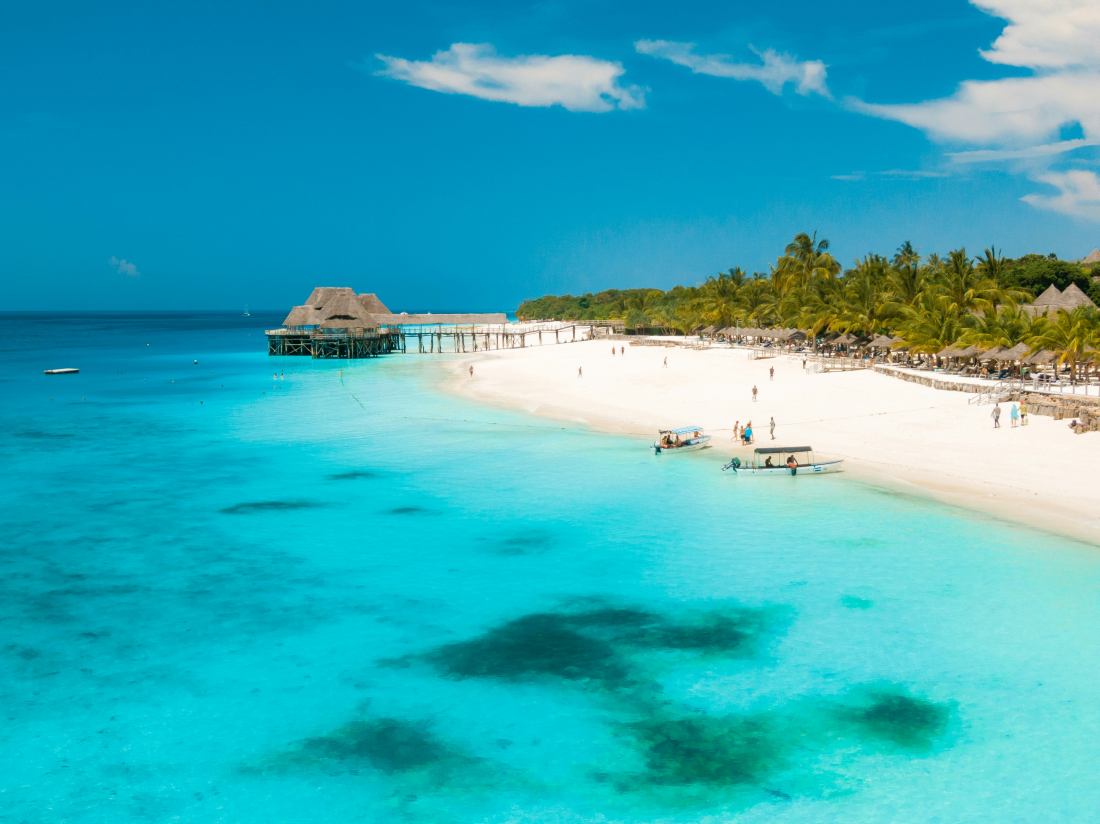
Zanzibar is a tropical archipelago off the coast of East Africa that lures travelers with its white sandy beaches, spice-island atmosphere, and rich history. The questions and answers below will help you navigate the most important things to know, whether it’s about visas, safety, transportation, or health matters.
Table of Contents
Basic information
Why is it worth traveling to Zanzibar?
Zanzibar is a popular destination because it combines a beach experience reminiscent of Caribbean islands with a unique historic town shaped by Swahili-Arab-Indian culture.
The island’s best-known hub is Stone Town, whose narrow alleys, carved doors, and markets are part of a UNESCO World Heritage site. Zanzibar is also famous for its spices – cloves, vanilla, pepper, and nutmeg – and spice tours can be booked on numerous plantations. Around the island there are nearly untouched coral reefs, making diving and snorkeling an outstanding experience, while in the coastal villages travelers can also get a glimpse of local fishing life.
What time zone is Zanzibar in?
Zanzibar is in the East Africa Time zone (UTC+3) and does not observe daylight saving time.
When is the best time to travel to Zanzibar?
The most favorable time to visit Zanzibar is roughly from late June to October, as well as around January-February, when the weather is dry and sunny.
The island has two alternating rainy seasons: the long rainy season lasts from March to May, when downpours are frequent and long, and many accommodations close during this time. The short rainy season falls in November and December, characterized by shorter, often afternoon showers, though most of the day still remains sunny. The dry, cooler period between June and October is ideal for beach time and exploring the island, while January-February are hot but also low-rainfall months.
How many days is it worth spending in Zanzibar?
To explore Zanzibar, it’s generally worth setting aside at least 5-7 days, so that alongside time at the beach there’s also room for Stone Town and a few excursions.
In 3-4 days only the most essential experiences fit in: a day or two in Stone Town with its historic old town and markets, plus a few days at a beachfront place to stay. With a week or longer, there’s comfortably room for a spice tour, a trip to Prison Island to see the giant tortoises, as well as exploring several of the island’s beaches – such as Nungwi, Kendwa, or Paje.
What is the official currency in Zanzibar?
The official currency of Zanzibar and all of Tanzania is the Tanzanian shilling (TZS), though a significant portion of tourist services – hotels, safaris, entrance fees – are commonly quoted and paid for in US dollars (USD) as well.
It’s worth bringing smaller-denomination, intact dollar bills printed after 2009, since older or damaged notes are refused in many places. For everyday smaller expenses (markets, local restaurants, taxis), it’s practical to exchange money for local shillings or withdraw them from an ATM. Larger hotels and restaurants also accept bank cards, but this can’t be relied on everywhere.
Here is a currency converter where you can check the current exchange rate!
Is English spoken in Zanzibar?
Yes, English is one of Tanzania’s official languages, so you can generally get by well with it in tourist areas – hotels, restaurants, safari and diving operators.
The locals’ native language is Swahili, spoken by almost everyone, and it is the primary language of everyday communication. A few basic Swahili phrases – jambo (hello), asante (thank you), karibu (welcome/you’re welcome) – can come in handy, and locals appreciate it when visitors use them.
What type of power outlet is used in Zanzibar?
In Zanzibar and throughout Tanzania, British-standard, three-pin, square (Type G) outlets are typically used, so European devices will need a travel adapter.
At some accommodations, other, rarer plug types may also be found mixed in, so a universal travel adapter covering multiple standards is the safest solution.
The mains voltage in Zanzibar is 230 volts at 50 Hz, which matches the European standard, so no voltage converter is needed by itself, just a plug adapter.
How does internet access and SIM card use work in Zanzibar?
Wi-Fi is generally available in larger hotels and restaurants, but coverage and speed can be inconsistent in more rural areas, so it’s worth buying a local SIM card or an eSIM for continuous mobile internet.
At the airport and in Stone Town, tourist SIM cards are available from several local providers (such as Vodacom, Airtel, Tigo) upon presenting a passport. These are extremely affordable, and most packages provide generous data allowances for a few days or weeks. Those who’d rather not swap a physical SIM card can purchase and activate an eSIM in advance, which will already be working upon arrival.
Is it customary to tip in Zanzibar?
Yes, tipping is customary and expected in Zanzibar, especially at restaurants, on safaris, and at dive centers, as it makes up an important part of tourism workers’ income.
In restaurants, a customary tip is 5-10% of the bill, if a service charge is not already listed separately. It’s also polite to give tour guides, drivers, and hotel staff a few dollars in tips depending on the quality of service. It’s worth bringing small-denomination dollars or local shillings along for this purpose.
Travel and transportation
How can I get from the airport to Stone Town or to hotels?
Zanzibar’s main airport is Abeid Amani Karume International Airport (ZNZ), which lies just a few kilometers from Stone Town, so the town center is quick to reach.
Most travelers continue on from the airport with a pre-arranged transfer or a car provided by their accommodation, which is the most comfortable and safest option. Official taxis also wait at the airport, and it’s worth agreeing on the fare before setting off. Reaching the more distant northern or eastern coastal hotels (Nungwi, Kendwa, Paje) can take as much as 1.5-2 hours from the airport, so it’s worth planning this into the itinerary for arrival day.
What is the most convenient way to get around in Zanzibar?
For tourists, a rental car or a car hired with a driver, as well as organized transfers, are the most convenient ways to get around the island, since public transport is less predictable.
The local minibuses, called daladalas, are extremely cheap, but often crowded and don’t stick to a schedule, so they’re more suited to more adventurous travelers. Taxis are a convenient option for getting around town and for shorter trips, though the fare must always be agreed on before setting off, since there are no meters. For longer distances or safari-style excursions, many people hire a car with a driver, which offers flexibility and means not having to deal with left-hand traffic and the occasionally poor road quality.
Do you need to cross by ferry or boat from the mainland to Zanzibar?
Anyone flying directly into Zanzibar has no need for a ferry, but a fast ferry departing from Dar es Salaam or another mainland city is also a popular alternative.
The ferry between Dar es Salaam and Zanzibar takes about two hours, and several companies operate multiple daily crossings. According to official recommendations, it’s worth choosing the more reliable, well-known ferry lines and, where possible, avoiding late-evening or bad-weather crossings.
Accommodation and safety
Is Zanzibar a safe island?
Zanzibar is overall considered a safe destination for tourists; crime is typically limited to minor theft, and more serious violent incidents are rare in the areas visitors frequent.
The most common problems are pickpocketing and minor scams (overcharging, fake guides), so it’s worth keeping an eye on your valuables, especially in crowded markets and Stone Town’s narrow streets. For evening walks, it’s best to stick to well-lit, busy streets, and it’s recommended to visit more remote or deserted beaches during the day and in a group.
Which areas are considered safe and popular?
The most visited and safest-regarded areas include Stone Town, as well as the northern and eastern coastal resort areas such as Nungwi, Kendwa, and Paje.
- Stone Town – the historic old town, with numerous museums, markets, and restaurants, an ideal starting point for exploring the island.
- Nungwi and Kendwa – crystal-clear-water beaches at the island’s northern tip, with a lively nightlife.
- Paje and Jambiani – calmer towns on the southeastern coast with a surf and kitesurf atmosphere.
These areas typically see heavy tourist traffic, which means stronger local infrastructure and greater safety.
Which area is worth staying in on Zanzibar?
For tourists, Stone Town, Nungwi, Kendwa, and Paje are the most popular areas to stay, depending on whether you’re after a city atmosphere or beachside relaxation.
- Stone Town is a great choice if you want to stay close to the historic center and the harbor, though from here the most beautiful beaches are 1-2 hours away by car.
- Nungwi and Kendwa are the island’s most popular beach resorts, with excellent sandy shores and a lively range of restaurants and bars.
- Paje and Jambiani offer a calmer, more nature-close atmosphere and are especially popular among travelers who love surfing and kitesurfing.
Health information
Are mandatory vaccinations required for traveling to Zanzibar?
Travelers arriving from Europe have no mandatory vaccination requirement for Zanzibar, unless they are arriving from or transiting through a country with yellow fever, in which case proof of yellow fever vaccination is required.
Although not mandatory, it is recommended to have vaccinations against hepatitis A and B, typhoid, and tetanus-diphtheria, or to have them updated if they have lapsed. It’s worth visiting a vaccination center or your family doctor at least 4-6 weeks before travel for personalized advice.
Is there malaria in Zanzibar?
Yes, Zanzibar is considered an at-risk area for malaria, although the risk of infection is lower than in some regions of mainland Tanzania, so prevention is important.
There is no mandatory vaccination against it, but it’s worth discussing preventive medication (malaria prophylaxis) with a doctor. In addition, protection against mosquito bites – using repellents, wearing long sleeves in the evening, sleeping under a mosquito net – is always recommended, since there is currently no vaccine against dengue fever, so preventing it also depends on avoiding mosquito bites.
Is tap water safe to drink in Zanzibar?
No, drinking tap water in Zanzibar is not recommended; tourists should only drink bottled or filtered water.
Because of the risk of cholera infection, it’s also wise to be cautious: avoid ice from unknown sources, as well as raw or undercooked food and unpeeled vegetables and fruit in places where water and food hygiene standards are questionable.
Do you need travel insurance for Zanzibar?
Yes, it is definitely recommended, and as of October 2024 it is also mandatory for entry to have local travel insurance issued by the Zanzibar Insurance Corporation (ZIC).
Beyond this, it’s worth taking out a comprehensive international travel insurance policy back home as well, one that covers medical care, emergency hospital treatment, and repatriation if needed, since treatment for more serious health problems on the island is limited, and in more complicated cases patients must be transported to the mainland or abroad.
Experiences
What are the must-see sights in Zanzibar?
Zanzibar’s best-known sights include Stone Town’s historic old town, the spice plantations, Prison Island with its giant tortoises, and the island’s famous beaches.
- Stone Town is part of the UNESCO World Heritage site; with its narrow alleys, carved doors, and lively markets, it is the island’s cultural heart, where it’s also worth visiting the memorial site of the old slave market and the House of Wonders.
- At the spice plantations (spice tour), visitors can learn about the cultivation of cloves, vanilla, pepper, and nutmeg, combined with a tasting.
- Prison Island, reachable by boat from Stone Town, is home to giant tortoises hundreds of years old, which can also be observed up close.
- The beaches on the island’s northern and eastern coasts – Nungwi, Kendwa, Paje – rank among the most beautiful in the world with their crystal-clear water and white sand.
What are the most popular foods and drinks in Zanzibar?
Zanzibar’s cuisine is characterized by a mix of Swahili, Indian, and Arab influences, and its best-known dishes include Zanzibar pizza, spiced pilau rice, and fresh seafood.
- Zanzibar pizza is a distinctive street food made of thin dough filled with meat, vegetables, or chocolate, and most resembles a stuffed pancake.
- Pilau and biryani are spiced, Indian-origin rice dishes that are often served with meat or fish.
- Seafood – shrimp, octopus, lobster – is available in outstanding quality at coastal restaurants and at the famous evening market in Forodhani Gardens.
- Among drinks, fresh fruit juices and local spiced tea (chai) are the most popular, while alcohol – due to the island’s Muslim population – is typically served only in tourist restaurants and hotels.
What important holidays and festivals are there in Zanzibar?
Alongside local Muslim holidays, notable events in Zanzibar include the Zanzibar International Film Festival (ZIFF), as well as the anniversary of the Zanzibar Revolution on January 12.
- Zanzibar Revolution Day (January 12) commemorates the overthrow of sultanate rule in 1964; it is a national holiday with many local events.
- The month of Ramadan and the Eid al-Fitr holiday that closes it are of great importance in the life of the Muslim population; daily routines – restaurant opening hours, the general mood – change during this time, which is worth preparing for as a tourist.
- In summer, the Sauti za Busara music festival and the Zanzibar International Film Festival (ZIFF) are held, both important events in East African cultural life that attract many visitors to Stone Town.