
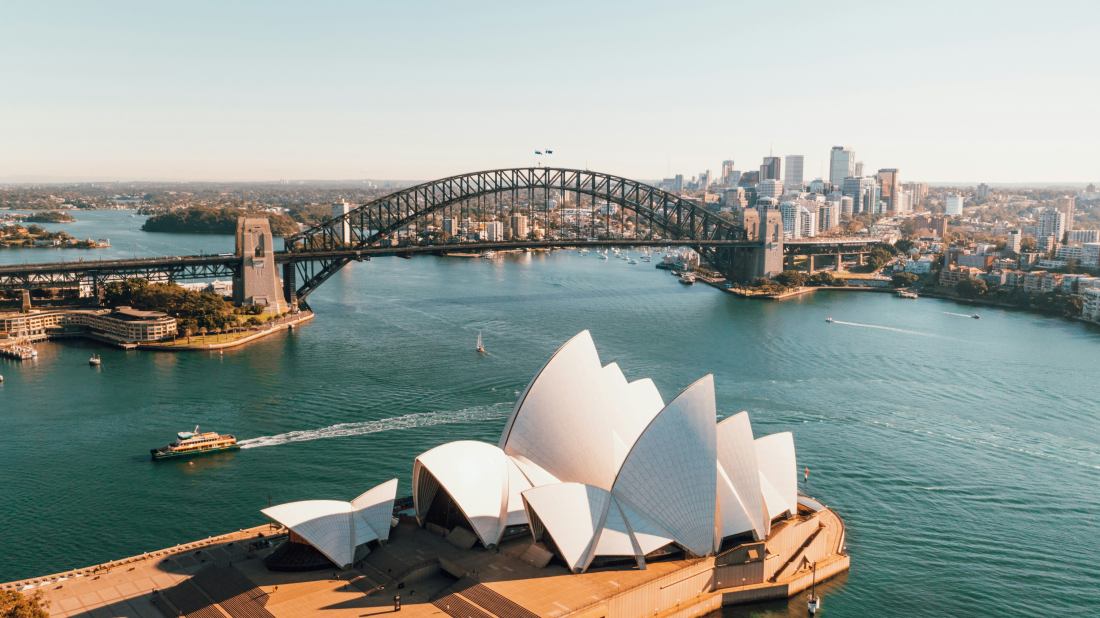
Sydney is Australia’s most famous city, welcoming the largest number of tourists. The following questions and answers will help you navigate the most important travel information, whether it concerns safety, transport, or the best time to visit.
Table of Contents
Basic information
What time zone is Sydney in?
Sydney is in the Australian Eastern Time Zone (Australian Eastern Standard Time, AEST, UTC+10).
It is important to note that Australia and Europe, North America, Asia observe daylight saving time in opposite seasons – when it is summer in Europe, it is winter in Australia, and vice versa.
When is the best time to visit Sydney?
The best time to visit Sydney is generally the Australian spring, from September to November, and the Australian autumn, from March to May. During these periods, the weather is pleasant – not too hot and not too cold – making it ideal for exploring the city.
The Australian spring (September–November) is one of the best times to visit Sydney. Temperatures generally range between 18–25 °C, and winter showers are no longer common. Nature comes alive, with beautiful blooms in the parks and botanical gardens.
The Australian autumn (March–May) is also a pleasant period, as the scorching Australian summer comes to an end. Temperatures gradually drop, tourist numbers decrease, and the beaches are less crowded. This period is ideal for those wishing to avoid peak-season crowds.
The Australian summer (December–February) is the peak season: beaches and tourist attractions are packed, and temperatures can exceed 35–40 °C. However, the New Year’s Eve fireworks over the Sydney Harbour Bridge are among the most spectacular celebrations in the world, and many visitors come specifically for this event.
How many days should you spend in Sydney?
At least 4–5 days are recommended to explore Sydney. The city is quite large, and there are plenty of activities not only in the city centre but also at the surrounding beaches, nature parks, and neighbourhoods.
In 3 days, you can visit the main highlights: the Opera House, the Sydney Harbour Bridge, The Rocks district, Darling Harbour, and one of the most famous beaches – Bondi Beach.
With a 5–7 day stay, you can explore the city at a more relaxed pace, and also have time for day trips to the nearby Blue Mountains National Park or the Hunter Valley wine region.
What is the official currency in Sydney?
The official currency of Sydney and all of Australia is the Australian Dollar (AUD). Card payments are widespread in major shops, restaurants, and hotels, and contactless payment is particularly popular in Australia.
Cash may be needed at smaller markets, street vendors, and some smaller restaurants. ATMs are easy to find throughout the city, but it is worth checking your bank’s transaction fees in advance.
Here is a currency converter calculator where you can check the current exchange rate!
Do people speak English in Sydney?
Yes, English is the official language in Sydney, so you can communicate in English everywhere. This is one of the most appealing factors for English-speaking tourists, as there are no language barriers to encounter.
What type of plug sockets are used in Sydney?
Australia (including Sydney) uses Type I plug sockets, which differ from those used in Europe. A travel adapter will be needed for most European devices.
The Australian socket has three flat pins arranged in a V-shape. The mains voltage is 230 volts and the frequency is 50 Hz so most European devices are compatible; only an adapter is required.
How does the internet and SIM card usage work in Sydney?
Sydney has excellent internet connectivity, and free Wi-Fi is available in most hotels, cafés, restaurants, and shopping centres. If you need continuous mobile internet, it is worth purchasing a local SIM card or eSIM.
The most well-known Australian mobile operators are Telstra, Optus, and Vodafone AU, all of which offer tourist SIM cards providing unlimited data for 30 days. These can easily be obtained at the airport or in the city.
eSIM is an increasingly popular solution: it can be purchased and activated at home, so mobile internet is up and running as soon as you arrive at the airport.
Is tipping customary in Sydney?
In Australia – and in Sydney – tipping is neither obligatory nor expected, unlike in the United States, for example. Australian workers are entitled to a legally guaranteed minimum wage, so service quality does not generally depend on tips.
However, if you were particularly satisfied with the service, leaving around 10% of the bill at a restaurant is a well-received gesture. In bars and cafés, tipping is likewise not required, but rounding up the change is an accepted custom.
Travel and transport
How do I get from the airport to the centre of Sydney?
Sydney Airport (SYD) is located just 8–10 kilometres from the city centre. The most convenient and fastest option is the Airport Link train, which departs directly from both terminals and reaches Central Station in 13 minutes.
The Airport Link train is the quickest option. The fare is higher than standard public transport, but it provides a convenient and fast connection to the city centre.
Buses offer a cheaper alternative, though they are slower, especially during peak hours. Payment is made using an Opal card.
Taxis and Uber are also readily available at the terminals. The journey to the city centre typically takes 20–30 minutes, with fares around 45–60 AUD depending on traffic.
What is the most convenient way to get around Sydney?
Sydney has an extensive and well-organised public transport network. For tourists, the best combination is usually the train, bus, ferry, and light rail.
The train is one of the fastest ways to travel within the city, particularly between the city centre and outer suburbs.
The ferry is not only a useful mode of transport but also a scenic experience: crossing Sydney Harbour offers stunning views of the Opera House and the Harbour Bridge.
The Opal card is a unified payment card that can be used on trains, buses, ferries, and the light rail. It is worth obtaining one in the first few days – available at the airport and in many shops.
Accommodation and safety
Is Sydney a safe city?
Sydney is one of the safest major cities in the world. The rate of violent crime is low, and tourists generally feel safe in the city centre and popular neighbourhoods alike.
Of course, it is still advisable to follow general travel guidelines: do not leave valuables unattended, avoid dark and deserted areas at night, and watch out for pickpockets at busy tourist attractions.
Which neighbourhood is best to stay in Sydney?
The most popular areas for tourists to stay in Sydney are the CBD (Central Business District), The Rocks, Darling Harbour, Newtown, and the Bondi Beach area. These districts offer great locations, with many sights, restaurants, and transport hubs nearby.
The CBD (city centre) is ideal if you want to be close to everything. The Opera House, the Botanical Garden, and most museums are within walking distance.
The Rocks is Sydney’s oldest and most atmospheric historic quarter, where you can walk on cobbled streets and feel the city’s past. It is close to the harbour and the Opera House.
Bondi Beach is an ideal base for beach lovers. Besides the famous beach, excellent restaurants and cafés, as well as a vibrant atmosphere, await visitors.
Newtown is a bohemian, alternative neighbourhood full of small restaurants, bars, and galleries – recommended for those who prefer a younger, more eclectic vibe.
Health information
Are any vaccinations required for travel to Sydney?
Generally, no mandatory vaccinations are required for Hungarian travellers visiting Sydney, provided they are arriving directly in Australia.
Is the tap water safe to drink in Sydney?
Yes, tap water in Sydney is of excellent quality and is safe to drink.
Australia is one of the countries with the highest tap water quality in the world, so there is no need to buy bottled water. Numerous free drinking fountains can be found in parks, public spaces, and public buildings throughout the city.
What health risks should you be aware of in Sydney?
One of the most important health warnings in Sydney is the intense UV radiation. Australia’s ozone layer is thinner than in many other regions, so the sun can be extremely strong – UV index values above 10 can occur in summer.
It is advisable to use strong sunscreen (SPF 50+), wear protective clothing, and put on a hat, especially at midday.
Attention should also be paid to marine life: certain jellyfish, sea urchins, and other sea creatures can cause stings and bites. It is worth following the signs displayed on beaches and the guidance of lifeguards.
Experiences
What are the must-see attractions in Sydney?
Sydney’s most famous attractions include the Opera House, the Sydney Harbour Bridge, Bondi Beach, the Blue Mountains, and The Rocks district. These places showcase the city’s unique natural beauty, architectural heritage, and cultural richness.
The Opera House is one of the world’s most iconic buildings, listed as a UNESCO World Heritage Site. It is well worth seeing from the inside too: there is a wide choice of performances, concerts, and guided tours.
The Sydney Harbour Bridge is the world’s widest steel arch bridge, and visitors can even climb it via the BridgeClimb programme – offering a magnificent panoramic view of the harbour and the city.
Bondi Beach is perhaps the world’s most famous beach. You can not only swim here but also enjoy a pleasant stroll along the coastal path, and the cafés and restaurants lining the shore are very tempting.
The Blue Mountains National Park is just an hour and a half’s drive from the city, and awaits visitors with breathtaking canyons, waterfalls, and the famous Three Sisters rock formation.
The Rocks is Sydney’s oldest quarter, where strolling along cobblestone streets you can feel the remnants of 18th-century colonial atmosphere, and on weekends a bustling market welcomes visitors.
What are the most popular foods and drinks in Sydney?
Sydney’s gastronomic scene is extraordinarily diverse, reflecting the city’s multicultural character. Alongside classic Australian dishes, Asian, Middle Eastern, and European cuisines are also strongly present in the city.
Fish and chips is one of the most iconic Australian dishes, which is especially enjoyable to eat by the harbour or at the beach.
The Aussie meat pie is a traditional savoury pastry loved throughout Australia. It can be found at bakeries and sporting events alike.
Flat white coffee is a source of pride for Australia (and New Zealand): a stronger, creamier milk coffee that was perfected in Sydney’s café culture.
Pavlova is a light, airy meringue dessert topped with fresh fruit, claimed by both Australians and New Zealanders as their own.
Sydney’s wine regions are also outstanding: the wines from the nearby Hunter Valley are definitely worth tasting, even as part of a day trip.
What important festivals and events are held in Sydney?
Sydney hosts numerous important events and festivals throughout the year. Among the most spectacular are the New Year’s Eve fireworks, the Vivid Sydney light festival, and the Mardi Gras parade.
The New Year’s Eve fireworks (31 December) are one of the world’s most spectacular New Year’s celebrations: the waters around the Sydney Harbour Bridge and the Opera House are illuminated by a breathtaking fireworks display, watched by millions in person and on television.
Vivid Sydney (May–June) is a stunning light and music festival during which the Opera House and buildings in the city centre are projected with fantastic light displays. It has become one of the largest events in Australia.
The Sydney Gay and Lesbian Mardi Gras (February–March) is one of the world’s best-known LGBTQ+ parades and festivals, held annually since 1978. The parade is simultaneously a celebration, a political demonstration, and a cultural event.
The Sydney Festival (January) is a month-long cultural festival featuring music, theatre, dance, and visual arts programmes – with many free outdoor events.