
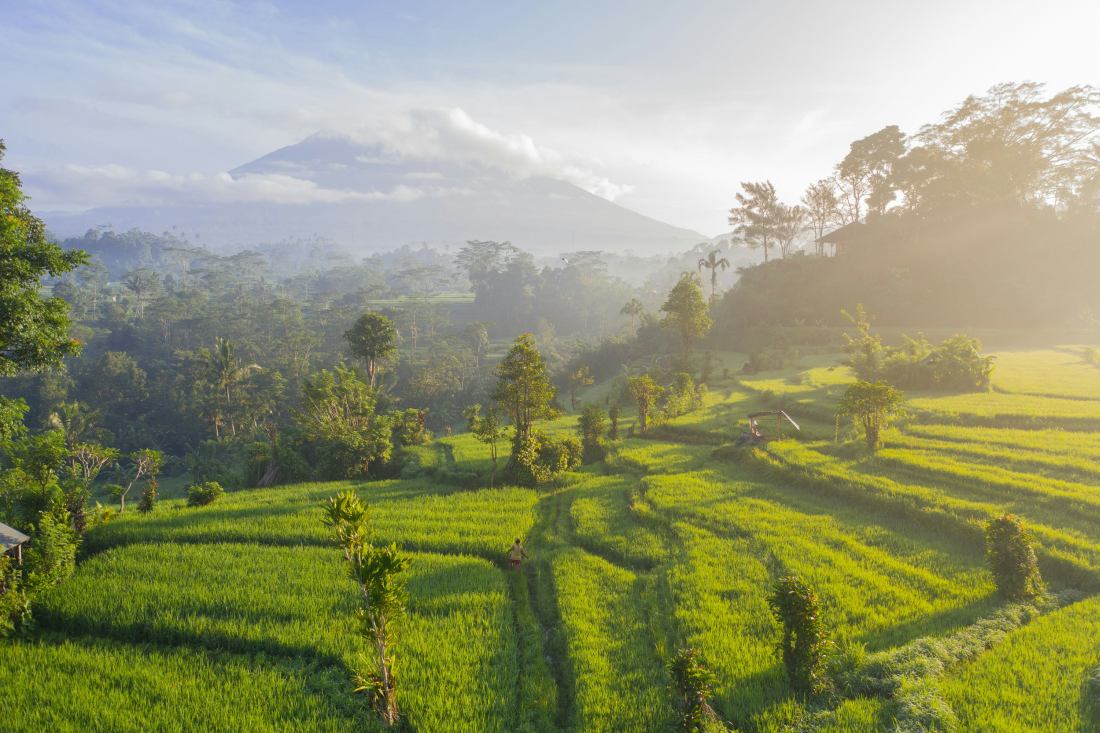
Bali is one of the most enchanting destinations in the Indonesian archipelago, where beautiful rice terraces, stunning Hindu temples and picturesque beaches await visitors. The following questions and answers will help you navigate the most important things to know, whether it comes to safety, transport or the best time to travel.
Table of Contents
Basic information
What time zone is Bali in?
Bali is located in the Central Indonesian Time Zone (WITA, UTC+8).
When is the best time to visit Bali?
The best time to visit Bali is considered to be the dry season, which runs from late April to early October. During this time there is little rain, the sunshine is brilliant, and conditions are ideal for beach trips, temple visits and nature excursions.
The dry season is typically most stable between May and September. Humidity is relatively low, and both coastal and highland areas are beautiful. This is the most visited period, so it is worth booking accommodation and activities in advance for July and August.
The rainy season runs roughly from late October to mid-April. This period is characterised by heavy but usually brief afternoon showers. Although the rain often lasts only a few hours, humidity is high and some roads can become difficult to navigate. On the other hand, the rainy season brings fewer tourists, lower prices, and the rice terraces are at their most beautiful.
How many days should you spend in Bali?
To explore Bali, at least 7–10 days are generally recommended, to allow enough time to discover the different areas, beaches and cultural attractions.
In 5–6 days it is still possible to take in the main sights, but this makes for a fairly packed schedule. It is best to focus on one or two areas, such as the Ubud region and the southern beaches (Seminyak, Kuta, Nusa Dua).
The stay of 7–10 days allows you to explore Bali at a more relaxed pace. There is time for a trip to Mount Batur, a visit to the Tegalalang rice terraces, exploring temples, and even a day trip to the nearby island of Nusa Penida.
The stay of more than 2 weeks is a good opportunity to visit lesser-known areas such as Amed, Lovina or the Bukit Peninsula.
What is the official currency in Bali?
The currency of Bali is the Indonesian rupiah (IDR). The amounts are very large, so it is worth getting used to all the zeros.
In most places in Bali, payment is by cash only, especially at local markets, smaller restaurants and rickshaws. In more tourist-oriented areas, hotels and larger restaurants, card payments are increasingly accepted, though not always.
ATMs are generally reliable, but it is worth paying attention to fees, which vary. It is advisable to withdraw larger amounts at once. Currency can also be exchanged at the airport, but the exchange rate is usually better in town (especially in Kuta).
Here is a currency converter where you can check the current exchange rate!
Do people speak English in Bali?
Yes, in the areas visited by tourists in Bali – in hotels, restaurants, near beaches and at tourist attractions – you can generally get by well in English. Bali is one of the most visited tourist destinations in Asia, so most people working in the tourism industry speak at least basic English.
At local markets, in villages and in areas further from tourists, fewer people speak English. In such cases, a translation app or knowledge of a few Balinese/Indonesian words can be helpful.
What type of plug sockets are used in Bali?
In Bali, Type C and Type F plug sockets are used, which are the same as European plugs. This means most devices can be connected directly without an adapter.
The mains voltage is 220–240 Volts at 50 Hz, which also matches the European standard. This means that electronic devices (phone chargers, laptops, etc.) generally work in Bali without any issues.
How does internet and SIM card usage work in Bali?
In Bali, internet is generally reliable in tourist areas, and free Wi-Fi is available in most hotels, cafés and restaurants. If you need constant mobile internet, it is worth getting a local SIM card or eSIM.
The local SIM card can be purchased at the airport or in town at a relatively low cost. Among Indonesian providers, Telkomsel and XL are popular, with data packages available at competitive prices and good coverage in tourist areas.
More and more people are opting for an eSIM, which can be purchased and activated online before travelling. This is especially convenient as mobile internet works as soon as you arrive at the airport.
Travel and transport
How do I get from the airport to central Bali?
Bali’s international airport is Ngurah Rai International Airport (DPS), located south of the city of Denpasar, near Kuta and Seminyak. Due to the airport’s convenient location, the southern tourist districts are relatively quick to reach.
By taxi is the most comfortable way to reach your destination. The prepaid taxi is available at the airport, but Grab (one of Asia’s leading ride-sharing apps) is often a cheaper and reliable alternative.
With a pre-booked transfer many people also arrive, especially if their accommodation is in a more distant area (e.g. Ubud). In this case, the accommodation arranges the driver.
It is important to know that Bali has no real public transport system (metro, tram, etc.), so it is best to get around by car, taxi or motorbike taxi (ojek).
What is the most convenient way to get around Bali?
The most common modes of transport in Bali are scooter rental, the Grab app, pre-agreed price taxis and hiring a car with a driver. Each has its advantages depending on the destination and comfort requirements.
Scooter rental is the most widespread and cheapest method locally. Most tourists can rent a scooter for around USD 5–8 per day. Important: in Bali, traffic drives on the left, and traffic can be chaotic – it is advisable to proceed with caution and always wear a helmet.
The Grab app is convenient and has transparent pricing, especially for short trips within the city. It works similarly to Bolt or Uber.
A car with driver is an ideal solution for longer excursions (e.g. Ubud, Mount Batur). You can usually arrange in advance with a reliable local driver who will take on a full-day tour.
Accommodation and safety
Is Bali safe?
Bali is generally a safe destination for tourists, especially in the well-known districts and along the beaches. The most serious risks usually arise not from crime, but from traffic accidents, careless scooter riding or ocean currents.
How safe is it at night?
In the main tourist areas (Seminyak, Kuta, Canggu, Ubud), nightlife is vibrant, with many restaurants, bars and clubs open late. Nevertheless, it is advisable to be cautious, and if you need to travel further, the Grab app is the recommended option.
Which area is best to stay in Bali?
Different areas of Bali suit different types of travellers. The most popular accommodation areas are as follows:
Seminyak and Canggu are the trendiest districts, full of stylish hotels, surf beaches, cafés and restaurants. They are especially popular among digital nomads and younger travellers.
Ubud is the cultural heart: here you will find the rice terraces, temples, craft shops and yoga studios. It is ideal for those seeking nature and Balinese culture.
Nusa Dua is an elegant, quiet resort area with luxury hotels and beautiful beaches. Ideal for relaxation-oriented travellers and families.
Kuta is the most well-known and visited area – with cheap accommodation, nightlife and a surf beach. Lively, but crowded and noisy.
Amed and Lovina are the quieter, less touristy northern and eastern areas, where snorkelling and diving experiences await.
Health information
Are any vaccinations required for travel to Bali?
For travel to Bali, there are generally no mandatory vaccinations for most citizens, however several vaccinations are recommended, especially for longer stays.
Recommended vaccinations include hepatitis The and B, typhoid, a tetanus booster, and in some cases (for longer stays in rural areas) a rabies vaccine should also be considered. Malaria prevention is generally not necessary in Bali, but is recommended on neighbouring islands – it is worth consulting your GP or a travel medicine clinic.
Is tap water safe to drink in Bali?
No, tap water in Bali is not safe to drink. Both locals and experienced travellers drink bottled water.
Due to the water supply network and storage conditions, tap water may be contaminated and can cause serious stomach problems. Most hotels provide free drinking water (in bottles or via a filtration system), so it is worth making use of this.
Most experienced travellers also recommend using bottled water for brushing teeth, although how necessary this is depends on individual sensitivity.
It is also advisable to avoid ice cubes in unknown places, although in tourist restaurants and bars they are generally made from filtered water.
Experiences
What are the must-see attractions in Bali?
Bali’s most famous attractions include the Tanah Lot temple, the Uluwatu cliff temple, Ubud Royal Palace, the Tegalalang rice terraces and Mount Batur. These places beautifully showcase the island’s unique natural beauty and rich Balinese culture.
The Tanah Lot is a sea rock temple and one of Bali’s most iconic sights, especially at sunset. The waves surround the rocks and the view is unforgettable.
Az The Uluwatu Cliff Temple stands on the tip of a steep cliff at Bali’s southern tip, offering a breathtaking view of the Indian Ocean. In the evenings, the traditional kecak fire dance is performed here.
Az Ubud Royal Palace (Puri Saren Agung) is the former royal palace in the centre of Ubud. Traditional Balinese dance performances are held in the courtyard in the evenings.
The The Tegalalang Rice Terraces are located near Ubud, and the sight of the successive terraced rice fields is uniquely beautiful. It is best to visit in the morning when the light is at its finest.
The Mount Batur rises in the interior of Bali, and many people climb it at sunrise to watch the dawn from the summit. This is a moderately challenging hike for which a local mountain guide is recommended.
What are the most popular foods and drinks in Bali?
Bali’s cuisine is rich, spicy and varied. The most well-known local dishes are nasi goreng, mie goreng, satay, babi guling and lawar, while among drinks, fresh fruit juices, Bintang beer and local arak are the most popular.
Nasi goreng is the most popular Indonesian dish: spiced fried rice with eggs, vegetables and various meats. It is available virtually everywhere, and the flavours are unique.
Mie goreng is the noodle version of nasi goreng, also very popular among both locals and tourists.
Satay consists of pieces of meat marinated in a spicy sauce, skewered and grilled over an open fire. Served with peanut sauce.
Babi guling is a traditional Balinese roast suckling pig, served at ceremonies and in specialist restaurants. The Hindu Balinese reserve this dish for special occasions.
Bintang is the Indonesian beer, which is available everywhere in Bali and popular when enjoyed on the beach.
Fresh fruit juices and smoothies are available everywhere: mango, papaya, jackfruit, pitaya (dragon fruit) – Bali is a treasure trove of tropical fruits.
Is it customary to tip in Bali?
In Bali, tipping is not obligatory, but is becoming increasingly common, especially in more tourist-oriented areas. In the local culture, gratitude is expressed in other ways, but those working in the hospitality industry are happy to receive a tip.
In restaurants, if there is no service charge on the bill, 10% of the total is an accepted tip. It is also appropriate to tip masseurs, tour guides and hotel staff if you are satisfied.
What are the important holidays and festivals in Bali?
Throughout the year, numerous unique celebrations and festivals take place in Bali. The most well-known include Nyepi (the Day of Silence), Galungan and Kuningan, as well as various temple festivals characterised by processions.
The Nyepi, Bali’s Hindu New Year, is one of the most extraordinary celebrations. On this day, the entire island comes to a standstill: it is forbidden to be on the street, to light fires, to make noise, and the internet is also suspended. Tourists must also observe these rules. However, on the evening before, spectacular processions take place in the streets featuring giant monsters known as Ogoh-ogoh.
The Galungan is a 10-day festival celebrating the victory of good over evil, held approximately every 210 days. During this time, the streets are filled with bamboo decorations (penjor), and special ceremonies take place in the temples.
The Kuningan falls on the 10th day after Galungan and marks the end of the festival. This celebration is considered especially important in Balinese culture due to its connection to the veneration of ancestors.
These celebrations can provide one of the most unique experiences for travellers – it is worth finding out in advance whether your stay might coincide with one of these festivals.