
Johannesburg is South Africa’s most important city in almost every sense. As a result, numerous notable museums can be found here.
Table of Contents
Best museums in Johannesburg
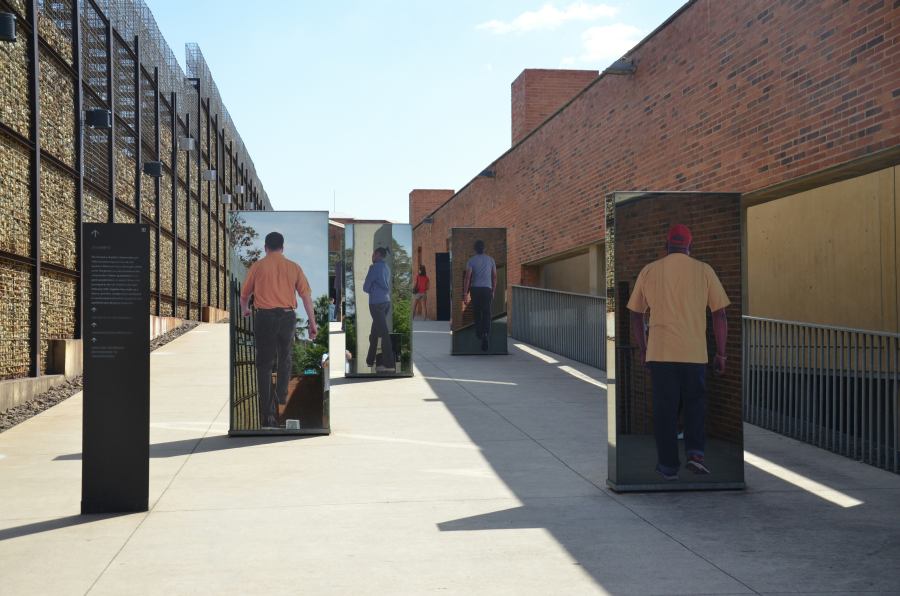
Apartheid Museum
South Africa’s most important institution of history opened in 2001 with the aim of documenting and preserving the memories of the apartheid system for posterity.
The building’s modern, symbolic architecture itself carries a message: its seven pillars represent the seven principles of the South African constitution. Visitors randomly receive either „white” or „non-white” entrance tickets, thus experiencing the feeling of segregation from the very first moment.
The museum guides visitors chronologically through 22 thematic exhibition spaces from the National Party’s 1948 election victory to the 1994 democratic elections. Documentary films, original photographs, personal objects, and interactive exhibitions showcase daily life during the segregation period. One of the most sobering exhibition sections tells the stories of political prisoners, while another section documents the Sharpeville massacre.
It not only conveys historical facts but demonstrates the devastating impact of the apartheid system on society through human stories. A gallery dedicated to Nelson Mandela’s life traces his journey from his Robben Island cell to his presidential inauguration. The visit is a profound experience that often takes several hours, but it is essential for those who wish to understand South Africa’s contemporary history.
All information can be found here!
Sci-Bono Discovery Centre
Africa’s largest interactive science museum opened in 2005 in the Newtown cultural district in a converted power station.
The building’s industrial past has been preserved, but the interior space has been completely transformed to accommodate more than 350 interactive exhibits. The name meaning „for the benefit of science” in Xhosa reflects the museum’s educational mission.
The exhibitions cover a wide spectrum: installations suitable for experimentation can be found in physics, chemistry, biology, astronomy, and technology. Visitors can generate electricity, understand how light and sound work, or program robots. The Digital Dome planetarium presents the universe with 3D projections, while the Energy exhibit showcases different energy sources and the importance of sustainability.
All information can be found here!
South African National Museum of Military History
The museum, founded in 1947, is located in the Saxonwold district, near Zoo Lake, and presents South Africa’s military history from the Boer Wars to the present day.
The building was originally created to preserve Second World War memories, but its collection has since expanded significantly. The museum is situated in a 22-hectare park, where tanks, aircraft, and artillery equipment can be viewed in the outdoor exhibition area.
In the indoor exhibition halls, we can learn about the history of South Africa’s wars in chronological order: documents from the Boer Wars, the African theaters of the First and Second World Wars, as well as the border wars are all featured. The collection of personal items is particularly valuable: soldiers’ letters, diaries, uniforms, and decorations give a human face to historical events.
One of the museum’s special features is the presentation of the history of African mercenaries and Black soldiers, who rarely appear in official military history accounts. The Spitfire and Messerschmitt aircraft located in the outdoor area are particularly popular among visitors.
All information can be found here!
Johannesburg Art Gallery
The museum, which opened in 1915, is located in the heart of Joubert Park and boasts one of Africa’s most significant art collections. The building’s architect, Sir Edwin Lutyens, designed the museum in a classical neo-baroque style, which is an architectural attraction in itself.
The collection contains more than 9,000 works of art: from works by European masters – including Picasso, Monet, and Rodin – to contemporary African art. The collection of works by South African artists is particularly significant, showcasing the country’s artistic development from the colonial era to the present day. The museum is continuously expanding and pays special attention to acquiring works by Black and colored artists.
Among the galleries is a rich sculpture collection that can also be viewed in the building’s inner courtyard and the surrounding park.
All information can be found here!
Wits Art Museum
The museum located on the University of the Witwatersrand campus opened in its current, modern building in 2012, although its collection has more than a century of history.
Its collection contains more than 10,000 works of art, primarily focusing on African contemporary and historical arts. The representation of South African artists is particularly strong: the collection includes art from the apartheid era, activist works by Black and colored artists, as well as post-apartheid artistic trends. European and international pieces are also present, but the emphasis is clearly placed on the African perspective.
The museum organizes constantly changing temporary exhibitions that explore themes of African identity, politics, social justice, and cultural heritage. The institution actively supports new generations of artists and regularly hosts debut exhibitions by young creators.
All information can be found here!
Lindfield Victorian House Museum
The Victorian villa built in the 1890s is located in the historic Parktown Ridge neighborhood and provides an authentic picture of the lives of wealthy European settlers during the gold rush era. The building showcases the elegant style of the late Victorian era with its original furniture, furnishings, and decorations.
The house’s special feature is that the original Stuart family’s personal belongings are also on display: family photographs, correspondence, and everyday utensils help us understand the lifestyle of the era. As a result of serious research work, every room has been faithfully reconstructed, from the fireplaces to the heavy brocade curtains.
During guided tours, visitors can explore the salons, bedrooms, kitchen, and staff quarters. The building’s architecture is also noteworthy: the cast-iron balconies, glazed verandas, and decorated facade reflect the architectural trends of the time. The garden is designed in Victorian style with period-appropriate plants and a cast-iron pavilion.
All information can be found here!
Museum Africa
The institution located in the Newtown cultural district opened in 1994, right at the dawn of democracy, with the aim of showcasing the rich cultural diversity of the African continent. The building is housed in a converted warehouse that perfectly fits the district’s industrial heritage.
The museum’s collection contains more than 3,000 objects from different regions of the continent. The exhibition presents traditional African sculptures, ritual masks, textiles, jewelry, and utilitarian objects from more than 40 African countries. The West African tribal art works and the spiritual objects of South African ethnic groups are particularly valuable. Interactive exhibition elements allow visitors to understand the cultural and religious significance of individual objects.
Museum Africa’s special feature is that it not only displays historical objects but also supports contemporary African artists. The museum emphasizes Africa’s rich cultural heritage.
All information can be found here!
Origins Centre
The museum opened in 2006 on the University of the Witwatersrand campus presents the story of Africa’s origins and humanity’s cradle. The center’s special feature is that it places the culture, art, and spirituality of Africa’s first people in focus in a modern museum environment.
The exhibition guides visitors chronologically: from the earliest stone tools through reproductions of San people’s rock paintings to the formation of modern African identity. One of the most spectacular parts is the digitally reconstructed versions of cave paintings thousands of years old, originating from the Drakensberg Mountains and other South African sites.
The interactive exhibitions allow visitors to understand how people lived in different regions of Africa, what tools they used, and how human culture developed. The museum places special emphasis on presenting the traditions of indigenous peoples, especially the San and Khoi communities.
All information can be found here!
James Hall Museum of Transport
Africa’s largest transport museum opened in 1964 and preserves more than 250 vehicles in a historic building complex.
The collection spans the period from horse-drawn vehicles of the late 1800s to modern cars, showcasing the development of South African transportation. The museum’s special feature is its collection of rare and unique vehicles: South Africa’s first gasoline-powered car, President Paul Kruger’s carriage, and more than 60 motorcycles can be found here. In one separate hall, the history of fire engines is presented, including vehicles that participated in fighting Johannesburg’s major fires.
The museum’s interactive exhibitions allow children to climb aboard some vehicles and experience what it was like to travel on a 1920s bus. There is also a vintage tram on the museum grounds that operates on its original track. Numerous historical curiosities can be found around the building: for example, former tram stops and road signs that preserve memories of Johannesburg’s urban transportation. The museum regularly organizes vintage car rallies and transportation history lectures, making it a must-see for classic vehicle enthusiasts.
All information can be found here!
Johannesburg Holocaust & Genocide Centre
One of South Africa’s most important memorial and educational institutions, which presents the history of the Holocaust and other genocides in a global and local context.
Its collection consists of archival photographs, historical documents, survivor testimonies, and audiovisual materials. In addition to the Holocaust, it also presents, for example, the Rwandan genocide, with a strong comparative perspective. Personal objects and stories are particularly emphasized, as they make historical events more relatable.
The center’s aim is not only to process the tragedies of the past but also to emphasize human rights, tolerance, and social responsibility.
All information can be found here!

Best museums in the world
There are many great museums in the world. Here are some of the best!