
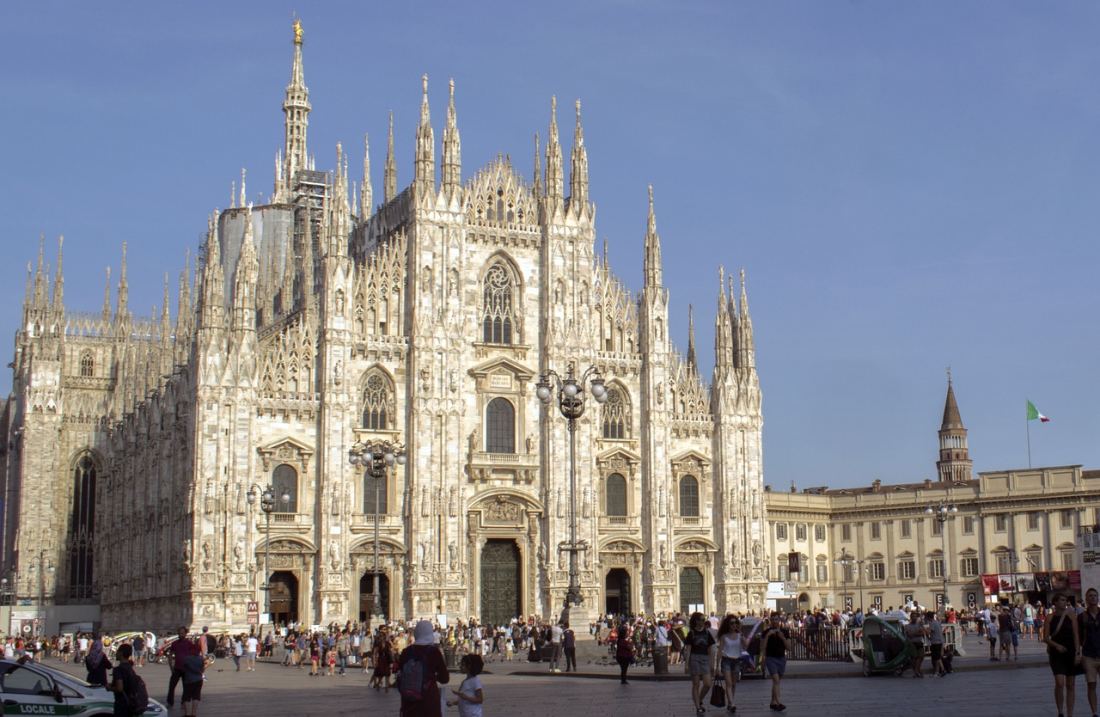
Milan is one of Europe’s most visited cities, with many flights to and from the city. The city centre offers a wealth of attractions.
Considered the economic capital of Italy, it is world famous for its fashion houses, opera house and cathedral. It is also home to two popular football teams. Most of Milan’s attractions are located in the area bounded by the boulevard that once stood on the site of the city walls, making it easy to get around on foot.
Table of Contents
Milan attractions
Milan Cathedral (Duomo di Milano)
Milan’s most famous building, a masterpiece of Italian Gothic architecture. Its beauty is indicated by the fact that it took about 600 years to complete. It is the second largest church in Italy after St. Peter’s Basilica in Rome.
Its highest point is the 4-meter tall gilded copper statue of the Madonnina (Virgin Mary), placed in 1774. The cathedral has 135 spires and about 3,400 statues decorate it.
In front of the cathedral, in the square, is the equestrian statue of Victor Emmanuel II, the first king of unified Italy.
You can also go up to the top of the cathedral, which offers a magnificent view of the city.
All information (entrance fees, opening hours, etc.) here!

Galleria Vittorio Emanuele II
This covered passage connects the city’s main square, Piazza del Duomo, with Piazza della Scala, where the opera house is located.
It is home to rows of famous stores such as Louis Vuitton, Prada, Gucci, thus earning the nickname „The Salon of Milan”.
The passage itself is beautiful with its glass dome, glass roof, and mosaic floor.

Royal Palace (Palazzo Reale)
One of the residences of the rulers of the Duchy of Milan. Today, it houses the cathedral museum and a conference center.
You can go up to the roof terrace, which offers a wonderful view of the surroundings.
All information (entrance fees, opening hours, etc.) here!
Piazza Mercanti
Although not the most spectacular, it is one of the oldest squares in Milan, located just 100 meters from the cathedral.
Its beauty lies in preserving its character from centuries ago. A festive market is held in the square before Christmas.

Piazza Cavour
One of Milan’s most famous squares, linking Via Manzoni with Piazza del Duomo.
Its iconic sight is the Porta Nuova. It was one of the gates that belonged to the city wall for defense purposes. The gate resembles a triumphal arch with Ionic capitals.
Porta Venezia
Milan has several surviving city gates, with Porta Venezia being one of the largest and most famous.
The two identical buildings were built in the 16th century and got their current name in 1862, hoping that Venice would join the Kingdom of Italy.
It is an important junction, connecting Corso Buenos Aires and Corso Venezia.
Giardini Indro Montanelli
Near Porta Venezia starts another large park in Milan, heading towards the city center.
Similar to Sempione Park, it hosts several notable buildings: the Natural History Museum, Palazzo Dugnani, and the planetarium, as well as several statues.
Basilica of San Lorenzo (Basilica di San Lorenzo Maggiore)
One of Milan’s most famous churches, a great example of early Christian central buildings.
Built on the site of a Roman sanctuary in the mid-4th century as an Arian basilica. Its facade was built by Cesare Nava in 1894. In front of the entrance is a replica of a statue of Emperor Constantine I, in memory of the Edict of Milan of 313.
In front of the basilica, a row of 16 Corinthian columns, known as the Colonne di San Lorenzo, decorates the square. This is the most complete Roman-era relic in Milan, likely belonging to a 2nd or 3rd-century Roman building (temple or bath).

Santa Maria delle Grazie
One of Milan’s most famous churches, part of UNESCO World Heritage since 1980. This church houses Leonardo da Vinci’s most famous work, The Last Supper fresco.
Interestingly, through the church, you can enter the Madonna delle Grazie chapel, which was the original church and incorporated into the new one.
Viewing The Last Supper can be tricky, as there are hardly any available slots. They allow 25 people every 15 minutes, and you can book slots in 15-minute intervals on the website below.
All information (entrance fees, opening hours, etc.) here!
Access: Take tram 16 to the S. Maria Delle Grazie stop.

Basilica of Sant’Ambrogio (Basilica di Sant’Ambrogio)
Built by Saint Ambrose, this basilica is one of Milan’s oldest churches.
You can explore the history of Christianity and view the relics of martyrs Saints Gervasius and Protasius in the crypt.
A staircase from its side nave leads to the upper rooms of the adjacent building, which houses the Sant’Ambrogio Museum (Museo del Sant’Ambrogio).
In the middle of the staircase is the treasury (Tesoro), a collection of gold and silver smithing works, chalices, processional crosses, and other valuable religious items from the 12th to 16th centuries.
Admission is free!
Access: Take metro line M2 to the S.Ambrogio stop.

San Maurizio al Monastero Maggiore
A smaller church in Milan, but one of the most beautiful inside.
The church has many frescoes depicting biblical stories, such as Noah’s Ark.
Admission is free, so it’s definitely worth a visit for those who don’t want to spend money to see a religious site.
Access: Take metro lines M1 or M2 to the Cadorna stop, then walk 400m; or take trams 16 or 19 to the C.so Magenta Via Nirone stop.
Sforza Castle (Castello Sforzesco)
It was once the grandest ducal seat of the Sforza dynasty, later becoming a significant fortress. Today, it hosts several museums: museum of applied arts, archeology, Egyptian, musical instruments, and furniture.
Entry to the castle is free, but the museums have an admission fee!
All information (entrance fees, opening hours, etc.) here!
In front of the castle entrance, the Fontana di Piazza Castello fountain offers a splendid sight.
Access: Take metro line M1 to the Cairoli Castello stop; tram lines 1 and 4 to the Cairoli stop.

Sempione Park
The park behind Sforzesco Castle is one of the largest in Milan.
This English-style park was established in 1893 based on the designs of Emilio Alemagna. Its avenues are named after famous artists, including Sándor Petőfi.
Several attractions can be found in the park, definitely worth walking through:
- Equestrian statue of Napoleon III: a creation of Francesco Barzaghi from 1881;
- Palazzo dell’Arte (Palace of Arts): a huge art gallery built in 1938 with large exhibition halls;
- Torre Branca tower: offers a beautiful view of the city from the top;
- Arena: built in the early 19th century according to Luigi Canonica’s plans. It’s a classical style building with an elliptical floor plan, imitating Roman amphitheaters.
Arco della Pace
At the northwest edge of Sempione Park stands the Peace Arch, also known as the Triumphal Arch.
Designed by Luigi Cagnola in the Lombardian classicism style. Its construction began in 1807 in memory of Napoleon’s splendid victories. The three-arched triumphal arch stands precisely in line with the statue of Garibaldi (constructed much later, during the Kingdom of Italy), the Piazza Castello fountain, and the front and rear gates of the Sforza Castle.
It is 25 meters high and 24 meters wide, adorned with four columns on each side. At its top is a massive bronze statue of a six-horse chariot created by Sangiorgio, and at its four corners are equestrian goddess statues (works of Giovanni Putti) symbolizing peace.

La Scala (Teatro alla Scala)
Milan’s opera house, one of the most famous in the world.
This 18th-century theater is a venue for Italian operas and ballets. At first glance, it may seem like a small provincial train station, but inside it is beautiful.
The museum section displays busts of famous composers along with beautiful paintings. The life and work of Verdi are thoroughly represented.
Ticket purchase for entry and performances here!
Leonardo da Vinci Museum (Museo della Scienza e della Tecnologia Leonardo da Vinci)
Italy’s largest museum of technology and science, it also showcases the works of Leonardo da Vinci, as implied by its name.
In the courtyard, there’s a submarine, and separate halls feature trains, ships, and airplanes. Exhibits include the history of telephones, computers, space travel, musical instruments, etc.
Many displays are interactive, making it an ideal venue for children.
All information (entrance fees, opening hours, etc.) here!
Access: Take metro line M2 to the S.Ambrogio stop.
Pinacoteca di Brera
The art gallery in the baroque palace is one of Italy’s most important art collections.
The venue itself is impressive, showcasing beautiful works of art. It exhibits over 500 paintings from the 15th to the 20th century, including works by Raphael, Caravaggio, Modigliani, Bellini.
Even for those not keen on art, this should be on the list of Milan sights!
Free entry for those under 18 years old! Additionally, free for everyone on the first Sunday of every month!
All information (entrance fees, opening hours, etc.) here!
Access: Take metro line M2 to the Lanza stop, then walk 500 meters; or take bus 61 to Piazza S. Marco stop.

Museo del Novecento
The newest museum, located near the Duomo, is housed in the Arengario Palace.
The museum displays works of 20th-century artists across several floors. It includes works by Boccioni, Modigliani, Morandi, Martini, and famous international artists like Picasso and Matisse.
Its most famous piece is „Il quarto stato” painted by Giuseppe Pellizza da Volpedo.
Free admission for those under 18 years old! All information (entrance fees, opening hours, etc.) here!
Access: Take metro lines 1 or 3 to the Duomo stop.
Navigli
One of the city’s most popular districts, lined with cafes, restaurants, shops, and entertainment venues along the canals. It’s worth visiting on the last Sunday of the month for the flea market.
Access: Take metro line M2 to the P.Ta Genova Fs stop; tram line 2 to the Via Valenza Alzaia Nav. Grande stop.

Bosco Verticale
These two tower buildings near the Porta Garibaldi train station are 110 and 76 meters tall. Their uniqueness comes from the 8,900 square meters of terraces and balconies where trees have been planted.
The facades of the two buildings host a total of 730 trees (480 large and 250 smaller), 5,000 shrubs, and 11,000 perennial and ground-cover plants.
Access: Take metro line M5 to the Isola stop.

Giuseppe Meazza / San Siro Stadium
One of the world’s most famous stadiums, home to two successful Italian clubs, AC Milan and Internazionale.
Even for non-football fans, it’s worth visiting the museum and going on a stadium tour.
Access: Take metro line M5 to the San Siro Stadio stop.
