
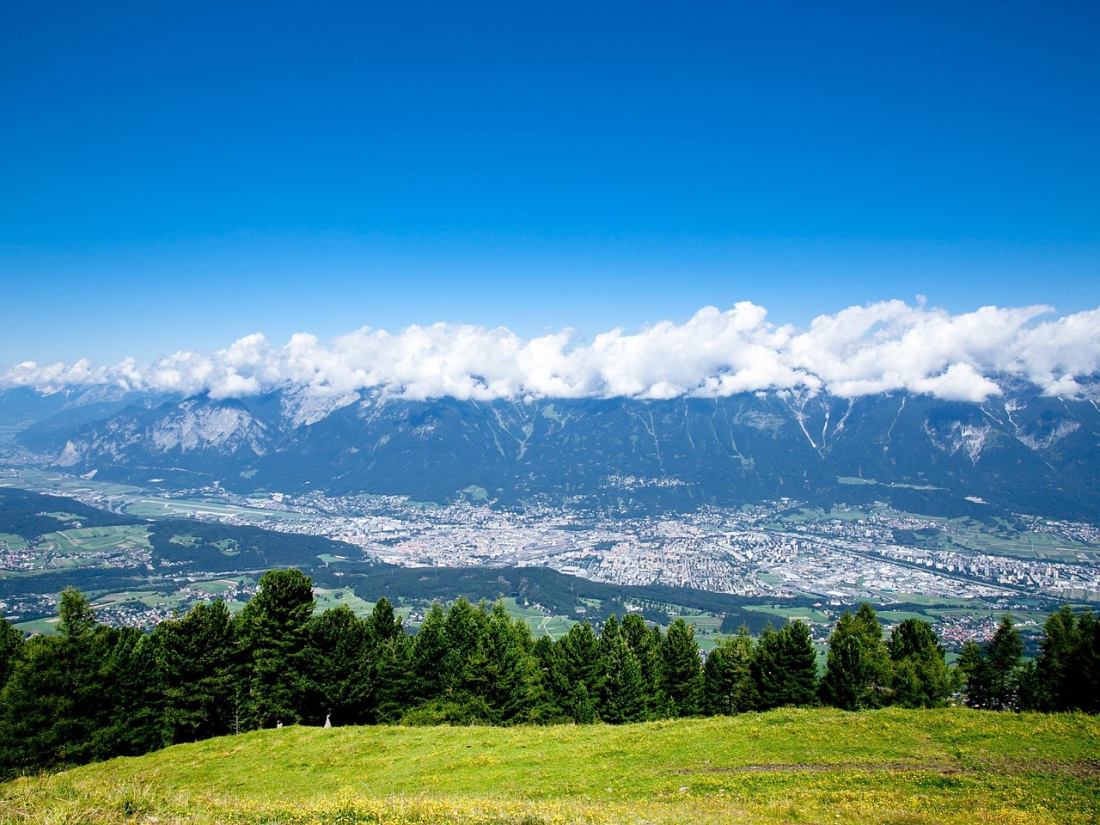
Innsbruck, the capital of Tyrol, is one of Austria’s most enchanting cities, defined by the splendor of its imperial past and the beauty of Alpine nature.
The city’s name, meaning „bridge over the Inn River”, itself refers to its geographical location: situated in the Inn Valley, embraced by mountains over 2000 meters high, making it a favorite destination for skiers in winter and hikers and culture enthusiasts in summer.
By road, it’s less than 40 km from Italy, 32 km from the German border, and barely 110 km from Switzerland. Highways provide access to Munich, Salzburg, Verona, and Bregenz.
The city’s significance was primarily established by its reputation as a favorite residence of the Habsburg dynasty, as Emperor Maximilian particularly favored this location and enriched it with numerous architectural masterpieces. Innsbruck’s character is defined by the colorful facades of the medieval old town, Renaissance and Baroque palaces, and modern Olympic facilities. The city’s atmosphere is unique: the narrow streets lined with bourgeois houses and the proximity of massive, snow-capped peaks offer an unparalleled experience.
Table of Contents
Innsbruck attractions
Imperial Palace (Hofburg)
One of the city’s most significant historical buildings is this 15th-century Habsburg residence, which later acquired its current form, famous for its Rococo splendor, during Maria Theresa’s reign. Within the palace walls, the political and representative life of Tyrolean and Habsburg rulers unfolded for centuries, allowing visitors to experience a truly imperial atmosphere while strolling through the former apartments.
The building’s most impressive part is the Riesensaal, or Giant Hall, which represents the greatest pride of Maria Theresa’s reign. The hall’s ceiling and walls are decorated with magnificent frescoes proclaiming the glory of the Habsburg family, while the snow-white stucco decorations and gilding represent the pinnacle of Rococo art. Many of the palace’s rooms have preserved their original furnishings, giving visitors insight into the daily life of the court.
The Hofburg’s uniqueness lies in being not just a museum, but also a living history lesson: through interactive exhibitions and rich collections, we can learn about the personal stories of Habsburg dynasty members. The park courtyard surrounding the palace offers a pleasant resting place during city tours, and most of the old town’s attractions are in close proximity. Despite high visitor numbers, it’s worth taking time for a detailed visit, as the palace’s objects and halls evoke key events in Austrian history.
Hofkirche
The court church, built between 1553 and 1563, was commissioned by Emperor Ferdinand I with the purpose of providing a worthy resting place for his grandfather, Emperor Maximilian. However, the church ultimately did not become his tomb, as Maximilian’s earthly remains rest in Wiener Neustadt, so the Hofkirche functions more as an empty cenotaph preserving the emperor’s memory.
Its main attraction is the 28 larger-than-life bronze statues guarding Maximilian’s cenotaph, cast based on designs by the era’s most renowned artists, including Albrecht Dürer. These dark bronze figures—including historical rulers, legendary heroes, and Maximilian’s relatives—create a wonderful atmosphere in the church nave and are stunning examples of Renaissance sculpture. Particularly noteworthy are the statues of King Theodoric and King Arthur of Britain.
Another special feature of the church is the Silberne Kapelle, or Silver Chapel, built by Archduke Ferdinand II for his beloved wife, Philippine Welser. The chapel takes its name from inscriptions rather than its material and forms an intimate, touching contrast to the monumentality of the main church.

Golden Roof (Goldenes Dachl)
The city’s most famous symbol is a late Gothic balcony built by Emperor Maximilian around 1500 to watch knightly tournaments and city celebrations taking place below. The balcony gets its name from the 2,657 fire-gilded copper tiles covering its roof, which glisten blindingly in the sunlight and appear on every Innsbruck postcard.
The facade of the building beneath the balcony is covered with rich fresco decoration depicting important moments from Maximilian’s life, including his two marriages. Today, a museum on the ground floor presents Maximilian’s life and era in an interactive manner.
The Golden Roof stands in the heart of the old town, on a crowded square surrounded by colorful bourgeois houses and café terraces. This is the city’s most photographed spot and an excellent starting point for exploring the old town. The area is always bustling with tourists and locals, so if you want to avoid crowds, it’s worth visiting early morning or later in the evening. The square’s atmosphere is especially magical during the Christmas market, when the Golden Roof is surrounded by festive decorations.

Helblinghaus
One of the old town’s most beautiful bourgeois houses, originally a late Gothic building, was adorned with spectacular Rococo-style facade decoration in the 18th century. The stucco decoration covering the house’s exterior walls is almost impossibly rich: garlands of flowers, angels, shell motifs, and plant ornaments cover the light green surface, making the building appear like something from a fairy tale.
Its uniqueness lies in the fact that while the house’s interior preserved its Gothic structure, the facade’s 1730s Baroque renovation completely transformed the building’s external appearance. The original Gothic residential house got its name from Anton Christoph Helbling, who owned the building in the 18th century and commissioned the magnificent stucco decoration that still characterizes the house today.
The building is located in the immediate vicinity of the Golden Roof, so visitors usually view both attractions together. The facade’s elaboration and wealth of detail are unparalleled in Innsbruck and an excellent example of how a medieval core house can be combined with the decorative arts of later periods. The Helblinghaus is now a private residence, so it can only be viewed from the outside, but the facade details alone provide sufficient spectacle. It’s worth taking several minutes to examine the mythological figures and symbolic motifs appearing on the walls.
St. James’s Cathedral
The early 18th-century Baroque cathedral is Innsbruck’s most significant religious building, erected on the ruins of a medieval church after the 1717 earthquake. The building was designed by Johann Jakob Herkomer and built in the era’s most modern Baroque style, with rich fresco decoration and stucco work.
The cathedral’s interior is stunning: the ceiling is covered with magnificent frescoes by Cosmas Damian Asam depicting the life and martyrdom of St. James. Above the main altar hangs Lucas Cranach the Elder’s painting „Maria Hilf” (Mary of Succor), the church’s most treasured possession, which Emperor Maximilian also revered. The altar itself is a monumental Baroque creation that draws all attention with its gilding and sculptural decoration.
The cathedral’s special features include two massive bell towers that are defining elements of Innsbruck’s cityscape, as well as the rich interior decoration representing the pinnacle of Baroque art. The church hosts several masses daily but is also open to tourists and, due to its acoustics, regularly hosts organ concerts. The tombstones and memorial plaques at the entrance preserve important figures in Tyrolean history, giving the building both sacred and historical significance.

Stadtturm (City Tower)
The old town’s watchtower, built around 1450, originally functioned as part of the town hall while also serving as an observation tower for early detection of fires and approaching enemies. The 51-meter-high Gothic tower symbolized the city’s defense and pride for centuries and remains one of the old town’s most distinctive structures.
To reach the viewing terrace, you must climb 148 steps up the narrow spiral staircase leading to the tower, but the effort is amply rewarded by the view. From the observation deck, a 360-degree panorama unfolds: on one side, the old town’s colorful roofs, the Golden Roof’s glitter, and the surrounding bourgeois houses; on the other side, the imposing peaks of the Nordkette mountain range rise into the sky. This view is especially magical at sunset.
An interesting feature of the Stadtturm is that it served not only as an observation point but also as a prison: the dungeons on the tower’s lower levels were reserved for serious criminals. Today, a small exhibition on the ground floor presents the tower’s history and functions. The tower’s bells still mark the time and form an important part of the city’s life.

Maria-Theresien-Straße
The main street running south from the old town is Innsbruck’s most elegant promenade, named after Empress Maria Theresa. The street’s special feature is that when viewed from the north, the Nordkette mountain range rises at its end, creating a unique combination of urban bustle and Alpine panorama.
Both sides of the street are lined with magnificent Baroque and Rococo-fronted houses, now home to elegant shops, restaurants, and cafés. The ground floors of the buildings are arcaded, making it pleasant to walk along the street even in rainy weather while discovering Tyrolean handicrafts and modern fashion brands in the shop windows. In the middle of the street stands the Annasäule, or St. Anne’s Column, a Baroque memorial column erected in 1706 celebrating the departure of Bavarian troops.
The city’s largest events are held here, including the Christmas market. The illuminated street is especially atmospheric in the evening.

Triumphal Arch (Triumphpforte)
The monumental triumphal arch at the southern end of Maria-Theresien-Straße was built in 1765 by order of Maria Theresa, originally to celebrate the marriage of her son, the later Leopold II, Grand Duke of Tuscany. However, the structure carries mixed emotions: while one side celebrates the joy of the wedding, the other side mourns the tragic death in Innsbruck of Maria Theresa’s husband, Emperor Francis, who died unexpectedly during the wedding festivities.
The two sides of the arch thus carry completely different messages: on the south side are reliefs glorifying the marriage and dynastic continuity, while on the north side are symbols of mourning and representations commemorating Emperor Francis. This duality was a constant feature of Habsburg family life.
Innsbruck’s only triumphal arch functions as the city’s southern gateway. Viewed from beneath the structure, it perfectly frames Maria-Theresien-Straße and the Nordkette peaks rising behind it, making it a popular photo spot. The arch’s surroundings are now a busy urban junction where modern trams also pass, but the building has preserved its original 18th-century splendor. The triumphal arch is also illuminated at night, providing a magical sight from evening until night.

Hofgarten
The historic park stretching between the Hofburg and the Congress Center was founded in the 15th century by Archduke Sigismund as a royal garden, then continuously beautified and expanded in subsequent centuries. Today it’s Innsbruck’s most popular green space, where locals and tourists alike relax in the Alpine air.
The park’s design follows the English garden style, with irregular paths, ponds, fountains, and pavilions offering varied scenery. In summer, the lawns are filled with picnicking families and sunbathing youth, while the shaded tree-lined walks provide pleasant refuge from the sunshine. The park’s music pavilion hosts regular concert series where visitors can attend free open-air performances, especially on summer evenings.
The park is easily accessible on foot from the old town, so locals often come here to have lunch or read after work.
Ambras Castle
The Renaissance castle rising atop a hill above the city was originally a medieval fortress, which Archduke Ferdinand II had converted into a magnificent royal residence in the 16th century. The castle’s special feature is that Ferdinand established one of Europe’s earliest museums here, and with his collection laid the foundations of modern museology.
The castle consists of three main parts: the lower castle, which contains the residential wings and the famous Spanish Hall, the upper castle, where the art collection is located, and the park stretching between them. The Spanish Hall is Europe’s most beautiful Renaissance ceremonial hall, its ceiling and walls covered with wood paneling, and it remains visitable with its original furnishings. The hall is 43 meters long and a perfect venue for concerts and events.
Ferdinand’s collection is unique worldwide: the castle preserves thousands of armors, weapons, portrait paintings, coins, curiosities, and art objects. The armor chamber displays combat and ceremonial armors that are masterpieces of Renaissance metalwork, while the Kunst- und Wunderkammer (Chamber of Art and Curiosities) presents curiosities, exotic objects, and natural rarities reflecting the era’s interests. The portrait collection depicts Habsburg family members and European rulers.
The castle offers wonderful views of Innsbruck and the Inn Valley. Ambras Castle is somewhat farther from the city center but easily accessible by bus, and it’s worth dedicating half a day to the visit to thoroughly explore the exhibitions and park.

Best museums in Innsbruck
Tyrolean Folk Art Museum
The museum in the impressive building next to the court church houses Europe’s richest and largest ethnographic collection, presenting Tyrolean traditions, lifestyle, and craftsmanship. The museum opened in 1888 and has since been the most important guardian and presenter of Tyrolean identity.
The museum’s permanent exhibition guides visitors chronologically through centuries of Tyrolean peasant and bourgeois life, displaying clothing, furniture, religious objects, and everyday utensils. Particularly impressive are the complete reconstructions of original peasant rooms and Alpine wooden houses, authentically evoking past life. The wood carvings, painted furniture, and rooms displaying traditional Trachten costumes provide insight into the high level of Tyrolean craftsmanship.
The museum’s collection also includes traditional masks, nativity scenes, and religious art objects that present the peculiarities of Tyrolean folk religiosity and festival cycles. The Christmas nativity scenes are especially rich and elaborate, while carnival masks reflect ancient Alpine beliefs. The museum’s temporary exhibitions also present contemporary folk art and handicraft creations.
The building is Baroque in style and forms part of the Hofkirche, so both attractions can be viewed together. Tyrolean handicraft products can be purchased in the museum shop, making authentic gifts.
All information can be found here!
Tyrolean State Museum (Ferdinandeum)
The museum, founded in 1823, houses Tyrol’s most significant art and historical collection and was named after Archduke Franz Karl, later Emperor Franz Joseph I of Austria’s father. The museum building was constructed in 1845 in neo-Renaissance style, and the imposing facade remains one of the city’s significant architectural works.
The museum’s collection covers an extremely wide spectrum: it presents Tyrol’s artistic and historical development from prehistoric times to the modern era. The archaeology department preserves Roman-era finds, Celtic relics, and medieval objects documenting the earliest periods of the Inn Valley’s history. The painting collection is particularly rich: ranging from Gothic altarpieces to 19th-20th century Austrian and German painting.
The Ferdinandeum’s pride is its collection of Dutch and Flemish painting, including works by Rembrandt and other masters. Lovers of Austrian art can encounter works by Klimt and Schiele here, as well as creations by Tyrolean landscape painters immortalizing the beauty of Alpine nature. The sculpture collection is also significant, with both Baroque and modern works.
All information can be found here!
Bell Museum (Glockenmuseum)
The special museum on the Grassmayr foundry grounds presents over 400 years of bell-making history and offers insight into the ancient craft of bell-making at one of the world’s largest bell foundries. The Grassmayr family business has operated since 1599, delivering its bells to churches and towers worldwide, including many famous cathedrals.
The museum exhibition presents the technological process of bell casting from melting to acoustic fine-tuning, and historical bells from various periods can also be seen. Visitors can learn about the cultural and religious significance of bells and the differences between various types of bells—church bells, cow bells, and carillon bells. A special feature of the museum is the opportunity to observe the bell-casting process live if such work is in progress.
The Glockenmuseum emphasizes the acoustic properties of bells and how a bell’s size, shape, and alloy determine its sound. Through interactive exhibition elements, visitors can try ringing different bells themselves and understand the physics of sound waves.
All information can be found here!
Innsbruck weather: when is the best time to visit?
Innsbruck’s climate is Alpine continental, determined by its mountainous geographical location. The seasons are distinctly different from each other, each offering special atmosphere and opportunities for visitors.
Winter (December–February):
Winter months are cold and snowy, with average temperatures ranging between -5 and +5 degrees Celsius. During this time, the city becomes a winter sports paradise: nearby ski slopes in perfect condition await skiers and snowboarders. The Christmas market creates a magical atmosphere in the old town, when decorated wooden stalls and the scents of mulled wine and gingerbread fill the squares. The most tourists arrive during the holiday season and mid-February, at the peak of the ski season.
Spring (March–May):
The spring transition progresses slowly in Alpine regions. In March, skiing is still possible on higher slopes while snow is already melting in the valley. From late April, nature awakens: parks bloom with flowers, and days become pleasantly warm. May temperatures range between 10-20 degrees, and this period is less crowded, making it ideal for peaceful city tours and exploring the surrounding mountains. Prices are also more favorable than during high season.
Summer (June–August):
Summer months are warm but not too humid due to the high altitude, with average temperatures between 20-26 degrees Celsius. This is the time for hikers and cyclists, when mountain cable cars operate and the Nordkette or other nearby peaks are easily accessible. Days are long, and the period is characterized by numerous outdoor concerts and city festivals. July and August see the most visitors, and accommodation prices are highest during this time.
Autumn (September–November):
Autumn casts golden splendor on the surrounding forests, and pleasant temperatures (10-18 degrees) favor hiking and city tours. In September and October, many mountain hiking trails are still accessible, the air is clear, and the panorama is breathtaking. From early November, the first snowfall gradually arrives, and the city slowly prepares for the winter season. The autumn period is quieter with fewer tourists, offering a more authentic experience, and accommodation prices are more favorable.
Best time to visit:
The ideal time to visit Innsbruck depends on individual interests. For winter sports enthusiasts, travel is recommended from mid-December to early March, when ski slopes await guests with excellent snow conditions and the city’s winter magic is at its peak. For those seeking Christmas atmosphere, it’s worth visiting from late November to late December, when the old town is bathed in lights and the market creates a truly special atmosphere.
For culture and city tour enthusiasts, the months of May–June or September–October are ideal, when temperatures are pleasant (15-22 degrees), days are long, and crowds can be avoided. During these periods, museums and historical buildings can be visited peacefully, walks in the old town and parks are enjoyable, and surrounding mountain hiking trails are accessible. May and September prices are more favorable than during the summer peak season, making them optimal choices budget-wise as well.
In summer (June–August), those who enjoy mountain hiking, cycling, and outdoor programs should travel. Although this is the warmest period (20-26 degrees average), due to the city’s altitude the air is not humid, and long days can be excellently utilized. Summer months are especially recommended for families, as children’s school holidays fall during this period, and the city organizes numerous outdoor programs and festivals.
Periods to avoid: Mid-November is rarely attractive, as it’s too cold for sightseeing but there’s not yet adequate snow for skiing. Early April is also a transitional period when skiing season is over but it may still be too cold for hiking.