

Normandy is one of France’s most diverse and beautiful regions. Through its long history, it boasts numerous attractions.
Normandy is a geographical and cultural region in northwestern France, one of the historic provinces of the French Kingdom.
Table of Contents
Normandy attractions
Mont-Saint-Michel
Near the Normandy coast, in the play of the Atlantic Ocean’s tides, this unique island rises from the sea.
The Benedictine abbey atop the rocky cone has attracted pilgrims and travelers for centuries. At high tide it becomes an island, at low tide it can be reached on foot across the sandy plain, offering a truly unique experience for every visitor.
Construction of the abbey began in the 8th century and was continuously expanded during the Middle Ages. The Gothic-style church and monastery can be reached through narrow streets lined with small shops and restaurants.
The highlight of the visit is the view from the abbey, which extends over the endless sand desert and the ocean. The surrounding bay has world-record tide speeds, creating a special natural phenomenon. It’s worth spending sunset here.

Rouen
In Normandy’s historic capital, a blend of the Middle Ages and modern life comes alive. The city on the Seine has been an important trading center for centuries, and today still beckons travelers with its vibrant life. Joan of Arc was burned here in 1431, and historical monuments can be found on every corner of the city.
The Gros Horloge, or Great Clock, is a 14th-century astronomical clock that keeps time above an ornately carved archway. Passing under the clockwork, one arrives directly at the cathedral, which became world-famous thanks to Monet’s paintings. The cathedral’s facade shows different faces in various lights, just as the painter immortalized it.
The downtown streets are lined with half-timbered houses that radiate a cheerful atmosphere with their colorful beams. In the center of Place du Vieux-Marché, the old market square, stands the simple monument where Joan of Arc died at the stake.

Omaha Beach
On this sandy beach on June 6, 1944, during D-Day, American troops landed, and it became the site of one of the most severe battles.
Walking along the shore, remnants of bunkers and battle memorials can be seen in the sand and on the hills. The American military cemetery is located on nearby heights, where more than 9,000 white crosses stand in perfect order. It’s difficult to pass by the sight without words, such strong emotional charge the place carries.
The beach section is surrounded by museums and monuments that present the history and significance of the landing. The Visitor Center welcomes visitors with a detailed exhibition where veterans’ stories come to life.

Arromanches-les-Bains
This small seaside town holds a special place in history, thanks to the events after D-Day. After the landing, the Allies built a temporary port here that enabled the massive transfer of troops and equipment.
Walking along the shore, the gigantic concrete blocks still stand in the sea like some futuristic art installation. These Phoenix ship wrecks once formed parts of the artificial harbor and could transport 9,000 tons of goods daily through them. The maritime undertaking was an engineering marvel of its time.
The 360-degree circular panorama room brings the landing events to life with a modern presentation. From the hilltop, there’s a beautiful view of the sea and historical monuments. In the small town, there are also several good restaurants where local seafood and Normandy cheeses can be tasted.
Giverny
In this small village in the Seine Valley, Claude Monet lived and worked for more than four decades.
The painter’s house and garden now operate as a museum, and thousands make pilgrimages here every year to see the place that inspired so many famous works. The pink plastered house and beautiful gardens have perfectly preserved the atmosphere in which the master worked.
The garden is divided into two main parts: the flower courtyard and the famous water garden. In the flower garden, colors change according to seasons, with tulips in spring, roses and daffodils decorating the paths in summer. Monet designed the garden himself so he would always have something to paint, and he chose plants for pictorial harmony.
The water garden with the Japanese bridge is the location of an iconic impressionist painting. The sight of the green bridge arching over the pond and the water lilies is wonderful. Willow trees reflect on the water’s surface, exactly as we see them on Monet’s canvases. During the visit, we can glimpse into the artist’s studio and residence, where original furniture and Japanese woodcuts decorate the walls.

Caen
William the Conqueror’s birthplace is Normandy’s dynamically developing urban center.
World War II devastation severely affected it, yet it managed to preserve its historical treasures and cultural significance. The city is a perfect starting point for discovering the Normandy landing sites, while its own attractions are worth an extended stay.
The medieval castle’s imposing walls still stand in the heart of the city, which William the Conqueror had built around 1060. Within the castle walls, two museums operate, presenting Normandy’s history and art. The nearby Abbaye aux Hommes, the men’s abbey, is also William’s foundation, and the conqueror’s resting place is located here.
The Mémorial de Caen, the peace museum, presents the history of 20th-century wars with a modern approach. The interactive exhibition places special emphasis on Normandy operations and peace education. In the city, numerous restaurants and cafes offer opportunities to discover Normandy gastronomy; tasting local cider and Camembert cheese is a mandatory program.

Bayeux
This charming Normandy town became world-famous because of the Bayeux Tapestry, which fortunately escaped World War II destruction.
Walking through the medieval town center’s streets, we immediately feel the magic of the past as the cathedral tower rises above the houses. The town is the perfect size for a one or two-day visit and an excellent base for discovering the D-Day beaches.
The world-famous tapestry, which is actually a 70-meter-long embroidered canvas, dates from the 11th century. The work depicts William the Conqueror’s conquest of England in 1066 in 58 scenes, providing special insight into medieval life and warfare. Visitors can admire this exceptional historical document in a specially built museum, which was created with astonishing detail.
The Notre-Dame Cathedral was built in the 11th century, combining Gothic and Romanesque style elements. The interior space is monumental, the stained glass windows create a beautiful play of light. Near the town is also the British war cemetery, which is the resting place of more than 4,000 fallen soldiers, with a beautifully maintained garden and monument.

Honfleur
The port city at the Seine estuary has long been a favorite of artists, who were attracted by the special light and picturesque harbor.
Around the Vieux Bassin, the old harbor, colorful tall houses line up, whose reflection on the water provides a truly photogenic sight. The city has preserved its authentic atmosphere, and today is still characterized by vibrant artistic life in streets full of galleries.
The harbor is surrounded by restaurants and cafes offering dishes made from freshly caught seafood. Besides seafood, Normandy apple wine, cider, is also a popular drink among locals. The Sainte-Catherine church’s peculiarity is that it was built entirely of wood by shipwrights in the 15th century, which is a rare architectural solution in France.
The Eugène Boudin Museum is home to the forerunner of impressionism and other local artists. Boudin was the one who introduced the young Monet to the magic of outdoor painting. Walking through the city’s narrow alleys, a multitude of antique shops and craft stores await visitors.

Le Havre
The rebuilt port city’s modern appearance may be initially surprising, but it quickly reveals its unique beauty.
World War II bombings almost completely destroyed the city, which was then rebuilt from concrete based on architect Auguste Perret’s plans. UNESCO declared this special urban planning experiment a World Heritage site in 2005.
The Saint Joseph Church’s 107-meter-high tower signals the city from afar, with more than 12,000 stained glass windows inside. Besides modern architecture, the harbor’s pulsating life characterizes the city, which is France’s second-largest sea gateway. The long sandy beach and promenade offer a great location for a pleasant afternoon walk.
MuMa, the modern art museum, has a stunning impressionist collection. Alongside works by Monet, Renoir and other masters, contemporary artists’ works are also featured. The city also contains Oscar Niemeyer’s creations, such as the futuristic-shaped Volcano cultural center, which enriches Le Havre’s appearance with another architectural peculiarity.

Deauville
The pearl of the Normandy Riviera attracts visitors with its elegant atmosphere and wide sandy beach.
It became a popular resort in the 19th century when the Parisian aristocracy discovered this seaside town. Today it still retains its distinguished character with beautiful villas, luxury hotels and the famous boardwalk promenade, along which colorful umbrellas mark different beach sections.
Les Planches, the wooden-built seaside promenade, boasts Hollywood-style decorated cabins. Each cabin bears the name of an American film star who participated in the city’s famous film festival. On the wide beach, riders practice, which provides a special sight, as Deauville is also known as a horse racing center.
In August, the city is particularly lively when the film festival and horse races simultaneously attract an international audience, but even in quieter periods it’s pleasant to walk around the harbor or on the beach.

Fécamp
The fishing town nestled in white cliffs is a special mix of maritime traditions and religious heritage, giving it a unique character. Fishing boats still work in the harbor today, and the taste of fresh fish can be felt in every restaurant.
The Benedictine Palace building was built in neo-Gothic style, and the famous herbal liqueur is made here. Visitors can learn about the liqueur’s more than 500-year history and the secrets of its preparation, for which allegedly 27 different plants are used. The building’s museum also preserves a valuable art collection.
The Sainte-Trinité church, also known as the Abbey church, is an impressively sized structure in the heart of the city. According to legend, a vessel containing Christ’s blood washed up here, making the city a pilgrimage site. The walkway along the white cliff faces offers a beautiful view of the sea and the city; the sight is especially magical at sunset.

Suisse Normande
The name is somewhat misleading, as it’s not in Switzerland but in the heart of Normandy.
The area stretching in the Orne river valley reminds one of Alpine landscape with its rocky gorges and green hills, hence its name. It’s a paradise for nature lovers and those seeking active relaxation, where numerous hiking trails and water sports opportunities await visitors.
The Roche d’Oëtre viewpoint rises 118 meters above the valley, from where an amazing panorama unfolds before us. The sight of the river winding between cliff faces and wooded hills is wonderful. Rock climbing, kayaking and paragliding are also popular in the area.
Small villages like Clécy or Pont-d’Ouilly are excellent starting points for exploration. In autumn, the hillsides offer colorful forest views, while in spring flowering apple trees cover the landscape.
Lisieux
The small town became one of the Catholic world’s significant pilgrimage sites, thanks to Saint Thérèse of Lisieux. The Carmelite nun’s short life and spiritual legacy inspired millions worldwide.
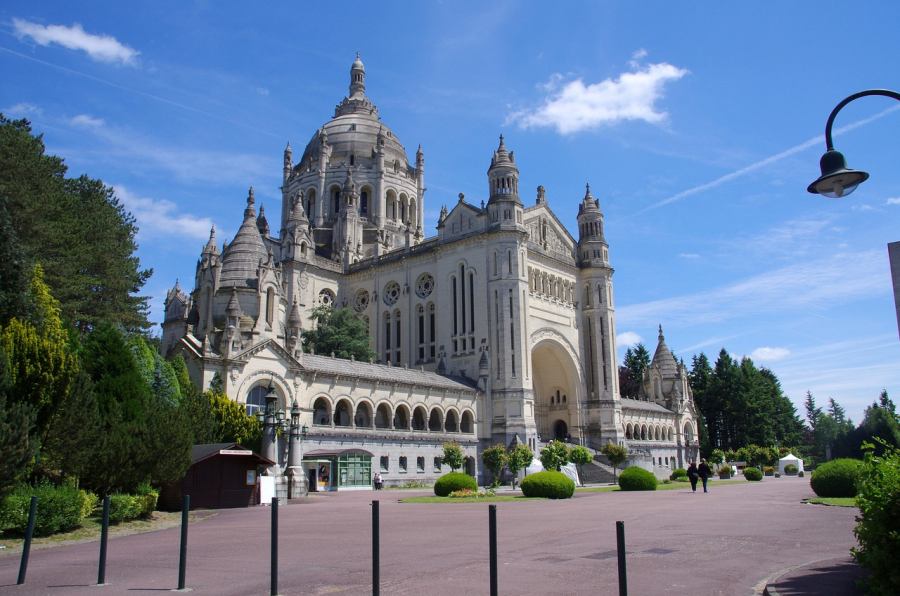
The Sainte-Thérèse Basilica is a monumental structure that was consecrated in 1954 and is the second-largest church in France. The dome’s height is 95 meters, the interior space is decorated with mosaics and stained glass windows. From the basilica there’s a beautiful view toward the Normandy hills. In the crypt, chapels from several countries can be found, showing the international nature of Thérèse’s cult.
Les Buissonnets, Thérèse’s family home, can be visited as a museum, where we can learn about the saint’s daily life. Walking among the old town’s half-timbered houses, we can still encounter medieval structures, such as Saint Peter’s Cathedral.
Côte d’Albâtre
The alabaster coast name perfectly describes this special coastal section, where white limestone cliffs rise above the sea.
This more than 120-kilometer section stretches between Étretat and Dieppe, which became world-famous with its dramatic cliff formations and natural arches. The contrast of white walls with the blue sea and green grassy plateaus provides a picturesque sight.
At Étretat are the most famous rock formations, the Aiguille, or needle-shaped rock, and natural stone arches. It was a favorite painting spot of Monet and other impressionists, and today is still a photographers’ paradise. Along the walking paths on the cliff tops, we can admire the ocean and the water waving deep below us.
Along the coast, smaller fishing villages like Yport or Veules-les-Roses offer an intimate atmosphere. The beaches consist of stony pebbles and sometimes disappear completely under water at high tide. It’s worth spending several days exploring the coast, as each section shows a different character.

Barfleur
This tiny fishing village is located at Normandy’s easternmost tip and has preserved its authentic maritime character. The village was once a significant port; William the Conqueror departed from here toward England, and in the Middle Ages it played an important commercial role.
Walking among the granite houses, we feel as if time has stopped. Seaside restaurants offer fresh oysters and fish, which are prepared directly from local catches. Lobster is a special delicacy here, which is definitely worth tasting.
The nearby Gatteville-le-Phare lighthouse is France’s second-tallest tower at 75 meters. After climbing 365 steps, an unparalleled view opens to the English Channel and the surrounding countryside.

Parc Naturel Régional des Marais du Cotentin et du Bessin
The Cotentin Peninsula’s marshlands offer a unique natural experience in Normandy.
The marshy areas, water channels and meadows form a special ecosystem where rare bird and plant species live. The park extends over more than 145,000 hectares, and water continuously shapes the landscape with water levels changing according to seasons.
Among the marsh inhabitants can be found the avocet, the lapwing and numerous waterfowl, making the area an ornithologists’ paradise. In spring and autumn, thousands of migratory birds rest here during their journey. Traditional peat cutting and animal husbandry still continue today; the area’s farmers preserve old methods and the landscape’s character.
Numerous hiking trails and bicycle paths lead through the marshes in the park, where we can discover the aquatic world traveling on small bridges and dikes. The town of Carentan is a good starting point for exploration; the park center and information office are located here. Local farms engage in cheese-making, and visitors can taste specialties made from milk of cows raised on marsh pastures.
Évreux
The seat of Eure department is located between the Seine and continental Normandy and often falls off tourists’ itineraries. Yet the city’s historic center is worth visiting, especially because of its stunning cathedral. The city rebuilt after World War II destruction combines modern and historical elements, creating an interesting contrast.
The Notre-Dame Cathedral is a special treasure of the city, which combines Gothic and Renaissance style elements. Some of the stained glass windows date from the 13th century and create a wonderful play of light inside the church. The carved stonework and traces of different construction periods are clearly visible on the building.
The Saint-Taurin church’s peculiarity is the 13th-century reliquary, which is a masterpiece of gold and silversmithing. In the city, it’s pleasant to walk along the Iton river, where parks and gardens can be found. The local museum preserves interesting archaeological finds and an art collection.