
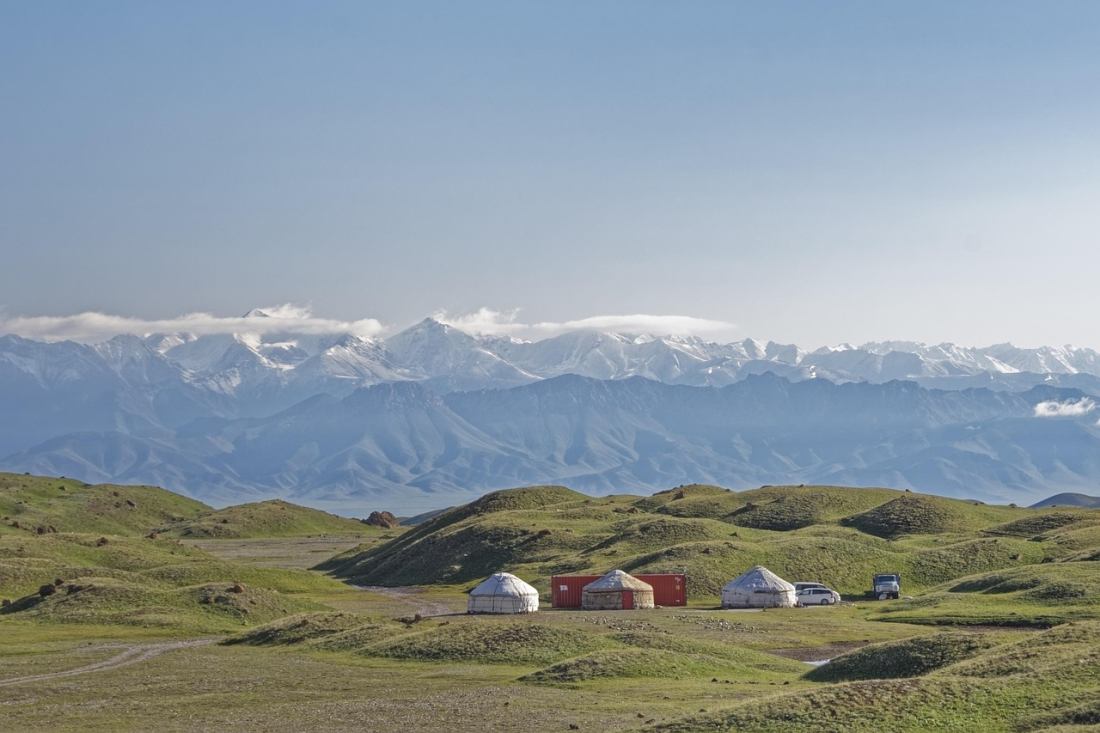
Kyrgyzstan is one of Central Asia’s most authentic countries, dominated by massive snow-capped mountain peaks, crystal-clear glacial lakes, and nomadic steppes.
Kyrgyzstan is located between the Tien Shan and Pamir mountain ranges, south of Kazakhstan, west of China, north of Tajikistan, and east of Uzbekistan. The country is also called the Switzerland of Asia due to its beautiful mountainous regions.
Besides its cultural heritage, Kyrgyz nomadic traditions, life in yurts, and horse culture also attract visitors. The country’s climate is continental, pleasant in the mountains during summer, and offers excellent skiing opportunities in winter. Kyrgyzstan is one of the friendliest Central Asian countries, where tourists can freely wander among the stunning mountain landscapes.
Table of Contents
Kyrgyzstan attractions
Issyk-Kul Lake
One of the world’s largest and deepest mountain lakes, situated at 1,607 meters altitude in the eastern part of the Tien Shan mountains. The lake’s name means „warm lake” in Kyrgyz, as the water never freezes even in winter, despite being surrounded by snow-capped peaks. This natural phenomenon is thanks to warm springs emerging from the lake’s depths.
Issyk-Kul is nearly 180 kilometers long and 60 kilometers wide, making it the second-largest mountain lake in the world after Lake Baikal. The crystal-clear water is slightly salty, making it excellent for swimming and bathing. Lakeside resorts welcome visitors throughout the summer, who can try sailing, jet skiing, or even paragliding.
Numerous natural and cultural attractions can be found around the lake. The northern shore has more modern beaches and hotels, while the southern shore offers a wilder, more pristine natural environment. The surrounding mountains provide excellent hiking trails, offering unparalleled panoramas of the lake and surrounding snow-covered peaks.

Bishkek
Kyrgyzstan’s capital and largest city, located in the northern part of the country at the foot of the Tien Shan mountains. The city was named after an ancient dairy processing tool that was an important part of nomadic culture.
Bishkek combines wide tree-lined avenues, spacious squares, and monumental buildings from the Soviet era with modern architecture. Ala-Too Square is the heart of the city, where the independence monument and flagpole stand. From the square, you can access the History Museum, where you can learn about Kyrgyzstan’s rich history.
The city acts as a green oasis in the foothills. Dubovy Park is a favorite meeting place for locals, where sculptures and peaceful walkways await visitors. Osh Bazaar lends an Eastern atmosphere to the city, where spices, traditional handicrafts, and local specialties are available. Bishkek is an excellent starting point for surrounding mountain hikes and natural attractions.

Burana Tower
One of Kyrgyzstan’s most important historical monuments, located about 80 kilometers from Bishkek in the Chuy Valley.
The minaret, built in the 11th century, belonged to the ancient city of Balasagun, which was one of the significant centers of the Karakhanid Empire along the Silk Road. It was originally about 45 meters high, but due to earthquakes, it now rises to about 25 meters.
The tower’s brick decoration and conical shape are fine examples of Central Asian Islamic architecture. In the surrounding archaeological park, balbal stone statues, tombstones, and a small museum can be viewed.

Ala-Archa National Park
Located just 40 kilometers south of the capital, this national park is one of Kyrgyzstan’s most popular natural destinations. The park extends along the northern slopes of the Tien Shan mountains and was named after the wild apple trees found here.
The national park covers 200 square kilometers, with elevations ranging between 1,500 and 4,895 meters. The highest peak is Semenov-Tian-Shansky, which is a target for experienced mountaineers. The park boasts rich flora and fauna, including snow leopards, ibex, and golden eagles.
Various hiking trails of different difficulty levels are available for visitors. The easier path to Broken Heart rock is ideal for beginners, while experienced hikers can reach Ratsek Pass or even the glaciers. Crystal-clear mountain streams flow through the valley, alongside which rest areas can be found. The park is accessible year-round and also serves as a popular ski area in winter.
Ala-Kol Glacial Lake
A breathtakingly beautiful glacial lake located at 3,560 meters altitude in the Terskey Alatau mountains, which many consider one of Kyrgyzstan’s most beautiful natural wonders.
The lake’s name means „colorful lake” because the water’s color changes depending on the time of day and weather: turquoise blue in the morning, emerald green at noon, and can even take on purple hues in the evening. This phenomenon is caused by the mineral content of the glacial water and the special refraction of sunlight.
Reaching Ala-Kol requires a 2-3 day trek through stunning mountain landscapes. The route is suitable for intermediate-level hikers, although proper acclimatization is important due to the high altitude. Snow-capped peaks rise around the lake, perfectly reflected in the clear water. The area is a popular camping spot where starry nights offer unforgettable experiences.
Karakol
A charming town located at the eastern end of Issyk-Kul Lake, one of Kyrgyzstan’s most interesting cultural centers. The town was founded by Russian explorers in 1869 and was named after the nearby Karakol River.
The town’s uniqueness lies in its cultural diversity: a Russian Orthodox church, Dungan mosque, and Uyghur communities live peacefully side by side. The wooden Dungan mosque was built in the early 20th century, completely without nails. The nearby Russian Orthodox Holy Trinity Church, decorated with colorful onion domes, is a dazzling sight.
Karakol is famous for its local cuisine, especially the Dungan noodle dish called ashlan-fu and the distinctive Karakol stew. The Sunday animal market provides insight into local life, where nomads buy and sell their horses and livestock. The town is an excellent starting point for hiking trails in the surrounding mountains and exploring the southern shore of Issyk-Kul.

Jeti-Oguz Rock Formations
Distinctive red sandstone rock formations located on the southern shore of Issyk-Kul, west of Karakol, whose name means seven bulls in Kyrgyz.
According to legend, the rocks forming seven bulls originated from a tragic love story. A local khan kidnapped a beautiful girl who was also loved by another tribe’s prince. When the prince attacked the khan to retrieve his love, the girl lost her life in the battle, and the blood flowing from her heart became seven streams, from which the rocks rose.
The red rock walls rise 40-50 meters high and are especially spectacular in sunlight. Nearby is another famous rock formation, the Broken Heart, which forms a split rock mass. The area is a popular excursion spot where healing springs also emerge, which locals use to treat rheumatic complaints.
Bokonbayevo
A small town on the southern shore of Issyk-Kul, famous for preserving traditional Kyrgyz culture. The settlement was named after a local hero, Bokonbay, who lived in the 19th century.
Its main attraction is the tradition of falconry. The Kyrgyz have used falcons for hunting for centuries, and here visitors can meet experienced falconers who demonstrate this ancient craft. The training and care of falcons is passed down from generation to generation, and visitors can even participate in a falcon hunt.
Near the town is Sentimentalnaya Zatoka, or Sentimental Bay, one of the most beautiful shore sections of Issyk-Kul. The clear water and picturesque environment are ideal for relaxation. In Bokonbayevo, we can also visit numerous local craft workshops where traditional Kyrgyz carpets, textiles, and leather goods are made.

Skazka Canyon
A fairy-tale atmosphere colored rock canyon located on the southern shore of Issyk-Kul, whose name means fairy tale in Russian. Red, orange, and white clay rocks shaped by nature have created fantastic formations.
Among the canyon’s rock formations, visitors can discover formations resembling Chinese dragons, castle walls, and giant animals. The colored layers come from sediments deposited over millions of years, which were shaped by wind and rain into today’s formations. At sunset, every shade of the rocks comes to life, and the landscape truly transforms into a fairy-tale environment.
The canyon is easily accessible and doesn’t require special equipment or fitness. Visitors can freely wander among the rocks, discovering the art gallery created by nature. The area is an ideal location for photographers.
Song-Kol Lake
An alpine lake situated at 3,016 meters altitude in the Tien Shan mountains, one of Kyrgyzstan’s most magical and remote locations. The lake’s name means „last lake”, referring to its isolated, lonely location.
Endless grassy plateaus surround the lake, where nomadic families graze their animals and live in yurts during summer. Visitors can experience authentic Kyrgyz nomadic lifestyle here, participate in sheep herding, learn traditional dairy processing, or even ride horses in the surrounding mountains.
There are no permanent settlements, mobile networks, or electricity around Song-Kol Lake, so visitors can completely disconnect from the noise of the modern world. The night sky here is exceptionally clear, with the Milky Way clearly visible to the naked eye. The lake water is cold, but brave swimmers are rewarded with crystal-clear, blue water. The surrounding mountains offer hiking trails with breathtaking panoramas of the lake and endless steppe.
Arslanbob Walnut Forest
The world’s largest natural walnut forest, located in the southwestern part of Kyrgyzstan, in Jalal-Abad province. The forest, covering more than 600 square kilometers, includes trees several thousand years old.
According to legend, Alexander the Great’s soldiers rested here and planted the first walnut trees. While this is not historically proven, the forest’s age is indeed ancient, and genetic research suggests this may be the place from which walnut trees spread to Europe and Asia. Communities living in the forest have been collecting walnuts for centuries, which is an important source of income for them.
The Arslanbob area also includes two wonderful waterfalls. The Big Waterfall cascades down from 80 meters, while the Small Waterfall is 25 meters high but wider and more easily accessible. Numerous hiking trails are found throughout the forest, during which visitors can discover the diverse flora and possibly encounter brown bears or snow leopards living here.
Tash Rabat
A 15th-century stone caravanserai located at 3,200 meters altitude in Naryn province, one of the most important stops on the ancient Silk Road.
The building’s exterior resembles a fortress, with thick stone walls and only one entrance. The interior space consists of labyrinth-like branching corridors, more than 30 rooms, and a central domed hall. Merchants could rest from their journey’s fatigue here, while their animals could graze on nearby pastures. The building’s cold stone walls protected travelers from harsh mountain weather.
The landscape around Tash Rabat is stunning: green valleys, snow-capped peaks, and nomadic yurts make the environment magical. Accessing the site is an adventure, as poor roads lead here, but the distance traveled is worth the effort. In summer, Kyrgyz families set up their yurts nearby, where visitors can stay and taste traditional Kyrgyz hospitality.
Osh
Kyrgyzstan’s second-largest city in the Fergana Valley, located in the southern part of the country. The city boasts more than 3,000 years of history, making it one of the oldest continuously inhabited settlements in Central Asia.
Osh has always been an important commercial center on the Silk Road. The heart of the city is the massive Osh Bazaar, one of Central Asia’s largest and liveliest markets. Everything can be found here: from spices and dried fruits to traditional handicrafts and even live animals. The market’s atmosphere, colors, and scents provide a true Eastern experience.
Besides Sulaiman Mountain, Osh offers additional attractions. The Rabat Abdul Khan Mosque dates from the 16th century and is made of beautifully carved wood. The city also has an interesting museum that showcases the region’s history and cultural heritage. Osh is an excellent starting point for exploring the Pamir Plateau and areas near the Tajik border.
Sulaiman Mountain
A 1,140-meter-high sacred mountain rising in the center of Osh, which has been a pilgrimage site for Muslims for millennia. The mountain has been part of UNESCO World Heritage since 2009, one of Central Asia’s most important cultural and religious sites.
According to legend, Prophet Sulaiman (King Solomon) prayed and meditated on this mountain. Caves and prayer rooms are found on the mountainside, which pilgrims visit to ask for healing or fertility. Ancient petroglyphs carved into the rocks are more than 3,000 years old, proving that the mountain was considered a sacred place even in prehistoric times.
The path to the mountain’s summit is moderately difficult, but the view from above is unparalleled: Osh city, the Fergana Valley, and surrounding mountains can be seen from here. At the foot of the mountain is a museum that presents the region’s history and the mountain’s religious significance.

Chon-Kemin National Park
A 1,200-square-kilometer national park located in the northern part of the country, east of Bishkek, offering stunning natural diversity. The park has elevations ranging from 1,200 to 4,800 meters.
The Chon-Kemin Valley is one of the most beautiful alpine valleys in Kyrgyzstan. Clear mountain rivers cut through green meadows where nomadic shepherds graze their animals. The valley is bordered by pine forests, which higher up transition into alpine meadows and glaciers. The park’s rich fauna includes ibex, maral deer, snow leopards, and more than 100 bird species.
Visitors can choose from easy walks to multi-day mountain treks. Several guesthouses and yurt camps are found in the valley, where tourists can experience traditional Kyrgyz lifestyle. Horseback riding is a popular activity, allowing longer distances to be covered in the valley. In winter, the park serves as an excellent ski area, although infrastructure is still under development.
Kel-Suu Lake
One of the country’s most remote and magical locations, found in the Ak-Sai Valley near the Chinese border. The glacial lake is situated at 3,500 meters altitude and is only accessible in summer, between June and September.
The lake water is an unreal turquoise blue color, surrounded by 800-meter-high vertical limestone walls. The rocks rise from the water as if we had landed on another planet. The lake is approximately 9 kilometers long, and its depth reaches 80 meters. Visitors can explore the lake’s hidden bays and caves by boat or kayak.
Accessing Kel-Suu is an adventure: starting from Naryn, a 4-5 hour off-road journey is required, followed by an additional 4-5 hour horseback ride or hike. Due to the distance, few people reach here, so the place has preserved its pristine beauty. Camping by the lake at night, the starry sky and towering rock walls around us offer an unforgettable experience.

Sulak Gorge
Although many confuse it with the place of the same name in Southern Russia, Kyrgyzstan also has a stunning Sulak Gorge that runs deep in the Tien Shan mountains in a wildly romantic environment.
A crystal-clear stream flows through the gorge’s narrow valley, surrounded by steep rock walls. The gorge is several kilometers long, and in some sections so narrow that it’s barely a few meters wide. Small waterfalls trickle down from the walls, forming rainbows in the sunshine.
Traversing the gorge requires a moderately difficult hike, with some sections requiring wading in the stream or climbing among rocks. However, it offers adventure enthusiasts an unforgettable experience discovering the channels formed by nature. The surrounding mountains offer additional hiking trails, during which alpine meadows and glacial valleys can be seen.
Sary-Tash
A small settlement at the edge of the Pamir Plateau, situated at 3,170 meters altitude, one of the world’s highest inhabited places. The name means yellow stone, referring to the characteristic color of the surrounding mountains.
It’s located at a strategic point where three countries – Kyrgyzstan, Tajikistan, and China – meet. The village is an important rest stop for those traveling on the Pamir Highway or preparing to climb the nearby Lenin Peak (7,134 meters). The surrounding landscape is bare and barren but stunningly beautiful: endless plateaus where only yaks graze.
The village itself is modest, with a few guesthouses and restaurants serving travelers. The real attraction is the surrounding landscape: the nearby Taldyk Pass, from which the Alay Valley and peaks of the Pamir mountains are visible, offers a breathtaking panorama. The area is ideal for high-altitude hiking and astronomical observations, as the air here is exceptionally clear and transparent.
