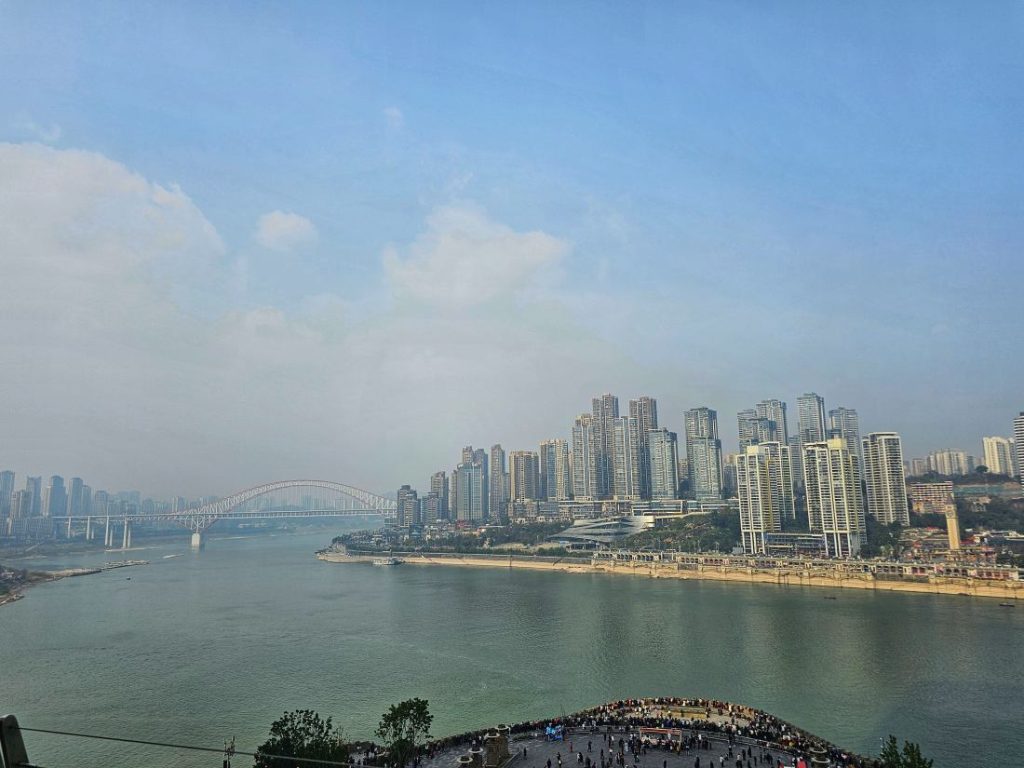
Chongqing is one of China’s most renowned metropolises. Its unique topography and futuristic cityscape make it an outstanding travel destination.
Known by the nicknames „Mountain City” and „Fog City”, Chongqing became famous for its dramatic terrain – buildings literally stacked on top of each other on steep hillsides. The city’s distinctive atmosphere comes from the blend of modern skyscrapers, traditional teahouses, spicy local cuisine, and moisture-laden air.
Table of Contents
Chongqing attractions
Hongyadong
Rising along the banks of the Jialing River, Hongyadong is a stunning 11-story complex that evokes traditional Bayu architecture in a modern setting. The complex opened in 2006 and has since become one of Chongqing’s most photographed locations – many compare it to the fantasy worlds of Studio Ghibli animated films.
The complex’s distinctive feature is that due to the terrain, the „first floor” can be found in multiple places: what appears to be ground level from one side is the 11th floor from another. In the evening hours, red lanterns and colorful lights create a magical atmosphere as the entire illuminated structure reflects in the river.
Hongyadong houses traditional craft shops, teahouses, restaurants, and bars where visitors can taste the famous spicy Chongqing hotpot. The rooftop terrace offers wonderful views of the river and the city’s skyscrapers.

Chaotianmen Square
Chongqing’s historic gateway, where the Yangtze and Jialing Rivers meet – this point has held strategic significance for centuries. The name means „Gate Bowing to Heaven” which dates back to the Ming Dynasty when messengers from the imperial court were ceremoniously received here.
The area has undergone a radical transformation in recent decades. The massive port still operates today, where ocean liners depart for the Three Gorges, and where the meeting of the two rivers’ differently colored waters is visible. New developments surrounding the square, including the Raffles City towers, have given the historic site a modern character.
At night, the square is particularly spectacular when the lighting of surrounding buildings and bridges reflects on the waters of both rivers. Chaotianmen is a popular meeting place for locals and tourists, from where river cruises depart and where Chongqing’s unique geographical position can best be observed.
Jiefangbei
The pedestrian street surrounding Jiefangbei, or the „Monument for Liberation”, forms the commercial and financial heart of Chongqing. The 27-meter-tall monument was erected in 1940 to honor resistance against the Japanese invasion, then renovated in 1950 to commemorate the Communist victory, giving it dual historical significance.
The area around the monument has become one of China’s busiest shopping districts, lined with luxury brands, traditional Chinese stores, restaurants, and entertainment venues. Among the pedestrian zone’s modern commercial buildings, futuristic LED displays and giant screens dominate the view, offering a dazzling experience especially in evening lighting.
On the area’s underground levels stretch massive shopping centers where local youth’s favorite hangouts can be found.

Raffles City Chongqing
Completed in 2019, Raffles City Chongqing is an architectural marvel consisting of eight skyscrapers, four of which are connected by a 300-meter-long horizontal skyscraper floating at 250 meters height. This structure, named „The Conservatory”, is one of the world’s largest high-rise connections.
The complex is the work of Israeli-Canadian architect Moshe Safdie, also known for Singapore’s Marina Bay Sands. The design draws inspiration from Chongqing’s topography and evokes traditional Chinese sailing vessels. The viewing point on the roof offers a 360-degree panorama of the city and the meeting of the two rivers.
The complex’s interior spaces house luxury shops, restaurants, hotels, and apartments, creating a modern urban quarter at the tip of the Chaotianmen Peninsula. Particularly impressive for visitors is the evening light show, when the building’s LED illumination projects colorful patterns onto the Yangtze’s waters.

Great Hall of the People
One of Chongqing’s most iconic buildings combines elements of traditional Chinese temple architecture with Soviet classicism, and its massive gilded dome is visible from afar, evoking Beijing’s Temple of Heaven.
The hall covers 4,200 square meters and originally served as a venue for political meetings and conferences. The main hall seats 4,000, while smaller halls host cultural events and theatrical performances. The building’s symmetry and grand spaces are excellent examples of Communist-era monumental architecture.
The People’s Square in front of the hall is freely accessible and a popular spot among locals who exercise, dance, or play chess there. The building’s nighttime illumination is particularly spectacular. Guided tours are available for visitors, providing insight into the building’s history and the workings of Chinese political life.

Ciqikou Old Town
The old town looks back on more than a thousand years of history and is one of the few places in Chongqing where visitors can immerse themselves in the atmosphere of the Ming and Qing Dynasty eras. It received the name „Porcelain Port” from the local ceramics industry, which flourished in the 17th-18th centuries.
Along the narrow, stone-paved streets stand traditional wooden houses hosting teahouses, craft shops, and stands offering local delicacies. The most famous local specialty is „mahua”, a spicy, twisted pastry treat that visitors can buy freshly made on-site.
The Buddhist temple in the quarter’s center and the riverside old dock convey the area’s former commercial significance. Although much of the old town is reconstruction, it has managed to preserve its authentic character.

Liziba Viewpoint (Train Through the Building)
The Liziba metro station’s world-famous peculiarity is that the Line 2 metro train literally passes through a 19-story residential building between the 6th and 8th floors. This engineering solution, seen nowhere else, was realized in 2004 and has since become one of Chongqing’s most emblematic attractions.
The building was designed to minimize noise for residents: special soundproofing materials, vibration dampers, and rubber-rimmed track systems reduced metro-caused inconveniences to below 60 decibels. The train runs every 2-3 minutes, and when it passes through the building, it offers a futuristic sight familiar from sci-fi films.
The Liziba station area has become a popular photography spot. The best view is from the hillside opposite the building, from where you can see in full perspective as the metro penetrates the building and then emerges on the other side.

Eling Park
Eling Park is located at Chongqing’s highest point, 344 meters above sea level, and is the city’s best natural viewpoint.
The park’s name means „Great Neck”, referring to its hilltop location, from where a 360-degree panorama opens over the city and the two rivers. The view is particularly spectacular from the viewing point next to the central pagoda, when the city’s skyscrapers emerge from beneath the fog.
The park, established in the early 20th century, played a significant historical role: during World War II, Chiang Kai-shek’s wife, Soong Mei-ling, frequently visited and received several diplomats here. Several period villas and protected buildings can still be viewed in the park today.
Yangtze River Cableway
The cableway has connected the river’s two banks since 1987 and was originally built as a practical transportation tool before bridges were constructed. The 1,166-meter-long cableway today serves primarily as a tourist attraction, though locals also use it for quicker crossing.
The cabins can accommodate 30 people and make the journey from one bank to the other in four minutes, floating approximately 20-30 meters above the water. During the trip, stunning views open of the Yangtze River, the urban panorama, and surrounding mountains, providing a unique perspective on Chongqing’s geography.

Chongqing Zoo
Opened in 1955, the zoo is home to approximately 230 species with roughly 4,000 individuals. Its specialty is that it not only serves an entertainment function but actively participates in the protection and breeding of endangered Chinese animals.
The facility’s main attraction is the giant panda pavilion, where several pandas can be viewed in near-natural environments. The zoo runs successful breeding programs, and more than twenty panda cubs have been born here so far.
The zoo’s other pride is the South China tiger, the most critically endangered tiger subspecies worldwide. The extensive 330-hectare area imitates different habitat types, and its terraced design integrated into urban topography makes for a pleasant walk during the visit.
Three Gorges Museum
One of China’s most significant regional museums. The institution’s primary purpose is to preserve and display cultural treasures rescued from areas flooded during the construction of the Three Gorges Dam, giving it special historical and archaeological significance.
On the museum’s four floors are more than 170,000 objects, of which approximately 4,000 are exhibited. The collection includes Bronze Age finds from the Ba culture (11th century BC – 316 BC), a rich selection of Han Dynasty sculptures and ceramics, and artistic treasures of Tang and Song paintings. The Ba culture is particularly interesting, as it is the region’s ancient civilization whose physical remains are rarely found elsewhere.
One of the museum’s specialties is the „Three Gorges Environmental Protection Exhibition” which details the environmental and social impacts of the dam’s construction, documentation of flooded villages, and the history of relocations. This exhibition presents one of China’s largest infrastructure projects with a critical approach.
Chongqing Art Museum
The center of the city’s contemporary and modern art life opened its doors in 2013 on the banks of the Yangtze River. The building’s ultra-modern, futuristic design fits into Chongqing’s sci-fi atmosphere cityscape and quickly became one of the iconic venues of contemporary culture.
The museum has three main functions: it maintains a permanent collection of 20th-21st century Chinese art, hosts international contemporary exhibitions, and provides space for local artists’ works. The permanent collection is particularly strong in Chinese painting and calligraphy, showcasing modern interpretations of traditional arts and international influences on contemporary Chinese art. Temporary exhibitions often focus on urban themes: the impact of modernization on traditional culture, migration, and China’s rapid urbanization.
The viewing terrace on the building’s roof offers an unparalleled panorama of the Yangtze River and the city’s skyscrapers, which alone is worth the visit. The museum’s café and bookstore are popular meeting places for the city’s intellectual community.
Chongqing weather: when is the best time to visit?
Chongqing’s climate is subtropical monsoon in nature, meaning hot, humid summers and mild, rainy winters. Due to the city’s geographical location in the Sichuan Basin and proximity to two rivers, it has particularly high humidity, which inspired the nicknames „Fog City” and „Three Furnaces City”. There are approximately 100 days per year when the city is covered in fog.
Spring (March-May):
Spring months offer pleasant temperatures between 15-25°C, though the weather is often overcast and rainy. Humidity is high, moving between about 75-85%, which can create a slightly musty feeling. Cherry blossoms in late March and April are particularly beautiful in the parks. Due to the frequency of rainy days, it’s worth bringing an umbrella, but tourist crowds are not yet as large as in summer.
Summer (June-August):
The summer period is extremely hot and humid, with temperatures often exceeding 35-40°C and humidity moving around 80-90%. In July and August, the heat is almost unbearable, especially in the concrete jungle. Monsoon rains do alleviate the heat, but storms can be strong and may cause flood risks.
Autumn (September-November):
Autumn months are ideal for visiting Chongqing: temperatures range between 18-28°C, humidity decreases, and mostly sunny weather can be expected. September is still warm, but from October to mid-November, excellent hiking and sightseeing weather prevails. Autumn foliage colors provide a beautiful sight in the mountains, and fog also rolls in more frequently, lending a special, mystical atmosphere to the city’s panorama.
Winter (December-February):
Winter is mild but cold and humid, with temperatures ranging between 5-12°C. Snowfall is rare, but the cold can be biting due to high humidity. From December to February, fog and gray skies are frequent, making sunlight rarely visible. Winter months are quieter from a tourist perspective, but some attractions, especially the nighttime illumination of buildings, can be particularly magical during this period.
Best time to travel:
The best time to visit Chongqing is from late March to mid-May, and from October to mid-November. Autumn months offer the most pleasant weather: in October and early November, temperatures around 20-25°C, lower humidity (60-70%), and more sunny days are characteristic. The spring period is also a good choice, though more rainy days should be expected, but there are fewer tourists in return. July and August are worth avoiding due to extreme heat.